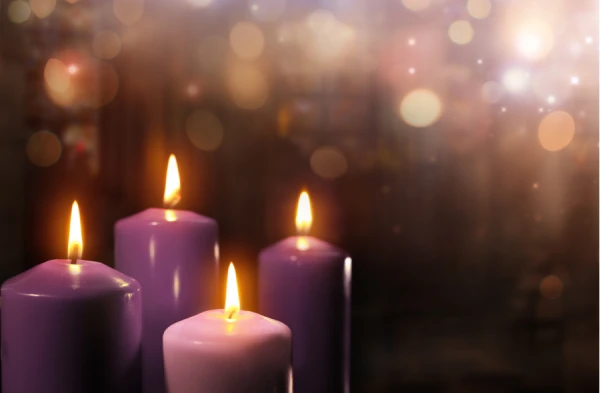
Denver, Colo., Nov 22, 2019 / 11:30 am (CNA).- Advent starts this year on Sunday, Dec. 1. Most Catholics, even those who don’t often go to Mass, know that Advent involves a wreath with some candles, possibly a “calendar” of hidden chocolates, and untangling strings of Christmas lights.
But Advent is more than that. Here are a few points that might help you have a great Advent this year:
What is Advent?
The people of Israel waited generations for the promised Messiah to arrive. Their poetry, their songs and stories, and their religious worship focused on an awaited savior, whom God had promised, over and over, would come to them to set them free from captivity, and to lead them to the fulfillment of all that God had chosen for them.
Israel longed for a Messiah, and John the Baptist, who came before Jesus, promised that the Messiah was coming, and could be found in Jesus Christ, God’s son, the “Lamb of God who takes away the sins of the world.”
Advent is a season in the Church’s life intended to renew the experience of waiting, and longing, for the Messiah. Though Christ has already come into the world, the Church invites us to renew our desire for the Lord more deeply into our lives, and to renew our desire for Christ’s triumphant second coming into the world.
Advent is the time in which we prepare for Christmas, the memorial of Jesus Christ being born into the world. Preparations are practical, like decorating a tree or stringing lights, but they’re also intended to be spiritual.
During Advent, we’re invited to enter more frequently into silence, into prayer and reflection, into Scripture, and into the sacramental life of the Church, all to prepare for celebrating Christmas.
The Catechism of the Catholic Church says the goal of Advent is to make present for ourselves and our families the “ancient expectancy of the Messiah…by sharing in the long preparation for the Savior’s first coming.”
Cool. So, it’s like 4 weeks long?
Advent is a slightly different length each year. It starts four Sundays before Christmas. But because Christmas is on a fixed date, and could fall on different days of the week, Advent can be as short as four weeks and a day, or as long as five weeks. Christmas is on a Wednesday in 2019, so Advent will be 4 weeks and two days long.
Ok, my priest keeps talking about Advent being the “new year.” But Advent is before Christmas. What’s the deal?
The Church’s feasts and celebrations run on a year-long cycle, which we call the “liturgical year,” because it’s a year of liturgy. The “liturgical year” starts on the first Sunday of Advent. So it’s a new liturgical year when Advent starts. But the Church also uses the ordinary calendar, so it would probably be a bit weird to have a “New Year’s Eve” party the night before Advent starts.
Still, though, Catholicism has a lot of weird feasts, so if you have a “New Liturgical Eve” party, invite me.
And, Advent wreaths. Where do they come from? Is it true that they’re just pagan wreaths borrowed by the Church?
The Catholic Church has been using advent wreaths since the Middle Ages. Lighting candles as we prepare for Christmas reminds us that Christ is the light of the world. And the evergreen boughs remind us of new and eternal life in Christ, the eternal son of the Father.
It is definitely true that Germanic people were lighting up candle wreaths in wintertime long before the Gospel arrive in their homeland. Because, well, candle wreaths in winter are beautiful and warm. That a Christian symbol emerged from that tradition is an indication that the Gospel can be expressed through the language, customs, and symbols of cultures that come to believe that Christ Jesus is Lord.
One candle is pink. Why?
There are four candles on the Advent wreath. Three are purple, and they are first lit on the first, second, and fourth Sundays of Advent. The pink candle is lit on the third Sunday of Advent, which we call Gaudete Sunday. On that Sunday, in addition to the pink candle, the priest wears a pink vestment, which he might refer to as rose. But rose, from this writer’s perspective, is a shade of pink.
Gaudete is a word that means “Rejoice!” and we rejoice on Gaudete Sunday, because we are halfway through Advent. Some people have the custom of throwing “Gaudete” parties, and this is also a traditional day on which Christmas carolers begin caroling door-to-door.
The three purple candles are sometimes said to represent prayer, fasting, and almsgiving, the three spiritual disciplines that are key to a fruitful Advent.
I like the Advent calendars that have chocolate in them. Do you know where they come from?
No. But I like them too. The chocolate is usually pretty waxy, but still. I think the idea is to build up anticipation by having only one little treat each day. But sometimes I eat them all in the first week. Oops.
Is it wrong to sing Christmas songs during Advent?
Wrong? No, not immoral or anything. Liturgically inappropriate? Totally. Plus, there are a lot of great Advent hymns and songs: “O Come O Come Emmanuel,” “Come Thou Long Expected Jesus,” “O Come Divine Messiah,” “Come Thou Fount,” “Hark! A Thrilling Voice is Sounding”
Wouldn’t you rather sing those than Rudolph? Or the theologically insufferable “Mary, Did you know?”
When should we put up our tree?
Look, when to put up the tree is a decision that families should decide on their own, through time-honored holiday traditions like, say, arguing about when to put up the tree. I’m not getting in the middle of that.
Some people put up their tree and decorate it on the first Sunday of Advent, to make a big transformation in their home and get them into “preparing for Christmas mode.” That seems cool.
Some people put up the tree on the first Sunday of Advent, put on lights the next Sunday, ornaments the next, and decorate it more and more as they get closer to Christmas. That seems cool.
Some people put up the tree on Gaudete Sunday, as a kind of rejoicing, and decorate it in the weeks between Gaudate and Christmas. That seems cool
Basically, as you can tell, I’m not going to take a side on that question.
What does the word Advent mean?
Oh right. I forgot to mention that, I’m glad you asked. Advent comes from the Latin ad+venire, which means, essentially “To come to,” or “to come toward.” Ad+venire is the root of the Latin “Adventus” which means “arrival.”
So Advent is the season of arrival: The arrival of Christ in our hearts, in the world, and into God’s extraordinary plan for our salvation.
 […]
[…]



Relative to the Eucharistic Congress—and the sacramental Real Presence—and of possible interest to those who possibly disdain this even and such faith…Emeritus Pope Benedict XVI’s posthumous book offers words to be pondered even by indifferent Nones (spiritual but not religious!) and even scientistic atheists.
Regarding “transubstantiation” and the Aristotelian—and prescientific—”substance” and “accidents,” from Benedict’s chapter on “The Meaning of Communion”, this:
“In order to explain this [the definition of ‘transubstantiation’], the philosophical category of ‘substance’ was employed, saying that the substance is taken away, as noted, and replaced with another, while the accidents of the bread and wine remain. Over the course of the development of philosophical thought and of the natural sciences, the concept of substance changed essentially and, likewise, the concept of what, in Aristotelian thought, had been designated an accident.’
“The concept of substance, which previously had been applied to every reality that subsists in itself, was more and more often used to refer to what is physically ungraspable, such as molecules, atoms, or elementary particles—although today we know that even these are not ‘substances’, but rather structures of relations [!]. This gave rise to a new task for Christian philosophy. The fundamental category of all reality in general terms is no longer substance, but, rather, relation. In this regard, we Christians can say only that for our faith God himself is relation, relatio subsistens. The fundamental category of a philosophy that corresponds to the findings of today’s natural sciences is identical to the fundamental category of the faith: God is relatio subsistens [….]” (Benedict XVI, “What is Christianity? The Last Writings,” Ignatius, 2023, pp. 155-174).
(Relatio subsistens? God is not to be objectified as yet another ex-isting thing among all other created things, but IS the sub-sisting and freely creating Being in action.)
And, the revealed “circumincession”—the absolutely simply theological doctrine of the reciprocal “existence” in each other (!) of the three persons of the supernatural Trinity—is like the finite human mind lately discovering that physical reality, too, is relational rather than ye olde “substantial.” For example, that under “quantum entanglement” a “subatomic” event in one part of the universe cannot be described independently of the simultaneous state of the other subatomic relations billions of miles and years distant—irrespective whatever time requirement might otherwise be presumed by the constant speed of light.
SUMMARY: at the consecration, the ordained priest speaks the words of the incarnate Jesus Christ, “THIS is my Body;” and not “this bread is my body.” Maybe one of the speakers at the Eucharistic Congress will dip into Benedict’s providentially well-timed and posthumous book.
A fascinating comment on the Holy Eucharist and being. Aristotle’s term substance or being as a category relates to material existence, explained in terms of form and matter, substance and accidents. God who is unconditional being cannot be relational to other things. Although your rendition here requires much thought, what Benedict says on a new philosophical understanding is subject to questioning [the comparatively ancient transubstantiation is simple and sufficiently clear for human understanding]. You allude to this in parenthesis and state it well (Relatio subsistens? God is not to be objectified as yet another ex-isting thing among all other created things, but IS the sub-sisting and freely creating Being in action.)
Being as Being simply understood as First Principle for the human intellect is sufficient. Deeper awareness or intellectual knowledge is gained spiritually as God is pure spirit different in kind from matter and matter based conceptions. When I speak the words of consecration I know God works a spiritual reality changing the visible tangible reality in my hands into himself. It’s the supreme moment in my life realizing what occurs is both mystery and miracle of love.