Turkish police stand guard outside the scene of an armed attack at a Catholic church in Istanbul, Turkey, on Jan. 28, 2024. (Credit: Rudolf Gehrig/EWTN)
Rome Newsroom, Jan 29, 2024 / 07:27 am (CNA).
The Islamic State has claimed responsibility for the deadly attack on a Catholic church in Istanbul during Sunday Mass that left one man dead.
Two suspects described as members of the Islamic State group have been arrested following the shooting on Jan. 28 at Santa Maria Church in Istanbul’s Sariyer district.
Turkish Minister of the Interior Ali Yerlikaya announced late on Sunday night that police had conducted raids on 30 locations across Istanbul following the attack during which the arrests were made.
“Both of the suspects are foreign nationals. One of them is from Tajikistan and the other is Russian, and we evaluated them to be with the Islamic State,” Yerlikaya said, according to Reuters.
The minister also identified the victim of the attack as 52-year-old Turkish national Tuncer Cihan in a post on the social media platform X.
The Turkish bishops’ conference has asked for prayers for the victim and his family in a statement released on Jan. 28.
“We firmly condemn this act of violence against humanity,” said the statement signed by Archbishop Martin Kmetec of Izmir.
“We trust that the Turkish state security forces will find those responsible and that justice will be done,” he said. “We firmly demand that the truth be revealed and that greater security be guaranteed to our communities and churches.”
The Turkish bishops also urged people “not to spread the culture of hatred and religious discrimination.”
The attack took place at 11:40 a.m. local time as Mass was being offered in the church. Video footage of the attack obtained by EWTN News showed two masked assailants dressed in black following a man with white hair into the church and shooting him in the back of the head as parishioners hid under the pews.
The Islamic State group claimed responsibility for the Istanbul attack on its official media outlet, Aamaq, according to the Associated Press.
Hours after the attack, Bishop Massimiliano Palinuro, the apostolic vicar of Istanbul, told EWTN News that the man was killed “during the consecration while all the congregation was praying.”
“We are worried about the future because if this is a sign of the religious intolerance, for our community it could be a bad sign. Let us pray,” Palinuro said.
There are about 25,000 Roman Catholics living in Turkey, including migrants from Africa and the Philippines, according to a 2022 report by the U.S. State Department.
Earlier this month, Turkish news outlet Anadolu Agency reported that 25 suspected Islamic State members were arrested in Turkey on Jan. 3 under accusation that they were plotting attacks on churches and synagogues.
In response to the news of the arrest of two suspects affiliated with the Islamic State, Palinuro told EWTN News on Jan. 29, “We trust in the justice of God.”
EWTN journalists Rudolf Gehrig and Colm Flynn contributed to this report from Istanbul, Turkey.
If you value the news and views Catholic World Report provides, please consider donating to support our efforts. Your contribution will help us continue to make CWR available to all readers worldwide for free, without a subscription. Thank you for your generosity!
Click here for more information on donating to CWR. Click here to sign up for our newsletter.
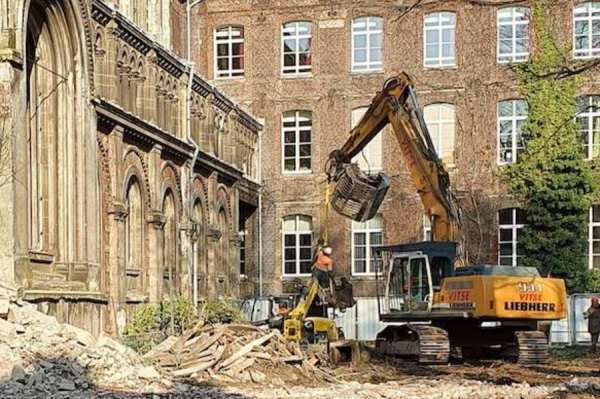
Rome Newsroom, Mar 11, 2021 / 12:00 pm (CNA).- Bulldozers have torn into a 135-year-old church dedicated to St. Joseph in northern France — the first of several church demolitions that could take place in the country in the coming months.
The Chapelle Saint-Joseph, built by the Jesuits in Lille between 1880 and 1886, is being bulldozed by the Catholic University of Lille to make way for a new student building. But the nearby Rameau Palace — designed by the same architect, Auguste Mourcou — is being preserved and restored.
A group appealed to the French Ministry of Culture to reclassify the church building as historical. But the ministry rejected the appeal, stressing that “giving up the demolition of the chapel would lead to the abandonment of an important project for the development of higher education, which represents an investment of 120 million euros [around $144 million].”
— La Gazette du Patrimoine (@gazettepatrim) March 3, 2021
Urgences patrimoine, an organization that seeks to preserve French cultural heritage, collected 12,400 signatures on a petition to save the St. Joseph chapel. But the demolition process, captured on video, began in late February regardless.
Meanwhile, discussions have been held to replace the Church of Sainte-Germaine-Cousin in Calais, an early 20th-century building in the Art Deco style, with an apartment complex, according to CNA’s Italian language news partner, ACI Stampa.
The Diocese of Arras announced in August 2020 that the church would no longer be used due to maintenance costs. The church’s 28 stained-glass windows, created by master glassmaker Louis Barillet, have been registered as protected historic architecture with the French government since 1997.
Another church facing potential demolition is the Saint-Èloi du Poirier church, built in 1902 in Trith-Saint-Léger. Local authorities have said that tearing down the church would be less expensive than renovating it, which it estimates would cost around $958,000.
Members of the local community have written letters, made phone calls to authorities, and organized a town hall meeting in an attempt to save the church.
According to French law, local authorities have the final word as to whether to renovate or demolish churches after the French government appropriated all church property in 1907.
Concert at the Santa Maria dell’Olivo convent in Maciano, Italy, in July 2024. / Credit: Courtesy of Amici della Nave Association
Rome Newsroom, Feb 17, 2025 / 11:05 am (CNA).
Pope Francis received heartfelt letters from inmates at Milan’s San Vittore prison after his hospitalization forced the cancellation of a planned meeting where the prisoners were to perform in a special concert.
The Holy Father knows well that judicial sentences are served behind bars and, above all, in the heart. That’s where he intended to enter this Monday, Feb. 17, when he was scheduled to meet with a group of inmates from San Vittore prison at Rome’s historic Cinecittà studios.
However, the event was canceled following his hospitalization at Rome’s Gemelli Hospital.
“It was difficult for them to accept because it also represented an opportunity to get out into the fresh air, see sunlight, and breathe freedom for a few hours,” explained Eliana Onofrio, president of the Amici della Nave association.
Since 2018, this organization has worked with the La Nave project, which assists Italian inmates dealing with drug and alcohol addiction. In collaboration with the Santi Paolo e Carlo healthcare association, they run a rehabilitation program where music is a fundamental therapeutic tool.
“Music helps them relax and connect with themselves; it’s an essential part of the re-education process that accompanies rehabilitation to help them overcome addictions,” Onofrio said.
Upon receiving official confirmation of the cancellation from the Vatican, some inmates decided to write letters to the pontiff. “It was a spontaneous gesture through which they wanted to express their affection,” Onofrio noted.
In one of the letters, an inmate expressed his sadness, saying that “everything had been organized in great detail” to offer Pope Francis a concert into which they had poured all their effort and affection. The inmate considers the pope a central figure, expressing his closeness and assuring his prayers.
Another detained person laments being unable to meet him but understands this is “a necessary pause due to his constant dedication and efforts.” Nevertheless, he emphasizes that the pope’s health is paramount and promises prayers for a swift recovery. He also asks Francis not to feel “distressed about the event’s cancellation” and wishes him a speedy return to strength.
The power of music and reintegration
For more than two decades, the Amici della Nave association has accompanied these inmates in various events outside prison. A notable highlight was their concert on April 9, 2019, at Milan’s prestigious La Scala theater.
“I still remember the journey and their faces of emotion as they got off the bus and stepped onto such an important stage,” Onofrio recalled.
Currently, 70 Italian prisoners form part of the choir, alongside volunteers and former inmates who have achieved complete reintegration after lives marked by crime.
The cells of San Vittore, small and cold, are filled with stories of stumbles and suffering. There, inmates await their final sentence. Once they reach the third grade, they are transferred to other prisons.
Some have committed serious crimes, but they have a right to a second chance. Sometimes, they just need “a shoulder to cry on to glimpse a new life,” Onofrio affirms.
Even in prison, goodness exists. Indeed, the light of hope and kindness can emerge after years of criminality when all seems lost.
Thanks to the mediation of the Vatican’s Department of Culture and Education, the letters will be delivered to the pontiff, who remains hospitalized.
This story was first publishedby ACI Prensa, CNA’s Spanish-language news partner. It has been translated and adapted by CNA.
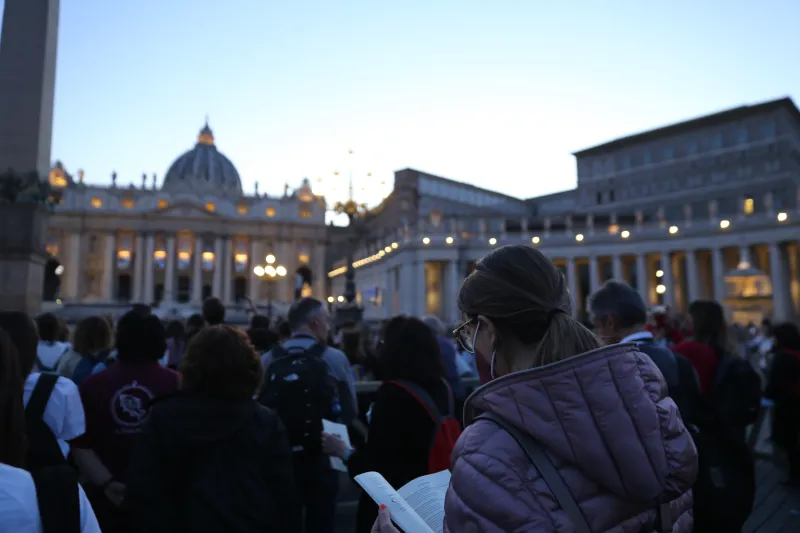
Pilgrims pray in front of St. Peter’s Basilica / Hannah Brockhaus/CNA
Rome, Italy, May 26, 2022 / 08:37 am (CNA).
When St. Philip Neri came to Rome from Florence in 1533, he encountered a city in upheaval. The Sack of Rome six years prior had left famine and plague in its wake. The Protestant Reformation was in full swing and the Church was rife with corruption.
The young Philip, who would spend around 16 years in Rome as a layman before becoming a priest, soon dedicated himself to caring for the city’s sick and poor.
The saint, whose feast day falls on May 26, also realized that Rome’s people were suffering from a spiritual sickness and tiredness as well, and so he set out to reinvigorate Catholics with the joy of the faith through song and dance — and jokes.
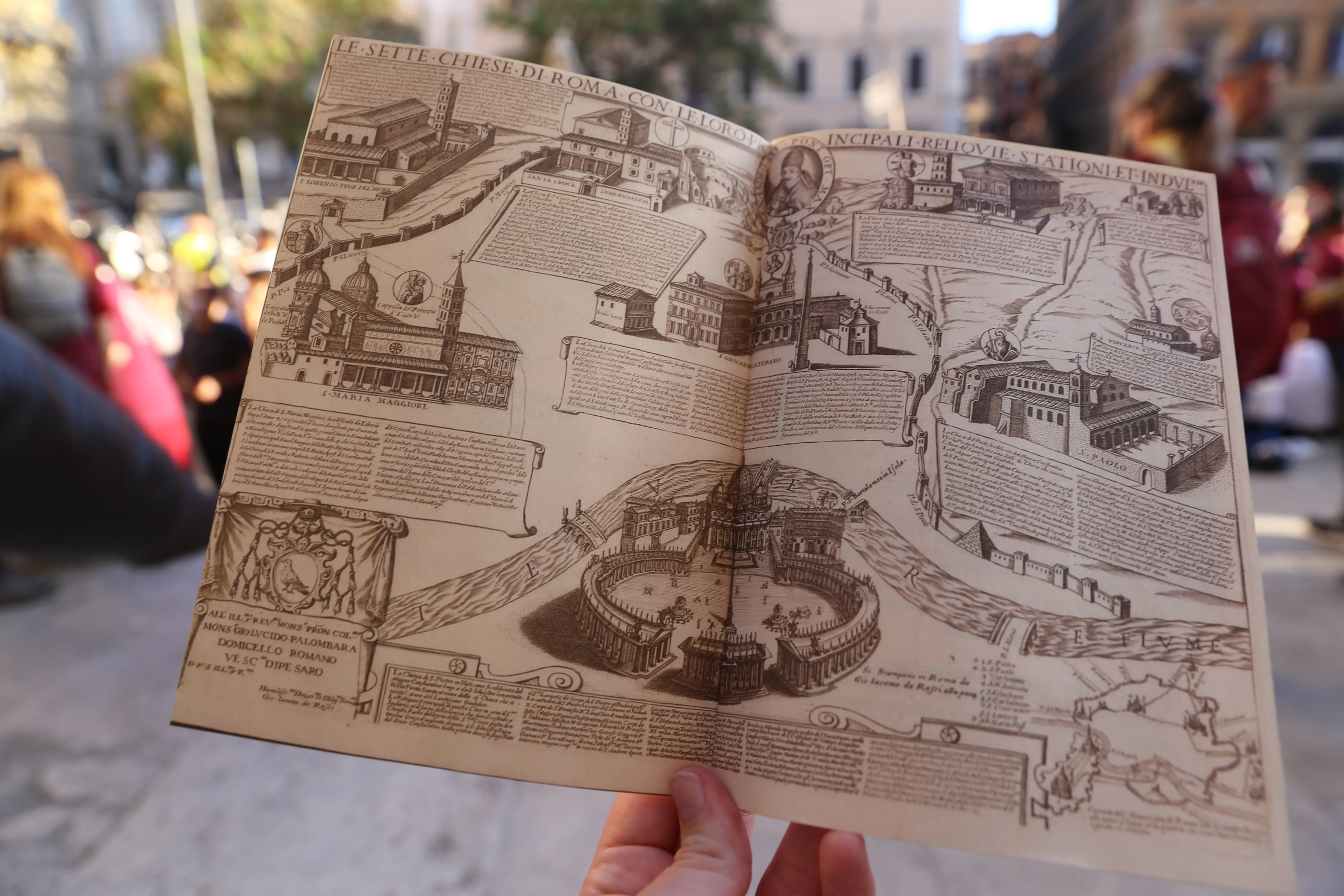
A historic illustration of the seven churches. Hannah Brockhaus/CNA
Part of St. Philip’s outreach was the revival of the Seven Churches visit. He may not be the originator of the idea of the pilgrimage to some of Rome’s most important churches, but he is credited with renewing its popularity.
After it fell out of use once again, St. Philip’s congregation of secular priests, the Oratory, revived it in the 1960s, including holding the walk one night each year, as close as possible to the way the saint would have done it.
Fr. Maurizio Botta, who led the pilgrimage, speaks at the start in front of Chiesa Nuova. Hannah Brockhaus/CNA
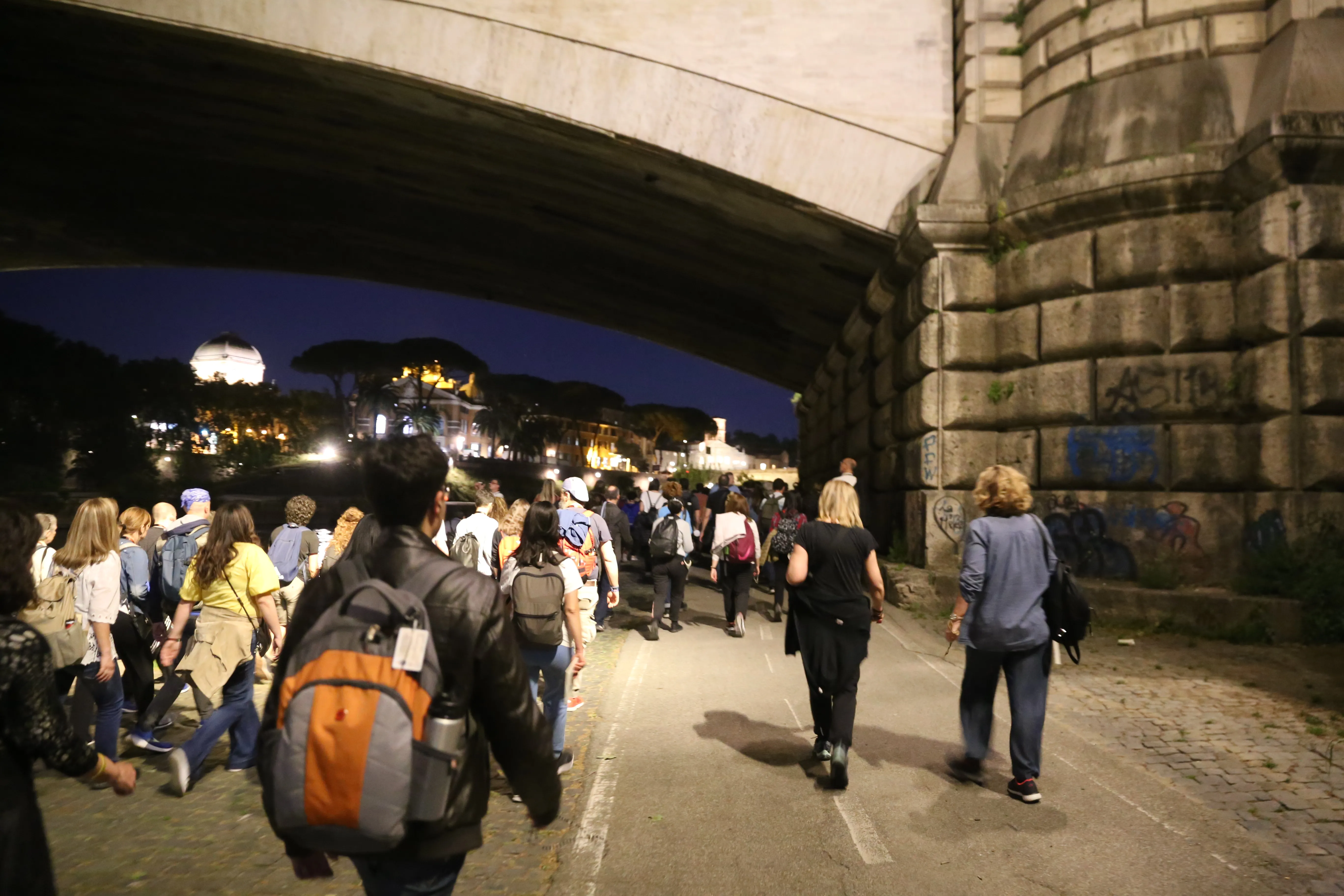
After a two-year pause, on the evening of May 13 into the morning of May 14, around 800 people walked 15 and a half miles in the footsteps of the saint and his followers.
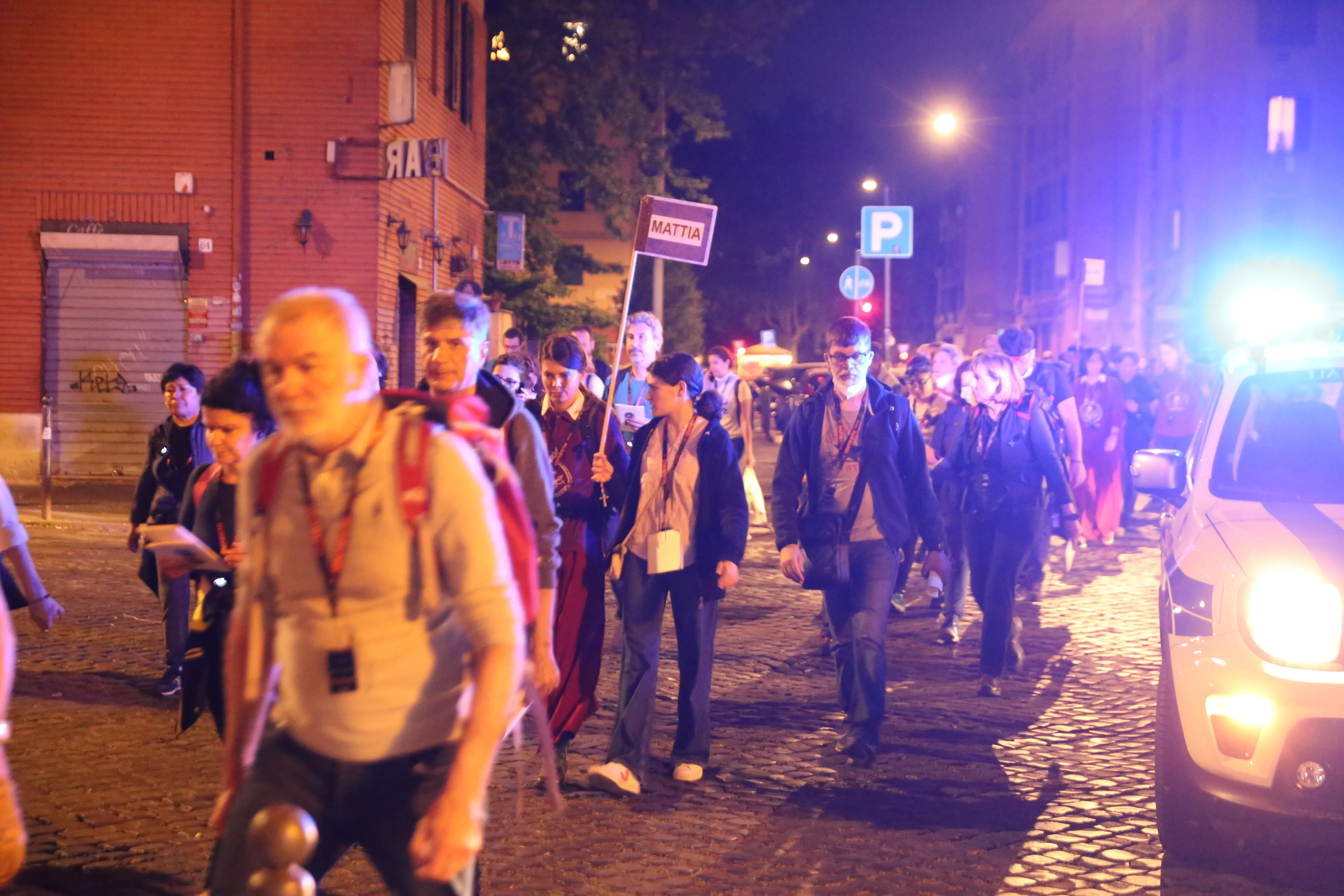
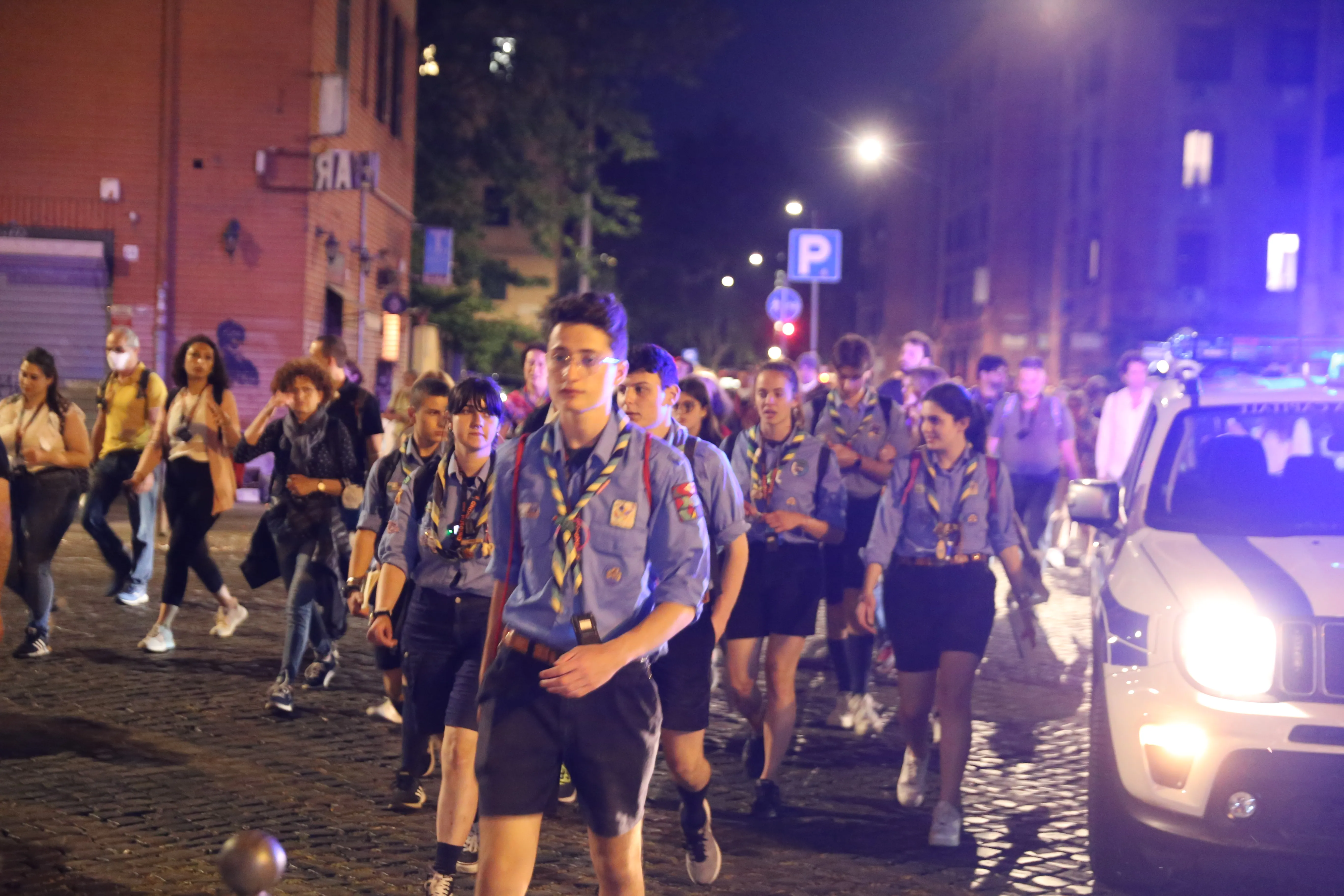
Police officers in cruisers drove ahead of the urban pilgrimage to block traffic as a sea of Catholics from around Italy crossed busy intersections and passed Friday night diners while praying the rosary in unison and singing the Taizé chant “Laudate Dominum,” whose words say in Latin, “Praise the Lord, all people, Alleluia.”
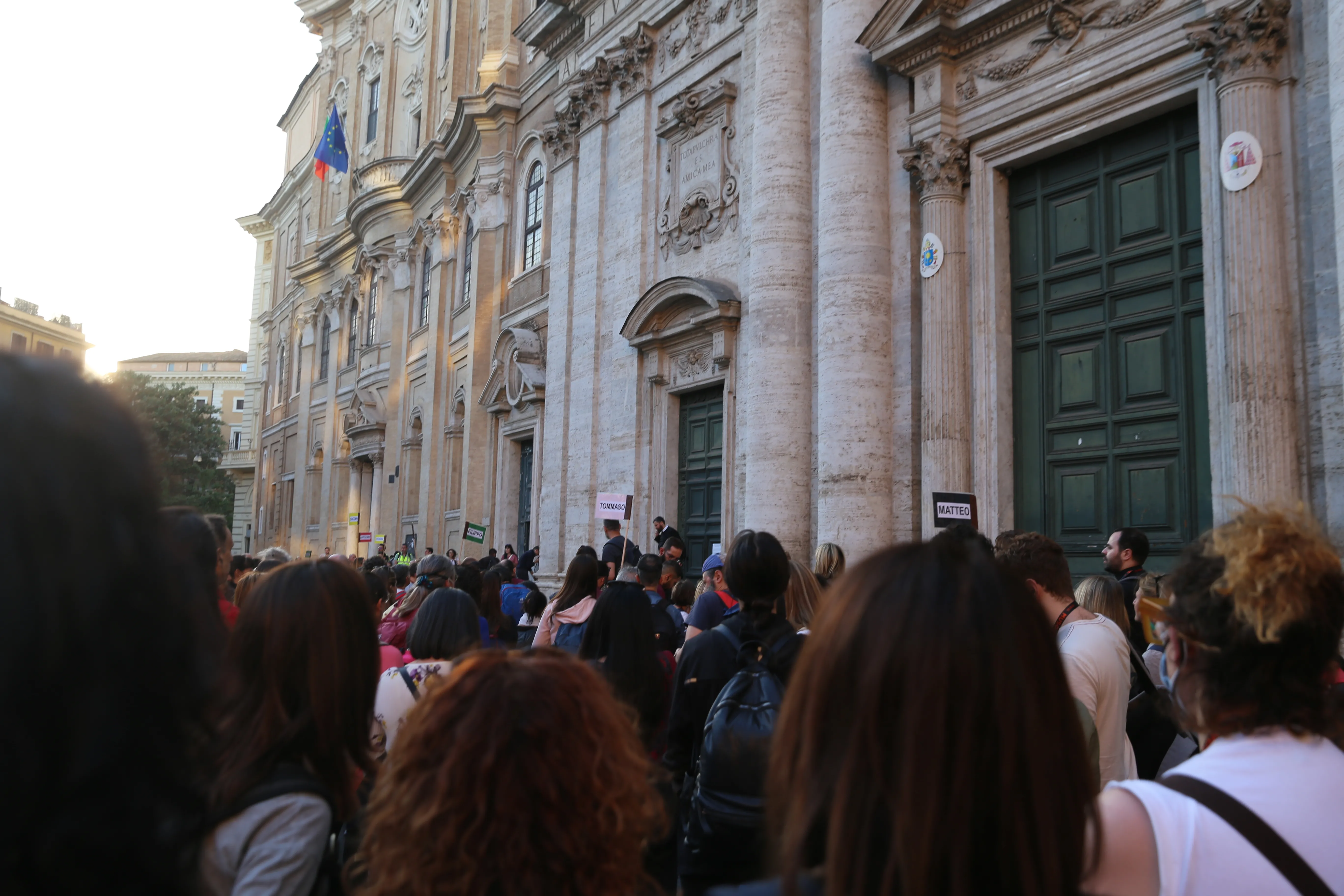
Pilgrims, including scouts, walk through Rome’s Ostiense neighborhood. Hannah Brockhaus/CNA
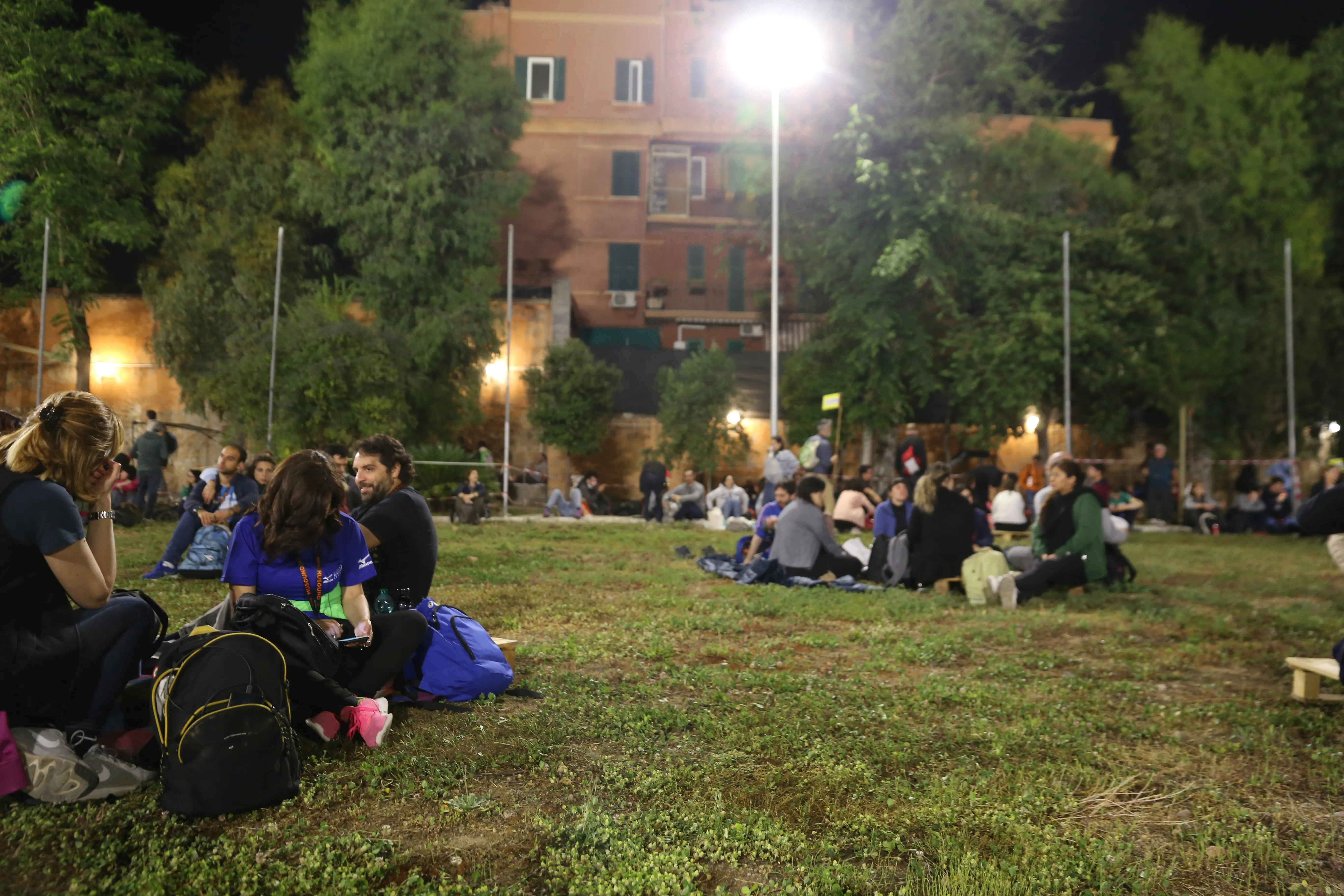
The rosary was prayed four times during the pilgrimage, which took almost 10 hours to complete, including stops for a sack dinner at midnight and short lessons on the virtues led by priests of the Oratory.
Pilgrims, including scouts, walk through Rome’s Ostiense neighborhood. Hannah Brockhaus
The seven basilicas were chosen by the saint for their importance to Christianity, and the walk on May 13-14 followed the path laid out in a 16th-century document almost certainly seen and used by St. Philip — and likely even written by him.
This document, recreated and printed into a booklet for use on the annual pilgrimage today, gives St. Philip’s guidance for those making the Seven Churches visit.
Eating a sack dinner in the courtyard of a church. Hannah Brockhaus/CNA
“Before setting out to make this holy Pilgrimage, each of the Brethren must lift up his mind to God, offering him the sincerity of his heart, with the purpose of desiring the sole glory of his divine Majesty in all actions, and especially in this one,” it says.
Those participating can also earn an indulgence under the usual conditions, and are asked to pray for specific intentions. These include praying for the penance of sins, the amendment of lukewarmness and negligence in the service of God, in thanksgiving for the forgiveness of sins, for the pope and the Church, for sinners still in the darkness of an evil life, for the conversion of heretics, schismatics, and infidels, and for the holy souls in purgatory.
Pilgrims stop to pray on the way to St. Peter’s Basilica. Hannah Brockhaus/CNA
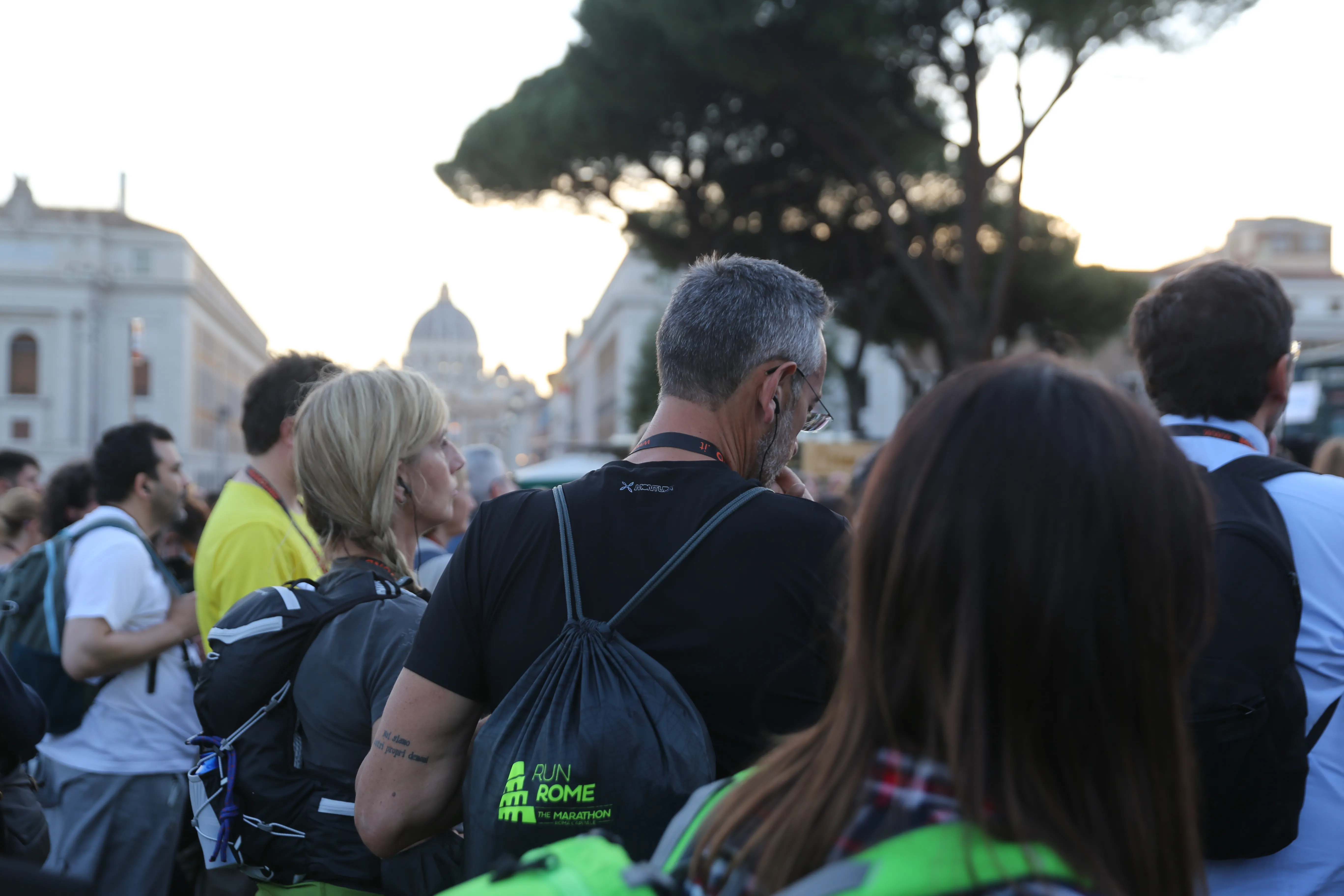
The pilgrimage began at Chiesa Nuova, the church built by St. Philip for the Oratory, and proceeded to St. Peter’s Basilica, reaching the site of St. Peter’s martyrdom at sunset.
Pilgrims walk on a path next to the Tiber River. Hannah Brockhaus/CNA
Each of the seven churches is associated with a moment of Christ’s Passion and Crucifixion. At each stop, an Oratory priest preached on a virtue and its opposing vice, before everyone joined in a prayer for an increase in that virtue and for the gifts of the Holy Spirit.
The virtues and vices were abstinence against gluttony, patience against ire, chastity against lust, generosity against avarice, fervor of spirit against acedia, charity against envy, and humility against pride.
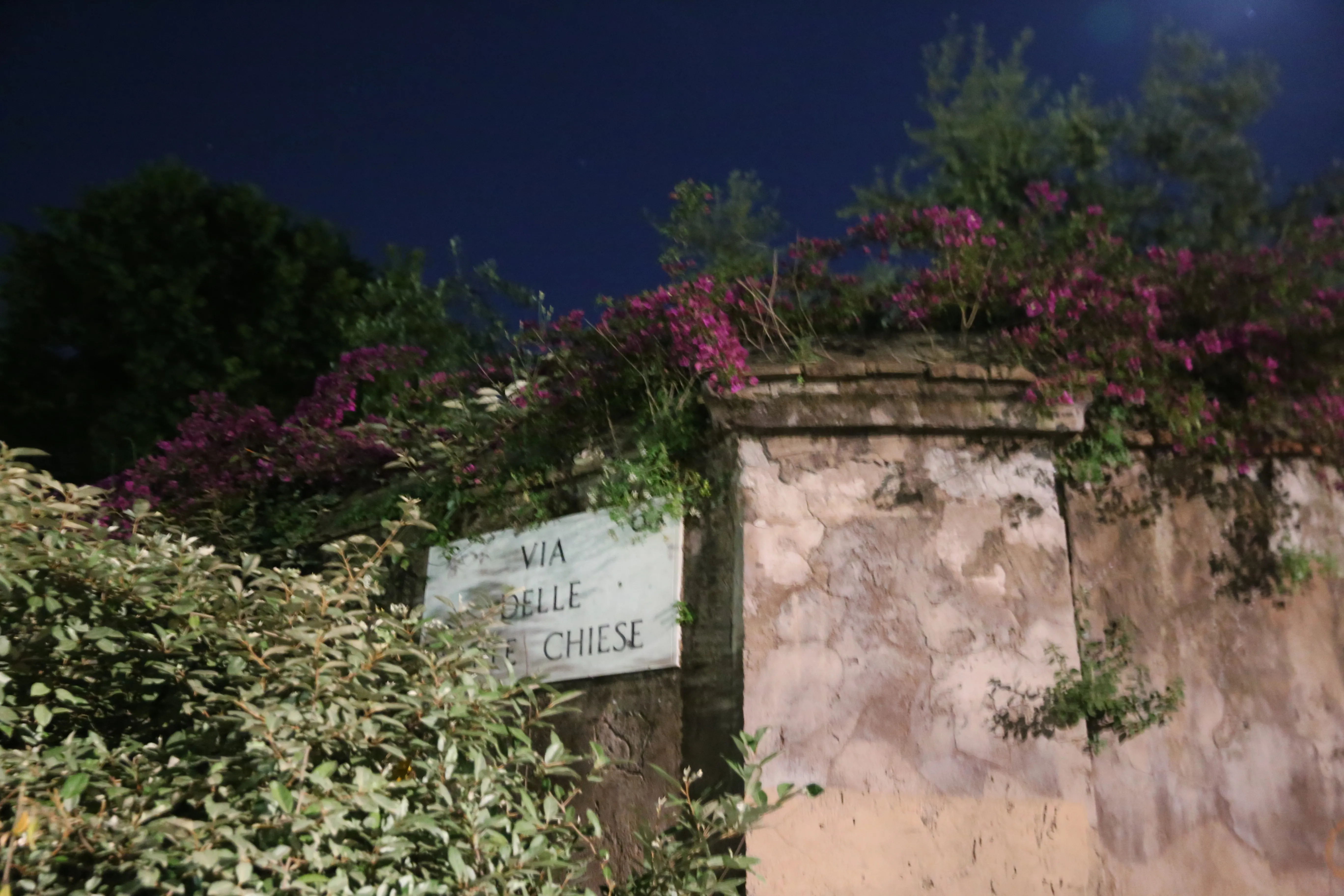
A street sign marking Seven Churches Way. Hannah Brockhaus/CNA
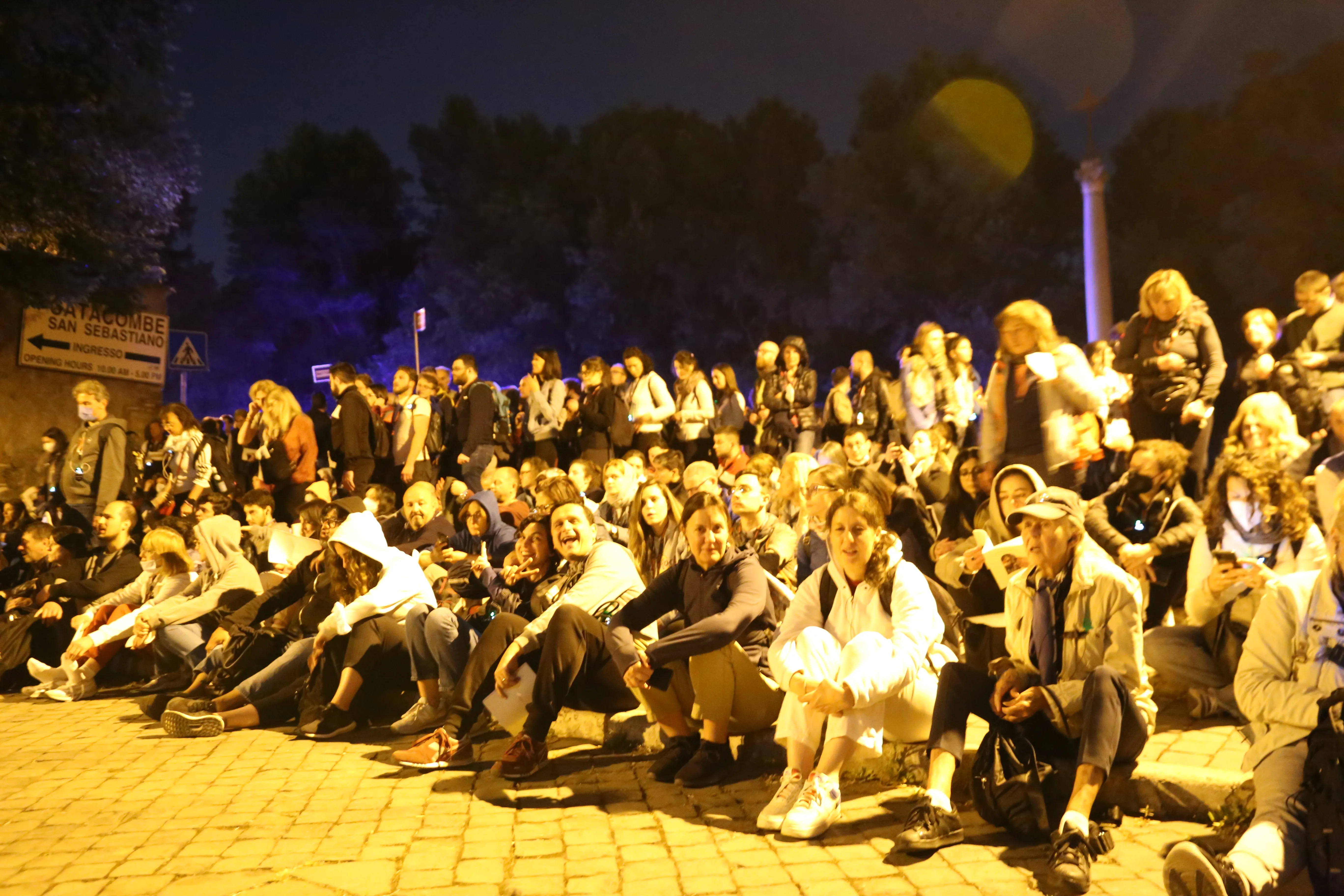
After the Basilica of St. Paul, the pilgrimage followed an ancient street still called Seven Churches Way to arrive at the catacombs and the Basilica of St. Sebastian, a third-century Christian martyr.
As a layman in Rome, St. Philip Neri used to visit the catacombs of St. Sebastian to pray. One night in the catacombs, about 10 years after moving to Rome, as he prayed, a mystical ball of fire entered his mouth and went down into his chest, exploding his ribs and doubling the size of his heart with love of God.
St. Philip was changed, both physically and spiritually, by this event, which he only revealed shortly before his death.
Pilgrims outside the catacombs of St. Sebastian. Hannah Brockhaus/CNA
Pilgrims next arrived at the Domine Quo Vadis Church after a silent, moonlit walk through the ancient Appian Way Park, flanked by the silhouettes of Italian cypress trees.
The small church of medieval origin marks the spot where, according to tradition, Jesus appeared to St. Peter as he was fleeing Rome to avoid martyrdom.
Peter asked Jesus, “Domine quo vadis?” (“Lord, where are you going?”), to which Christ said, “Venio Romam iterum crucifigi,” (“I am coming to Rome to be crucified again.”) This rebuke caused Peter to turn around and face his own martyrdom.
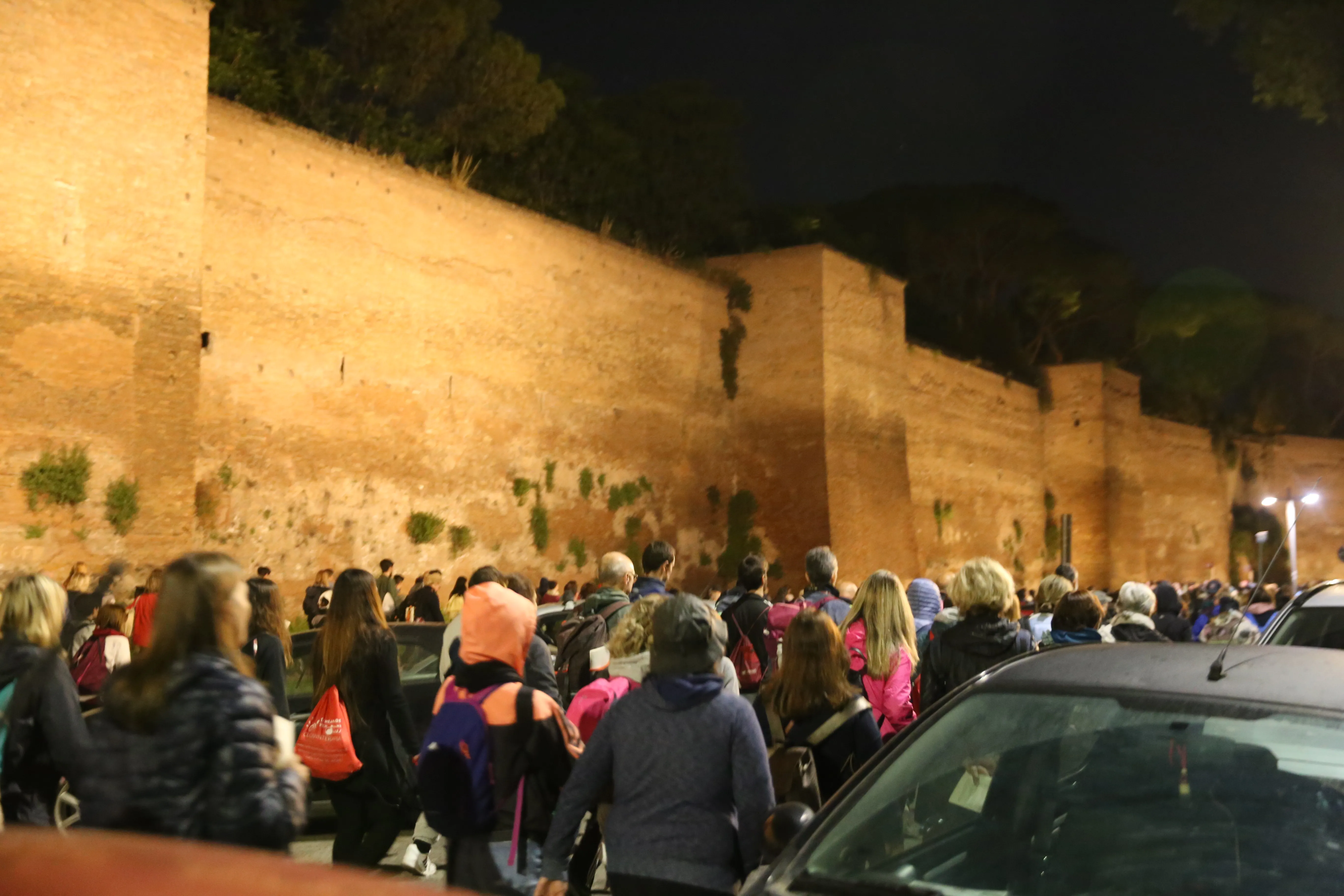
Pilgrims walk along the ancient Aurelian Wall on their way to the Basilica of St. John Lateran. Hannah Brockhaus/CNA
The Basilica of St. Lawrence Outside the Walls was the penultimate stop. The church, which has the tomb of St. Lawrence, is located next to Rome’s Verano Monumental Cemetery, and was included among the Seven Churches by St. Philip Neri, Father Botta said, as a reminder of mortality.
Almost 2 weeks ago I went on St. Philip Neri’s 7 Churches Walk in Rome.
800 people walked over 15 miles during the 10-hour night pilgrimage.
During the last stretch, at 5:15am, we passed through Termini train station, and Francesco caught this video of the moment. pic.twitter.com/C2SPHn5yoR
— Hannah Brockhaus (@HannahBrockhaus) May 26, 2022
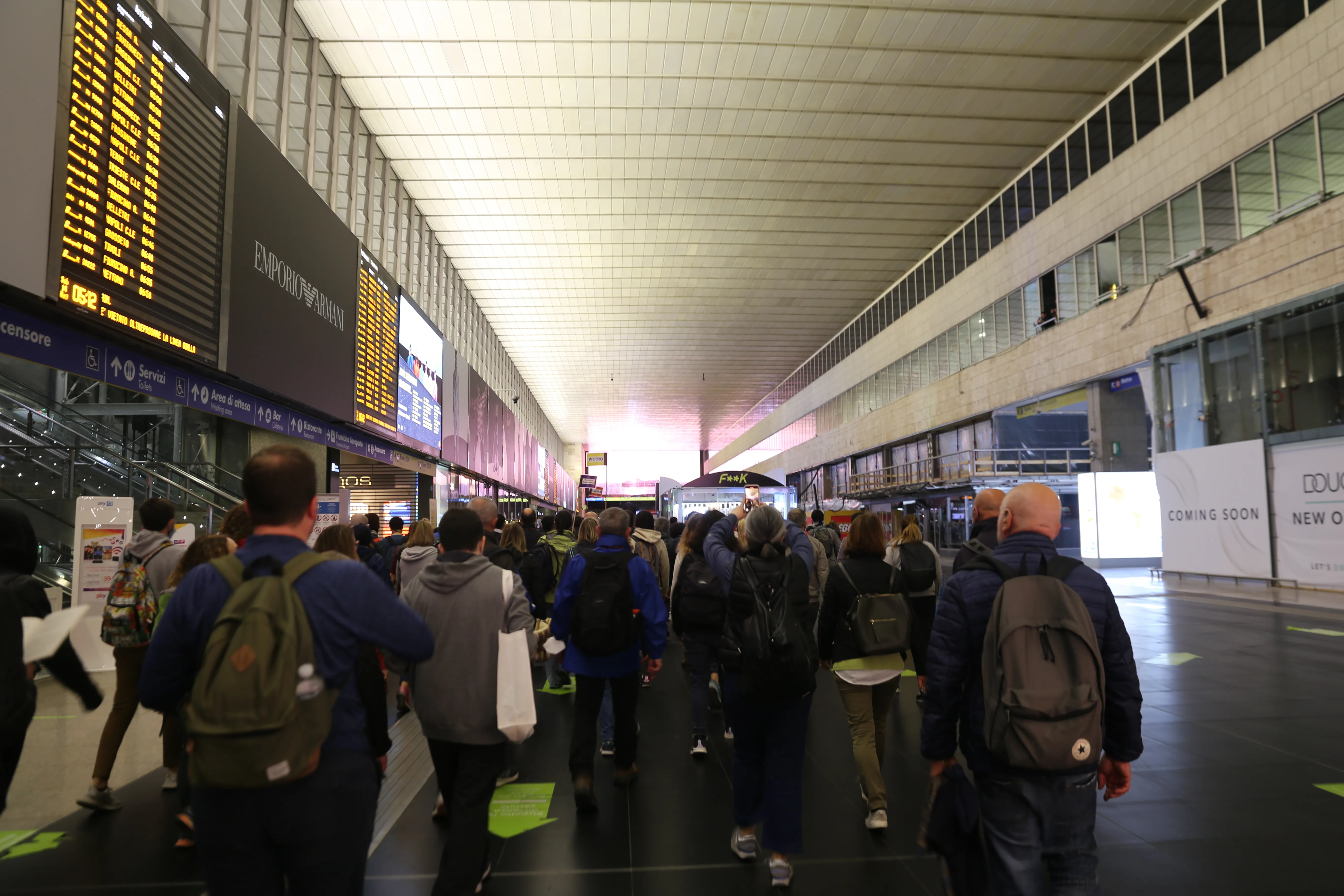
The final stretch of the walk passed through Rome’s main train station, Termini, where pilgrims sang the Marian antiphon “Salve Regina.”
Pilgrims walk through Termini train station singing the “Salve Regina”. Hannah Brockhaus/CNA
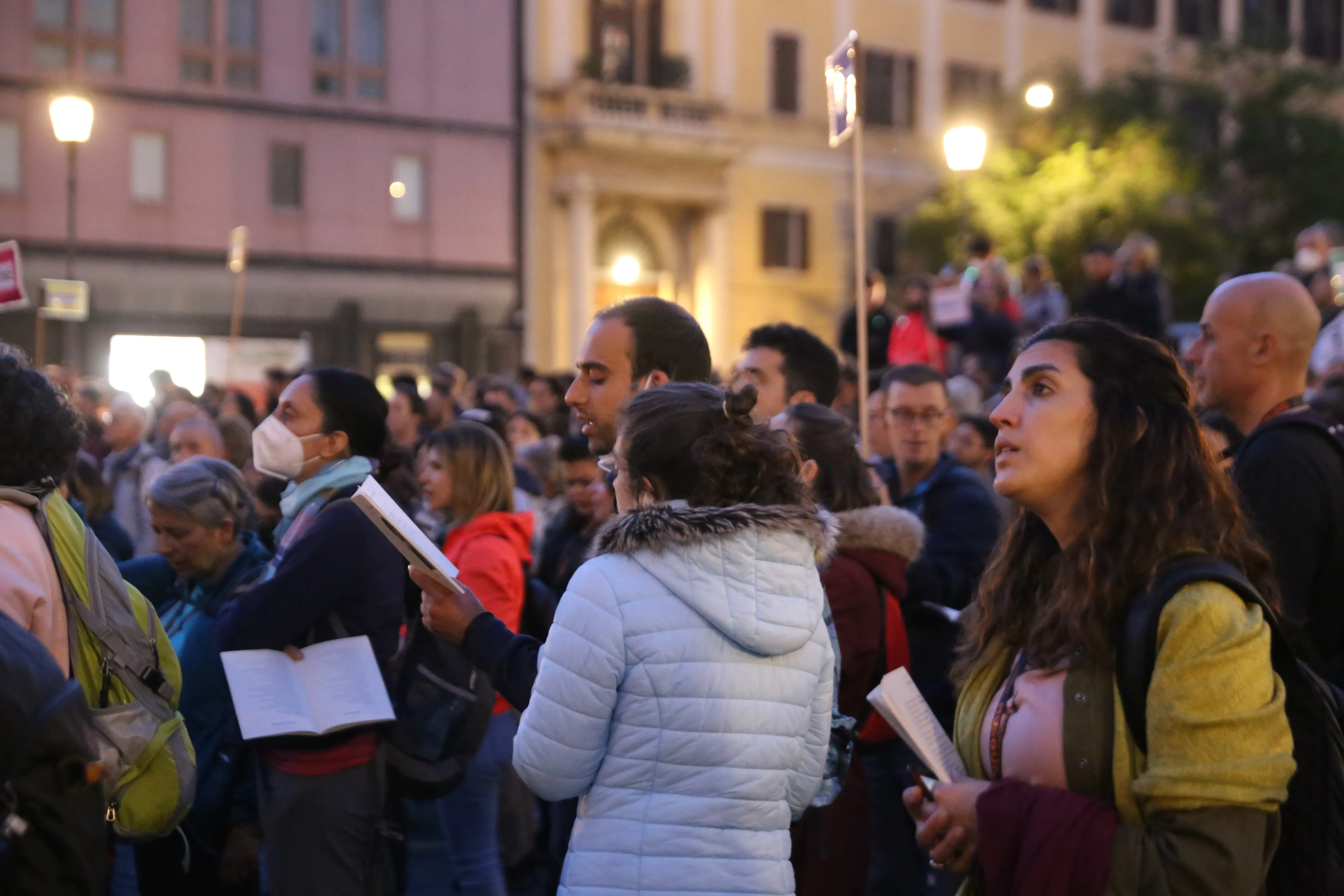
The pilgrimage finished shortly before 6:00 a.m. at the Basilica of St. Mary Major, the traditional end of the walk, where the “Salve Regina” hymn was sung again in honor of the Virgin Mary.
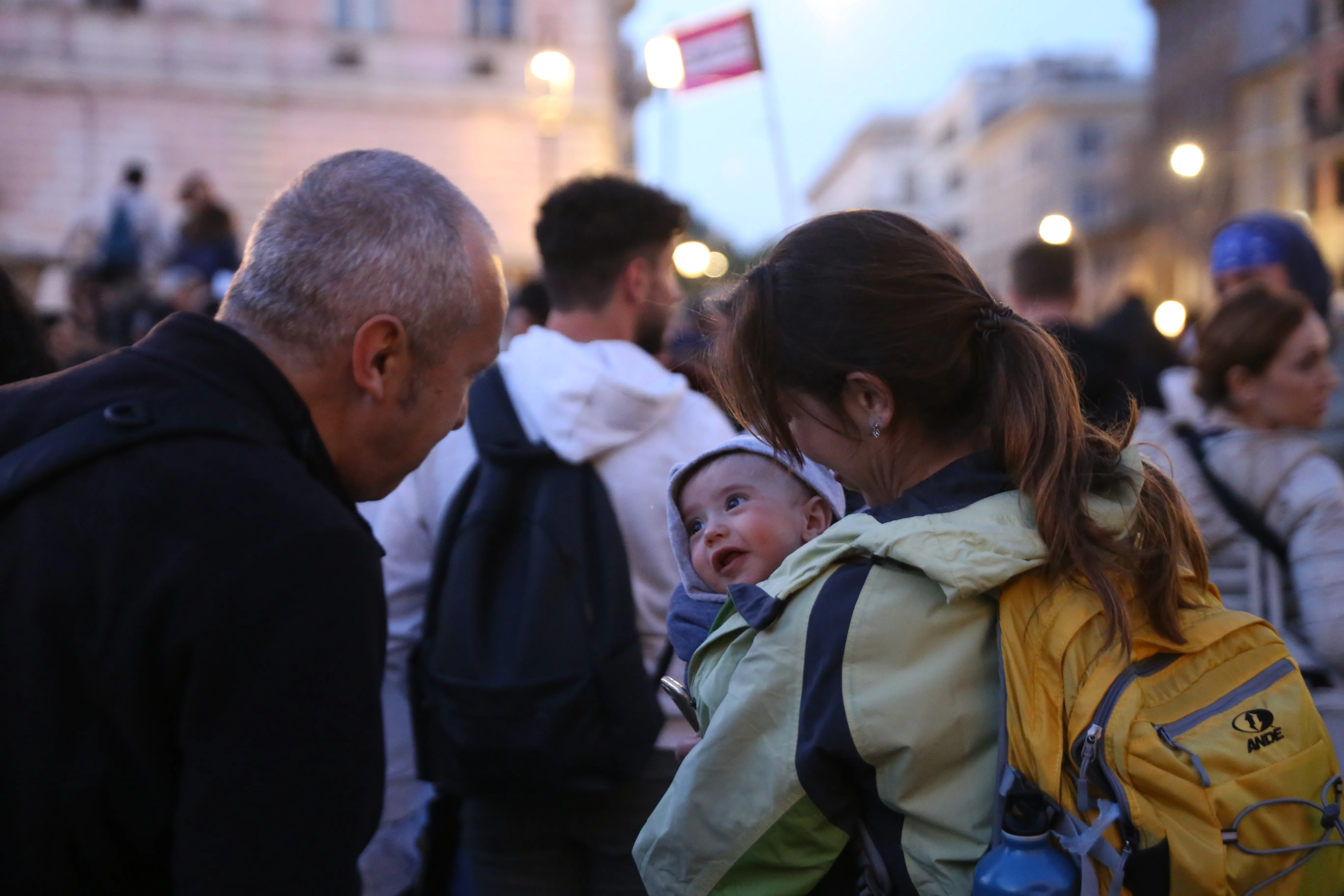
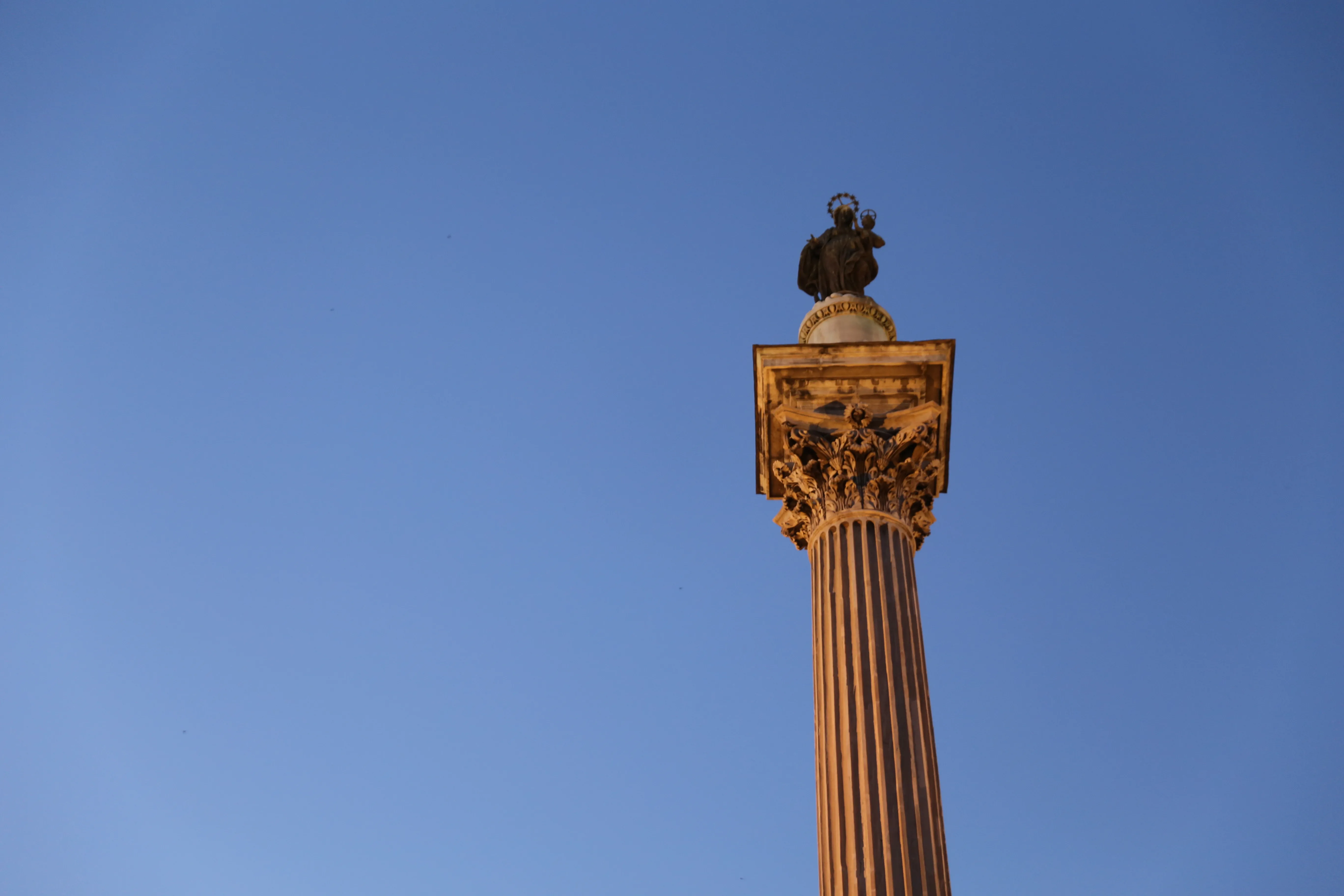
Pilgrims sing the “Salve Regina” outside the Basilica of St. Mary Major. Hannah Brockhaus/CNAA baby and his mom enjoy a moment with a new friend at the end of the pilgrimage. Hannah Brockhaus/CNAA statue of Mary on a column outside the Basilica of St. Mary Major. Hannah Brockhaus
Turkey has lost its democratic secular attitude and for many years now has been speeding toward islamic fundamentalism. They make no secret about it.
Ironically I see their commercials on TV trying to draw people to vacation there. Here’s my slogan: “Come see Turkey. Get shot in the head while you pray.” Turkey is a popular vacation spot for Europeans in particular and I am aware many Irish Catholics vacation there. Maybe its time to open your eyes and STOP financially supporting countries that want to murder you and snuff out your religious beliefs. Keep your tourist dollars HOME or in nations which are actually pro-western democracies. They are becoming fewer and fewer. Money talks. Money has power. USE IT.
It’s a shame.
Turkey is an absolutely beautiful place & the people are overwhelmingly hospitable. One of my dear friends had Turkish grandparents. You couldn’t visit them without being offered a meal. Pretty similar to Southern hospitality. Her grandmother was one of the loveliest, most gracious ladies I’ve ever known & an incredible cook.
Islamic State began when Al Qaeda, Boko Haram, Kony 2012, etc were losing their cache as the official moslem bogeymen we’re all supposed to be exercised about. Islamic State also arose when we were contemplating leaving Iraq. The powers that be made damn sure that that would never happen. Hence the new Moslem bogeyman which immediately manifested itself in 2014.
In all likelihood, all these groups were created by, and are shepherded and sustained by, Western and Israeli intelligence services. (In the case of Al-Qaeda, we *know* it began as a CIA op in the 80’s–a “database” for Afghan guerillas fighting the Soviets).
Terrorist incidents, real or merely theatrical, can then be activated whenever necessary.
The reason for this terrorist incident is transparent.
Israel is losing the media war because of its daily murder of Palestinian civilians, mostly women and children. Add to this the World Court raising the genocide issue, and America’s growing reluctance to commit to another war in the middle east.
So Israel and assorted Neo-cons need another “Moslem terrorist incident” to distract from their own murderous agenda, to remind the Western population who the “real bad guys” are, and to draw America ever deeper into a new Middle East war–for Israel.
Watch also for many “connections” to Iran to be found. Sen. Lindsey Graham, and others will soon be calling for war (in fact, I believe he did so just yesterday).
Enjoy the future–another “cool” apocalyptic middle east conflict!







Those loving and fraternal bretheran from the great religion of peace? I’m shocked, shocked ….
they are not loving and fraternal bretheran from the great religion of peace. they are religion of war
Turkey has lost its democratic secular attitude and for many years now has been speeding toward islamic fundamentalism. They make no secret about it.
Ironically I see their commercials on TV trying to draw people to vacation there. Here’s my slogan: “Come see Turkey. Get shot in the head while you pray.” Turkey is a popular vacation spot for Europeans in particular and I am aware many Irish Catholics vacation there. Maybe its time to open your eyes and STOP financially supporting countries that want to murder you and snuff out your religious beliefs. Keep your tourist dollars HOME or in nations which are actually pro-western democracies. They are becoming fewer and fewer. Money talks. Money has power. USE IT.
Jus wait, Islamic State will be getting a private audience with Pope Francis. Why not?
I always think that instead of the phrase “claims responsibility for” some heinous act, articles such as this should say “confessed their guilt.”
It’s a shame.
Turkey is an absolutely beautiful place & the people are overwhelmingly hospitable. One of my dear friends had Turkish grandparents. You couldn’t visit them without being offered a meal. Pretty similar to Southern hospitality. Her grandmother was one of the loveliest, most gracious ladies I’ve ever known & an incredible cook.
Islamic State began when Al Qaeda, Boko Haram, Kony 2012, etc were losing their cache as the official moslem bogeymen we’re all supposed to be exercised about. Islamic State also arose when we were contemplating leaving Iraq. The powers that be made damn sure that that would never happen. Hence the new Moslem bogeyman which immediately manifested itself in 2014.
In all likelihood, all these groups were created by, and are shepherded and sustained by, Western and Israeli intelligence services. (In the case of Al-Qaeda, we *know* it began as a CIA op in the 80’s–a “database” for Afghan guerillas fighting the Soviets).
Terrorist incidents, real or merely theatrical, can then be activated whenever necessary.
The reason for this terrorist incident is transparent.
Israel is losing the media war because of its daily murder of Palestinian civilians, mostly women and children. Add to this the World Court raising the genocide issue, and America’s growing reluctance to commit to another war in the middle east.
So Israel and assorted Neo-cons need another “Moslem terrorist incident” to distract from their own murderous agenda, to remind the Western population who the “real bad guys” are, and to draw America ever deeper into a new Middle East war–for Israel.
Watch also for many “connections” to Iran to be found. Sen. Lindsey Graham, and others will soon be calling for war (in fact, I believe he did so just yesterday).
Enjoy the future–another “cool” apocalyptic middle east conflict!
Thanks for the glimpse into what insanity looks like.