St. Macartan’s Cathedral in the Diocese of Clogher, in Northern Ireland. Laypeople will soon preside over funerals in 12 parishes in the diocese due to a shortage of priests. / Credit: JohnArmagh|Wikipedia|CC BY-SA 3.0
CNA Staff, Dec 19, 2023 / 13:30 pm (CNA).
More than 40 laymen and laywomen in the Diocese of Clogher in the north of Ireland will soon begin presiding over funeral liturgies amid a shortage of priests.
A major vocation crisis could result in fewer than 10 active priests in the diocese in less than 20 years, according to the local ordinary, Bishop Larry Duffy.
“Over the past few months, over 40 people from 12 parishes across the diocese have taken part in a formation course to enable them to accompany people and families at the time of bereavement,” Duffy, bishop of Clogher, announced in a Christmas pastoral letter Dec. 16.
Other parishes have indicated a “willingness” to nominate people for a similar course in the spring, he wrote.
In the letter, he said that the lay ministers would lead the “liturgy of reception of the body at the church and the Rite of Committal at the graveside.”
Duffy said the lay ministers will continue to be trained over the “coming months” and be commissioned to preside over funerals in their parishes. “We are very grateful to all those who have come forward for the formation and training and to the priests of those parishes for their involvement,” he said. Duffy asked for prayer for the new ministers.
He said that the ministers will be “commissioned publicly to act in the name of the Church” and added that “this is not a lessening of service to families and loved ones at the time of a death but, rather, a strengthening of the local parish commitment to accompany people at such a difficult and sensitive time.”
Duffy announced in a July pastoral letter that the northern Irish diocese has a severe shortage of priests and will be ordaining just one priest in the next seven years. By CNA’s count, the diocese has 72 priests and deacons covering about 40 parishes and 85 churches.
“The figures given to us indicate that if we continue as we are, in less than 20 years there will be fewer than 10 priests covering the 85 churches across the whole diocese — from Bundoran on the Atlantic to Inniskeen and Killanny near Dundalk,” he said.
A shortage of priests
“The truth is that we cannot continue to operate and provide pastoral ministry across our diocese in the same way as we do now or as we did in the past,” Duffy said in July. He said that there would be fewer Masses as a result of the lack of priests.
Duffy said that the diocese is “far too dependent” on priests for pastoral care, administration, property maintenance, planning, and parish governance.
The “well-being” of clergy needs to be a “priority area for immediate attention,” he said.
“We need to move from a model that is clergy-dependent and based almost solely on sacramental provision to one that is broader in terms of recognizing, utilizing, and honoring the vocation and varied gifts of all the baptized and which will, over time, allow for really effective and meaningful co-responsibility in the Church’s mission,” he said.
In 2021, a survey by the Association of Catholic Priests found that only about 30% of Catholics in Ireland attend Mass weekly — a significant drop from 91% in 1975.
In 2022, a survey from the Irish organization Association of Catholic Priests found that 2,116 priests serve the nation’s 26 dioceses, which consists of more than 2,650 churches or “Mass Centers,” according to the Irish Times.
That survey also found that almost 15% of priests are over the age of 75 and “still working,” while more than a quarter are between the ages of 60 and 75, the outlet reported. That survey found that only 52 priests in the country were under 40 years old, and 464 priests were between the ages of 40 and 60.
If you value the news and views Catholic World Report provides, please consider donating to support our efforts. Your contribution will help us continue to make CWR available to all readers worldwide for free, without a subscription. Thank you for your generosity!
Click here for more information on donating to CWR. Click here to sign up for our newsletter.
Washington, D.C. Newsroom, Apr 2, 2024 / 17:05 pm (CNA).
Michigan Gov. Gretchen Whitmer, a Democrat, signed a bill that legalizes and regulates paid surrogacy in the state.Michigan will join the large majority of sta… […]
Massachusetts Gov. Maura Healey walks across the campus of St. John’s Prep in Danvers, Massachusetts, on April 9, 2024. / Credit: Screenshot of St. John’s Prep Facebook page last visited April 19, 2024
Boston, Mass., Apr 23, 2024 / 16:45 pm (CNA).
Pro-lifers in the Archdiocese of Boston are criticizing Cardinal Seán O’Malley over two recent appearances at Catholic education events by the pro-abortion governor of Massachusetts.
Earlier this month, Massachusetts Gov. Maura Healey, a Democrat who supports legal and publicly funded abortion and who has taken steps to make abortions easier to obtain, spoke at a fundraiser for The Catholic Schools Foundation, which raises money for Catholic schools in the archdiocese and helps poor students attend.
O’Malley, the archbishop of Boston, is the chairman of the board of trustees of the foundation, though he was in Rome at the time of the gala and did not attend it.
Healey also recently visited a Catholic school north of Boston, speaking to students and answering questions.
C.J. Doyle, executive director of the Catholic Action League of Massachusetts, called Healey’s appearances “a grave scandal.”
“Cardinal O’Malley should be ashamed of himself. Is Maura Healey an inspiring role model for Catholic students?” Doyle said.
Thomas Harvey, chairman of the Massachusetts Alliance to Stop Taxpayer Funded Abortions, called including Healey at the Catholic events “really disgraceful,” and he placed the blame on O’Malley.
“Maura Healey is a huge proponent of killing babies in the womb, in direct defiance of Catholic teaching, and yet here she is being presented to impressionable Catholic students as if she were a Catholic role model,” Harvey told the Register by text. “And the clear message being sent to Catholic students here is that killing babies in the womb is just not that big a deal.”
In June 2004, the U.S. Conference of Catholic Bishops approved a document called “Catholics in Public Life,” which states: “The Catholic community and Catholic institutions should not honor those who act in defiance of our fundamental moral principles. They should not be given awards, honors, or platforms which would suggest support for their actions.”
Terrence Donilon, a spokesman for the Archdiocese of Boston, pointed out that Healey was not an honoree at the gala or during her earlier appearance at the Catholic school.
Since Healey is the governor of the state, Donilon said, Cardinal O’Malley has worked with her “on a number of issues important to Catholics and the wider community,” including public funding for the archdiocese’s charitable work providing “basic needs assistance, job training, child care services, and immigration and refugee assistance to thousands of residents,” as well as building “badly needed affordable housing” and trying “to stem gun violence.”
“At the same time, the cardinal has been a leader in the pro-life movement for over 50 years and his commitment in being a staunch promoter of life is well known and unwavering,” Donilon said.
O’Malley, 79, a Capuchin Franciscan, has frequently attended the March for Life in Washington, D.C., and has spoken at pro-life rallies. Last week, The Boston Globe published a column by O’Malley urging state legislators to oppose a bill that would legalize physician-assisted suicide.
But critics such as Doyle claim that O’Malley during his time as archbishop has seemed to mix easily and uncritically with abortion-supporting Catholic politicians, including the late U.S. Sen. Edward Kennedy (whose funeral Mass he celebrated), the late Boston mayor Thomas Menino, former Boston mayor Marty Walsh, and the current governor, Healey, with whom he co-authored a column in The Boston Globe in September 2017 on immigration.
Donilon, O’Malley’s spokesman, addressing Healey’s participation in The Catholic Schools Foundation gala last week, said that “the governor has been a vocal supporter of Catholic education. … Our Catholic schools save cities and towns hundreds of millions of dollars in education costs. Our families benefit from an outstanding education based in an excellent faith-based environment.”
Gov. Maura Healey speaks to students at St. John’s Prep on April 9, 2024. Credit: Screenshot of St. John’s Prep Facebook page last visited on April 9, 2024.
Who is Maura Healey?
Healey, 53, was elected Massachusetts attorney general in 2014 with an endorsement from Planned Parenthood Advocacy Fund. She served two terms as attorney general before being elected governor of Massachusetts in November 2022.
As an elected official, Healey has frequently supported public policies that clash with Catholic teachings on life and sexuality.
She has verbally attacked pro-life pregnancy centers, steered state government money to private abortion funds, and, in April 2023, quietly arranged for the flagship campus of the state-run University of Massachusetts to purchase 15,000 doses of abortion pills.
Healey’s administration in June 2023 successfully proposed a curriculum framework for public schools that calls for teaching between third and fifth grades “the differences between biological sex and gender identity” and “how one’s outward behavior and appearance does not define one’s gender identity or sexual orientation.”
Healey appeared Thursday, April 11, at the annual gala of The Catholic Schools Foundation at a hotel in Boston.
“So I didn’t have the benefit of going to Catholic school,” Healey said, according to a text of her remarks provided by a spokesman. “My mom went to Catholic school, and my nephew goes to Catholic school; we have priest[s] at the dinner table every Sunday. But I do know, both having been your attorney general and now as your governor, what your work means. And I can see that experience firsthand.”
She also said she wants to find ways “to partner” with the foundation “in the important work that you [are] doing.”
“And I want you to know that, as governor, I value our vibrant mix of education, our public schools, our private schools, and our religious schools,” Healey said.
Two days earlier, on Tuesday, April 9, Healey spent about 50 minutes with a group of 120 students at St. John’s Preparatory High School, a Catholic boys’ school founded by the Xaverian Brothers in Danvers, about 18 miles northeast of Boston, according to a description of the visit published on the school’s website. The school is in the Archdiocese of Boston, though it is not run by the archdiocese.
Healey had never visited the school before, “but it was quickly clear her personal values are closely aligned with those of the Xaverian Brothers,” the school’s write-up states.
Healey emphasized leadership and empathy during her remarks. The governor also told the students that while she believes in civil discourse, “there are some basic values that have kept our society intact,” and she told students they should “call out hate when you see it.”
“We can have differences of opinion on things,” Healey said, according to the school’s write-up, “but, to me, equality has got to abide. Respect for the dignity and worth of each person is something I call on people to really adhere to.”
Robert Joyce, a lawyer and member of the board of the Pro-Life Legal Defense Fund, which provides legal representation for pro-lifers, said that St. John’s Prep last fall turned down an offer he made to provide a pro-life assembly for students featuring a canon lawyer, a physician, and a vocations director. (The head of school, Edward Hardiman, did not respond to requests for comment by deadline.)
Joyce called Healey’s recent appearances at the gala and at the school “abominations for Catholic education.”
“They send the clear message to Catholic students and parents that critical, fundamental precepts of the Catholic faith are not all that important. In simple terms, they declare that protection of innocent unborn life and the defense of traditional marriage are negotiable with these Catholic educators,” Joyce indicated.
Healey is also a featured speaker at the annual Spring Celebration of Catholic Charities Boston scheduled for Wednesday, May 29, at the Boston Harbor Hotel in Boston. O’Malley is expected to receive an award at the event for his work in welcoming immigrants.
Healey and the Catholic Church
Healey does not often talk about religion in public, but she occasionally identifies herself as a Catholic.
In October 2018, when she was state attorney general, she led off a brief column in The Boston Globe with the words: “As a member of law enforcement and as a Catholic …”
In April 2022, when Healey criticized Bishop Robert McManus of Worcester for calling for a Catholic school to take down a rainbow flag, she added, according to MassLive.com: “And I speak as a Catholic …”
In October 2022, during a debate while she was running for governor, Healey used a Catholic reference while defending herself from a claim by her Republican opponent that a bill she had supported effectively legalized infanticide, as the National Catholic Register subsequently reported. “You know, my mom goes to Mass every morning,” Healey said.
Healey is widely thought of as a potential candidate for other offices. She would be an obvious Democratic nominee for U.S. Senate in Massachusetts if either of the two incumbents (both in their 70s) leaves office.
Additionally, just hours before her appearance at The Catholic Schools Foundation gala, Healey participated in an event at Northeastern University in Boston honoring former Massachusetts governor and 1988 Democratic presidential nominee Michael Dukakis. The moderator floated Healey as a potential future candidate for president of the United States, to applause from the audience.
This story was first published by the National Catholic Register, CNA’s sister news partner, and is reprinted here on CNA with permission.
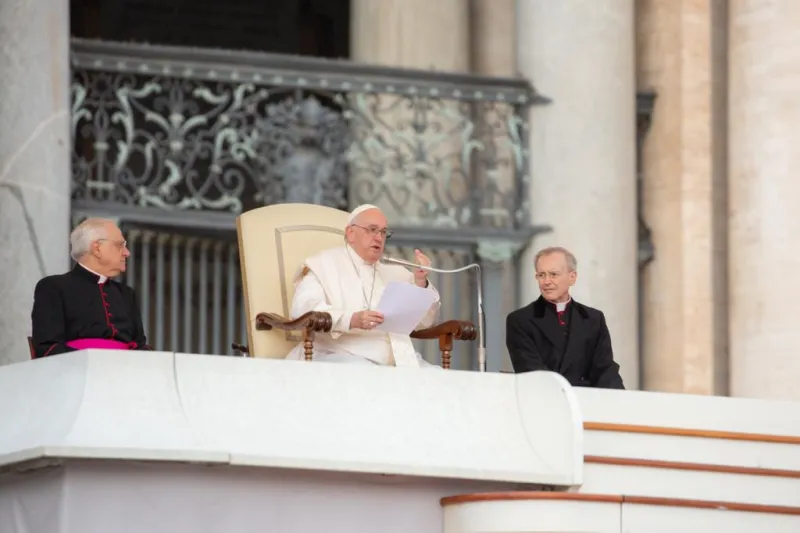
Pope Francis speaking at the general audience on St. Peter’s Square, Nov. 9, 2022 / Daniel Ibáñez / CNA
Rome Newsroom, Nov 9, 2022 / 03:34 am (CNA).
Pope Francis said Wednesday his trip to the Gulf kingdom of Bahrain was a new step on the journey to create “fraternal alliances” between Christians and Muslims.
The pope spoke about his Nov. 3-6 visit to Bahrain, a small, overwhelmingly Muslim country in the Persian Gulf, during his weekly public audience in St. Peter’s Square Nov. 9.
“The journey to Bahrain should not be seen as an isolated episode,” he said. “It was part of a process initiated by Saint John Paul II when he went to Morocco.”
This is why, he continued, “the first visit of a pope in Bahrain represents a new step on the journey between Christian and Muslim believers — not to confuse things or water down the faith, but to create fraternal alliances in the name of our Father Abraham, who was a pilgrim on earth under the merciful gaze of the one God of Heaven, the God of peace.”
“And why do I say that dialogue does not water down [the faith]?” Francis said. “Because to dialogue you have to have your own identity, you have to start from your identity. If you do not have identity, you cannot dialogue, because you do not understand what you are either.”
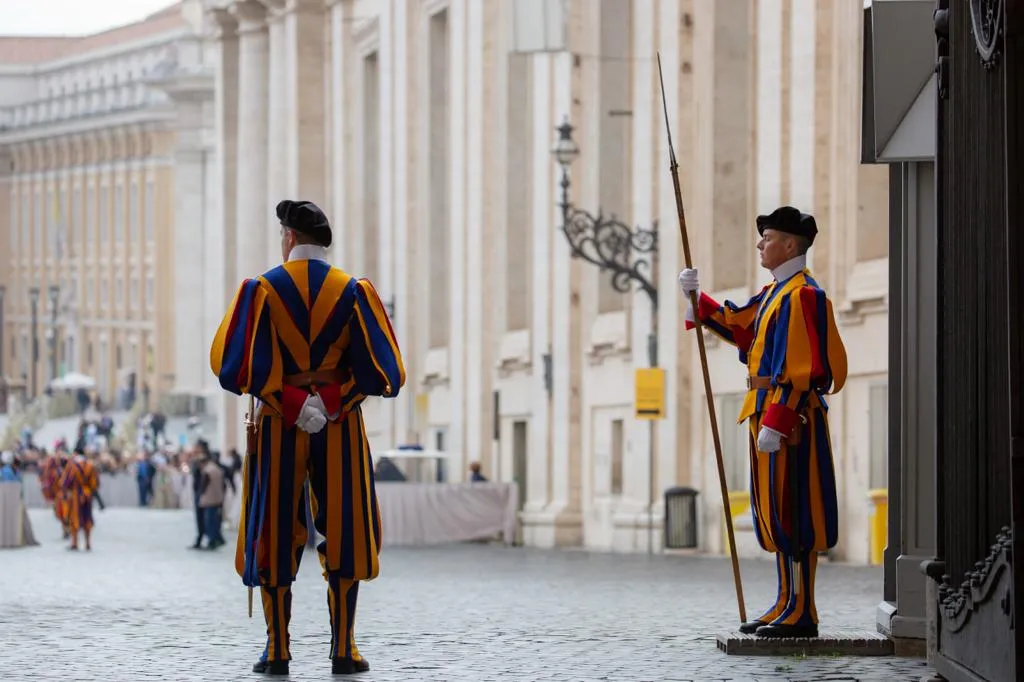
The Papal Swiss Guard at St. Peter’s Square, Nov. 9, 2022. Daniel Ibáñez / CNA
The motto of Pope Francis’ visit to Bahrain was “Peace on earth to people of goodwill.” The trip included encounters with government officials, Muslim leaders, and the small Catholic community, including a Mass with around 30,000 people in Bahrain’s national soccer stadium.
The small Christian minority in Bahrain is mostly made up of immigrants, especially from India and the Philippines.
More than 70% of the total population — 1.5 million — is Muslim, while there are only about 161,000 Catholics living in the country, according to 2020 Vatican statistics.
Pope Francis said Wednesday it was “marvelous” to see the many Christian immigrants in Bahrain.
“The brothers and sisters in the faith, whom I met in Bahrain, truly live ‘on a journey,’” he said. “For the most part, they are immigrant laborers who, far from home, discover their roots in the People of God and their family within the larger family of the Church. And they move ahead joyfully, in the certainty that the hope of God does not disappoint.”
The pope pointed out that the Kingdom of Bahrain is an archipelago of 33 islands, which “helps us understand that it is not necessary to live by isolating ourselves, but by coming closer” — something which aids peace.
He said “dialogue is the ‘oxygen of peace,’” not only in a nation but also in a family: Dialogue can help bring peace to a husband and wife who are fighting, for example.
Throughout his visit to Bahrain, Francis said, he heard several times the desire to increase encounters and strengthen the relationship between Christians and Muslims in the country.
He recalled a custom in that part of the world to place one’s hand on the heart when greeting another person. “I did this too,” he said, “to make room inside me for the person I was meeting.”
“For without this welcome, dialogue remains empty, illusory, it remains on the level of an idea rather than reality,” he said.
Francis encouraged Catholics to have “open hearts,” not closed, hard hearts, and said he would like to transmit the “genuine, simple, and beautiful joy” of the Christian priests, religious, and lay people he met in Bahrain.
“Meeting each other and praying together, we felt we were of one heart and one soul,” he said.
At the beginning of the general audience, Pope Francis drew attention to two “courageous” children who had approached the platform where he was sitting.
These children “didn’t ask permission, they didn’t say, ‘Ah, I’m afraid’ — they came directly,” he said. “They gave us an example of how we are to be with God, with the Lord: go for it.”
“He is always waiting for us,” he continued. “It did me good to see the trust of these two children: it was an example for all of us. This is how we must always approach the Lord: with freedom.”





Leave a Reply