Pope Francis delivers his Sunday Angelus message to about 20,000 faithful in St. Peter’s Square at the Vatican on Oct. 22, 2023. / Credit: Vatican Media
Vatican City, Oct 31, 2023 / 08:50 am (CNA).
In the Catholic Church, the first days of November are an important time for remembering those who have come and gone before us — both the holy men and women who are canonized saints in heaven and our departed loved ones we hope and pray are also partaking in the beatific vision.
At the Vatican, Pope Francis will mark this holy and significant season with prayer and two liturgies.
On the solemnity of All Saints on Nov. 1, Pope Francis will give a short address and lead the Angelus, a traditional Marian prayer, from a window overlooking St. Peter’s Square at noon Rome time.
It is the pope’s custom to lead an Angelus on holy days of obligation.
Since All Saints’ Day falls on a Wednesday this year, Francis will not hold his usual weekly general audience.
For All Souls’ Day on Nov. 2, he will continue his recent custom of holding a Mass at a cemetery to pray for the dead.
Since 2016, Pope Francis has celebrated a Mass at five different cemeteries in or near Rome. For All Souls’ Day in 2019, he celebrated Mass at the Catacombs of Priscilla, while in 2022 he did not visit a cemetery but offered Mass for deceased bishops and cardinals in St. Peter’s Basilica — another papal custom during the week of All Saints’ and All Souls’ Days.
For 2023, Francis will again return to a cemetery to mark All Souls’ Day. He will preside over a Mass at 10 a.m. at the Rome War Cemetery, which contains 426 Commonwealth burials from the Second World War.
The small cemetery is near the Pyramid of Cestius, a Roman-era pyramid in the Ostiense neighborhood south of the historic center of Rome.
The following morning, on Nov. 3, Pope Francis will preside over a Mass in St. Peter’s Basilica for the repose of the soul of Pope Benedict XVI and the bishops and cardinals who have died in the previous year. It is the pope’s practice to offer this Mass sometime during the first week of November.
If you value the news and views Catholic World Report provides, please consider donating to support our efforts. Your contribution will help us continue to make CWR available to all readers worldwide for free, without a subscription. Thank you for your generosity!
Click here for more information on donating to CWR. Click here to sign up for our newsletter.
Mayor Muriel Bowser during a speech at the Pride Parade on June 12, 2021. / Shutterstock
Washington D.C., Apr 8, 2022 / 17:16 pm (CNA).
In her first public comment on the case, D.C. Mayor Muriel Bowser gave no indication Friday that the city in… […]
Pope Francis celebrates Christmas Mass in St. Peter’s Basilica Dec. 24, 2020. / Vatican Media.
Greccio, Italy, Dec 17, 2021 / 04:00 am (CNA).
In 2019, Pope Francis issued an apostolic letter on the meaning and importance of the Christmas nativity scene. He signed the document, Admirabile signum (“Enchanting image”), on Dec. 1 that year, at the Shrine of the Nativity in Greccio, a hilltown in the Italian region of Lazio.
The choice of Greccio was significant, because it was there in 1223 that St. Francis of Assisi created history’s first nativity scene.
In the apostolic letter, widely regarded as one of the most moving documents of Francis’ pontificate, the pope sets out “to encourage the beautiful family tradition of preparing the nativity scene in the days before Christmas.”
Here are 10 things that Pope Francis wants us to learn from the nativity scene, drawn from Admirabile signum.
1.The nativity scene is like a living Gospel. The depiction of Jesus’ birth is “a simple and joyful proclamation of the mystery of the Incarnation of the Son of God,” the pope writes. The nativity scene invites everyone who contemplates it “on a spiritual journey, drawn by the humility of the God who became man in order to encounter every man and woman.”
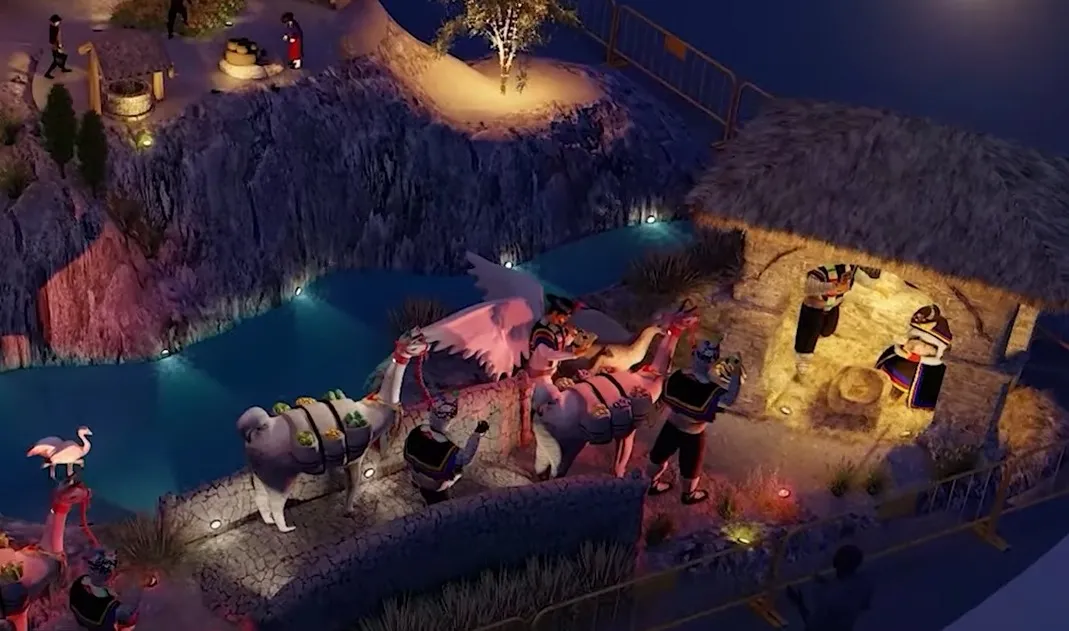
The Vatican Nativity scene. Agencia Andina
2. The custom is rooted in the Bible. The pope underlines that the nativity scene rises from “the pages of sacred Scripture.” St. Luke’s Gospel says that Mary “gave birth to her firstborn son and wrapped him in swaddling cloths, and laid him in a manger, because there was no place for them in the inn” (2:7). The manger is the focus of nativity scenes. Indeed, the Italian word for nativity scene is “presepe,” from the Latin word “praesepium,” meaning “manger.”
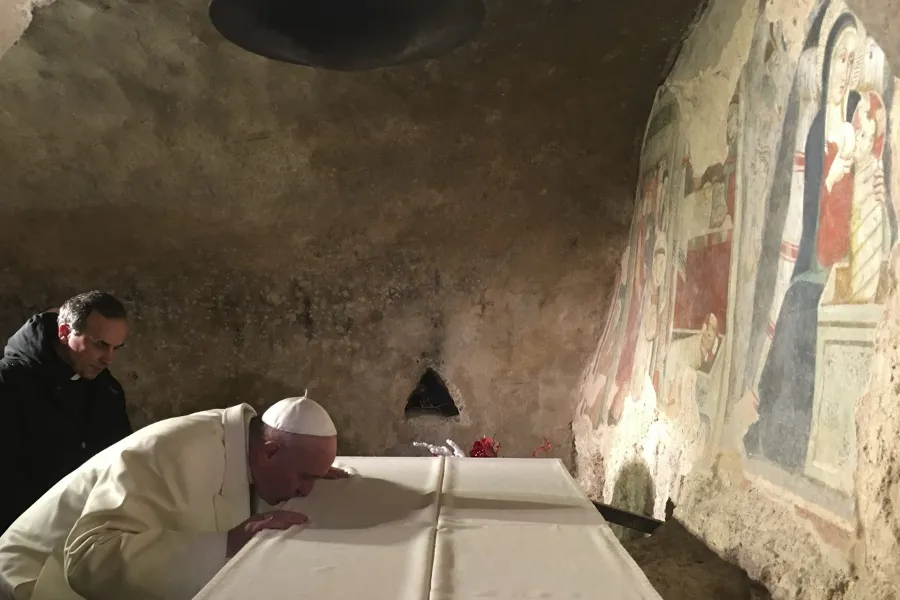
Pope Francis visits the site of the first nativity scene in Greccio, Italy, on Jan. 4, 2015. Vatican Media.
3.The tradition was born in an unassuming Italian town. St. Francis of Assisi stopped in Greccio in November 1223, probably on his way back from Rome after receiving papal approval for the Rule of his religious order. Fifteen days before Christmas, he asked a local man named John to help him “bring to life the memory of that babe born in Bethlehem, to see as much as possible with my own bodily eyes the discomfort of his infant needs, how he lay in a manger, and how, with an ox and an ass standing by, he was laid upon a bed of hay.” On Christmas Day, St. Francis was joined by his friars and people from the surrounding area before a manger full of hay, watched over an ox and a donkey.
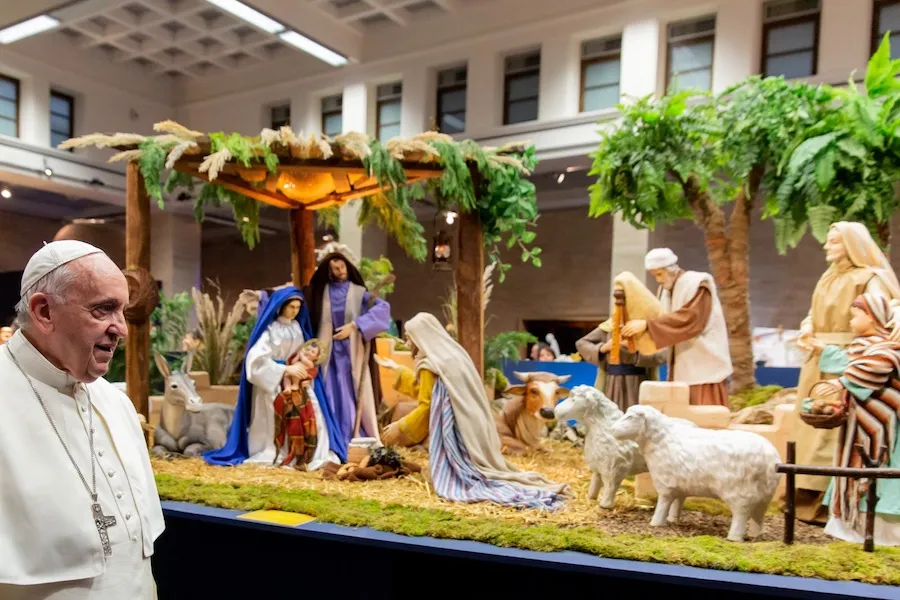
Pope Francis blesses nativity scenes near the Vatican Dec. 9, 2019. .
4.The first nativity scene was connected to the Eucharist. Describing the scene in Greccio that day, Pope Francis writes: “All those present experienced a new and indescribable joy in the presence of the Christmas scene. The priest then solemnly celebrated the Eucharist over the manger, showing the bond between the Incarnation of the Son of God and the Eucharist.” Unlike in nativity scenes today, the pope says, there were no statues. Instead, “the nativity scene was enacted and experienced by all who were present.”
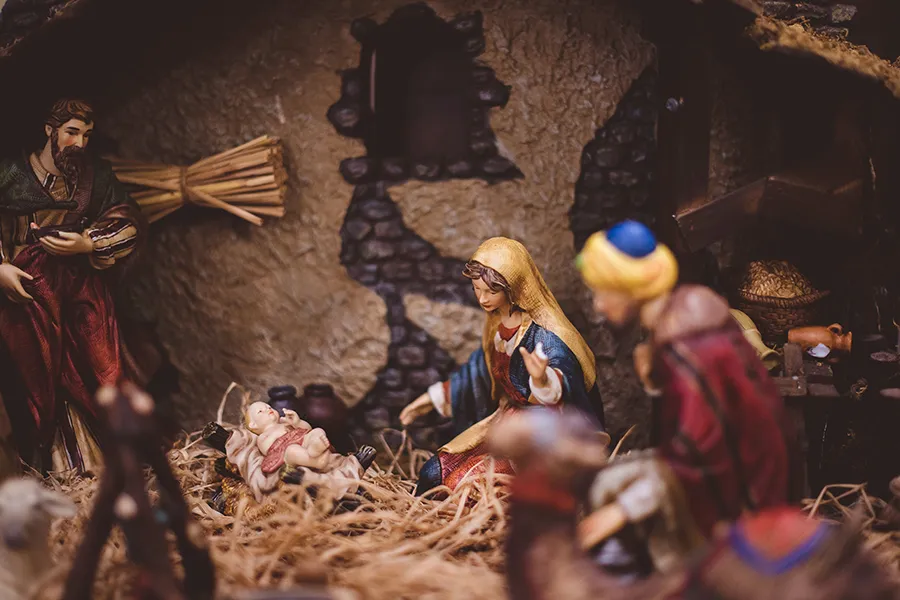
Nativity scene. . Ben White Photography via Unsplash.com.
5.The original nativity scene inspired a vision. The pope recalls that one of the witnesses to the first nativity scene saw “a marvelous vision.” Thomas of Celano, the first biographer of St. Francis, wrote that “one of those present saw the Baby Jesus himself lying in the manger.”
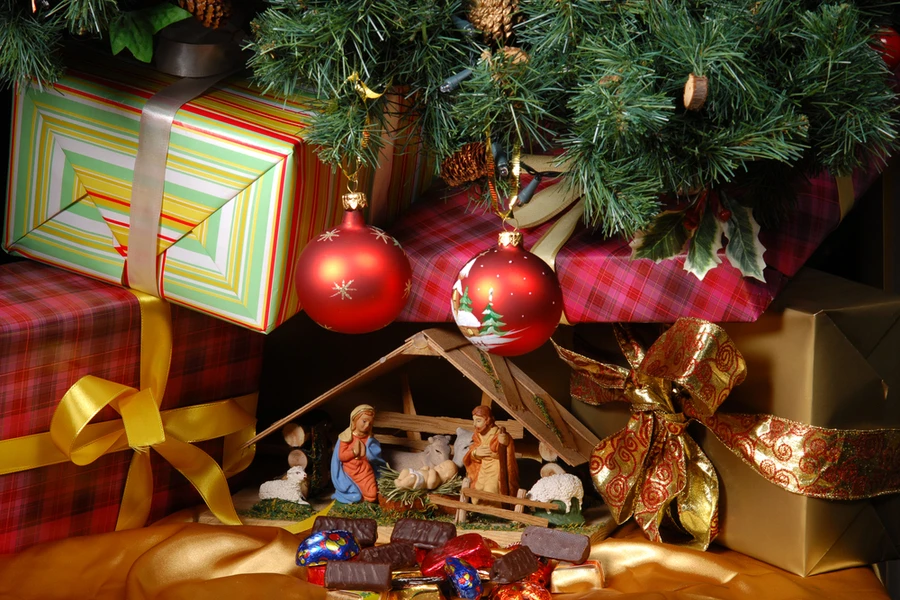
. fotorutkowscy / Shutterstock.
6.The nativity scene is a means of evangelization. The pope says that by creating the nativity scene, St. Francis “carried out a great work of evangelization” that continues to touch hearts to this day. The saint had discovered “a simple yet authentic means of portraying the beauty of our faith” that was accessible to all.
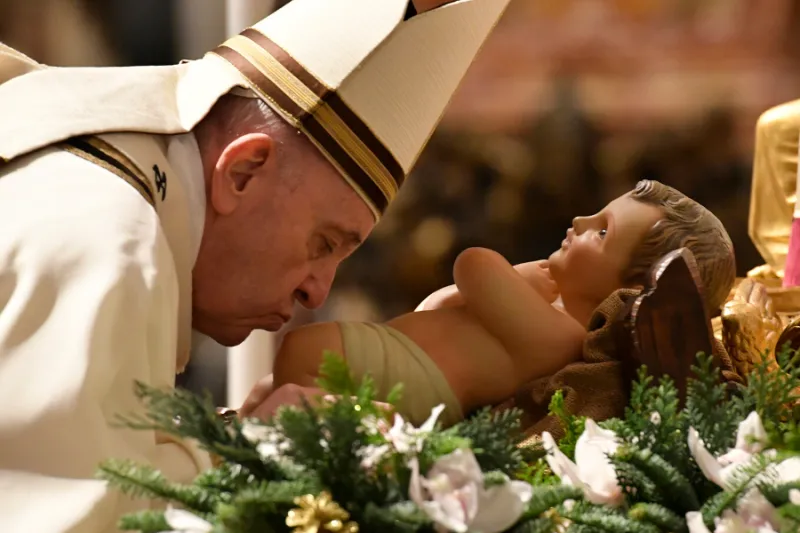
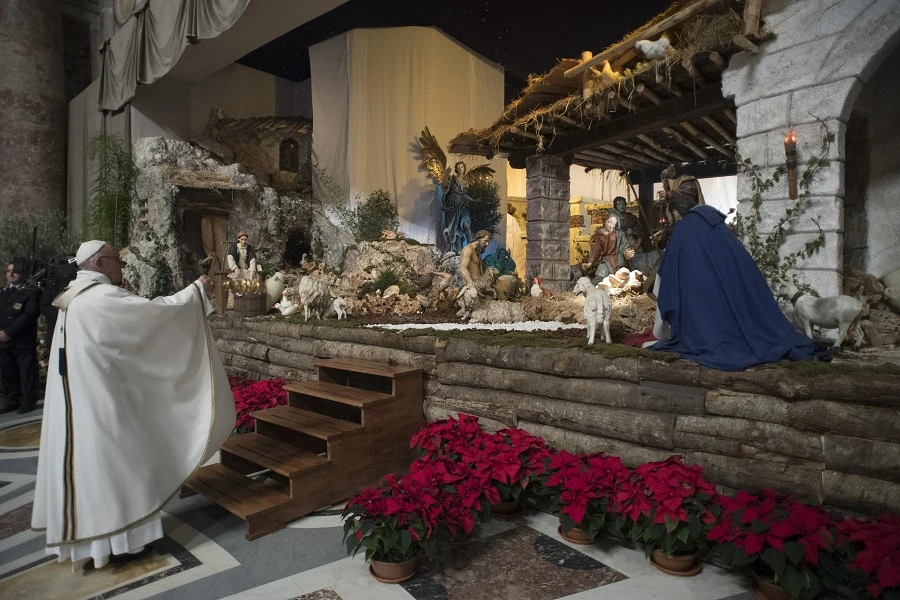
Pope Francis incenses the nativity scene in St. Peter’s Basilica Dec. 24, 2017. . Vatican Media.
7.The manger is a sign of God’s love. Pope Francis writes that nativity scenes resonate so deeply because they show God’s tender love. They proclaim that “the Creator of the universe lowered himself to take up our littleness.” They engage the senses and imagination, helping people “to ‘feel’ and ‘touch’ the poverty that God’s Son took upon himself in the Incarnation.”
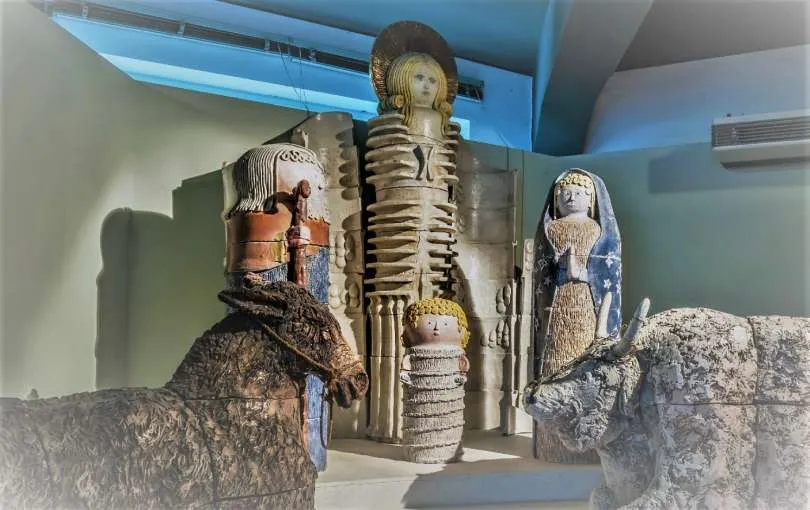
A detail from the monumental Nativity scene of the Castelli. . YouTube.
8.The nativity scene contains a call to service. The pope says that the Christmas crib contains an implicit message. “It summons us to follow him along the path of humility, poverty, and self-denial that leads from the manger of Bethlehem to the cross,” he writes. “It asks us to meet him and serve him by showing mercy to those of our brothers and sisters in greatest need.”
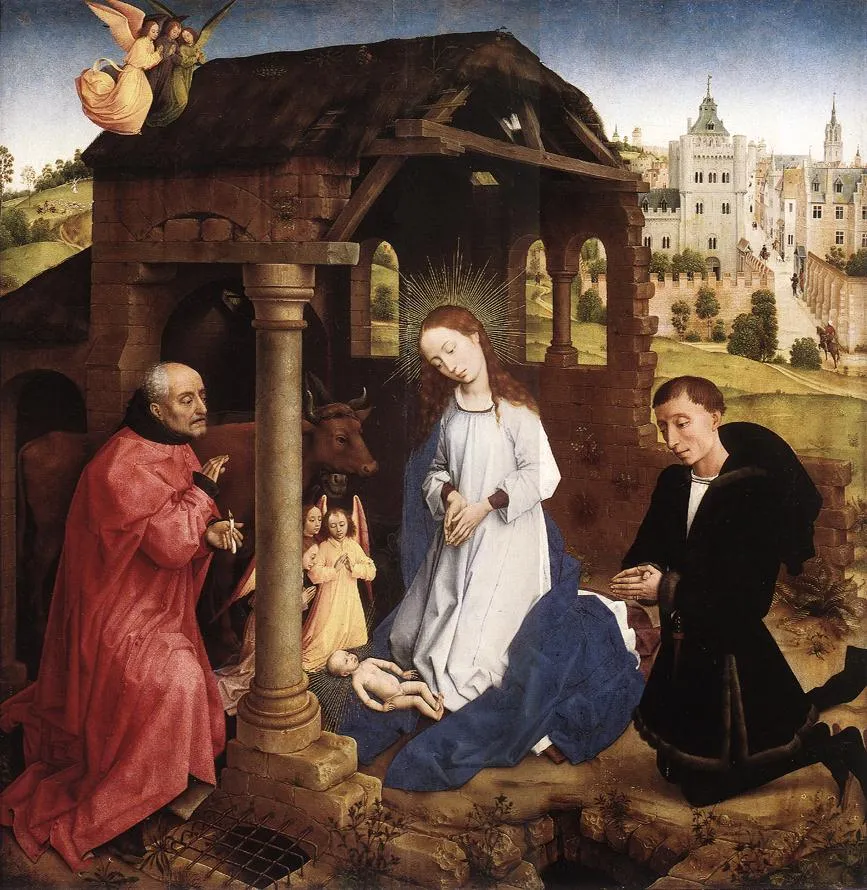
The Nativity, by Rogier van der Weyden, part of the Bladelin Altarpiece. Public Domain.
9.Even a nativity scene’s landscapes are meaningful. The pope notes that depictions of the Nativity often include “the ruins of ancient houses or buildings.” He writes: “More than anything, the ruins are the visible sign of fallen humanity, of everything that inevitably falls into ruin, decays, and disappoints. This scenic setting tells us that Jesus is newness in the midst of an aging world, that he has come to heal and rebuild, to restore the world and our lives to their original splendor.”
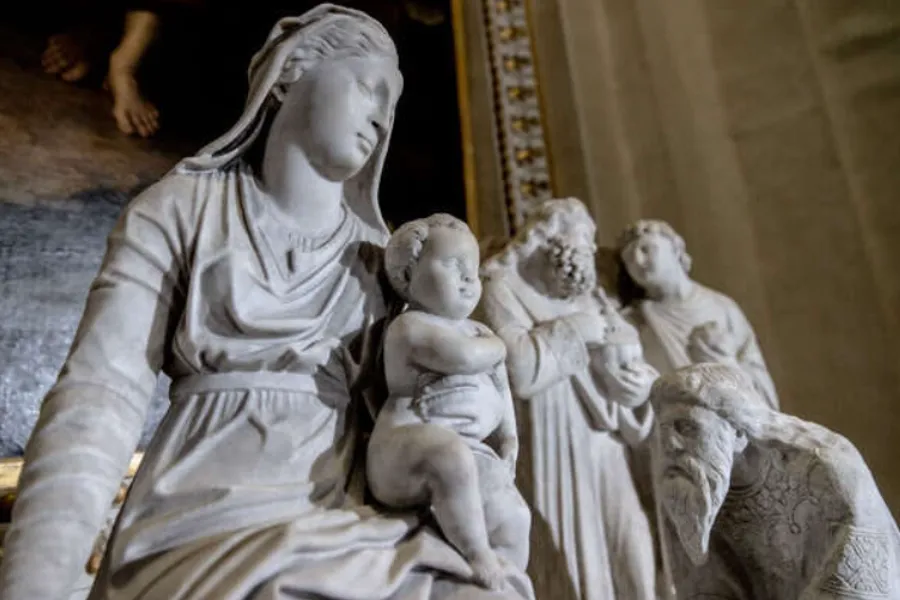
Courtney Mares.
10.Nativity scenes nourish devotion to Mary and Joseph. The pope observes that the Virgin Mary is shown as “a mother who contemplates her child and shows him to every visitor.” In her, “we see the Mother of God who does not keep her Son only to herself, but invites everyone to obey his word and to put it into practice.” St. Joseph stands at Mary’s side, protecting her and the Christ Child. The nativity scene reminds us that Joseph “entrusted himself always to God’s will, and put it into practice,” encouraging us to do the same.




Leave a Reply