Emergency crew members work at the scene after a bus accident near Venice on Oct. 3, 2023, in Mestre, Italy. / Credit: Stefano Mazzola/Getty Images
CNA Staff, Oct 6, 2023 / 10:20 am (CNA).
Pope Francis this week extended his condolences and prayers for the victims of a deadly bus crash in Venice, Italy, the Vatican said in a bulletin on Thursday.
The Holy See Press Office said in a release that the Holy Father had dispatched a “telegram of condolence” to those who had been affected by the Tuesday crash, which occurred when a bus ran off an overpass in the Venetian borough of Mestre.
Authorities reported that the bus broke out in flames after crashing. At least 21 people were reported dead by Friday morning, with nearly as many injured.
In the telegram, addressed to Patriarch of Venice Francesco Moraglia, Vatican Secretary of State Cardinal Pietro Parolin said that “having learned of the serious road accident that occurred in Mestre, in which several people lost their lives, including children,” Francis asked Moraglia “to convey his affectionate proximity to the families of those who died so tragically.”
The pope “assur[ed] them of a special prayer for their repose,” Parolin said, “and as he implores the consolation of faith for the relatives, he invokes from the Lord prompt healing for the injured and sends his heartfelt paternal apostolic blessing.”
The cause of the crash was as of Friday morning still unclear. Luca Zaia, the president of the Veneto region of Italy of which Venice is the capital, told the state-owned Radiotelevisione Italiana that it was “difficult to understand how it happened.”
“The bus was new and electric, and that street wasn’t particularly problematic,” Zaia told RAI.
The president said elsewhere that authorities were assuming the bus driver had “fallen ill” before the crash, according to Reuters.
The bus was reportedly carrying foreign tourists to a camping site.
If you value the news and views Catholic World Report provides, please consider donating to support our efforts. Your contribution will help us continue to make CWR available to all readers worldwide for free, without a subscription. Thank you for your generosity!
Click here for more information on donating to CWR. Click here to sign up for our newsletter.
Vatican City, Jul 3, 2018 / 04:51 am (CNA/EWTN News).- The Vatican announced Tuesday that Pope Francis has named three new auxiliary bishops for the Archdiocese of Chicago, appointing Fr. Ronald Hicks, Fr. Robert G. Casey and Fr. Mark Bartosic to the positions.
The July 3 announcement of the priests’ appointments coincided with the news that two of Chicago’s six current auxiliary bishops, George Rassas and Francis Kane, would be retiring. With Hicks, Casey and Bartosic, there will now be seven auxiliaries serving in the archdiocese.
Born in Chicago in 1967, Hicks has until now served as the archdiocese’s vicar general.
In 1985 he graduated from Quigley Seminary South, and obtained a bachelor’s degree in philosophy four years later from the University of Chicago. He also has a master of divinity degree and a doctor of ministry degree from the University of St. Mary of the the Lake in Mundelein.
Hicks was ordained a priest in 1994 for the Archdiocese of Chicago, after which he served in various pastoral roles throughout the diocese.
After a stint as dean of formation at St. Joseph College Seminary from 1999-2005, the bishop-elect received permission from his then-archbishop, the late Cardinal Francis George, to move to El Salvador, where he served a 5-year term as regional director of the Nuestros Pequeños Hermanos home for orphaned and abandoned children.
From 2010-2014 he served as dean of formation at Mundelein Seminary, while also helping with weekend Masses at St. Jerome Parish in Rogers Park. He was named vicar general for the archdiocese by the current archbishop, Cardinal Blase Cupich in 2015.
Casey, also a Chicago native, was born Sept. 23, 1967, and is currently serving as pastor of St. Bede the Venerable Church in Chicago.
After obtaining a bachelor’s degree in English from Niles College of Loyola University Chicago in 1989, Casey went on to pursue a master of divinity, which he received from the University of St. Mary of the Lake in Mundelein in 1994.
The bishop-elect was ordained a priest in 1994, after which he served as associate pastor of St. Ita parish in Edgewater until his 1998 appointment by Cardinal George as the part-time, associate director of Casa Jesus. In 1999, he was named the organization’s full-time director.
After a 40-day pilgrimage to Santiago de Compostela in Spain in 2003, Casey began serving as pastor of Our Lady of Tepeyac in the Little Village neighborhood of Chicago. In 2008, he co-founded the Taller de José ministry, which is sponsored by the Congregation of St. Joseph and provides accompaniment to those in need.
Casey then served in a number of other pastoral roles before being named to the Placement Board of the archdiocese, a role in which he helps assign priests to parishes.
The only non-Chicago native of the new appointments, Bartosic was born in Neehah, Wis., in 1961, and is currently serving as pastor of Assumption of the Blessed Virgin Mary Church in Chicago and as director and chaplain of the Kolbe House, Cook County Jail.
Raised in Ashland, Ohio, Bartosic obtained a bachelor’s degree in theater from Ashland University in 1983, and went on to earn a both a master of divinity degree and a licentiate degree in sacred theology from the University of St. Mary of the Lake.
He was ordained a priest for the Archdiocese of Chicago by Cardinal Joseph Bernardin in 1994, and has served in several pastoral roles since, including his position as chaplain of the Kolbe House jail ministry.
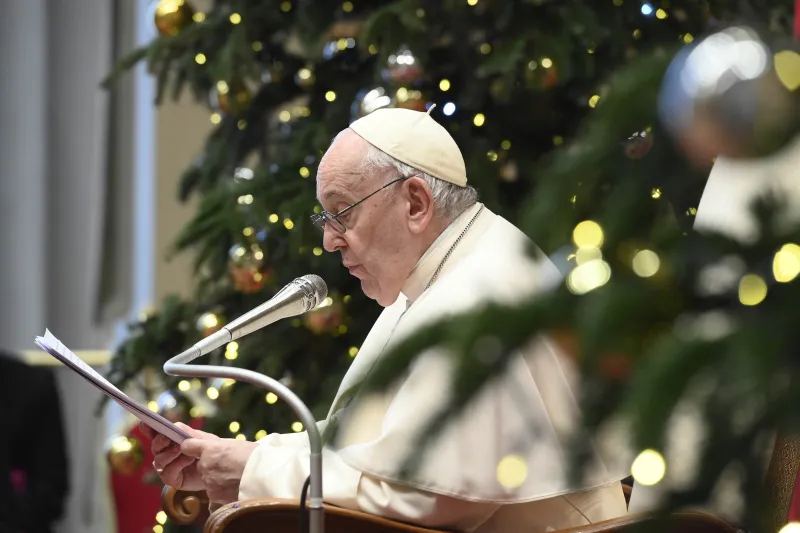
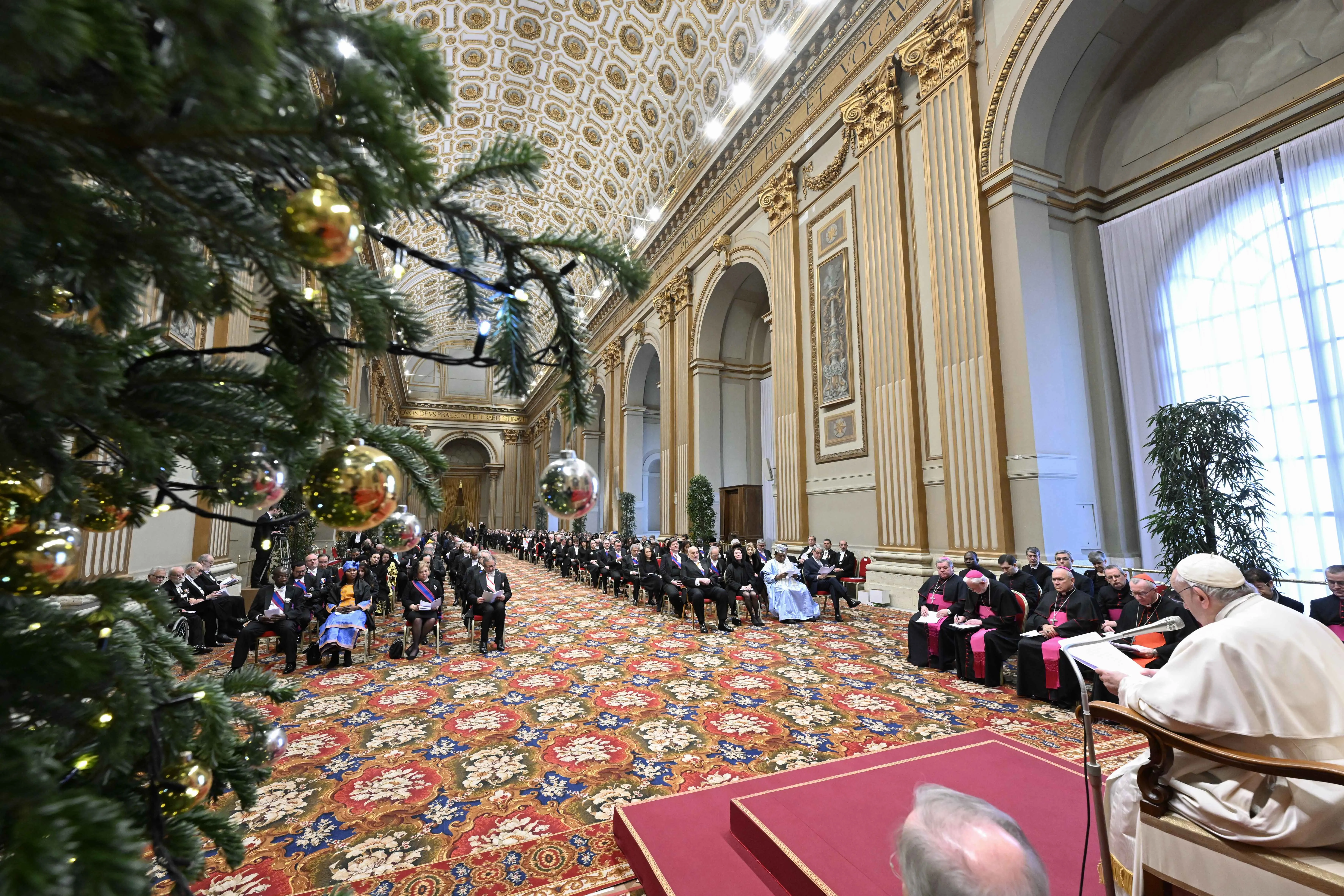
Pope Francis addresses international diplomats to the Holy See on Jan. 9, 2023, in the Vatican’s Blessing Hall. / Vatican Media
Rome Newsroom, Jan 9, 2023 / 06:28 am (CNA).
The global community is engaged in a “third world war” marked by heightened fear, conflict, and risk of nuclear violence, but a recommitment to “truth, justice, solidarity and freedom” can provide a pathway to peace, Pope Francis told international diplomats Monday.
Citing the ongoing war in Ukraine, but also drawing on conflicts in places such as Syria, West Africa, Ethiopia, Israel, Myanmar, and the Korean Peninsula, the Holy Father said this global struggle is being “fought piecemeal,” but is nonetheless interconnected.
“Today the third world war is taking place in a globalized world where conflicts involve only certain areas of the planet direct, but in fact involve them all,” said Pope Francis, speaking in the Vatican’s apostolic palace.
The pope made these remarks as part of his annual address to the diplomatic corps accredited to the Holy See. Pope Francis characterized this speech as “a call for peace in a world that is witnessing heightened divisions and war.”
Pope Francis addresses diplomats to the Holy See in the Blessing Hall at the Vatican on Jan. 9, 2023. Vatican Media
As part of this heightening of tensions, the Pope warned about the increased threat of nuclear warfare, drawing particular concern to the stall in negotiations for the Iran nuclear deal. He told the gathered diplomats that the possession of nuclear weapons is “immoral” and called for an end to a mentality that pursues conflict deterrence through the development of ever-more lethal means of warfare.
“There is a need to change this way of thinking and move toward an integral disarmament, since no peace is possible when instruments of death are proliferating,” the pope said.
In proposing a path towards global peace, the Holy Father drew heavily from Pacem in Terris (“Peace on Earth”), the papal encyclical promulgated by St. John XXIII in 1962. Pope Francis said the conditions which prompted the “good Pope” to issue Pacem in Terris 60 years ago bear a striking similarity to the state of the world today.
In particular, the Holy Father drew from what John XXIII described as the “four fundamental goods” necessary for peace: truth, justice, solidarity, and freedom, values that “serve as the pillars that regulate relationships between individuals and political communities alike.”
Regarding “peace in truth,” the Holy Father underscored the “primary duty” of governments to protect the right to life at every stage of human life.
“Peace requires before all else the defense of life, a good that today is jeopardized not only by conflicts, hunger, and diseases, but all too often in the mother’s womb, through promotion of an alleged ‘right to abortion,’” said Pope Francis, also calling for an end to the death penalty and violence against women.
Speaking of the necessity of religious freedom for peace, the Holy Father noted widespread religious persecution against Christian minorities, but also discrimination in countries where Christianity is a majority religion.
“Religious freedom is also endangered wherever believers see their ability to express their convictions in the life of society restricted in the name of a misguided understanding of inclusiveness,” he said.
Regarding justice, the Holy Father called for a “profound rethinking” of multilateral systems such as the United Nations to make them more effective at responding to conflicts like the war in Ukraine. But he also criticized international bodies for “imposing forms of ideological colonization, especially on poorer countries” and warned of the growing risk of “ideological totalitarianism” that promotes intolerance towards those who dissent from certain positions claimed to represent ‘progress.’”
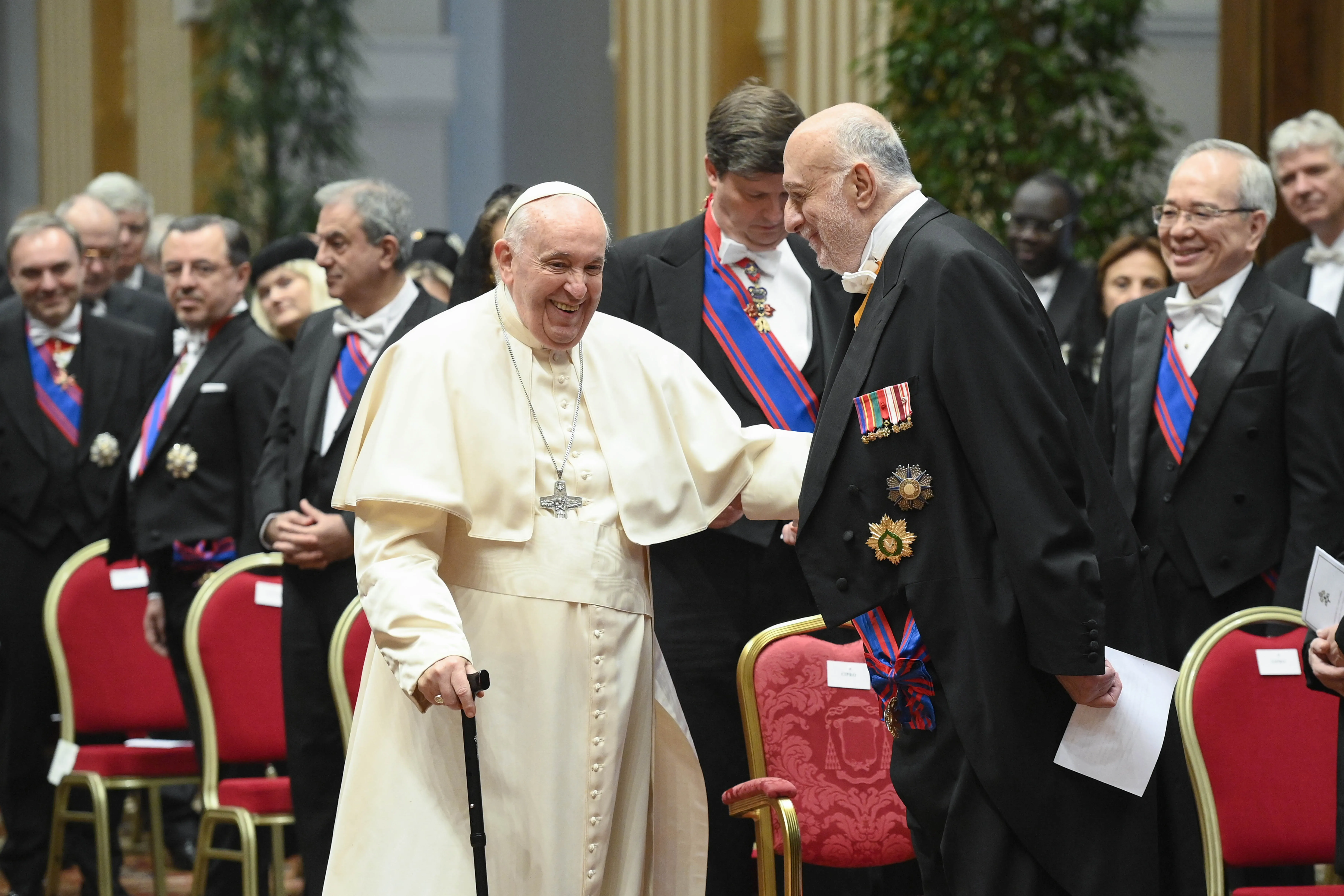
Pope Francis visits with international diplomats accredited to the Holy See on Jan. 9, 2023, at the Vatican. Vatican Media
The Holy Father also spoke of the need to deepen a sense of global solidarity, citing four areas of interconnectedness: immigration, the economy and work, and care for creation,
“The paths of peace are paths of solidarity, for no one can be saved alone. We live in a world interconnected that, in the end, the actions of each have consequences for all.”
Finally, regarding “peace in freedom,” Pope Francis warned of the “weakening of democracy” in many parts of the world, and an increase in political polarization. He said peace is only possible if “in every single community, there does not prevail that culture of oppression and aggression in which our neighbor is regarded as an enemy to attack, rather than a brother or sister to welcome and embrace.”
The Holy Father’s address to the diplomatic corps, which includes representatives of the 91 countries and entities with an embassy chancellery accredited to the Holy See, also served as an opportunity to review diplomatic highlights of the past year and expectations for the year to come.
Milestones included the signing of new bilateral accords with both the Democratic Republic of São Tomé and Príncipe and with the Republic of Kazakhstan. The Holy Father also briefly mentioned the provisional agreement between the Holy See and the People’s Republic of China, first agreed to in 2018 and renewed in 2022 for an additional two years.
“It is my hope that this collaborative relationship can increase, for the benefit of the life of the Catholic Church and that of the Chinese people.”
The next significant marker on the pope’s diplomatic docket: His trip to the Democratic Republic of Congo at the end of the month as a “pilgrim of peace,” followed by a joint visit to South Sudan with the Archbishop of Canterbury and the head of the Presbyterian Church of Scotland.




Leave a Reply