


Washington, D.C. Newsroom, Aug 22, 2023 / 09:40 am (CNA).
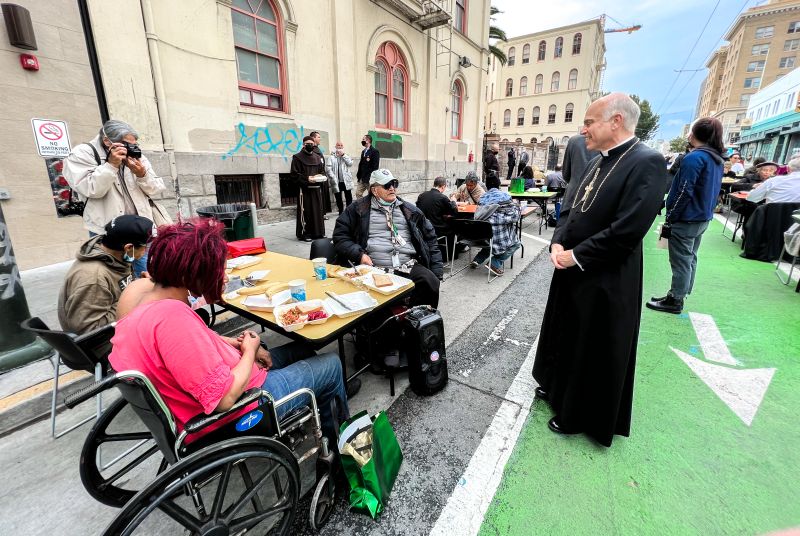
San Francisco Archbishop Salvatore Cordileone on Monday announced that the archdiocese would be submitting a Chapter 11 bankruptcy filing, a development the prelate had earlier warned might come about as a result of numerous abuse filings against the bishopric.
Cordileone earlier in August had warned that the filing was “very likely” in response to the “more than 500 civil lawsuits” alleging clerical sexual abuse filed against the archdiocese.
A Chapter 11 filing, the archbishop said at the time, would allow the archdiocese to deal with those cases “collectively rather than one at a time,” resulting in both a “faster resolution” of the crisis as well as “fair compensation” for the victims.
In an announcement posted on the archdiocese’s website, Cordileone said that “after much reflection, prayer, and consultation with our financial and legal advisers,” the archdiocese has “filed for Chapter 11 bankruptcy reorganization.”
“We believe the bankruptcy process is the best way to provide a compassionate and equitable solution for survivors of abuse,” the archbishop said, “while ensuring that we continue the vital ministries to the faithful and to the communities that rely on our services and charity.”
The prelate noted that San Francisco is one of a growing number of dioceses and archdioceses filing for Chapter 11 as a way to address abuse lawsuits. At least 13 dioceses are currently engaged in bankruptcy proceedings, while 18 have emerged from it.
Cordileone said only the “legal entity” of the archdiocese itself would be covered by the bankruptcy filings. “Our parishes, schools, and other entities are not included in the filing,” he said. “Our mission will continue as it always has.”
The archbishop said offertory funds from individual parishes, as well as funds raised during annual appeals, would not be used to cover the costs of the settlements. “[T]hese funds, which you so generously donate, are collected for use by the stated ministries, which exclude legal settlements or related expenses,” he said.
Cordileone noted that the “great majority” of abuse claims occurred “many decades ago,” with most of them involving “priests who are deceased or no longer in ministry.”
The archbishop urged the faithful to “join together on a daily basis in praying the rosary, spending an hour each week in adoration before the Blessed Sacrament, and fasting on Fridays for the survivors of abuse, for the mission of our archdiocese, and for the eradication of this shameful crime from our society as a whole.”
Among the other U.S. dioceses that have filed for bankruptcy this year include Oakland; Ogdensburg, New York; and Albany, New York.
The San Francisco Archdiocese covers about 2,300 miles of area in northern California; it lists about 440,000 Catholics in its boundaries.
If you value the news and views Catholic World Report provides, please consider donating to support our efforts. Your contribution will help us continue to make CWR available to all readers worldwide for free, without a subscription. Thank you for your generosity!
Click here for more information on donating to CWR. Click here to sign up for our newsletter.


No closure without disclosure.
Until every person credibly accused is known, this injustice will drag on. Everyone, especially the victims, need maximum transparency. Chapter 11 should not be used to hide anything. If most the 500+ are long gone, why not release their names? How the we assume good with the overwhelming evidence of cover-ups over the decades.
Precision…The “500” refers to filed lawsuits, not to the perpetrators of a lesser number. The names of the 500 plaintiffs need not be disclosed, and many or most or all would not want it, whether “long gone” or not.
Many of the Catholic dioceses in the United States have published the names of priests whom they consider to be credibly accused. If you search for “credibly accused” and the name of the diocese, you often get the results you seek on the diocesan website Sometimes, a search engine will return results found on the website of the law firm representing the plaintiffs in these cases.
List of Accused Priests in the Archdiocese of San Francisco
SF Archdiocese Files for Bankruptcy Amid Child Sexual Abuse Scandals
Olga R. Rodriguez
The Associated Press
Aug 21, 2023
Excerpt:
The Archdiocese of San Francisco is the only diocese in California yet to release a list of clergy credibly accused of child sexual abuse, Anderson said.
Cordileone said in his statement that a list of priests and deacons who are in good standing can be found on the Archdiocese website. He said those under investigation for alleged child sexual abuse are prohibited from exercising public ministry and are removed from the list.
Excellent comment, God’s Fool! You are so very correct.
The clergy sexual misconduct is mainly and majority homosexual predation not pedophilia predation. Why can’t the bishops declare that fact and distinction? Why?