Bishop Neil Tiedemann, who was appointed Auxiliary Bishop of Brooklyn April 29, 2016. / Passionist Province of St. Paul of the Cross.
Boston, Mass., Jun 30, 2023 / 09:54 am (CNA).
Pope Francis has accepted the resignation of Brooklyn Auxiliary Bishop Neil Tiedemann, who recently turned 75, the mandatory age for bishops to submit a letter offering to step down from their ecclesiastical office.
Tiedemann served as auxiliary bishop in the diocese since 2016, after he was appointed to the position by Pope Benedict XVI.
“I am grateful for Bishop Tiedemann’s many years of dedicated service here in Brooklyn and Queens,” Brooklyn Bishop Robert Brennan said in a statement released by the diocese on Friday.
“Bishop Tiedemann has had extraordinary experience beyond the boundaries of our diocese and therefore was able to enrich us with his knowledge, passion, and dedication to the Church and its people,” he said.
Prior to his service in Brooklyn, Tiedemann was the bishop of Mandeville, Jamaica — a position to which Pope Benedict XVI also appointed him. Tiedmann held that office for eight years.
A member of the Passionists, Tiedemann was ordained to the priesthood on May 16, 1975, in the Brooklyn Diocese.
He served as parochial vicar at Immaculate Conception Parish in Jamaica, Queens, for his first assignment from 1975–1982. He also served at St. Joseph Catholic Church in Union City, New Jersey, and Blessed Sacrament in Springfield, Massachusetts, both parishes with large Hispanic presences.
During his time ministering in Tegucigalpa, Honduras, Tiedemann helped establish an AIDS hospice called Casa Pasionista.
From 1998–2005 he served at Visitation of the Blessed Virgin Mary Church in the Red Hook neighborhood of Brooklyn, where both his grandparents and great grandparents were married.
Tiedemann was elected to the provincial council of the Passionists in 2006.
In the statement from the diocese on Friday, Tiedemann said: “Throughout my priesthood, I have been blessed, and I am so grateful.”
“I thank Bishops [Nicholas] DiMarzio and [Robert] Brennan for their kindness, support, and encouragement,” he said.
“Of my 48 years as a priest, I have spent 21 here in the Brooklyn Diocese. I am thankful to my brother priests for their friendship. Most importantly, I have been blessed by the wonderful people of our diocese,” he said.
“They make you the priest that you are because they encourage and strengthen you. They teach you so much about life and actually become the face of God in your life,” he said.
If you value the news and views Catholic World Report provides, please consider donating to support our efforts. Your contribution will help us continue to make CWR available to all readers worldwide for free, without a subscription. Thank you for your generosity!
Click here for more information on donating to CWR. Click here to sign up for our newsletter.
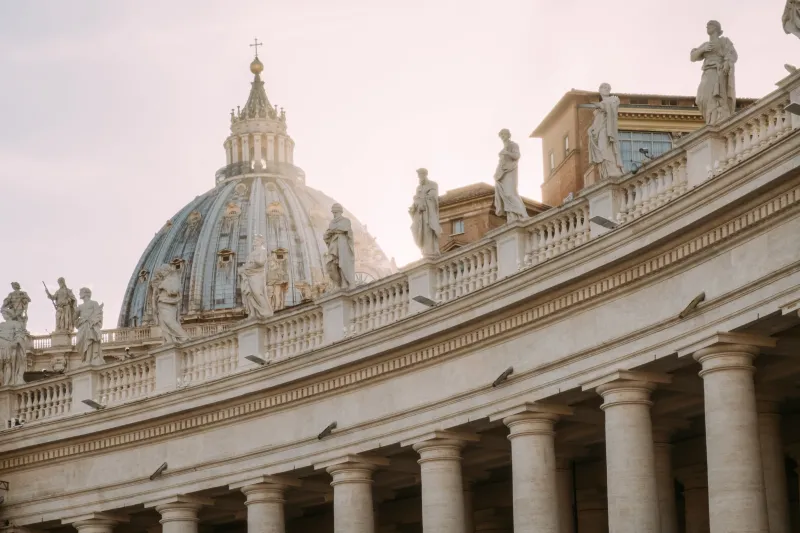
St. Peter’s Basilica / Simone Savoldi / Unsplash (CC0)
Rome Newsroom, Oct 2, 2022 / 03:00 am (CNA).
The world’s newest bishops gathered in Rome last month to learn more about what it means to be a Catholic bishop.
While the week’s presentations spanned a range of topics, three U.S. bishops who attended told CNA that synodality emerged as a key theme.
The Vatican’s annual formation course, sometimes known by the nickname “baby bishop school,” was canceled for two years because of the COVID-19 pandemic — making the 2022 edition the largest yet, with approximately 330 participating bishops across two sessions.
“People kind of picture baby bishop school as nuts and bolts, like ‘how to be a bishop.’ It’s not that at all,” Bishop Erik Pohlmeier of the Diocese of St. Augustine, Florida, told CNA at the end of the course.
“It’s kind of whatever the Church is talking about at that time, bringing that to the bishops that are coming on board,” he said. “The synodal process has been … a hallmark of conversation for the last couple of years, so now as we’re new bishops … the reflections revolved around that.”
The seminar’s first session was primarily attended by bishops consecrated in 2019 and 2020, while the second session was mostly those who joined the ranks in 2021 and the first part of 2022.
Thirty-nine U.S. bishops and auxiliary bishops attended, divided between the two weeks.
Pohlmeier was the freshest U.S. bishop to join. He was ordained a bishop on July 22 — just two days after his 51st birthday and seven weeks before arriving in Rome for the Sept. 12–19 course.
Speaking to CNA in Rome on Sept. 19, Pohlmeier said that as a new bishop, there are many things you do not know, but that’s where one’s fellow bishops come in.
“Every bishop knows other bishops,” he explained, like the bishop of the diocese where they served as a priest. “And they’re always, I mean to a person, helpful.”
Bishop Gregory Gordon, the first-ever auxiliary bishop of Las Vegas, Nevada, told CNA on Sept. 19 that the U.S. bishops’ conference also organizes meetings between bishops of the same ordination year, or “class,” as a way to build fraternity and create a network of support.
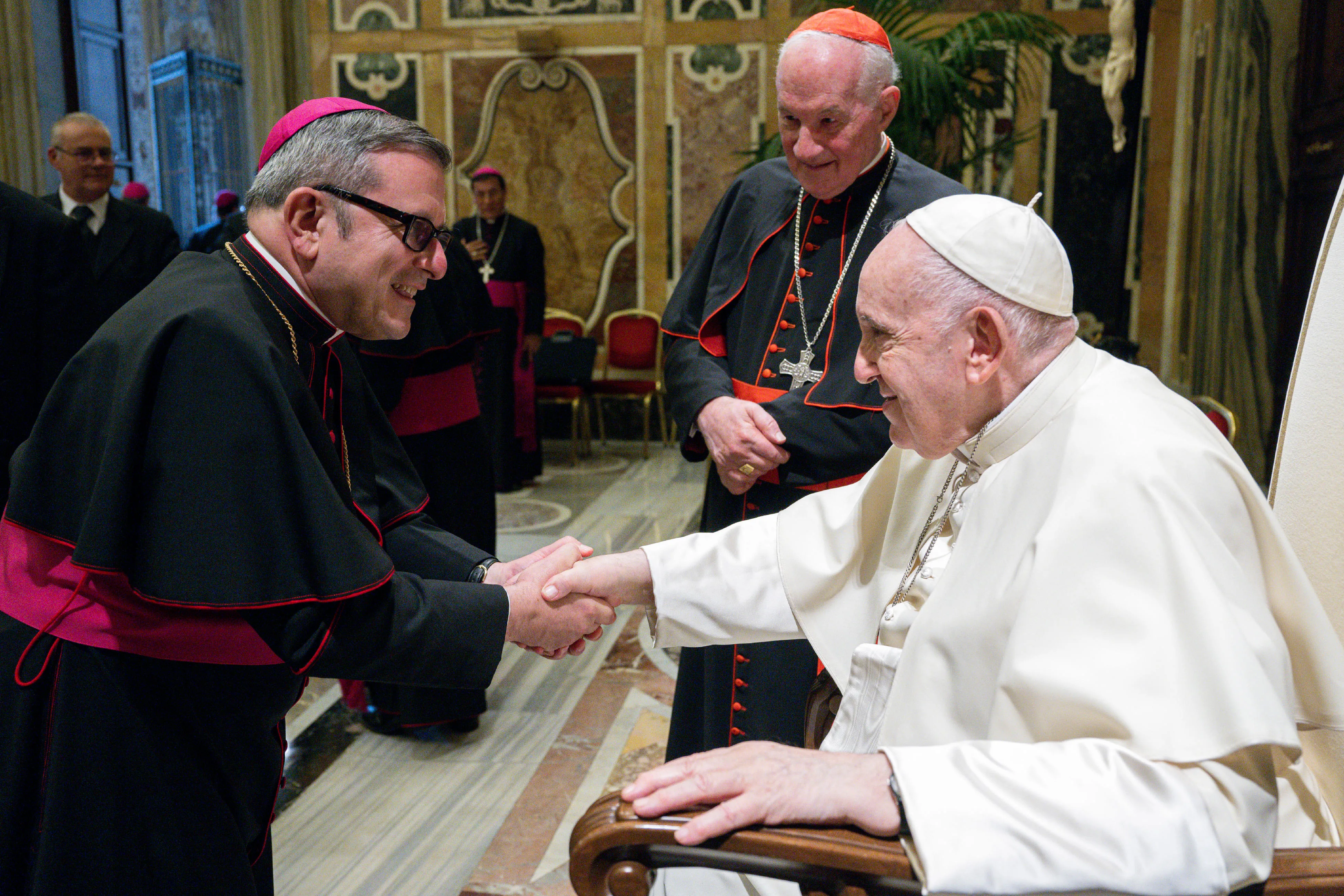
Bishop Gregory Gordon greets Pope Francis at the end of the course Sept. 19, 2022. Vatican Media
While the formal theme of this year’s seminar was how to announce the Gospel in changing times, Pohlmeier, Gordon, and Bishop Louis Tylka of Peoria, Illinois, said the unofficial topic of the week was synodality.
What they talked about
“We’re in the midst of the synod,” Tylka, who attended the seminar Sept. 1–8, told CNA by phone from his diocese. So the course, he added, focused on questions such as: “What does it mean to be a synodal Church? What is the ministry of the bishop in relation to that?”
Care for the planet and one’s neighbor, themes important to Pope Francis’ pontificate, were also a major part of the seminar, Tylka said.
The week’s presentations also covered child protection and the sexual abuse crisis.
“That’s one of those things that I think we will take home, saying we will be very, very careful not to neglect,” Gordon said.
Some talks, Pohlmeier noted, were directly about synodality and what it means. At the same time, those of a more practical nature, such as canon law for bishops, “would always include some comment on the synodal approach.”
“You’re going to get different articulations of what that means depending on who you talk to, but in general, my understanding is that it is more of a listening posture,” the St. Augustine bishop said.
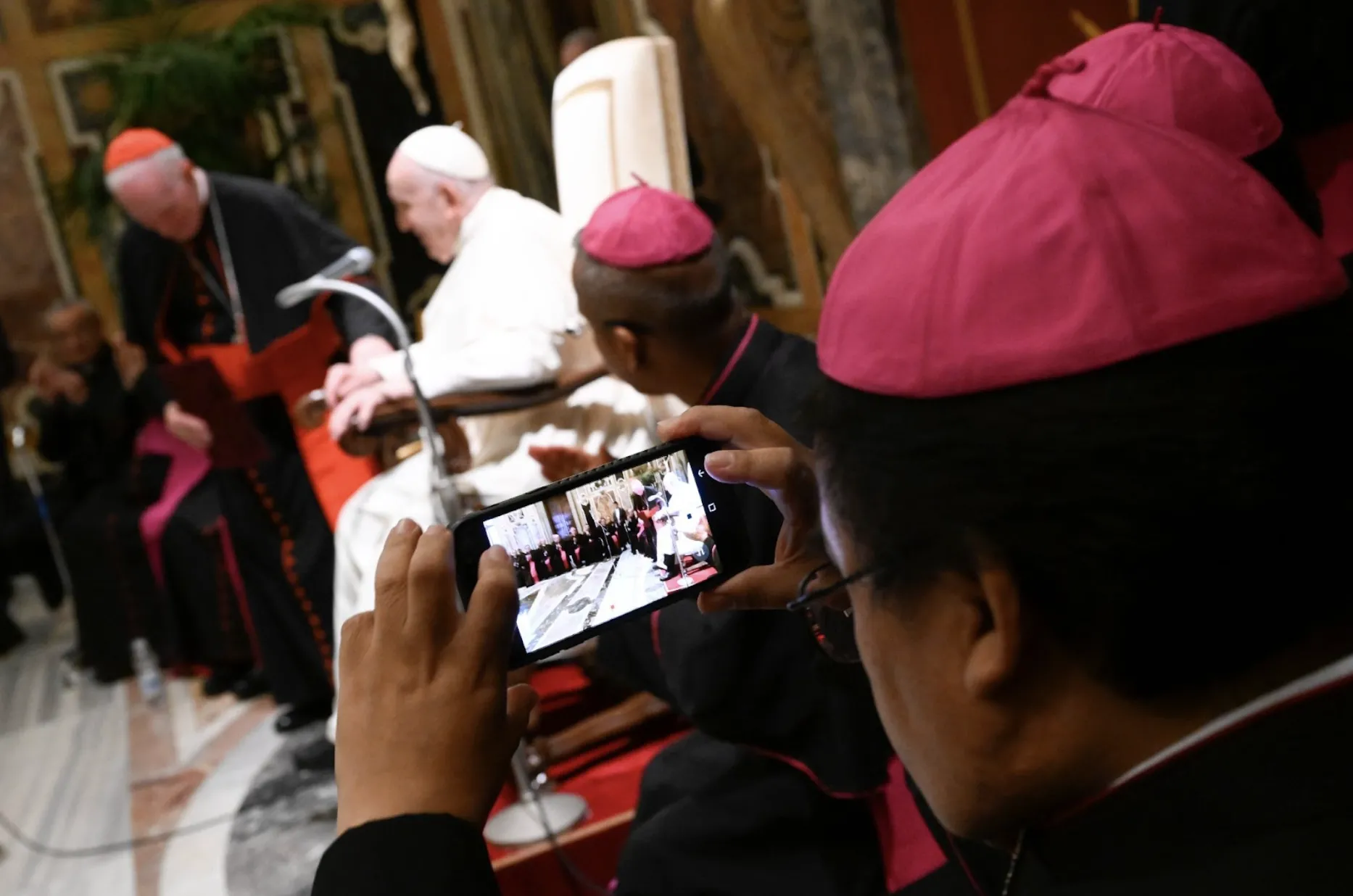
A bishop takes a photo of Pope Francis during their encounter on Sept. 19, 2022. Vatican Media
Bishop Gordon said Pope Francis himself modeled this listening attitude in their meeting with him on the final day of formation.
In the nearly two-hour meeting, he said most of the time was spent with the pope answering the bishops’ questions. “So you finished the course, [the pope] said. You’ve heard a lot already… Now I want to hear from you.”
This was Gordon’s big takeaway from the week: “It has to go back to the Holy Father’s words to us as he was answering our own questions, you know, asking us to exercise that episcopal closeness.”
The week also included time for communal prayer, Mass, adoration, and confession.
Bishop Tylka of Peoria said his personal opinion is that “a big part of synodality is the willingness and openness to create space for people to share their stories, to share their own encounters with Christ, to share their own experiences of how life is going.”
“So I think the role of the bishop clearly is to model that openness and that willingness to engage in dialogue,” he said.
This was my small group for discussion on Synodality! What an amazing group of bishops from around the world. Such a rich discussion on the Church! pic.twitter.com/fIOPLXwnfo
But there is also a lighter side to being a new bishop, as Pohlmeier evidenced with an amusing scene from the end of the week.
“Here we are, brand new and so … we got instructions on what we’re supposed to wear to meet the pope,” Pohlmeier said.
He explained that bishops in the Latin Church have two main styles of a full-length garment called a cassock. The new bishops were told to meet the pope. They should wear a black cassock with red trim, a purple fascia, and a purple zucchetto. (There is also a purple cassock with red trim for special liturgical events.)
Pohlmeier said it was funny to watch the bishops get ready for Mass in St. Peter’s Basilica and, afterward, the meeting with Pope Francis. Many of them were helping each other figure out where each piece of the complicated attire went — including the tall headpiece, called a mitre, which bishops wear to denote their office.
Today I joined the celebration in St Peter’s for the beatification of Blessed John Paul I. The rain did not dampen the joy of lifting up the ‘Smiling Pope.’ Humbled to be with the universal Church for such a celebration. pic.twitter.com/08AtzMUlMd
“Guys are literally opening up bags that haven’t been opened with miters from right there, from Euroclero,” Pohlmeier said, pointing over his shoulder in the direction of a clerical supply store next to St. Peter’s Square.
“You could see everybody that bought one this morning because they all matched,” he chuckled. “There were several people that were literally opening it up and pulling it out of the package and trying to get it on straight, and get things attached right, and not sure what clips go where and what’s right.”
“Those kinds of things are funny,” Pohlmeier said, “but nobody just tells you, ‘OK, buy this stuff, here’s what you need.’”
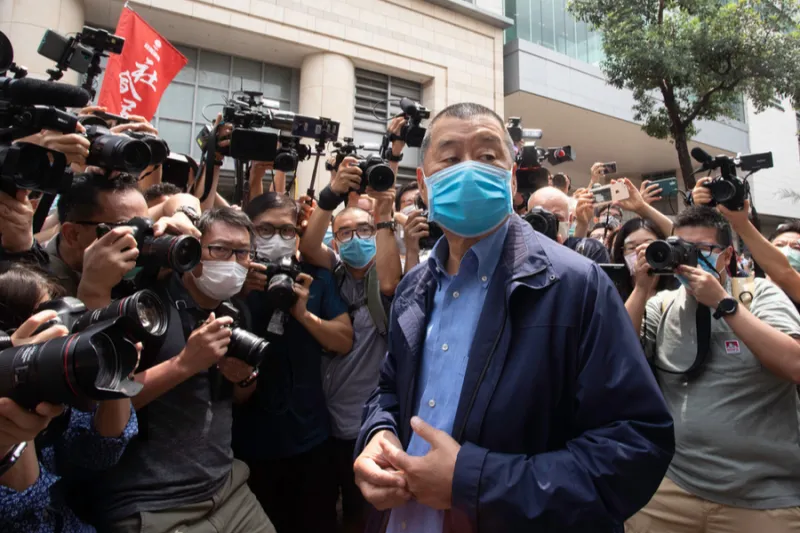
Hong Kong.Hong Kong media tycoon and founder of Apple Daily newspaper Jimmy Lai Chee Ying arrives at the West Kowloon Magistrates’ Court, May 18, 2020. / Yung Chi Wai Derek/Shutterstock
Washington D.C., Sep 14, 2021 / 16:01 pm (CNA).
A Catholic democracy advocate was honored in absentia on Tuesday at a Catholic gathering in Washington, D.C., while he remains imprisoned in Hong Kong.
Jimmy Lai, a media entrepreneur and Catholic pro-democracy advocate in Hong Kong, was given the Christifidelis Laici award on Sept. 14 by organizers of the National Catholic Prayer Breakfast. The award is named for Pope John Paul II’s 1988 exhortation on the mission of the laity in the world.
Lai “believed that we are created for truth and that it is our job to speak the truth,” said William McGurn, a member of the Wall Street Journal editorial board who accepted the award on Lai’s behalf on Tuesday. “His publications told the truth about China & Hong Kong.”
“He is a man of extraordinary means, serving ordinary men and women longing for freedom,” said Joseph Cella, a board member of the National Catholic Prayer Breakfast.
Lai has been imprisoned for 10 months in Hong Kong, having long supported the pro-democracy movement there and having cited his Catholic faith in support of his efforts.
An entrepreneur, he founded both Next magazine, a Chinese weekly publication, and Apple Daily, a pro-democracy publication critical of the Chinese mainland government. Apple Daily shut down publication earlier this summer, after its accounts were frozen and top leadership was arrested.
In 1997, he converted to Catholicism and was baptized by the now-retired bishop of Hong Kong, Joseph Cardinal Zen.
Lai’s conversion, at the time the United Kingdom handed over sovereignty of Hong Kong to the People’s Republic of China, was “like a small green shoot breaking through the concrete,” McGurn said of the time.
Hong Kong had previously maintained its own legislature and democratic form of government under the “one country, two systems” agreement, as the U.K. prepared to hand sovereignty of the region to China. However, the Chinese mainland government had sought greater control over Hong Kong in recent years before imposing a sweeping national security law on the region in 2020, bypassing the island’s legislature. The act followed months of pro-democracy protests in Hong Kong.
Under the new law, a person convicted of secession, subversion, terrorism or collusion with foreign forces would receive a minimum of 10 years in prison, with the possibility of a life sentence.
Lai was arrested in August 2020 over his support for pro-democracy protests in Hong Kong, and remained on the island to face his charges. People had urged Lai – who is also a British citizen – to leave Hong Kong before he would be arrested, McGurn noted.
“If you thought that [leaving] was ever a possibility, you don’t know Jimmy Lai,” McGurn said.
Released on bail, he was arrested again later in the year, and was charged in December with breaching the terms of a lease for his company, Next Digital Media.
Hong Kong’s Court of Final Appeal on Feb. 9 denied Lai bail, but allowed his legal team the possibility of applying again for bail. He has remained in prison for 10 months.
During his prison term, he has applied the Rule of St. Benedict – “ora et labora,” or “prayer and work,” McGurn noted.
“When he’s not reading the classics of the faith,” McGurn said of Lai, “he has a job folding paper into envelopes.” Some fellow prisoners have even been baptized during his term, McGurn said.
“While Jimmy may be stuck in prison, his soul remains free,” he said.
Archbishop Domenico Battaglia of Naples, Italy. / Vincenzo Amoruso via Wikimedia (CC BY-SA 4.0).
Rome Newsroom, Oct 12, 2021 / 06:17 am (CNA).
The archbishop of the Italian city of Naples responded on Tuesday to a spate of deadly violence with a… […]



Leave a Reply