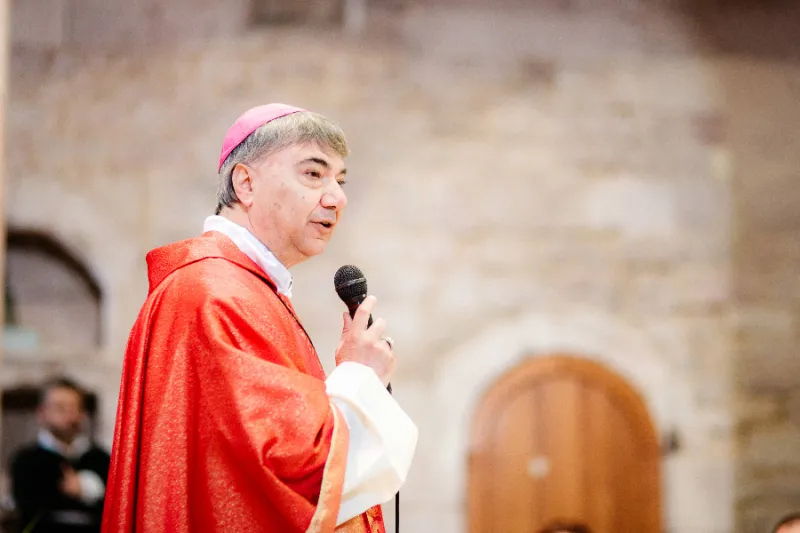
Archbishop Domenico Battaglia of Naples, Italy. / Vincenzo Amoruso via Wikimedia (CC BY-SA 4.0).
Rome Newsroom, Oct 12, 2021 / 06:17 am (CNA).
The archbishop of the Italian city of Naples responded on Tuesday to a spate of deadly violence with an appeal for members of organized crime groups to “be converted.”
“They are killing Naples! The trail of blood that is crossing the city these days, causing death to young lives and terror and anguish to entire neighborhoods, streets, families, cannot leave us indifferent,” Archbishop Domenico Battaglia said in an Oct. 12 statement on the archdiocesan website.
His appeal followed the Oct. 9 murder of a 19-year-old man. Police are investigating the man’s connections to the Camorra, a Naples-based criminal organization. A 23-year-old man was also killed last week.
Over the weekend, armed robbers entered a pizzeria in a Naples suburb, pointing guns at families eating dinner, including young children.
In his message, Battaglia addressed members of the Camorra and others connected with crime.
“I say: go back to being human! Be converted!” he said. “Your bishop will not hold back in welcoming and accompanying the steps of conversion and the human rebirth of those who will listen to their conscience and the word of the Gospel, laying down their weapons, and undertaking paths of collaboration with justice.”
The 58-year-old Battaglia became archbishop of Naples in December 2020. Prior to the appointment, he was a parish priest in another southern Italian archdiocese, Catanzaro-Squillace, where he was called “Don Mimmo” and known as a “street priest” who cared for the marginalized.
Battaglia said this week that he and a group of young adults from the archdiocese would visit the Ponticelli district of Naples, one of the areas most affected by the Camorra’s recent escalation of violence.
“They are killing Naples!” he reiterated. “The Camorra and the underworld are killing it, with the violence and cruelty of those who have forgotten that they are human.”
He added that people’s indifference and a failure to take a stand against the violence were also destroying the city.
“Under the cross of our city, we must today more than ever, together and without distinction of faith, politics, social and institutional role, stand up, avoid lying on our backs waiting for something to change by itself and sitting, hardened and resigned to seeing Naples die,” he said.
Addressing the mothers of Naples, especially those living in difficult neighborhoods and family situations, he said: “Be an instrument of conversion for your children, help your families to repent, be once again the womb that generates life and not accomplices of death paths.”
Battaglia will hold a meeting on Oct. 13 with members of civil society, the private sector, and the Catholic Church to work on an educational initiative for Naples.
“The kids and young people of Naples cannot be passive recipients of change but must become its protagonists,” he said.
“To all institutions, to civil society, to men and women of goodwill, to my Neapolitan Church, I ask today more than ever to walk together, overcoming individualism and mistrust, working together to restore Naples to its vocation as a city of peace, welcome, solidarity.”
If you value the news and views Catholic World Report provides, please consider donating to support our efforts. Your contribution will help us continue to make CWR available to all readers worldwide for free, without a subscription. Thank you for your generosity!
Click here for more information on donating to CWR. Click here to sign up for our newsletter.
Pope Benedict XVI arrives in St. Peter’s Square in the Vatican for the Oct. 21, 2012, canonization ceremony for Jacques Berthieu, Pedro Calungsod, Giovanni Battista Piamarta, Maria Carmen Salles y Barangueras, Marianne Cope, Caterina (Kateri) Tekakwitha, and Anna Schaffer. / Photo by Franco Origlia/Getty Images
Washington, D.C. Newsroom, Jan 2, 2023 / 14:00 pm (CNA).
During his pontificate, Pope Benedict XVI beatified 870 people and canonized a total of 45 saints. Though his papacy was relatively short, spanning from 2005 to 2013, the 45 people whom he declared saints are models of faith and holiness, celebrated by Catholics all over the world.
Here are seven of the best-known saints Pope Benedict XVI canonized:
St. Kateri Tekakwitha
St. Kateri Tekakwitha, or “Lily of the Mohawks,” was the first Native American saint to be canonized. Born in what is today New York state, she was the daughter of a Mohawk father and a Christian Algonquin mother. She was baptized at age 21 and fled persecution to St. Francis Xavier Mission near Montreal, Canada, joining a community of Native American women who had also converted to Christianity. She is remembered for her suffering, devout faith, courage, and her purity. St. Kateri died on April 17, 1680, at age 24.
Statue of St. Kateri Tekakwitha with lily. Shutterstock
She was canonized by Benedict XVI on Oct. 21, 2012. He said: “Kateri impresses us by the action of grace in her life despite the absence of external help and by the courage of her vocation, so unusual in her culture. In her, faith and culture enrich each other! May her example help us to live where we are, loving Jesus without denying who we are.”
St. Hildegard of Bingen
St. Hildegard of Bingen was an abbess, artist, author, composer, mystic, pharmacist, poet, preacher, and theologian from Germany. Born in 1098, in her late teens she became a Benedictine nun at the Monastery of Saint Disibodenberg. From the age of 3, she experienced visions of God and was asked by her confessor to write them down in what became the influential illustrated book “Scivias.”She founded two monasteries and was a prolific writer of poetry, theology, and sacred music. She died on Sept. 17, 1179.
A sculpture of Hildegard of Bingen by Karlheinz Oswald at Eibingen Abbey in Hesse, Germany. . Gerda Arendt (CC BY-SA 3.0).
St. Hildegard was canonized on May 10, 2012, and declared a Doctor of the Church by Benedict XVI on Oct. 7, 2012. He said: “In Hildegard are expressed the most noble values of womanhood: hence the presence of women in the Church and in society is also illumined by her presence, both from the perspective of scientific research and that of pastoral activity.”
St. Damien of Molokai
The bronze cast of Marisol Escobar’s ‘Father Damien’ in the National Statuary Hall (detail). public domain.
Joseph de Veuster, later to become St. Damien of Molokai, was born in 1840 in rural Belgium. At the age of 13, he was forced to leave school to work on a farm but later decided to pursue a religious vocation with the Congregation of the Sacred Hearts of Jesus and Mary. As a priest, he served victims of leprosy quarantined on the Hawaiian island of Molokai. He eventually contracted the disease, losing his eyesight, speech, and mobility. St. Damien died of leprosy on April 15, 1889. Benedict XVI said of St. Damien, whom he canonized on Oct. 11, 2009: “Following in St. Paul’s footsteps, St. Damien prompts us to choose the good warfare, not the kind that brings division, but the kind that gathers people together. He invites us to open our eyes to the forms of leprosy that disfigure the humanity of our brethren and still today call for the charity of our presence as servants, beyond that of our generosity.”
St. Marianne Cope
St. Marianne Cope was born in Germany in 1838 and entered religious life with the Sisters of the Third Order of St. Francis in Syracuse, New York, in 1862. Mother Marianne served as an educator and opened two of central New York’s first hospitals. She was sent to Kalaupapa on the island of Molokai in Hawaii at age 45 to care for leprosy patients and established an education and health care system for them in the years she was there.
Painting of nun Saint Marianne Cope and images with lepers and her team on Molokai Island at Mary, Star of the Sea, Catholic Church, Kalapana, Hawaii. Claudine Van Massenhove / Shutterstock
Benedict XVI canonized St. Marianne Cope on Oct. 21, 2012. Of her legacy, he said: “At a time when little could be done for those suffering from this terrible disease, Marianne Cope showed the highest love, courage, and enthusiasm. She is a shining and energetic example of the best of the tradition of Catholic nursing sisters and of the spirit of her beloved St. Francis.”
St. Jeanne Jugan
St. Jeanne Jugan was born on Oct. 25, 1792, during the French Revolution. At age 25, she joined the Third Order of St. John Eudes, a religious association for laypersons. After some time serving as a nurse caring for elderly women, she acquired an unused convent building that would hold 40 people and established the Little Sisters of the Poor. At the time of her death on Aug. 29, 1879, 2,400 members were serving internationally.
Portrait of St. Jeanne Jugan (1792–1879), foundress of the Little Sisters of the Poor, by Léon Brune 1855. Public domain
At St. Jeanne Jugan’s canonization on Oct. 11, 2009, Benedict said: “Jeanne lived the mystery of love, peacefully accepting obscurity and self-emptying until her death. Her charism is ever timely while so many elderly people are suffering from numerous forms of poverty and solitude and are sometimes also abandoned by their families.”
St. Pedro Calungsod
St. Pedro Calungsod was born in 1654 in the Philippines. In 1668, at the age of 14, he was among the young catechists chosen to accompany Spanish Jesuit missionaries — among them Blessed Diego Luis de San Vitores — to the Marianas Islands to spread the Catholic faith. St. Pedro was responsible for converting many people, especially through the sacrament of baptism. On April 2, 1672, he was killed, along with San Vitores, while they were conducting a baptism. He is now recognized as a martyr.
Pope Francis and Cardinal Luis Antonio Tagle before a mosaic of catechist St. Pedro Calungsod in St. Peter’s Basilica on Nov. 21, 2013. Credit: Kerri Lenartowick/CNA.
He was canonized on Oct. 21, 2012. Of St. Pedro’s hardships, while visiting the Marianas Islands, Benedict said: “Pedro, however, displayed deep faith and charity and continued to catechize his many converts, giving witness to Christ by a life of purity and dedication to the Gospel. Uppermost was his desire to win souls for Christ, and this made him resolute in accepting martyrdom.”
St. Alphonsa
St. Alphonsa was born in Kerala, India, on Aug. 19, 1910. As a young woman, she rejected all suitors who came her way, as she was determined to enter religious life. In 1923, she suffered an accident that left her burned, disabled, and partially disfigured. She joined the Franciscan Clarist Congregation, and until her death suffered from physical ailments and problems associated with her disability. In her love for God, she embraced her sufferings until her death on July 28, 1946.
1996 stamp of India with photo of St. Alphonsa. India Post, Government of India via Wikimedia Commons
St. Alphonsa was canonized by Benedict XVI on Oct. 12, 2008. She is the first Indian woman to become a saint. In a Vatican statement released on the day of her canonization, she is described as “a victim for the love of the Lord, happy until the final moment and with a smile of innocence always on her lips.”
Archbishop José H. Gomez of Los Angeles speaks at the Cathedral of Our Lady of the Angels on the feast day of Our Lady of Guadalupe, Dec. 12, 2022. / YouTube screenshot taken via Cathedral of Our Lady of the Angels
Rome Newsroom, May 13, 2020 / 10:00 am (CNA).- For the first time in its history, the Shrine of Our Lady of Fatima celebrated the May 13 anniversary of the 1917 Marian apparitions without the presence of the public.
“Yes, the sanctuary is empty, but not deserted. We are physically separated, but spiritually united as a Church with Mary, in an intense way, with a heart full of faith and trust,” Cardinal António Marto said as he led the rosary on the eve of the anniversary.
“Holy Mary, teach us to believe, hope, and love you. Star of the Sea, shine on us and guide us on our way in the sea of history,” the cardinal prayed.
Marto, the bishop of Leiria-Fátima, offered Mass May 13 via livestream at the Fatima shrine, calling for conversion and dedication to the rosary in response to the coronavirus pandemic.
“A pandemic is a call to a deep spiritual conversion,” Cardinal Marto said in his homily May 13.
“A short time ago we were living with enormous trust in the technical-scientific power, in the economical-financial power, thinking that we were perhaps immune to any epidemic or, if it came, a quick solution would be found. But, unexpectedly, an unpredictable, invisible, silent virus, able to contaminate everything and all, staggering the world. We felt the ground falter under our feet,” he said.
Marto said that the current “dramatic and tragic situation” reveals humanity’s vulnerability and frailty, and invites one to reflect on what is essential in life.
In Portugal, the celebrations of Our Lady of Fatima began on the eve of the feast. Fr. Carlos Cabecinhas, the rector of the Marian shrine, invited families to place candles in the windows of their houses as a way to participate in the traditional procession of candles at Fatima from home.
The rector said that while people cannot make a pilgrimage with their feet, they can make an interior pilgrimage with their hearts.
Public Masses are expected to resume in Portugal May 30 with some restrictions laid out by Portugal’s bishops’ conference to help prevent the spread of COVID-19.
At Fatima’s Chapel of the Apparitions, Cardinal Marto led the rosary May 12 with meditations on the sorrowful mysteries for the intention of ending the coronavirus pandemic.
“To the virus pandemic we want to respond with unity and prayer, with compassion and tenderness,” he said.
“Today we respond with the rosary, a prayer for difficult times,” Marto said. “By meditating on the painful mysteries, we unite all the suffering humanity. We entrust our pain to Mary’s maternal heart.”
The cardinal then quoted the Virgin Mary’s request when she appeared to three shepherd children Lucia, Jacinta and Francisco on May 13, 1917: “Pray the rosary every day to bring peace to the world and an end to the war.”
Jacinta and Francisco Marto were canonized on May 13, 2017, by Pope Francis in Portugal. Both of the young saints died of the Spanish flu pandemic that killed between 50 and 100 million people in the early 20th century.
Pope Francis encouraged devotion to Our Lady of Fatima during his general audience offered via livestream from the Vatican’s Apostolic Palace May 13.
“Today we celebrate the liturgical memorial of Our Lady of Fatima,” he said. “We turn our thoughts to the apparitions and its message transmitted throughout the world.”
“In our prayer we ask God, through the intercession of the Immaculate Heart of Mary, for peace for the world, the end of the pandemic, the spirit of penance and our conversion,” Pope Francis said.
Leave a Reply
