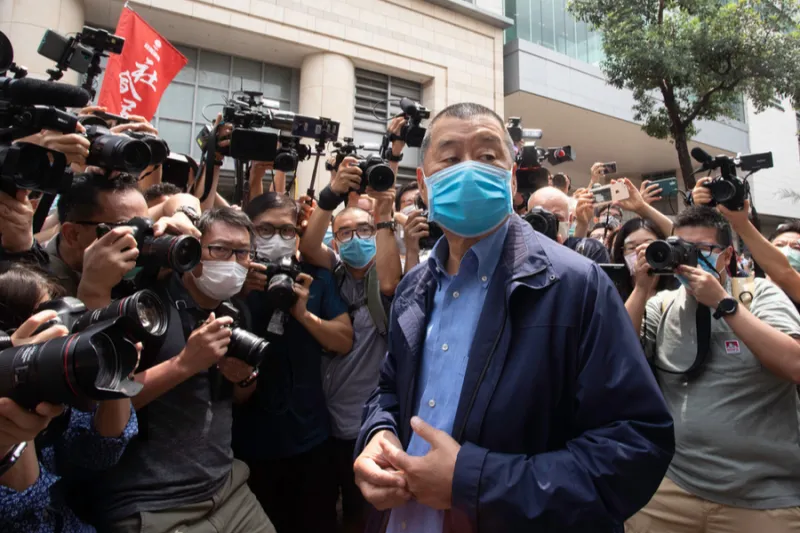
Hong Kong. Hong Kong media tycoon and founder of Apple Daily newspaper Jimmy Lai Chee Ying arrives at the West Kowloon Magistrates’ Court, May 18, 2020. / Yung Chi Wai Derek/Shutterstock
Washington D.C., Sep 14, 2021 / 16:01 pm (CNA).
A Catholic democracy advocate was honored in absentia on Tuesday at a Catholic gathering in Washington, D.C., while he remains imprisoned in Hong Kong.
Jimmy Lai, a media entrepreneur and Catholic pro-democracy advocate in Hong Kong, was given the Christifidelis Laici award on Sept. 14 by organizers of the National Catholic Prayer Breakfast. The award is named for Pope John Paul II’s 1988 exhortation on the mission of the laity in the world.
Lai “believed that we are created for truth and that it is our job to speak the truth,” said William McGurn, a member of the Wall Street Journal editorial board who accepted the award on Lai’s behalf on Tuesday. “His publications told the truth about China & Hong Kong.”
“He is a man of extraordinary means, serving ordinary men and women longing for freedom,” said Joseph Cella, a board member of the National Catholic Prayer Breakfast.
Lai has been imprisoned for 10 months in Hong Kong, having long supported the pro-democracy movement there and having cited his Catholic faith in support of his efforts.
An entrepreneur, he founded both Next magazine, a Chinese weekly publication, and Apple Daily, a pro-democracy publication critical of the Chinese mainland government. Apple Daily shut down publication earlier this summer, after its accounts were frozen and top leadership was arrested.
In 1997, he converted to Catholicism and was baptized by the now-retired bishop of Hong Kong, Joseph Cardinal Zen.
Lai’s conversion, at the time the United Kingdom handed over sovereignty of Hong Kong to the People’s Republic of China, was “like a small green shoot breaking through the concrete,” McGurn said of the time.
Hong Kong had previously maintained its own legislature and democratic form of government under the “one country, two systems” agreement, as the U.K. prepared to hand sovereignty of the region to China. However, the Chinese mainland government had sought greater control over Hong Kong in recent years before imposing a sweeping national security law on the region in 2020, bypassing the island’s legislature. The act followed months of pro-democracy protests in Hong Kong.
Under the new law, a person convicted of secession, subversion, terrorism or collusion with foreign forces would receive a minimum of 10 years in prison, with the possibility of a life sentence.
Lai was arrested in August 2020 over his support for pro-democracy protests in Hong Kong, and remained on the island to face his charges. People had urged Lai – who is also a British citizen – to leave Hong Kong before he would be arrested, McGurn noted.
“If you thought that [leaving] was ever a possibility, you don’t know Jimmy Lai,” McGurn said.
Released on bail, he was arrested again later in the year, and was charged in December with breaching the terms of a lease for his company, Next Digital Media.
Hong Kong’s Court of Final Appeal on Feb. 9 denied Lai bail, but allowed his legal team the possibility of applying again for bail. He has remained in prison for 10 months.
During his prison term, he has applied the Rule of St. Benedict – “ora et labora,” or “prayer and work,” McGurn noted.
“When he’s not reading the classics of the faith,” McGurn said of Lai, “he has a job folding paper into envelopes.” Some fellow prisoners have even been baptized during his term, McGurn said.
“While Jimmy may be stuck in prison, his soul remains free,” he said.
If you value the news and views Catholic World Report provides, please consider donating to support our efforts. Your contribution will help us continue to make CWR available to all readers worldwide for free, without a subscription. Thank you for your generosity!
Click here for more information on donating to CWR. Click here to sign up for our newsletter.
A Chase bank building in Wilmington, Delaware. / Credit: Harrison Keely, CC BY 4.0, via Wikimedia Commons
CNA Staff, Mar 25, 2025 / 06:00 am (CNA).
Legislators in several states are moving to address the practice of “debanking” as part of an effort to stop what some critics say are anti-conservative measures employed by major U.S. financial institutions.
The Cambridge Dictionary defines debanking as “the act by a bank of closing someone’s account because they are regarded as a risk legally, financially, or to the bank’s reputation.” Critics have claimed that the practice is used by banks to antagonize certain groups, including conservatives and other political activists.
For example, the Trump Organization filed a lawsuit earlier this month against one of the largest banks in the United States. President Donald Trump claims he was a victim of debanking after Capital One allegedly closed hundreds of his organization’s accounts soon after his supporters’ Jan. 6, 2021, storming of the U.S. Capitol.
In her recently-released memoir, Melania Trump alleged that she and her son, Barron, were also debanked.
The Ruth Institute, a global coalition designed to equip Christians to defend the family, alleged it was debanked in 2017. Just two years ago, a Memphis-based Christian charity called the Indigenous Advance Ministries also claimed that it had been debanked by Bank of America.
In another high-profile case, in 2022 former U.S. senator and ambassador Sam Brownback announced that his nonprofit group the National Committee for Religious Freedom had been debanked.
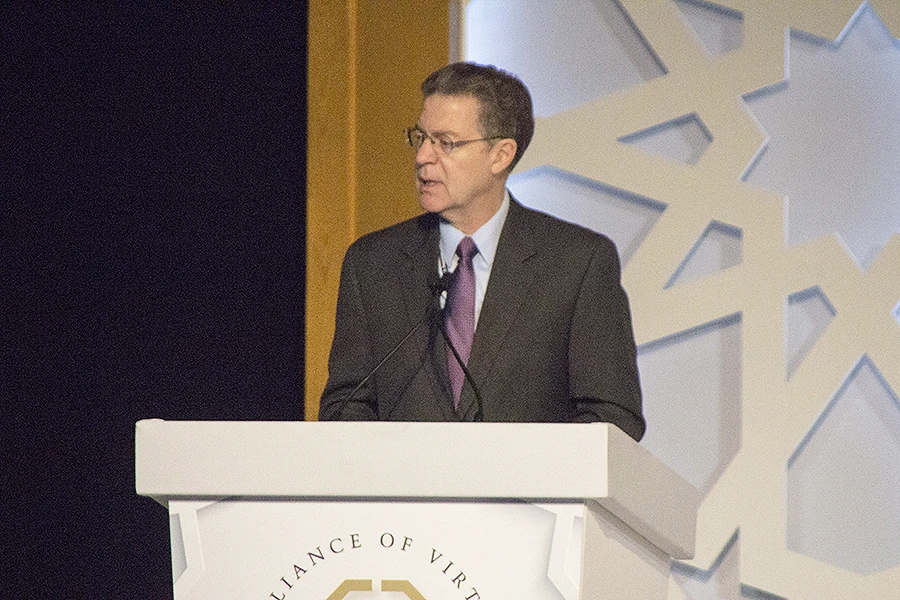
Ambassador Sam Brownback speaks on Feb. 6, 2018. Credit: Jonah McKeown/ CNA
Over the past decade, other high-ranking individuals and grassroots organizations have reportedly faced debanking, including Nigel Farage, who led the Brexit effort in the United Kingdom; evangelist and motivational speaker Nick Vujicic; Moms for Liberty, a parental rights advocacy group; Christian author and preacher Lance Wallnau; and Timothy Two Project International, a Christian ministry.
U.S. bishops ‘monitoring’ debanking; legislators move to address
While it’s unclear to what extent debanking has affected U.S. Catholics, the U.S. Conference of Catholic Bishops acknowledged the phenomenon in its 2025 religious liberty report.
“In recent years, individuals have raised concerns that banks are discriminating on the basis of political and religious viewpoints,” the report read.
“In response to incidents like these, some states have begun passing laws intended to prevent politically motivated debanking,” the bishops noted. “However, the U.S. government argues that these laws hamstring banks, who need to be able to account for potential customers’ exposure to foreign actors. The lack of transparency, though, makes it difficult to ascertain why someone like Ambassador Brownback would be debanked.”
According to the report, the USCCB is “monitoring this issue but has not taken a position on it.”
Taking action against debanking
Some lawmakers are moving to address the controversy via legislation.
An anti-debanking bill in Idaho was sent to the state governor for signature last week.
The Transparency in Financial Services Act would prohibit “large financial institutions from discriminating against customers based on their political or religious views” and would give customers the right to request the reason for denial from an institution.
Montana’s Republican-sponsored Equality in Financial Services Act and South Carolina’s anti-debanking bill — similar to Idaho’s bill — have made some progress in the state Legislature, while Georgia’s Freedom of Speech and Belief Act failed to pass at the beginning of March.
Some see changes in bank policy, or even legal changes, as potential solutions to debanking.
Alliance Defending Freedom (ADF) — a legal group committed to protecting religious freedom and freedom of speech — worked with Indigenous Advance Ministries to file a consumer complaint following its alleged debanking in 2022.
“No American should ever fear losing access to their bank account due to their religious or political beliefs,” Lathan Watts, ADF’s vice president of public affairs, told CNA.
In its 2023 Viewpoint Diversity Score Index, ADF found that 7 out of 10 of the largest commercial banks — including Chase — have “hate speech” or “reputational risk” policies that contribute to debanking.
JPMorgan Chase, a top American bank, recently adjusted its policy, agreeing to protect clients against political and religious debanking in its code of conduct after 19 attorneys general petitioned the bank to cease its debanking practices in 2023.
“Chase’s policy change is a significant step by our nation’s largest bank to uphold financial access for all Americans,” Watts said. “This change provides necessary protections for customers like Ambassador Brownback, whose account at the National Committee for Religious Freedom was unexpectedly canceled in 2022.”
Watts shared his hope that other banks will take similar measures.
“Alliance Defending Freedom actively engaged with Chase in these negotiations, and we are hopeful that other banks will follow suit in safeguarding fundamental financial freedoms,” Watts said.
Jennifer Roback Morse, the founder and president of the Ruth Institute — an organization dedicated to combating the effects of the sexual revolution — recalled her own experience allegedly being debanked.
“In 2017, the Ruth Institute was one of the first organizations to be attacked in the banking arena,” Morse told CNA. “In our case, our credit card processor cut us off with no notification, or explanation, except to say that we ‘violated its standards.’”
Ruth Institute President Jennifer Roback Morse speaks on “The World Over with Raymond Arroyo” on June 13, 2019. Credit: “The World Over with Raymond Arroyo/EWTN News screenshot
While there was no clear explanation, Morse believes it was due to a leftist law center labeling the organization as a hate group.
“We surmised this was because we were listed on the Southern Poverty Law Center’s ‘Hate Map’ for our opposition to the redefinition of marriage and other LGBT-issues,” Morse said. “Thankfully, we were able to secure another credit card processor fairly quickly.”
Morse told CNA that banking “is a highly regulated, semi-monopolistic industry, comparable in some respects to public utilities such as electricity and water.”
“I am in favor of banks being legally required to be transparent and even-handed in their standards,” she said.
“Alternatively, if banks are permitted to engage in viewpoint discrimination,” she argued, “I would urge that bakers, florists, therapists, and other professionals also be permitted to refuse service to potential customers for any reason they choose.”
“A disappointed customer can find an alternative photographer a lot easier than they can find an alternative bank,” Morse noted. “And it is a lot easier to participate in the business world without a photographer or florist than to survive without banking services.”
‘A balanced approach’
While conservative legislators are pushing these anti-debanking bills, support for this legislation is not entirely united within the conservative movement.
A recent poll found that while a majority of conservatives are concerned about debanking, nearly three-quarters of conservatives expressed support for banks having the right to choose their own clients.
The poll by the Tyson Group found that conservatives “do not support broad government intervention that prevents financial institutions from making risk-based assessments when determining their customers.”
“When informed that legislation could force businesses to provide services to customers at odds with their values and the conservative movement, many expressed hesitations,” the study noted.
“As conservatives push for greater accountability from regulators, they also seek a balanced approach to debanking that avoids unintended consequences and protects the rights of both consumers and businesses.”
Some opponents of anti-debanking laws maintain that restrictions against debanking could have unintended consequences.
In South Carolina, for example, an anti-debanking bill under consideration, the Equality in Financial Services Act, would prevent financial institutions from discriminating when providing financial services.
But a Republican executive committeeman from Richland, South Carolina, is concerned that such an anti-debanking law could require pro-life banks to work with abortionists.
“Stopping abortion and protecting children requires winning hearts and minds but also cutting off the financial pipeline that enables these activities,” Eaddy Roe Willard, Richland GOP executive committeeman, told CNA. “Misguided legislation at the state level will only make it harder to do that.”
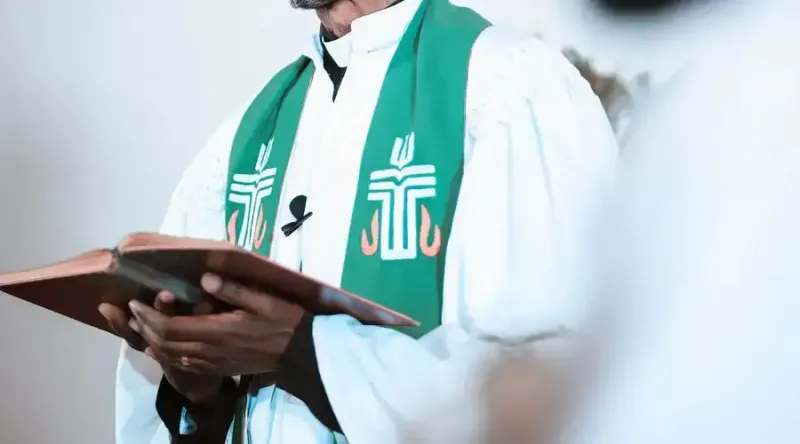
Forty-five priests and four bishops in Venezuela have died from COVID-19 as of December 2021, the Venezuela bishops’ conference has reported. / Unsplash
Caracas, Venezuela, Dec 15, 2021 / 13:45 pm (CNA).
The Venezuelan bishops’ conference published new statistics showing that since the beginning of the pandemic 45 priests and four bishops have died from COVID-19.
The conference noted that “in the midst of the global crisis caused by the pandemic, priests are not exempt from the risks of contracting COVID-19,” as they carry out their ministry.
“At a time when people more earnestly seek the comfort of the spirit and closeness to the faith … priests offer their service to the Church,” the conference said.
The conference published current figures on the priests who were infected and died from the deadly virus. In the report, they noted that between March 2020 and Dec. 13, 2021, 439 priests were infected with COVID-19, a figure that represents 20.77% of the total clergy in the country.
During this period, 45 priests have died, or 10.25% of all priests infected with the virus, and 2.13% of all Venezuelan clergy.
Of those infected, 26 were bishops and of these 22 prelates recovered; the other four died in 2021.
The four bishops who died were Archbishop Cástor Oswaldo Azuaje, who served as the bishop of the Diocese of Trujillo until his death on January 8; Bishop César Ortega, who died on April 9; Archbishop Tulio Chirivella, Archbishop Emeritus of Barquisimeto, who died on April 11; and Cardinal Jorge Urosa Savino, Archbishop Emeritus of Caracas, who died on Sept. 23.
The bishops’ conference said that the Church in Venezuela currently has 2,068 priests. Siixty are bishops and of these 41 are titular bishops, three are auxiliary bishops, and 16 are bishops emeritus.
The dioceses with the greatest number of priests are San Cristóbal (208), Trujillo (154), Barquisimeto (148), Mérida (127), Caracas (121), the conference reported.
The bishops’ conference said that since the beginning of the COVID-19 pandemic “it has urged the entire population to comply with the guidelines and recommendations in the field of biosafety” to prevent contracting the virus.
The conference also stressed that taking proper care of oneself, the family and the community “is the best way to prevent the spread of COVID-19.”
Finally, the bishops’ conference exhorted the faithful to “increase their trust in God in times of a health emergency” and encouraged them to continue praying from the Word of God, “especially in the family, the Domestic Church,” since prayer “is an expression of the faith and hope that we need to strengthen.”
Sacramento, Calif., Feb 24, 2020 / 05:20 pm (CNA).- Facing the threat of major cuts to federal HHS funds, California Attorney General Xavier Becerra has said the state will not back down from its ban on health insurance plans that exclude abortion, eve… […]







Leave a Reply