


Vatican City, Apr 12, 2023 / 04:10 am (CNA).
Pope Francis has told “keyboard warriors” to put aside online polemics and get out from behind their desks to proclaim the Gospel.
Speaking in St. Peter’s Square on April 12, the pope urged Christians to go out and “get moving” to share the good news of the Gospel with the world.
“One does not proclaim the Gospel standing still, locked in an office, at one’s desk or at one’s computer, engaging in polemics like ‘keyboard warriors’ and replacing the creativity of proclamation with copy-and-paste ideas taken from here and there,” Pope Francis said.
“The Gospel is proclaimed by moving, by walking, by going.”
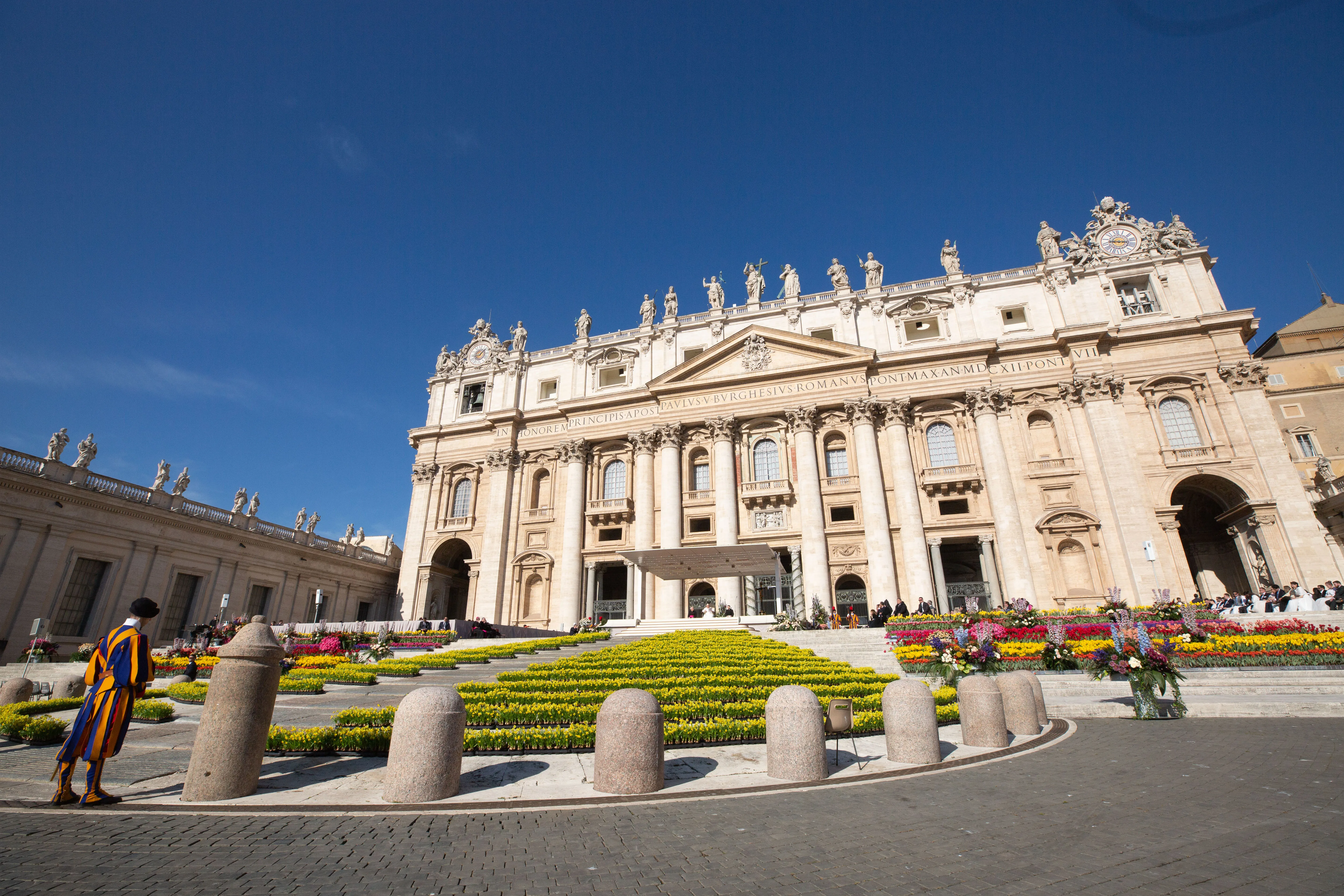
In his Wednesday audience, the pope warned that it is possible to have “misdirected zeal” that is “doggedly persistent in the observance of purely human and obsolete norms for the Christian community.”
“We cannot ignore the solicitude with which some devote themselves to the wrong pursuits even within the Christian community itself; one can boast of a false evangelical zeal while actually pursuing vainglory or one’s own convictions,” he said.
As part of the pope’s cycle of catechesis on “passion for evangelization,” Francis offered a reflection on two lines from St. Paul’s Letter to the Ephesians: “Therefore, put on the armor of God, that you may be able to resist on the evil day and, having done everything, to hold your ground. So stand fast with your loins girded in truth, clothed with righteousness as a breastplate, and your feet shod in readiness for the gospel of peace.”

Pope Francis noted that St. Paul connects zeal for the Gospel with footwear “because one who goes to proclaim must move, must walk.”
“Evangelical zeal is the support on which proclamation is based, and heralds are somewhat like the feet of the body of Christ that is the Church,” he said.
At the end of the audience, Pope Francis marked the 60th anniversary of the publication of St. John XXIII’s encyclical Pacem in terris, calling the document a “true blessing” for the world when it was published in 1963 amid the tensions of the Cold War.

Pope Francis added that the encyclical remains relevant today, encouraging people to read Pacem in terris.
“For example, this passage will suffice: ‘Relationships between political communities, like those between individual human beings, must be regulated not by resorting to the force of arms, but in the light of reason, that is, in truth, in justice, in active solidarity,’” he said, quoting paragraph 62 of the document.
“I pray that the heads of nations will let themselves be inspired by it in their plans and decisions,” the pope added.
Pope Francis also reminded the crowd that the Church will celebrate Divine Mercy Sunday this week on April 16.
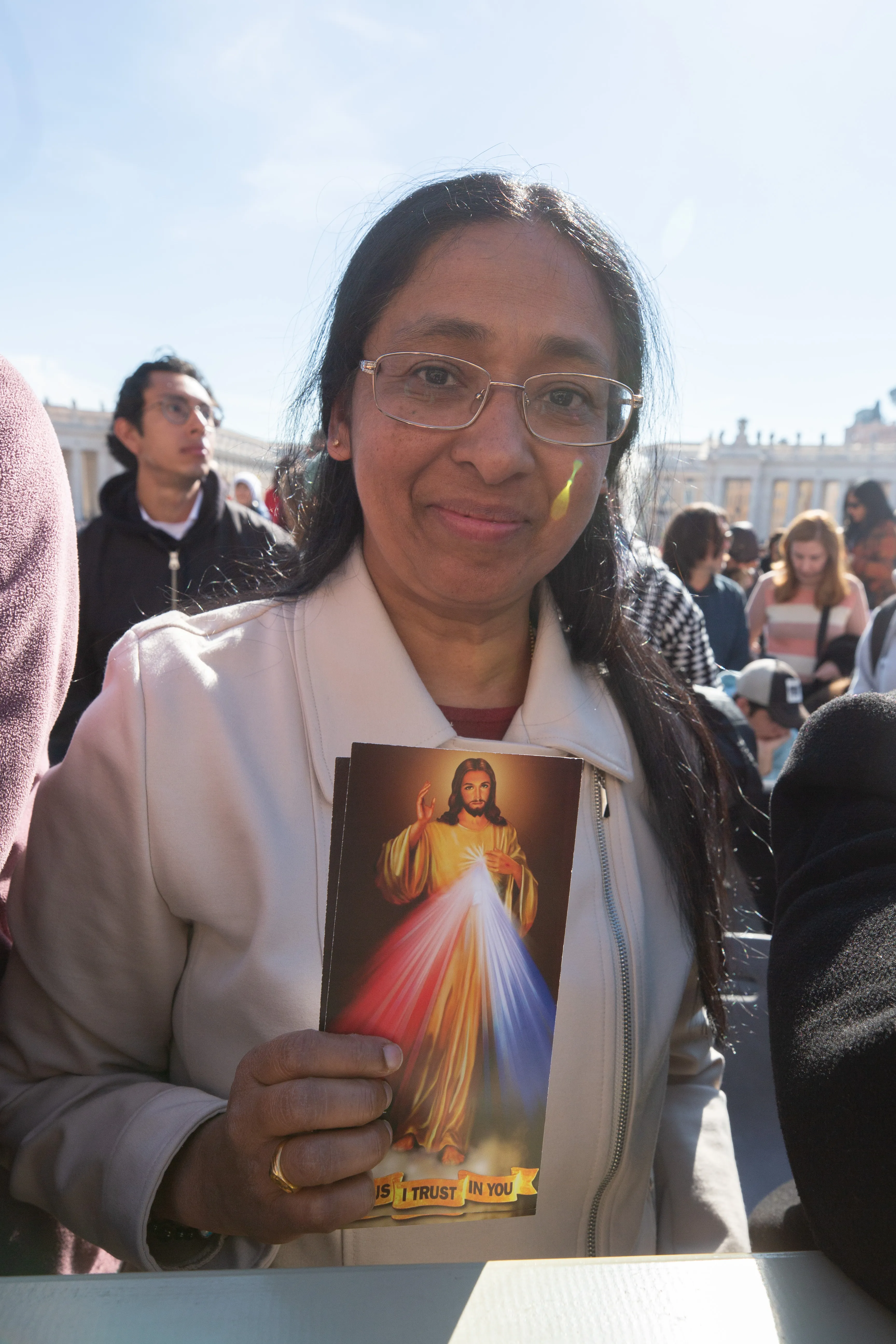
“The Lord never ceases to be merciful. Let us think of the Mercy of God who always welcomes us, always accompanies us, never leaves us alone,” Francis said.
“I invite you to live this Easter season with your gaze turned to the Risen Christ, who sacrificed himself for us and for our salvation,” he added.
If you value the news and views Catholic World Report provides, please consider donating to support our efforts. Your contribution will help us continue to make CWR available to all readers worldwide for free, without a subscription. Thank you for your generosity!
Click here for more information on donating to CWR. Click here to sign up for our newsletter.


It seems to me that you can’t be too defensive about things that require a certain amount of scrutiny and basic honesty. A bad way, eg., homosexualism, is made worse by an absence of desire to change it; and made worse again when you say about the person “it is how he is” and he “must be accepted” as “that”. It is unjust; he is unjust to himself; and you are unjust to him and everyone else. It shuns mercy and you are being unmerciful. He can be told as much in a very straightforward manner.
Just as you can be told. And he is obliged on hearing it just as you are obliged when you heard. The same ones who are “moving” and “walking”, in name or anon – they too are obliged! Are you all to be as silly women?
Now you say “polemics”. The word of God is alive and active and a two-edged sword penetrating sinews and marrows, where is the injuring!
When it comes through via keyboard what difference does it make to God!
Ah you get miffed up: but it’s to flip topic and you are teaching that to them! What you do, you help it organize itself with “bathos” and “pathos” into some kind of “ethos” even as you add drive onto compulsiveness and craft solidarity around artificiality and banality. The problem is simple but you make it complex – over-peering, over-psychologizing, over-characterizing. And pushing neutralism Jesus Christ never taught or demonstrated anywhere.
Moving, walking, going, running is the way forward. Keyboard warriors are yet to do justice to their enormous potential in transmitting the Good News of liberation, emancipation, empowerment, justice, equality, harmony, peace, mercy, forgiveness, compassion, solidarity, nonviolence, and co-humanity.
Yes, by all means, with Pope Francis get moving! But, how to walk and chew gum at the same time?
The challenge, of course, is how we are to both “move [and] walk” and, at the same time, “stand fast” and “hold our ground.” Easy enough to focus on the first truth as “forward” while branding the latter as “backward.”
Surely the Synod on Synodality will clarify that in positioning traditional truths in possibly larger contexts, there still is no latitude for contradictions. Such was the meaning of St. Vincent of Lerins (whom Pope Francis likes to cite) and the more recent Cardinal Newman, the Father of Vatican II, who spelled things out:
“I venture to set down seven notes of varying cogency, independence, and applicability to discriminate healthy developments of an idea from its state of corruption and decay, as follows: “There is no corruption if it retains:
(1) One and the same TYPE [doctrine/natural law v. disconnected pastoral accompaniment?],
(2) The same PRINCIPLES [sound philosophy v. neo-Hegelianism, e.g., any distortion of the four cryptic principles advanced in Evengalium Gaudi],
(3) The same ORGANIZATION [the Barque of Peter v. all religions framed pluralistically and equivalently (?) as ‘the will of God’?];
(4) If its beginnings ANTICIPATE its subsequent phases [Scripture/Catechism/Veritatis Splendor v. Germanic normalization of homosexual activity, etc.?],
(5) Its later phenomena PROTECT and subserve its earlier [Veritatis Splendor/Familiarus Consortio v. the published discussions by the Vatican’s Pontifical Academy of Life, in ‘Theological Ethics of Life: Scripture, Tradition, and Practical Challenges,’ 2021];
(6) If it has a power of assimilation and REVIVAL [New Evangelization v. mutations nested within Amazonia and Germania?], and
(7) A vigorous ACTION from first to last…” [vigorous as in ‘steadfastness’ and “holding our ground’–precisely because engaging fully, our new challenges].
There is much merit in proclaiming the Gospel of Jesus Christ by means of CWR. Bergoglio seems delighted to avail himself of the pages on a daily basis!
He invited criticism and now that is constant on these pages and elsewhere, might he like to call the whole thing off?
On three aspects of God’s guidance and injunctions, he departs from established belief, bringing his own perspective which does not honour the words of the Lord. Others can probably offer more examples than the three I am prepared to pose.
There has been an interesting discussion between Bergoglio and Jordan Peterson. Apparently he posited that Bergoglio was not a Christian! Yet he is not alone in this view. Cultural Marxists tend to eschew religion, alas. Gnostic Jesuits are another thorn in the flesh.
2 Timothy 3:7 always learning and never able to arrive at a knowledge of the truth.
2 Timothy 4:3-4 For the time is coming when people will not endure sound teaching, but having itching ears they will accumulate for themselves teachers to suit their own passions, and will turn away from listening to the truth and wander off into myths.
Ephesians 4:14 so that we may no longer be children, tossed to and fro by the waves and carried about by every wind of doctrine, by human cunning, by craftiness in deceitful schemes.