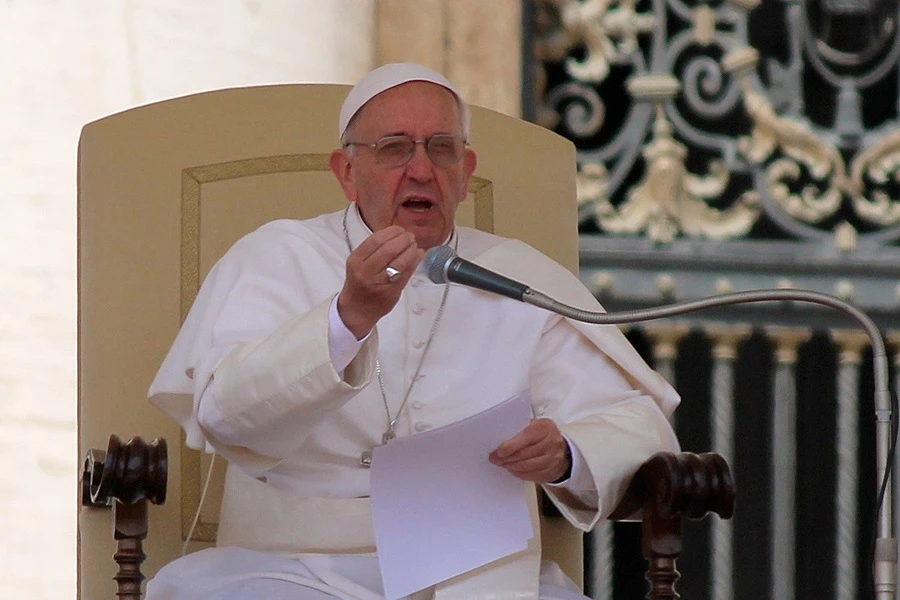
Vatican City, Jun 5, 2018 / 07:53 am (CNA).- In a letter to Catholics in Chile on May 31, Pope Francis said he is ashamed of the Church’s failure to listen to victims, and urged all the baptized to make a commitment to ending the culture of abuse and cover-up.
Please find below CNA’s translation of the full text of Pope Francis’ May 31 letter:
To the Pilgrim People of God in Chile
Dear Brothers and Sisters,
This past April 8, I called my brother bishops to Rome to seek together in the short, medium and long term the ways of truth and life in face of an open, painful and complex wound which for a long time has not stopped bleeding.[1] And I suggested that they invite the entire faithful Holy People of God to place themselves in a state of prayer so the Holy Spirit might give us the strength to not fall into the temptation of getting wound up in empty word games, in sophisticated diagnostics, or in vain gestures which would not allow us the necessary courage to look directly at the pain caused, the face of its victims, the magnitude of the events. I invited them to look to where the Holy Spirit is moving us, since “closing our eyes to our neighbor also blinds us to God.”[2]
With joy and hope I received the news that there were many communities, towns, and chapels where the People of God were praying, especially the days we were gathered together with the bishops: the People of God on their knees who implore the gift of the Holy Spirit to find the light in the Church, “wounded by her sin, granted mercy by her Lord, and so that every day she may become prophetic in her vocation.”[3] We know that prayer is never in vain and that “in the midst of darkness something new always buds forth, that sooner or later bears fruit.”[4]
1. To appeal to you, to ask for your prayers was not a practical recourse nor was it a simple goodwill gesture. On the contrary, I wanted to frame things in their precise and valuable place and put the issue where it ought to be: the condition of the People of God “the dignity and freedom of the sons of God, in whose hearts the Holy Spirit dwells as in His temple.”[5] The faithful Holy People of God are anointed with the grace of the Holy Spirit; therefore when we reflect, think, evaluate, discern, we must be very attentive to this anointing. Whenever as a Church, as pastors, as consecrated persons, we have forgotten this certainty, we have lost our way. Whenever we try to supplant, silence, look down on, ignore or reduce into small elites the People of God in their totality and differences, we construct communities, pastoral plans, theological accentuations, spiritualities, structures without roots, without history, without faces, without memory, without a body, in the end, without lives. To remove ourselves from the life of the People of God hastens us to the desolation and to a perversion of ecclesial nature; the fight against a culture of abuse requires renewing this certainty.
As I said to the young people in Maipú, I want to specially tell each one of you: “Holy Mother the Church today needs the faithful People of God to challenge us […] you need to take out your adult ID card, as spiritual adults, and have the courage to tell us ‘I like this,’ ‘this is the way I think we should go,’ ‘that’s not going to work,’ …Tell us what you feel and think.”[6] This is capable of involving all of us in a Church with a synodal character which knows how to put Jesus in the center.
The People of God does not have first, second or third-class Christians. Their participation is not a question of goodwill, concessions, rather it is constitutive of the nature of the Church. It is impossible to imagine a future without this anointing operating in each one of you, which certainly demands and requires new forms of participation. I urge all Christians to not be afraid to be the protagonists of the transformation that is demanded today and to propel and promote creative alternatives in the daily search for Church that every day wants to put what is important in the center. I invite all the diocesan organizations from whatever area they may be to consciously and lucidly seek areas of communion and participation so that the Anointing of the People of God may find its concrete mediations to express itself.
The renewal of the Church hierarchy by itself does not create the transformation to which the Holy Spirit moves us. We are required to together promote a transformation of the Church that involves us all.
A prophetic Church and, therefore, full of hope, demands of everyone an eyes-wide-open mysticism, that questions, that is not asleep.[7] Do not let yourselves be robbed of the anointing of the Spirit.
2. “The wind blows where it wills, and you can hear the sound it makes, but you do not know where it comes from or where it goes; so it is with everyone who is born of the Spirit.” (Jn 3:8) This is how Jesus responded to Nicodemus in the conversation they were having on the possibility of being born again in order to enter the Kingdom of Heaven.
At this time in the light of this passage it is good for us to look back at our personal and communal history: The Holy Spirit blows where and how he wills with the sole purpose of helping us to be born again. Far from letting us get boxed up in schemes, modalities, fixed or obsolete structures, far from letting yourself be resigned or “letting down your guard” in the face of events, the Spirit is continually in movement to widen your horizons, to make the person who has lost hope[8] to dream, to do justice in truth and charity, to purify from sin and corruption, and always invited to necessary conversion. Without looking at this with faith, everything we could say or do would be useless. This certainty is essential to look at the present without evasions but with bravery, with courage, but wisely, with tenacity but without violence, with passion but without fanaticism, with constancy but without anxiety, and thus change all that which today puts at risk the integrity and dignity of every person; since the solutions that are needed demand facing the problems without getting trapped in them or, what would be worse, repeating the same mechanisms that we want to eliminate.[9] Today we are challenged to look straight ahead, assume and suffer the conflict, and thus be able to resolve and transform it in a new direction.[10]
3. In the first place, it would be unfair to attribute this process just to the recently experienced events. Every process of review and purification that we are experiencing is possible thanks to the effort and perseverance of specific individuals, who even against all hope or stains of discredit, did not tire of seeking the truth; I am referring to the victims of abuses of sexuality, power and authority and to those who at the time believed and accompanied them. Victims whose cry reached the heavens.[11] I would like once more to publicly thank all of them for their courage and perseverance.
This recent time is a time of listening and discernment to arrive at the roots that allowed such atrocities to occur and be perpetuated and thus find solutions to the abuse scandal, not merely with containment strategies—essential but insufficient—but with the measures necessary to take on the problem in its complexity.
In this regard I would like to pause on the word “listening,” since discerning supposes learning how to listen to what the Spirit wants to tell us. And we will only be able to do it if we are capable of listening to the reality of what is going on.[12]
I believe that here resides one of our main faults and omissions: not knowing how to listen to the victims. Thus partial conclusions were drawn which lacked crucial elements for a healthy and clear discernment. With shame I must say that we did not know how to listen and react in time.
The visit of Archbishop Scicluna and Monsignor Bertomeu was born when we saw that there were situations that we did not know how to see and hear. As a Church we could not continue to walk ignoring the pain of our brothers. After reading the report, I wanted to personally meet with some of the victims of sexual abuse, the abuse of power and the abuse of conscience, to listen to them and to ask forgiveness for our sins and omissions.
4. In these meetings, I noted how the lack of recognition/listening to their stories, as well as the recognition/acceptance of the errors and omissions in the entire process impedes us from making headway. A recognition that ought to be more than an expression of goodwill toward the victims, rather that ought to be a new way to for us to adopt a new attitude before life, before others and before God. Hope for tomorrow and confidence arises from and grows in taking on the fragility, the limitations and even the sins in order to help us go forward. [13]
The “never again” to the culture of abuse and the system of cover up that allows it to be perpetuated demands working among everyone in order to generate a culture of care which permeates our ways of relating, praying, thinking, of living authority; our customs and languages and our relationship with power and money. We know today that the best thing we can say in face of the pain caused is a commitment to personal, communal, and social conversion that learns to listen to and care for especially the most vulnerable. It is therefore urgent to create spaces where the culture of abuse and cover up is not the dominant scheme, where a critical and questioning attitude is not confused with betrayal. We have to promote this as a Church and to seek with humility all the actors that make up the social reality and promote ways of dialogue and constructive confrontation to move toward a culture of care and protection.
To attempt this enterprise by ourselves alone, or with our efforts and tools, would shut us up in dangerous voluntaristic dynamics that would perish in the short term.[14] Let us allow ourselves to be helped and to help create a society where the culture of abuse does not find the space to perpetuate itself. I exhort all Christians and especially those responsible for centers of higher education, formal or informal, healthcare centers, institutes of formation and universities, to join together with the dioceses and with all of civil society to lucidly and strategically promote a culture of care and protection. Let each of these spaces promote a new mentality.
5. The culture of abuse and cover up is incompatible with the logic of the Gospel, since the salvation offered by Christ is always an offer, a gift that demands and requires freedom. Washing the feet of the disciples is how Christ shows us the face of God. It is never by way of coercion or obligation but by way of service. Let us say it clearly, every means that attacks freedom and a person’s integrity is anti-Gospel. Therefore it is also necessary to create processes of faith where we learn to know when it is necessary to doubt and when not to. “Doctrine, or better our understanding and expression of it ‘is not a closed system, deprived of dynamics capable of bringing up questions, doubts, questionings,’ since the questions of our people, their anxieties, their fights, their dreams, their struggles, possess an hermeneutical value that we cannot ignore if we want to take seriously the principle of incarnation.[15] I invite all centers of religious formation, theology schools, institutes of higher learning, seminaries, houses of formation and spirituality to promote a theological reflection that is capable of rising to the challenge of the present time, to promote a mature, adult faith that assumes the vital humus of the People of God with their searching and questioning. And thus, to then promote communities capable of fighting against abusive situations, communities where exchanges, debate and confrontation are welcome.[16] We will be fruitful to the extent that we empower and open communities from within and thus free ourselves from closed and self-referential thoughts full of promises and mirages which promise life but which ultimately favor the culture of abuse.
I would like to make a brief reference to the pastoral ministry of popular devotion carried out in many of your communities since it is an invaluable treasure and authentic school of the heart for our people and in the same act the heart of God. In my experience as a pastor I learned to discover that pastoral ministry of popular devotion is one of the few places where the People of God is sovereign from the influence of that clericalism that seeks to always control and stop the anointing of God on his people. Learning from popular piety is to learn to enter into a new kind of relationship of listening and spirituality that demand a lot of respect and does not lend itself to quick and simplistic readings since popular piety “reflects a thirst for God that only the poor and simple can know.” [17]
To be “the Church that goes out” also is to allow itself to be helped and to be challenged. Let us not forget that “the wind blows where it wills: you hear its sound but you do not know where it comes from or where it is going. So it is with everyone born of the Spirit.” (Jn 3:8)
6. As I told you, during the meetings with the victims I was able to see that the lack of recognition prevents us from getting anywhere. That is why I think it is necessary to share with you that I rejoiced and it gave me hope to confirm in conversation with them their recognition of people that I like to call “the saints next door.”[18] We would be unfair if alongside our pain and our shame for those structures of abuse and cover up that have been so much perpetuated and have done so much evil, we would not recognize the many faithful lay people, consecrated men and women, priests and bishops who give life through love in the most obscure areas of the beloved land of Chile. All of them are Christians who know how to weep with those who weep, who hunger and thirst for justice, who look and act with mercy;[19] Christians who try every day to illumine their lives in the light of the standards by which we will be judged: “Come, you who are blessed by my Father. Inherit the kingdom prepared for you from the foundation of the world. For I was hungry and you gave me food, I was thirsty and you gave me drink, a stranger and you welcomed me, naked and you clothed me, ill and you cared for me, in prison and you visited me.” (Mt 25:34-36)
I recognize and am thankful for their courage and constant example – in turbulent, shameful and painful moments they continue to make a stand with joy for the Gospel. That witness does me a lot of good and sustains me in my own desire to overcome selfishness to give more fully of myself.[20] Far from diminishing the importance and seriousness of the evil caused and seeking the root of the problem, it also commits us to recognize the acting and operating power of the Holy Spirit in so many lives. Without looking at this, we would remain half-way there and we could enter into a logic that far from seeking to empower what is good and remedy what is wrong, it would partialize the reality, falling into grave injustice.
Accepting the successes, as well as the personal and communal limitations, far from being just one more news item, becomes the initial kickoff of every authentic process of conversion and transformation. Let us never forget that Jesus Christ risen presents himself to his own with his wounds. Moreover, it is precisely from his wounds that Thomas can confess his faith. We are invited to not dissimulate, hide, or cover over our wounds.
A wounded Church is able to understand and be moved by the wounds of today’s world, make them its own, suffer them, accompany them and move to heal them. A wounded Church does not put itself at the center, does not think it is perfect, does not seek to cover up and dissimulate its evil, but places there the only one who can heal the wounds and he has a name: Jesus Christ.[21]
This certainty is that which will move us to seek in season and out of season, the commitment to create a culture where each person has the right to breathe an air free of every kind of abuse. A culture free of the cover ups which end up vitiating all our relationships. A culture which in the face of sin creates a dynamic of repentance, mercy and forgiveness, and in face of crime, accusation, judgment and sanction.
7. Dear brothers, I began this letter telling you that appealing to you is not a practical recourse or a gesture of goodwill, on the contrary it is to invoke the anointing which as the People of God you possess. With you the necessary steps for ecclesial renewal and conversion will be able to be taken, that will be sound and long term. With you the necessary transformation can be generated that is so needed. Without you nothing can be done. I exhort all the faithful Holy People of God who live in Chile to not be afraid to get involved and go forward moved by the Holy Spirit in search of a Church which is increasingly more synodal, prophetic and hopeful; less abusive because it knows how to place Jesus at the center, in the hungry, the prisoner, the migrant, and the abused.
I ask you to not cease praying for me. I pray for you and I ask Jesus to bless you and the Virgin to care for you.
Francis
Vatican May 31, 2018, Feast of the Visitation of Our Lady.
[1]Cf. Letter of the Holy Father Francis to the Bishops of Chile following the report of His Excellency Archbishop Charles J. Scicluna, April 8, 2018
[2]BENEDICT XVI Deus Caritas Est, 16.
[3]Cf. Meeting of the Holy Father Francis with priests, men and women religious, consecrated men and women, seminarians, Cathedral of Santiago de Chile, January 16, 2018.
[4] Cf. FRANCIS, Evangelii Gaudium, 278
[5]Cf. VATICAN COUNCIL II, Lumen Gentium, 9.
[6]Cf. Meeting of the Holy Father Francis with young people at National Shrine of Maipú, January 28, 2017
[7]Cf. FRANCIS, Gaudate et Exsultate, 96
[8]Cf. FRANCIS, Homily at Solemnity of Pentecost Mass 2018
[9]It is good to recognize some of the organizations and media that have taken up the issue of abuse in a responsible way, always seeking the truth and not making out of this painful reality a means to boost program ratings.
[10]Cf. FRANCIS, Evangelii Gaudium, 227
[11]“The Lord said ‘I have witnessed the affliction of my people in Egypt and have heard their cry against their taskmasters, so I know well what they are suffering’.” Ex 3:7
[12]Let us remember that this was the first word-commandment that the people of Israel received from Yahweh: “Listen Israel” (Dt 6:4)
[13]Cf. Visit of the Holy Father Francis to the Women’s Correctional Center, Santiago de Chile, January 16, 2018
[14]Cf. FRANCIS, Gaudete et Exsultate, 47-59
[15]Cf. FRANCIS, Gaudete et Exsultate, 44
[16]It is essential to carry out the much needed in the centers of formation promoted by the recent Apostolic Constitution Veritates Gaudium. By way of example, I emphasize that “in fact, are called to offer opportunities and processes for the suitable formation of priests, consecrated men and women, and committed lay people. At the same time, they are called to be a sort of providential cultural laboratory in which the Church carries out the performative interpretation of the reality brought about by the Christ event and nourished by the gifts of wisdom and knowledge by which the Holy Spirit enriches the People of God in manifold ways – from the sensus fidei fidelium to the magisterium of the bishops, and from the charism of the prophets to that of the doctors and theologians. FRANCIS, Veritates Gaudium, 3
[17]PAUL Vl, Evangelii Nuntiandi,48.
[18]Cf. FRANCIS, Gaudete et Exsultate,6-9.
[19]Cf. FRANCIS, Gaudete et Exsultate,76, 79, 82.
[20]Cf. FRANCIS Evangelii Gaudium,76
[21]Cf. Meeting of the Holy Father Francis with priests, men and women religious, consecrated men and women, seminarians, Cathedral of Santiago de Chile, January 16, 2018.

 […]
[…]







I’d love to dialogue with Bergoglio.
“Dialogue” is just another empty word that wholly politicized prelates use to convince themselves and everyone else they can fool that their dishonesty is honest. Francis has repeatedly displayed his disbelief in immutable truth oblivious to the implications that this is not only an inconsistency with Catholicism but essential faith itself.
The real definition of atheism is the belief that truth changes. This applies even to those who think they believe in God.
God will not be mocked. Truth is exclusively the reflection of the mind of God. Man does not create truth, any truth at all. Man only gives witness to truth, unchanging truth. Francis’ rejection of immutable truth, like anyone else, reflects his atheistic inclinations, regardless if it is conscious or not.
You honestly think you’d get a word in “edgewise”?
May the Lion, George Cardinal Pell Rest in Peace. From Australia
For 81 years and popes from Pius XII to Francis I have watched the arguments between conservative and progressive members as they go back & forth about doctrine, opinions, truth, etc. The conservatives seem terrified by change the progressives seem ready to move on. I have noticed that conservatives ( now calling themselves ‘traditionalists’ after express hostility toward those who are more progressive. Inability to entertain an opposing perspective without reacting emotionally is difficult and the more emotionally mature we are the better we get to be at it. Conservatives held most of the power in the church for centuries. Now progressives are no longer being deliberately silenced. The deeper problem is not the immutability of truth so much as the psychological immaturity of men who have not yet integrated their own emotions into their mental abilities to evaluate what is true and what is false. They, therefore, lack the ability to see deeper levels of truth and so are limited to projecting their own unconscious wishes for the emotional security of sameness. Change is the only real constant in an ever evolving universe of which we are a conscious part. The conflict between those of us who have grown internally and those of us who cling to concepts (however logical they appear to ourselves) as learned in childhood will remain. The hostility toward opposing points of view does not have to remain. Just use your heart along with your logic. Be Christlike.
Bravo! You are to be commended for your courage and wisdom in writing this.
Eleanor: Pilate asked Jesus what is Truth; a query answered at trial and resolved upon a Cross of dogwood cut from an orchard that still exists in Jerusalem.
Jesus is Truth which Pilate witnessed before washing his hands. His Resurrection confirms eternal Divine existence. Jesus is Truth constant;everlasting Divinity and not subject mortal correction even by a pope.
At “Pope Francis never answer[ed] the Dubia”, [Feser] indicated the purpose, at least by reasonable inference that what the four cardinals considered contrary to doctrine is correct. Although not necessarily meaning that the pontiff considered his positions in Amoris contra doctrine, rather a justifiable advance in favor of pastoral resolution.
Insofar as resolution of the ambiguity of Amoris, uncertainty prevents a sustainable accusation of error. That’s because what Amoris Laetitia teaches for liceity of communion for, example divorce and unlawful remarriage [Dr Feser covers this well from the perspective of credentialed authority] depends on variable conditions subject to prudential judgment [that a priest discerns probable just cause for conferring the sacrament]. In effect, the objectionable premises answer themselves.
Otherwise, a valid criticism may be made if it’s demonstrated that the arguments contained in Amoris Laetitia actually remove the permanence of moral principles. It is here that Amoris is subject to valid criticism one example Francis’ mistaken interpretation of Aquinas ST 1a2ae 94, 4 that we always find defects in the singular [a sacramental marriage], whereas Aquinas refers to the universal application of intrinsically permanent natural law principles – that some cultures abrogate natural law [example Julius Caesar’s observation that some German tribes judge stealing a natural right]. Another is the teaching on mitigation, as if mitigating circumstances absolve the penitent, whereas Amoris omits reference to grace as the resolution. The other is the formation of conscience and the disputed understanding of obligation to the truth as taught and revealed.
Argument for valid criticism regarding all this finds basis in the ongoing German Synodaler Weg and lack of effective intervention, and the moral positions of Synod on Synodality Relator Card Hollerich SJ, as well as Card Grech.
Peter, There is a thunder in silence most deafening.
Vae victus veritas. Et pax vobiscum.
The Devil knows that criticism of the Church, the Pope, and other Church members, or the Church in its appearance in the world, instills a general disdain for the Church regardless who originates the criticism and what is said. The tone of the message is the message. Is this what Francis likes?
So, St. Paul was wrong to rebuke St. Peter in public? St. Catherine of Siena was wrong to take Popes to task? St. Thomas Aquinas lays out the conditions for when it can be right to rebuke a prelate, was he wrong about that too?
When a prelate is bringing disdain on the Church through his actions, criticism can be an act of charity.
“Then when it is necessary let us apply discipline. Otherwise, the evil may grow by the relaxing of discipline.
“If the sin is private, correct the sinner in private. If it is public and manifest, apply the correction in public so that the sinner may be led to betterment and others may conceive a salutary fear.” St. Augustine, New Testament Sermon No. 33
Well said – This pope’s pontificate has, from start to finish, been one of confusion among the faithful, and fear among faithful clergy.
May God’s truth prevail and may the courageous clergy be vindicated.
Speaking of the Devil, if Catholics were more willing to criticize their leaders and hold them accountable, the Church would be a physically safer place. We should follow Cardinal Pell’s good example, or the world’s disdain will prove well-earned indeed.
Maybe Francis will practise what he preaches. I wouldn’t get my hopes up.
Surely the cardinals are paying attention?
I believe Pope Francis has “la grace d’etat” for being Pope at this particular time in history. Neither Cardimal Pell nor former Pope Benedict has ” la grace d” etat”. I believe that for arrival Pell to call the reign of Pope Francis a : catastrophe” shows lack of respect and lack of humility. Former Pope Benedicts heartache about the continued use if the 1570 Tridentine mass really goes counter to the liturgical reforms of Ativan II. Also, you can be critical but respectful as well
For you to deny that the pontificate of Francis is a catastrophe shows a lack of respect and humility towards God, not to mention all the victims of Marxism from encouragement given to Marxist leaders, not to mention all the victims of sin given the redefining of “mercy” to eliminating God’s gift of guilt.
And your comments about liturgy and Vatican II simply reflects a level of being misinformed on the matter. Vatican II mandated no such thing as the displacement of the Holy Sacrifice of the Mass. Your point of emphasis that the Tridentine Mass being old is rather foolish. Truth never changes.
“Ativan II”…What a hoot!
I agree, one of the funniest things I have seen in a while. For those who do not know, Ativan is a benzodiazepine that is used to treat anxiety amongst other things
What exactly do you mean? I looked it up and the only definition I could find was in the French version of Wiktionary, and Google kindly translated it as “Said of illusions attached to a condition and that make it bearable.” Andthe example provided translated as “Ordinarily the sick of the chest do not see themselves in as great danger as they are, it is a grace of state.”
So what exactly were you trying to say? Apart from making silly comments about Pope Benedict and Cardinal Pell, of course. Nice that you know so much more about what Ativan II than did Pope Benedict, who (checks records) – was actually there as an advisor.
I fail to understand what you mean by attributing “liturgical reforms” to a psychotropic medication, unless your post is satire.
https://www.webmd.com/drugs/2/drug-6685/ativan-oral/details
Pauline Fournier: Your AI program needs an update. A mere human would not possibly produce so many spelling, typos, grammatical, and downright factual errors; even the opinions have no basis in reality.
Pauline, Je pense non. Cardinal Pell answered to Truth in criticizing the Pope.
Francis lacks humility to accept Truth which isn’t changed for personal opinion sake.
The Pope is old and his time is running short. We must hold tight to the rails of the bark and ride out the present storm and await the next pontificate. May God have mercy on the next Pope.
One wonders who would even want to be the next pope, given the fact Pope Benedict XVI resigned because he couldn’t handle the filth in the Church. It is startling to note the criticisms hurled against Pope Francis, while very little or none has been said or written against Pope Benedict in spite of the clerical sexual abuses that came to light when he was Archbishop of Munich. He was also aware of the sexual abuses of McCarrick and did nothing about it. He also refused to apologize for the appalling conditions that prevailed in Residential Schools run by the Catholic Church, offering only his regrets to the Indigenous people and also for the abuses in Munich. Pope Benedict was more concerned about the image of the Church than for the victims. It was Pope Francis who travelled to Canada and offered a sincere and heart-felt apology.
It was only on his deathbed that Pope Benedict offered his sincere apologies. Most of the arrows aimed at Pope Francis are coming from Traditional Catholics who have bluntly labelled Pope Francis as the Anti-Christ! They disagree entirely with the Documents of Vatican II — even though they have not read it!
I’ll leave it someone else to tally the exact number of lies you packed into your post. I’ll just concern myself with the one about McCarrick since it is put forward by many notorious Francis apologists. As the record shows, it was Benedict who imposed (admittedly, inadequate) sanctions against McCarrick. Francis, who knew about McCarrick’s crimes, lifted those penalties, and then made the fiend the point man in the negotiations with the CCP to betray Chinese Catholics. It was only after news of this monster’s deeds became public that Francis began the laicization process. In other words, Francis dumped him only when he became too hot to handle. It is a pattern that has repeated itself a number of times over the last decade.
The shamelessness of people who try to re-write history when the evidence is readily available always astonishes me.
You clearly state that Benedict imposed (admittedly, inadequate) sanctions against McCarrick. Unfortunately, you do not give the reason/s for those sanctions. In case you are not aware, permit me, please, to tell you what they are. They were for the sexual abuses.
Let me get this clear. Those abuses are clearly against the law of God and the law of the land — and all Benedict did was to impose sanctions! WOW! Benedict did exactly the same when sexual abuses against the clergy surfaced when he was Archbishop of Munich. Pope Francis did indeed lift those sanctions. He was questioned about it. He explained in detail that he was misinformed and reimposed those sanctions. By the way, it was not just Benedict who was aware of the sexual abuses committed by McCarrick. The saintly Pope John Paul II
was also aware of it and did nothing — absolutely nothing!
Leslie, Benedict is gone. The man understood the cauldron he faced in this world and what chastisement awaited him in the next. We pray for his soul all more so, his being greater than most in this world and his greater need in the next.
Pax vobiscum.
A priest, whether presbyter, bishop, cardinal [and the supreme pontiff] have a serious obligation to teach the truth of the faith. Whenever, for example, parish laity raise questions with the priest he is morally obliged to respond with the truth of the faith. Whenever there exists ambiguity on perennial doctrine inherent to Apostolic tradition, such as precepts prohibiting homosexuality, adultery, cohabitation the priest must respond in favor of that Apostolic tradition, and explain and defend that doctrine. If that ambiguity stems from the Roman pontiff, the priest must explain clearly and decisively the difference of non binding opinions, suggestions, informal statements of the pontiff from those that are formally pronounced to the entire Church specified by him as binding doctrine.
Failure to do this likely incurs condemnation for himself, and responsibility for the loss of souls misled by said opinions, ambiguous statements. To criticize clergy, [or qualified laity] for carrying out this ordained commission to Christ and his commandments does a disservice to the priest and the Church.
A prime example in this discussion is Pope Francis’ announcement that all that is required to receive the Holy Eucharist is the ‘garment of faith’. That remark repeats the error of Martin Luther who separated good works from faith in Christ. It putatively denies the necessity to repent.
Fr. Peter Morello, PhD: Vatican II has corrected this error of limiting the term “priest” to refer only to the ordained. The council has retrieved the biblical and patristic understanding that all the faithful are priests (Lumen Gentium 10). Priests here mean those called to offer living sacrifices of praise and thanksgiving. The 99% of the Church’s members are called royal or baptismal priests with the 1% called ministerial or ordained priests – called to serve as servants to the royalty (not the other way around as it is with clericalism-sacerdotalism). Both the royal and ministerial priesthoods participate in the one high priesthood of Christ. You’re right in using the term “presbyter” (which Vatican II retrieved and corrected) but wrong to limit “priest” only to the ordained. This Vatican II teaching is one that still awaits full reception and application after 60 years. The start was wrong with the English translations of the council documents (see translations of Optatam Totius, and Presbyterorun Ordinis, for example) returning to the old pre-Vatican II habit of referring to “priests” as limited to only the ordained without considering this Vatican II correction and return to the biblical and patristic sources about the priesthood of all believers.
Whenever I baptize I retain the ancient rite of anointing the infant, boy or girl, with chrism on the crown of the head. Chrism’s ancient use in the anointing of kings. And inclusive of the charisma related to baptism, priest, prophet, and king. That’s in reference to the universal priesthood pronounced by the Apostle Peter referring the us as a royal priesthood.
Nevertheless Deacon, do not err, as if there’s an equanimity [an unfortunate occurrence in our time], by confusing the priesthood of the faithful with the ordained priesthood and its exclusive ministry in the Church as Alter Christus, and confection of the sacraments Eucharist, penance, ordination, anointing, and confirmation.
Fr. Peter Morello, PhD: It might surprise you to discover that although it has a long tradition (especially in the writings of the French School after the Council of Trent) of referring it the presbyters, official church documents like Vatican II and the Catechism never use “alter Christus,” to refer to the ordained. The wording rather is that the presbyter is “conformed to Christ,” or “acts in the person of Christ.” Again taking the royal priesthood of all the baptized, in fact, all Christians – not just the presbyters – are “alter Christus.” St. Cyprian of Carthage who first used the term rightly declared that all who are baptized into Christ are also “another Christ”.
Again Deacon you’re espousing an egalitarian ideology that reflects current Woke thinking. You do a disservice to the Church instituted by Christ as hierarchal. That there are levels of authority that not all share, since by necessity a true familial institution requires that leadership as it was with Christ and the Apostles, the institution the Apostle Paul of a hierarchy of bishops like Timothy, and elders or presbyters to share the Apostolic mission. Deacons share that ministry in submission to their canonical pastor. A priest.
Priesthood is by necessity selective and contained within an ordered body that requires disciplined transmission of doctrine and stewardship regarding its practice. Your views would disassemble the flow of authority within the Body. Your presumed expertise is clearly selective. My advice is focus on what a deacon should be offering the Church, service and humble submission to Christ, recognizing your dutiful obedience to the priesthood in the same manner that I am to my bishop, and the bishop is to higher authority and the Roman pontiff. He in turn, elevated to the papacy to serve Jesus Christ and what Christ revealed, his eternal Word.
DD:
The documents of the Church do refer to the ordained acting ‘in persona ipsius Christi.’ The words of the Church have higher authority than the words of its saints.
CCC, paragraph 1548: “In the ecclesial service of the ordained minister, it is Christ himself who is present to his Church as Head of his Body, Shepherd of his flock, high priest of the redemptive sacrifice, Teacher of Truth. This is what the Church means by saying that the priest, by virtue of the sacrament of Holy Orders, acts in persona Christi Capitis:
It is the same priest, Christ Jesus, whose sacred person his minister truly represents. Now the minister, by reason of the sacerdotal consecration which he has received, is truly made like to the high priest and possesses the authority to act in the power and place of the person of Christ himself (virtute ac persona ipsius Christi).”
Baptized persons comprise the Body of Christ. We are not per se ‘other’ Christs insofar as we lack His Head.
“The council has retrieved the biblical and patristic understanding that all the faithful are priests”
Would you like me to hear your confession, Deacon?
Read again what I wrote, slowly and clearly please, so you get to understand it!
Some of us are literate enough to construe written material properly, assuming its not some discourse into incoherence or idiosyncracy.
You probably shouldn’t assume you are the smartest guy in the room (this or any other). It’s the sin of pride and often is the result of Dunning Kruger.
Above: Fr. Peter Morello, PhD: Check Vatican II and the Catechism. It’s not wokism. “Alter Christus” to refer to presbyters alone is never officially taught in any church document. It came as a tradition from the writings of the proponents of the French School of Spirituality but never taken as official church teaching. It has been handed down in spiritual writings and promoted in seminaries and consequently imbibed in the minds of presbyters not knowing it’s never an official church teaching. Vatican II has also corrected the hierarchicalism it inherited. The ecclesiology of the “People of God” is purposely placed before the “Hierarchy” indicative of the emphasis of the council fathers and as finally written in Lumen Gentium (LG 2 & 3). In the post-conciliar teachings especially the 1985 Synod Final Report priority and emphasis was made clearly of the church as “Communion” than as “Hierarchy.” Along this line John Paul II in Pastores Dabo Vobis (1992) also corrected the clericalism-sacerdotalism inherent in the “hierarchological” (term by Yves Congar) of the Church that made presbyters somehow think and act that they have to lord over the people as a matter of entitlement based on the mistaken notion of presbyters as “Alter Christus.” Discussing about the three offices of the presbyter, it is interesting to note how the Saint Pope somehow instituted a sort of de-clericalism and changed the terminologies for the third office. Instead of “kingly,” it is “royal service.” “Governing” (often lording over) is switched into “pastoral charity.”
Corrections: LG chapters 2 & 3… “hierarchological” view of the Church….
I look at the divide between those in the camp of Pope Benedict XVI and Cardinal Pell and those in the the camp of Pope Francis as the differing ecclesiologies (theological vision and understanding of the nature and mission of the church). The ecclesiology of the dead Pope and dead Cardinal is that of a “Fortress” Church. It is the warrior mindset of a Church in constant battle with the wider world’s culture viewed as often contradicting its teaching and threatening its existence. Its stance with the world is to close in by walling itself and clearly demarcating who’s in and who’s out whether in doctrine or practice. The Church here is understood to be the remnant few in the midst of the multitudes of the unchurch and the nonchurch judged to be the unsaved. Contrary to the judgmentalism of the Fortress Church, Pope Francis’ “Field Hospital” Church’s approach to the world is one not of a warrior but of a caregiver, so in this spirit not judgment but openness and dialogue is the way of relating with the world recognizing that there is so much evil of woundedness in the world that need healing. The members of the Body of the Christ do not build walls around them but to go to the battlefield of the world and look and care for the wounded without discrimination. Seen from this ecclesiological perspective, clearly those in the Fortress camp criticize those in the Field Hospital camp as not fully and faithful Catholic, and vice-versa.
The ecclesiology of the dead Pope and dead Cardinal is that of a “Fortress” Church. It is the warrior mindset of a Church in constant battle with the wider world’s culture viewed as often contradicting its teaching and threatening its existence.
That is a lie, pure and simple. Did you relish referring to both men as “dead”? What a vile, cowardly human being you are, defaming good men while hiding behind the veil of anonymity.
I’m stating a matter of fact in light of recent events which is the context of this article.
You have offered a false dichotomy and a naive worldview. At the present time, a good many people see Christianity as a disease to be eradicated (witness the annual assembly of misanthropes at Davos) rather that a physician.
In this I am reminded of the account of an old friend who took Protestant orders somewhat late in life. Part of his training was chaplaincy services, and he had the account of walking into room of a seriously ill man.
Before he could introduce himself and offer his services, the patient looked at his clerical attire and said “you can take yourself and your God and get the [expletive deleted] out of my room. There was nothing he could do for this man who seemed dedicated to isolation from God and man in his last days, despite being in a religious hospital.
That’s the world we face-not a world where there are great populations of unevangelized or uncatechized; but a world that is dedicated to any of a variety of false gospels that make them not ignorant, but axiomatically opposed to the Church, Christianity or Theism.
The pollsters that tell us that tell us the “nones” are the great rising demographic are wrong. The greatest rising demographics are the misotheists and Christophobes.
So, let’s tip our hats to stereotypes! From something including (inclusivity!) but larger than the “Field Hospital,” don’t we still remember, vaguely but also, something like this:
“Though they differ from one another in essence and not only [!] in degree, the common priesthood of the faithful and the ministerial or hierarchical priesthood are nonetheless interrelated.” Interrelated, but not blurred or flipped?
From whence commeth this citation? Oh, wait, it’s from the Body of Christ as articulated by the very same Second Vatican Council of which thou speaketh—indeed, from the very same Lumen Gentium 10!
So, maybe Pope Benedict XVI and Cardinal Pell are not so “dead,” after all, as some so gleefully announce. And maybe the “Field Hospital [and-More!]” Church has something better to offer than a synodal plebiscite muddling and dismissing so much of what comes earlier than 2013. Yes, “service,” but not adulterated with the likes of Bats-sing’s and Hollerich’s disservice and more (or less).
Missing today, might we both agree, is, first, the ability to hold more than one complementary truth at a time; and second, especially, and equally (equality!)—in our ideological era—some needed and essential precision—rather than slogans served (!) up by the “terrible simplifiers” (“terribles simplificateurs”—the prescient Swiss historian, Jacob Burckhardt, 1889).
The deacon appears to have changed u to o and dropped the b from the end of his name.
That’s not the way to discourse! You present your comments or arguments. Read, study, and think – and pray – more!
I don’t consider you to be someone whose advice or judgment I value.
Thank you Deacon Don for your informed contribution. I look forward to your future contributions.
Dear Deacon Dom:
The church should be our “fortress” against evil. It should also be a “field hospital” to those who are hurting. We should have words of wisdom for those who have spiritual and physical woes.
On the other hand, some view Papa as a n encourager of practices that are irreverent, while berating faithful priests and bishops that do their job and bring honour to the Church! We learn and grow and God gives us the tools we need to be a blessing to others when our hearts are open to His leading.
Psalm 62:6 He only is my rock and my salvation, my fortress; I shall not be shaken.
Psalm 31:2 Incline your ear to me; rescue me speedily! Be a rock of refuge for me, a strong fortress to save me!
Hebrews 10:24-25 And let us consider how to stir up one another to love and good works, not neglecting to meet together, as is the habit of some, but encouraging one another, and all the more as you see the Day drawing near.
Colossians 3:16 Let the word of Christ dwell in you richly, teaching and admonishing one another in all wisdom, singing psalms and hymns and spiritual songs, with thankfulness in your hearts to God.
God bless you,
Brian
Did you ever wonder what causes a mind to seek refuge in a dichotomized worldview of caricatures? Perhaps you should study people influenced by the likes of Charles Manson or Adolf Hitler and you’ll understand your inclinations better.
In your abuse of the Eighth Commandment in creating your dichotomy of caricatures, created to support your own self-accommodating fantasies of right and wrong and the non-tragic consequences of immoral behavior, you slander two saintly prelates who gave heroic witness to God’s immutable truths of the human condition, including innate divinely endowed moral imperatives, given by our creator to rescue us from our delusions, delusions that slaughter the innocent, encourage the eradication of conscience, and expand human tragedy, a witness you judgmentally judge as “guilty” of judgmentalism, devoid of any sense if honorable irony, in some baseless fantasy about their having isolated themselves from reality in some “fortress” for boldly stating these God-given truths about the human condition that all practitioners of evil (everyone) are naturally loath to hear, and given to persecuting the prophet who gives them such witness. These are truths that Jesus, when teaching us the benevolence of morality in the Sermon on the Mount, commanded His followers to go out to the world to give witness.
And yet you find no fault in those who have isolated their minds from a rational sober assessment of what happens to deluded souls in this vale of tears world, abandoned to and encouraged in their own victimizing caprices and depravities, by these high prelates, where the highest of prelates can not even come to terms of what it means to be in denial of immutable truth and moral absolutes implicit in the negative precepts of the natural law, even when formally and reasonably questioned to do so, for the good of the Church and the good of sharing God’s truth for humanity, publicly, by brother prelates, where a failure to do so, could only diminish the Church’s only mission which is to save souls.
“Pope Francis himself has explicitly said on several occasions that he welcomes criticism.” If Catholics can’t recognize Francis’ hypocrisy by now I don’t know what to say.
During the so-called Covid pandemic the Catholic Church surrendered to the secular régime by closing churches, limiting worshippers at Holy Mass and giving support to the big pharmaceutical companies promoting their «cures».
How different to the case during the many wars, famines and plagues of more faithful times when the Catholic Church was considerably less «prissy».
Jordan Peterson SLAMS Pope Francis’ Preoccupation with Climate Change, “Worshipping Gaia”
https://www.youtube.com/watch?v=RZgHXDLMahA
A lot of flowery rhetoric established around a pope who swears in Church…