A crowd accompanied Nathanael Alberione in his ordination on Nov. 21, 2022. / Credit: Christ the Worker Parish
CNA Newsroom, Nov 23, 2022 / 14:00 pm (CNA).
Nathanael Alberione of Cordoba, Argentina, won the battle against COVID-19 in 2021, and was ordained a priest Nov. 21. On that day he received a special surprise: Pope Francis sent him words of encouragement, and urged him to be a “priest of the peripheries.”
The newly-ordained 33-year-old priest has been assigned to a diocese in Patagonia where he has served as a deacon.
His ordination ceremony was presided over by the bishop of Comodoro Rivadavia, Joaquín Gimeno Lahoz, and was concelebrated by several prelates from the Patagonia-Comahue with a great many faithful in attendance.
The news of his priestly ordination was received with great joy in the local Church and in the Catholic community from all over who prayed for the health of the Cordovan when in April 2021 his case of COVID-19 got so bad that he was in a coma for 50 days.
“The word ‘thank-you’ falls short in a life situation like this, but unfortunately we don’t have another word that we can use to express thanks,” Alberione acknowledged in a radio interview on the Conversations program of Radio Divina Providencia.
Regarding his experience with the disease, he explained that you can think about what happened on two levels.
“Initially I took it like an adolescent, as a challenging rematch: from being prostrate to learning to walk again, to speak, perhaps it was a question of a bit of arrogance: who is going to keep me still now, after having been through this?”
“Then one gradually changes and what remains is: This difficulty is nothing compared to others, and it seems to me a wiser way to look at it. I really find it very enlightening not to take it so much as a rematch.”
At one point during his ordeal, Alberione recalled, “I prayed that if I wasn’t going to be a priest that I would die.”
The day they explained to him the complex situation he was going through due to his health, he recounted, “before I fell asleep I said: so I’m not going to be a priest.”
“The fact that I woke up and assimilated the days that I had spent in a coma was an answer. It has certainly been a turning point in my life, a starting point,” he admitted.
Now a priest, he said that “to this day I continue to meet people who prayed for me, and I always ask myself how to respond, always freely, because it’s an invitation that Jesus gives me.”
Referring to the fruits of so many prayers, he encouraged “not to focus so much on the petition, on the form, on the structure, or on the quantity, but always think of whom we are asking, think of the answer, and the answer is Jesus himself.”
“Just as some of us have made it out of survival situations like this, there are others who didn’t make it, and the question is why others didn’t make it but I did. And how many people prayed for those others as well. So, not having the answer in lowercase, I go to the answer in capital letters, which is Jesus himself.”
Greetings from Pope Francis
At the ordination ceremony, which had to be held at Municipal Stadium No. 1 in Puerto Madryn because the expected attendance exceeded the capacity of all the churches, the new priest received a special surprise.
Pope Francis expressed his closeness to the young man in a letter in which he invited him to be a “priest of the peripheries” and said that “it’s always better than being in the center, because reality is seen better from there.”
“Don’t forget your roots nor the look of Jesus who called you,” the Holy Father advised. “I ask the Virgin to protect you, take care of you with much attention and affection, and please don’t forget to pray for me,” Pope Francis concluded.
This story was first published by ACI Prensa, CNA’s Spanish-language news partner. It has been translated and adapted by CNA.
If you value the news and views Catholic World Report provides, please consider donating to support our efforts. Your contribution will help us continue to make CWR available to all readers worldwide for free, without a subscription. Thank you for your generosity!
Click here for more information on donating to CWR. Click here to sign up for our newsletter.
Washington D.C., Jan 27, 2023 / 14:40 pm (CNA).
A Democrat-controlled Virginia Senate committee voted down three bills that would have put more restrictions on abortion in the commonwealth, but similar bills are still being… […]
ACI Prensa Staff, Apr 15, 2021 / 16:22 pm America/Denver (CNA). A relic of Blessed Carlo Acutis will be displayed for veneration April 18 at a school in Córdoba, Argentina, marking the start of a […]
Dainelys Soto, Genesis Contreras, and Daniel Soto, who arrived from Venezuela after crossing the U.S. border from Mexico, wait for dinner at a hotel provided by the Annunciation House on Sept. 22, 2022 in El Paso, Texas. / Credit: Joe Raedle/Getty Images
CNA Staff, Sep 9, 2024 / 06:00 am (CNA).
Long a champion of immigrants, particularly those fleeing war-torn countries and impoverished regions, Pope Francis last month delivered some of the clearest words in his papacy yet in support of migrants — and in rebuke of those who turn away from them.
“It must be said clearly: There are those who work systematically and with every means possible to repel migrants,” the pope said during a weekly Angelus address. “And this, when done with awareness and responsibility, is a grave sin.”
“In the time of satellites and drones, there are migrant men, women, and children that no one must see,” the pope said. “They hide them. Only God sees them and hears their cry. This is a cruelty of our civilization.”
The pope has regularly spoken out in favor of immigrants. In June he called on the faithful to “unite in prayer for all those who have had to leave their land in search of dignified living conditions.” The Holy Father has called the protection of migrants a “moral imperative.” He has argued that migrants “[must] be received” and dealt with humanely.
Migrants aboard an inflatable vessel in the Mediterranean Sea approach the guided-missile destroyer USS Carney in 2013. Carney provided food and water to the migrants aboard the vessel before coordinating with a nearby merchant vessel to take them to safety. Credit: Commander, U.S. Naval Forces Europe-Africa/U.S. 6th Fleet, Public domain, via Wikimedia Commons
The Catholic Church has long been an advocate and protector of immigrants. The U.S. Conference of Catholic Bishops (USCCB) notes on its website that “a rich body of Church teaching, including papal encyclicals, bishops’ statements, and pastoral letters, has consistently reinforced our moral obligation to treat the stranger as we would treat Christ himself.”
The Catechism of the Catholic Church teaches that prosperous nations “are obliged, to the extent they are able, to welcome the foreigner in search of the security and means of livelihood which he cannot find in his country of origin.”
Popes throughout the years, meanwhile, have expressed sentiments on immigration similar to Francis’. Pope Pius XII in 1952, for instance, described the Holy Family’s flight into Egypt as “the archetype of every refugee family.”
The Church, Pius XII said, “has been especially careful to provide all possible spiritual care for pilgrims, aliens, exiles, and migrants of every kind.”
Meanwhile, “devout associations” throughout the centuries have spearheaded “innumerable hospices and hospitals” in part for immigrants, Pius XII said.
Implications and applications of Church teaching
Chad Pecknold, an associate professor of systematic theology at The Catholic University of America, noted that the catechism “teaches that nations have the right to borders and self-definition, so there is no sense in which Catholic teaching supports the progressive goal of ‘open borders.’”
“There is a ‘duty of care’ which is owed to those fleeing from danger,” he told CNA, “but citizenship is not owed to anyone who can make it across a national border, and illegal entry or asylum cannot be taken as a debt of citizenship.”
Paul Hunker, an immigration attorney who previously served as chief counsel of U.S. Immigration and Customs Enforcement (ICE) in Dallas, agreed.
“States have to have responsibility for their own communities, they have to look out for them,” he told CNA. “So immigration can be regulated so as to not harm the common good.”
Still, Hunker noted, Catholic advocates are not wrong in responding to immigration crises — like the ongoing irregular influx through the U.S. southern border — with aid and assistance.
Paul Hunker, an immigration attorney and former chief counsel of U.S. Immigration and Customs Enforcement (ICE) in Dallas, says Catholic advocates are not wrong in responding to immigration crises — like the ongoing irregular influx through the U.S. southern border — with aid and assistance. Credit: Photo courtesy of Paul Hunker
Many Catholic organizations offer shelter, food, and legal assistance to men, women, and children who cross into the country illegally; such groups have been overwhelmed in recent years with the crush of arriving migrants at the country’s southern border.
“It’s the responsibility of the federal government to take care of the border,” he said. “When the government has created a crisis at the U.S. border, Catholic dioceses are going to want to help people.”
“I completely support what the Catholic organizations are doing in Mexico and the United States to assist people who are there,” Hunker said. “The people responding are not responsible for these crises.”
Latest crisis and legal challenge
Not everyone feels similarly. Texas Attorney General Ken Paxton has launched an investigation of multiple Catholic nonprofits that serve illegal immigrants in the state. Paxton alleges that through the services it provides to migrants, El Paso-based Annunciation House has been facilitating illegal immigration and human trafficking.
A lawyer for the group called the allegations “utter nonsense,” though attorney Jerome Wesevich acknowledged that the nonprofit “serves undocumented persons as an expression of the Catholic faith and Jesus’ command to love one another, no exceptions.”
There are considerable numbers of Church teachings that underscore the need for a charitable response to immigrants. In his 1963 encyclical Pacem in Terris, Pope John XXIII argued that man “has the right to freedom of movement and of residence within the confines of his own state,” and further that “when there are just reasons in favor of it, he must be permitted to emigrate to other countries and take up residence there.”
In the encyclical Caritas in Veritate, meanwhile, Pope Benedict XVI in 2009 acknowledged that migration poses “dramatic challenges” for nations but that migrants “cannot be considered as a commodity or a mere workforce.”
“Every migrant is a human person who, as such, possesses fundamental, inalienable rights that must be respected by everyone and in every circumstance,” the late pope wrote.
Edward Feser, a professor of philosophy at Pasadena City College in California, noted that the Church “teaches that nations should be welcoming to immigrants, that they should be sensitive to the hardships that lead them to emigrate, that they ought not to scapegoat them for domestic problems, and so on.”
Catholic teaching does not advocate an ‘open borders’ policy
Yet Catholic teaching does not advocate an “open borders” policy, Feser said. He emphasized that the catechism says countries should accept immigrants “to the extent they are able,” and further that countries “may make the exercise of the right to immigrate subject to various juridical conditions.”
There “is nothing per se in conflict with Catholic teaching when citizens and politicians call on the federal government to enforce its immigration laws,” Feser said. “On the contrary, the catechism backs them up on this.”
In addition, it is “perfectly legitimate,” Feser argued, for governments to consider both economic and cultural concerns when setting immigration policy. It is also “legitimate to deport those who enter a country illegally,” he said.
Still, he acknowledged, a country can issue exceptions to valid immigration laws when the moral situation demands it.
“Of course, there can be individual cases where a nation should forgo its right to deport those who enter it illegally, and cases where the manner in which deportations occur is associated with moral hazards, such as when doing so would break up families or return an immigrant to dangerous conditions back in his home country,” he said.
“Governments should take account of this when formulating and enforcing policy,” he said.
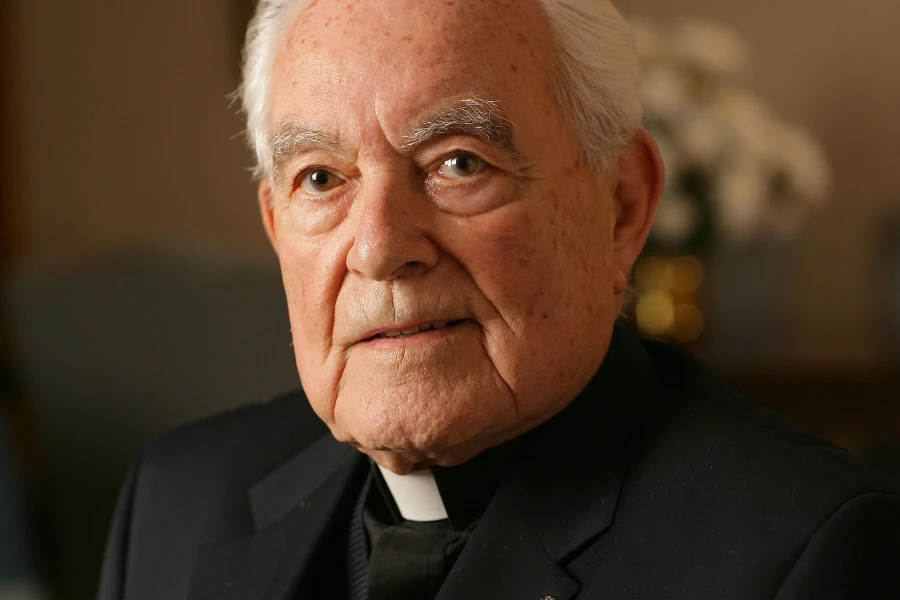
The tension between responding charitably to immigrants and ensuring a secure border was perhaps put most succinctly in 1986 by the late Father Theodore Hesburgh, who served as chairman of the U.S. Select Commission for Immigration and Refugee Policy that was created by the U.S. Congress in the early 1980s.
“It is not enough to sympathize with the aspirations and plight of illegal aliens. We must also consider the consequences of not controlling our borders,” said the late Father Theodore Hesburgh, who served as chairman of the U.S. Select Commission for Immigration and Refugee Policy that was created by the U.S. Congress in the early 1980s. Credit: Photo courtesy of University of Notre Dame
Writing several years after the commission, Hesburgh explained: “It is not enough to sympathize with the aspirations and plight of illegal aliens. We must also consider the consequences of not controlling our borders.”
“What about the aspirations of Americans who must compete for jobs and whose wages and work standards are depressed by the presence of large numbers of illegal aliens?” the legendary late president of the University of Notre Dame reflected. “What about aliens who are victimized by unscrupulous employers and who die in the desert at the hands of smugglers?”
“The nation needn’t wait until we are faced with a choice between immigration chaos and closing the borders,” Hesburgh stated nearly 40 years ago.





Hearty congratulations to Nathanael Alberione. God bless.