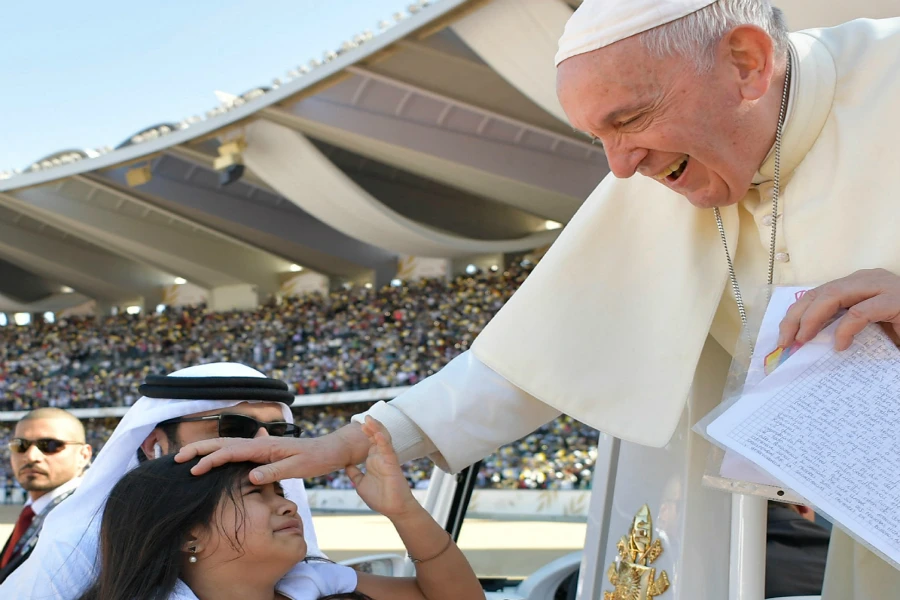
Abu Dhabi, United Arab Emirates, Feb 5, 2019 / 02:32 am (CNA).- Preaching on the Beatitudes during his visit to the United Arab Emirates on Tuesday, Pope Francis called on those present to seek communion with Christ before all else.
“Let us together ask here today for the grace of rediscovering the attraction of following Jesus, of imitating him, of not seeking anyone else but him and his humble love,” the pope said Feb. 5 during Mass at Zayed Sports City, a stadium in Abu Dhabi.
“For here is the meaning of our life: in communion with him and in our love for others,” he added.
Pope Francis is in the Emirati capital Feb. 3-5 to promote interreligious dialogue and to give support to the country’s Christian minority. During his visit he also attended an interreligious meeting and met privately with the Muslim Council of Elders.
Christ pronounced the Beatitudes to “fix in our hearts,” the pope said, the “essential message” that “if you are with Jesus, if you love to listen to his word as the disciples of that time did, if you try to live out this word every day, then you are blessed.”
“The Christian life, first and foremost, is not … simply a list of external prescriptions to fulfil or a set of teachings to know,” but “rather, it is the knowledge that, in Jesus, we are the Father’s beloved children.”
“The Christian life means living out the joy of this blessedness, wanting to live life as a love story, the story of God’s faithful love, he who never abandons us and wishes to be in communion with us always,” Francis stated. “This is the reason for our joy, a joy that no one in the world and no circumstance in our lives can take from us. It is a joy that gives peace also in the midst of pain, a joy that already makes us participate in that eternal happiness which awaits us.”
The Beatitudes are “an overturning of that popular thinking, according to which it is the rich and the powerful who are blessed, those who are successful and acclaimed by the crowds,” he said.
“Let us look at how Jesus lived: poor in respect to things, but wealthy in love; he healed so many lives, but did not spare his own. He came to serve and not to be served; he taught us that greatness is not found in having but rather in giving. Just and meek, he did not offer resistance, but allowed himself to be condemned unjustly. In this way Jesus brought God’s love into the world. Only in this way did he defeat death, sin, fear and even worldliness: only by the power of divine love.”
Pope Francis thanked the Catholics living in the UAE for “the way in which you live the Gospel we heard.”
He added that following Christ doesn’t mean “always being cheerful,” saying that one “who is afflicted, who suffers injustice, who does everything he can to be a peacemaker, knows what it means to suffer.”
Many of the Catholics in Abu Dhabi are guest workers from Africa, Bangladesh, India, Pakistan, and the Philippines, though some are local Arabs.
The pope noted that many of the UAE’s Catholics “live far from home, missing the affection of your loved ones, and perhaps also feeling uncertainty about the future.”
“The Lord is faithful and does not abandon his people,” Pope Francis said. He recalled the life of St. Anthony the Great, who was accompanied by Christ amid his torments, saying: “The Lord is close. It can happen that, when faced with fresh sorrow or a difficult period, we think we are alone, even after all the time we have spent with the Lord. But in those moments, where he might not intervene immediately, he walks at our side. And if we continue to go forward, he will open up a new way for us; for the Lord specializes in doing new things; he can even open paths in the desert.”
Living the Beatitudes does not require “great works”, Pope Francis said, but “the imitation of Jesus in our everyday life.”
The Beatitudes “invite us to keep our hearts pure, to practice meekness and justice despite everything, to be merciful to all, to live affliction in union with God,” and they are “for those who face up to the challenges and trials of each day.”
“Those who live out the Beatitudes according to Jesus are able to cleanse the world. They are like a tree that even in the wasteland absorbs polluted air each day and gives back oxygen. It is my hope that you will be like this, rooted in Jesus and ready to do good to those around you. May your communities be oases of peace.”
The pope singled out two of the Beatitudes: Blessed are the meek, and Blessed are the peacemakers.
Concerning meekness, he said: “Those who attack or overpower others are not blessed, but rather those that uphold Jesus’ way of acting, he who saved us, and who was meek even towards his accusers.”
The pope quoted from St. Francis of Assisi’s Earlier Rule regarding approaches to “Saracens and non-Christians”: “Let them not get into arguments or disagreements, but be subject to every human creature out of love for God, and let them profess that they are Christians”.
“Neither arguments nor disagreements,” the pope stressed. “At that time, as many people were setting out, heavily armed, Saint Francis pointed out that Christians set out armed only with their humble faith and concrete love. Meekness is important.”
Turning to “Blessed are the peacemakers”, Pope Francis said that a Christian “promotes peace, starting with the community where he or she lives.”
“I ask for you the grace to preserve peace, unity, to take care of each other, with that beautiful fraternity in which there are no first or second class Christians,” he told the Catholics living in the UAE.
Pope Francis concluded: “May Jesus, who calls you blessed, give you the grace to go forward without becoming discouraged, abounding in love ‘to one another and to all’.”
At the conclusion of Mass, Pope Francis was addressed by Bishop Paul Hinder, Vicar Apostolic of Southern Arabia, who thanked him for his visit.
Bishop Hinder said that the pope had “come to a Muslim country with the intention to do as Saint Francis did in the year 1219,” when he met in “mutual respect” with Al-Kamil, Sultan of Egypt.
“We Christians try to implement the order Saint Francis gave at his time to his brothers and to ‘live spiritually among the Muslims … not to engage in arguments and (simply) to acknowledge that (we) are Christians.’”
The bishop also thanked the Emirati authorities, especially Mohammed bin Zayed Al Nahyan, “who generously have made possible this visit and given us this space in order to have a public Mass with as many faithful as possible.”
 […]
[…]




It seems to me that there are three obvious possibilities for finding a common date for Easter, or Pascha: The Orthodox could transition to the Gregorian calculation of Pascha; Rome could return to the Julian calculation; or we could dispense with both calculations and institute a new calculation. None of these proposals is without problems, so what can be done?
Catholics and Orthodox agree on the formula: The solemnity of the Resurrection of the Lord is held on the first Sunday after the first full moon after the vernal equinox, or, more precisely, March 21st. (For the purposes of calculating Pascha, the first full moon after the vernal equinox represents the Jewish “Passover,” or Pesach, from which “Pascha” is derived. Passover is always held on the 14th of Nisan, the full moon of the first month of the Jewish calendar, which always falls in the spring.)
The problem is that “March 21st” according to the old Julian calendar, which included a leap year every 4 years without exception, now falls on what we reckon as April 3rd on the Gregorian calendar — about 11 days after the true vernal equinox. That’s because a leap year every 4 years without exception is a bit of an overcorrection, and adds an extra day every 128 years, and three days every 400 years. In 1582 Pope Gregory XIII decided to do something about it, and implemented a new calendar that would skip leap year once a century three times out of four. So 1600 was a leap year, but 1700, 1800, and 1900 were not; 2000 was a leap year, but 2100, 2200, and 2300 will not be; etc. (This means that whereas an “average” Julian calendar year was exactly 365.25 days, an averge Gregorian calendar year is a bit shorter, i.e., 365.2425 days, which is very, very, very close to the actual solar year of 365.2422 days. Over a course of millennia, it will be necessary to correct the Gregorian calendar by one day every 7,700 or so years.)
Pope Gregory also dropped 10 days from the calendar in October of 1582, so that October 4th was directly followed by October 15th. Of course Protestant and Orthodox countries didn’t want to take marching orders from the pope, but eventually they mostly came around—but not when it comes to calculating the date of Orthodox Pascha. They still use the Julian calendar for that. (They also don’t go by the actual phases of the moon, but by a 19-year lunar cycle called the Metonian Cycle, after an ancient Greek mathematician and astronomer named Meton, that was also updated in the Gregorian reform.)
The divided celebration of Jesus’ resurrection is a tragedy and a scandal. Easter, or Pascha, is the Solemnity of Solemnities, the apex of the entire Christian calendar, and it should belong to all Christians—not my Pascha/Easter vs. your Pacha, but our Paschal celebration.
But how can we achieve this?
In the very long term, the Orthodox are either going to have to accept that their Pascha is sliding further and further toward summer, or reform their system. On the other hand, very little ecumenical progress has ever been made by people saying “We’re right and you’re wrong.” Successful ecumenism involves give and take. What does that leave us with?
1. We could ditch the whole calculation based on the equinox and the phases of the moon and agree on a new formula like “the second Sunday in April” or “the 12th Sunday after January 6th” or something. But this is a terrible idea: severing Pascha from Pesach, cutting us off both from our patristic heritage as well as from the Jewish roots of our faith. So what are better options?
2. For the sake of unity, Rome might agree to return to the Julian calculation of Pascha—at least for a time. Potentially a long time, like 500 years—say, from 2025 to 2525. (The Gregorian calendar is a bit less than 500 years old, so there’s a nice near-symmetry to this.) Then, in 2525, we could all ecumenically transition to the Gregorian calculation. I don’t know how well this suggestion would go over with the Orthodox, but I think it’s worth thinking about!
3. The Orthodox could agree to accept the Gregorian calculation of Pascha—but what comparable move could we offer in exchange for their doing so? Here’s something I think worth considering: We might agree to drop the filioque from liturgical recitation of the Creed. (This was an innovation introduced in the West for divisive reasons, contrary to papal authority, and eventually more or less imposed on Rome through force. Nothing wrong with the theology, but we should be happy to return to the original, canonical, and ecumenical form of the Creed!)
Oh dear what can the matter be, the unresolved is so long at the fair!
Your thoughts are fair minded and reasoned, still, we Christians face difficulties of even greater proportions as you point out here and elsewhere. It is sometimes difficult for those of the faith to find concordance, yet Jesus knows our plight!
Thank you for your approach to serving the Lord. The talents he has given you have not been buried!
1 John 4:19 We love because he first loved us.
1 John 3:1 See what kind of love the Father has given to us, that we should be called children of God; and so we are. The reason why the world does not know us is that it did not know him.
1 Corinthians 13:13 So now faith, hope, and love abide, these three; but the greatest of these is love.
God bless you as you honour Him.
Your Recommendaton #3: So, the solution to a difference in calendar dates is to be traded for possibly different translations tied up in the meaning of the filioque? My own non-expert impression is as follows…
The Holy Spirit was the focus of the ecumenical Council of Constantinople (A.D.381). The filioque (the Holy Spirit proceeds from the Father “and from the Son”) was present in the ancient texts and put forth by the Synod of Aachen in A.D. 809 (my recollection is that Charlemagne was concerned about an uptick of Arianism in Moorish Spain), and later introduced in Rome during the coronation of Emperor Henry II (A.D. 1014). The filioque was adopted by both the Greeks and the Latins at the Councils of Lyon (II, 1274), and Florence (A.D. 1438-1445) where it was initially agreed that the Greek “through the Son” did not differ essentially from the Latin “from the Son.”
The mutually agreed wording:
“In the name of the Holy Trinity, Father, Son and Holy Spirit, with the approval of this sacred and universal Council of Florence, we establish that this truth of faith must be believed and accepted by all Christians: and thus all must profess that the Holy Spirit is eternally of the Father and the Son [!], that He has His existence and His subsistent being from the Father and the Son together [!], and that He proceeds from the one and from a single principle [!] and from a single spiration.”
But the Greeks at home rejected the agreement, and have disagreed ever since. Spurred in part by the earlier devastation and looting of Constantinople by the rerouted Latin and Fourth Crusader in A.D. 1204…
So, what if, instead of deleting the clarifying filioque, some of the plunder from the tragic Fourth Crusade (A.D. 1204) were returned to the Orthodox world? The museum-piece four giant bronze horses, replicated above the entrance to St. Mark Cathedral in Venice, might still say “neigh,” and it would be useless to mention the considerable booty absconded back to France. The revolutionaries of A.D. 1789 destroyed or tossed most into the Seine during their blood lust against any kind of religious faith.
Are the eastern and western understanding of the filioque really identical? The filioque is the tip of a complex iceberg, and probably not a poker chip. But what difference do such fineries of wording make? Oh, wait, the Nicene Creed, itself, in the relation between the Father and the Son, turns on a single letter—homoousios rather than homoiousios!
Peter, I’m no historian myself, but based on my reading I tend to regard the filioque controversy largely, though not entirely, as a historical accident involving linguistic and other cultural differences, including varying religious pressures in the West and the East, but also political machinations and expediencies. This does not mean that the Eastern objections are unwarranted, however, particularly as regards liturgical use of the filioque.
Very briefly, Christianity was born in a world linguistically united by koine Greek, but by the fifth century Western Christian writers like Augustine often had little if any Greek, while in the East Justinian I in the sixth century was the last Byzantine emperor to speak Latin as a first language. The divide between East and West was further exacerbated by the fall of Rome in the fifth century and the rise of Islam in the East in the sixth and seven centuries, and finally by the rise of the Frankish state and the founding of the Carolingian empire at the dawn of the ninth century.
In this culturally and linguistically divided world, varying theological emphases emerged in East and West, in part due to pressure from different heretical controversies. The filioque championed by Augustine and widely accepted in the West reflected an abiding concern over Arianism, while in the East defending Trinitarian belief from the charge of warmed-over polytheism coming from and Islam led to emphasis on the monarchy of the Father and his unique role as the one source of the Godhead as the guarantee of God’s oneness.
Differences in context and emphasis can easily contribute to misinterpretation. Unfamiliar conceptual approaches and language, particularly in translation, can easily be seen in an unduly critical light. Categories of orthodoxy and heresy are constructed around accepted or proscribed formulation to maintain unity, but also to explain or rationalize differences or tensions that exist partly for other reasons. Maximus the Confessor in the seventh century had no theological problem with the filioque, but by the ninth century the Ecumenical Patriarch Photios I denounced the filioque as sufficient blasphemy to smite the Franks “with a thousand anathemas, even if the other charges did not exist,” and in 1285 the Council of Blachernae, with the Ecumenical Patriarch Gregory II presiding, anathematized the filioque as a heretical novelty.
The rise of Eastern anti-filioque sentiment in the ninth century is inseparable from the Frankish introduction of liturgical use of the filioque in the recitation of the Creed, a practice advocated by the Carolingians (who championed both the doctrine of the filioque and its use in the Creed) as a two-pronged instrumen against both Byzantium (which condemned both) and Rome (which defended the doctrine but condemned the interpolated Creed). The accusation of heresy against the Byzantines, who did not accept Charlemagne’s imperial claims, was obviously politically expedient. But the Frankish use of the filioque in liturgical recitation of the Creed was firmly rejected by Pope Leo III, not because of its theology, but because of the Creed’s ecumenical significance. The pope’s defense of the original text of the Creed was so strong that he had the text of the Creed without the filioque engraved in both Greek and Latin on silver plaques that were publicly displayed in Rome. In spite of the pope’s resistance, the Frankish interpolation spread, and finally in 1014 the Creed with the filioque was sung in Rome for the first time at the request of King Henry II of Germany, who had come to Rome to be crowned as Holy Roman Emperor after first helping to restore Pope Benedict VIII to the papacy following the usurpation of Antipope Gregory VI. So Rome capitulated—that doesn’t seem too strong a word—to the use of the filioque only at the request of an emperor to whom the current pope owed his own reign!
The short-lived union of the Council of Lyons was effected without theological discussion or debate, the Latins having condemned the errors of the Greeks in the second session of the council, before the Greeks even arrived. The Creed with the filioque was sung in both Latin and Greek at least five times, a humiliation to which the bishop of Nicaea reportedly did not submit. Gravely compounding this counter-ecumenical imposition, Pope John XXI later insisted, contrary to the conciliar agreement, that the Eastern Churches add the Filioque to the Creed—a demand that, of course, only further destabilized the precarious union. Needless to say, this is among the more shameful pages in the annals of what we can only loosely call ecumenism!
Well done! Thank you. I do agree, most especially, with the linguistics disconnect.
But on the other hand, what if the filioque is a good “accident of history?”
What if the entire mystery of the “circumincession” is providentially affirmed by the fragmentary filioque relationship between the Father and the Son? What if the internal relationship of the Divinity is not even partly Byzantine “monarchical,” but rather, the fully reciprocal existence the Holy Spirit with the Father and the Son, each fully in each other, all three distinct Persons of the Trinity fully in each of the other two and vice versa? Fully complementary; clearly not linear as in “the Holy Spirit from the Father and through the Son.”
But, yes, the perfect storm: a collision of historical accidents culminating a thousand years past…
As for the accidents of today, to exchange a common calendar date for Easter with retraction of the filioque would, in my opinion, open the door to widespread consternation. And a full circus of illegitimate and disintegrating retractions, e.g., the mutations coming out of sin-nod Germany et al, even including but not limited to upending our inborn natural law itself and binary/complementary (!) human sexuality.
With the overall doctrine of the “circumincession,” the uncritical synodal chorus that “the (disconnected?) Holy Spirit is on the move” inevitably descends into ideology. Dejas vu! The stale and linear three ages of Joachim of Fiore with his sequential Age of the Father, Age of the Son, and now Age of the Holy Spirit.
Once you start from here, see quote from CATHOLIC ANSWERS “Why is Easter date moveable”, you can easily find the best calendar system to use. This is the gist of it.
Immediately therefore we see that the Orthodox calendar system is out of step; and moreover the filioque question has no bearing on how to rectify dating decisions.
The Catholic method mustn’t rely on the Rabbis/Jews to make the determinations, because, they already succeeded, ONCE AND FOR ALL, in the part given to them to do.
The Gregorian calendar system is the perfecting of a natural system of the ancient Greco-Roman calendar. This one alone can be tailored to better perfections.
This natural system is the only one that hinges to the actual event on Mt. Calvary. All others result in deviation and complexity that have to accommodate to caprice.
Why then not approach it this way and bend yourself to the obvious.
‘ The reason why the Church has retained the Jewish method in the case of the death and Resurrection of Christ is chiefly based upon the religious significance of these events. The paschal lamb of the Old Law, celebrating the liberation of the Jews from captivity in Egypt by the slaying of a lamb to preserve them from the slaughter of the children of the Egyptians, was but a type or figure of Christ, the true Lamb of God. By his death and resurrection we are liberated from the captivity of Satan. In order to bring out the identity between the figurative paschal lamb of the Old Law, and the true Lamb of God in the New, the Church insists that Easter be celebrated at that very time when the Jews used to celebrate the Passover. ‘
https://www.catholic.com/magazine/online-edition/why-is-christmas-day-fixed-but-easter-moveable-a-radio-reply
Filioque is not linguistics; it is the Truth.
Filioque questions can’t be a way of calculating dates; THEREFORE, drawing into the dating issue, the old fight, is irrational too if not non compos mentis. Date calculation could be a way to address the old fight, so then why excise Filioque?
Dates are sacred because Filioque is IN them; hence the particular importance of the Calvary calendar.
As it turns out, it is the singular part of the calendar that can have a definite and conclusive determination, both as to when the Redemption was fulfilled and when the anniversary happens.
This peculiar detail is ANOTHER WITNESS OF FILIOQUE.
Filioque is two issues, not one. One is theological, and on that score filioque is the truth. But the other is liturgical and ecumenical, and on that score filioque represents an ecumenically harmful, unilateral interpolation to an ecumenical and conciliar symbol of faith: one opposed by popes and imposed through disobedience and power. It is no attack on the faith to say that the original ecumenical and conciliar text of the Creed, properly recited in every particular Church within the Catholic communion except the Latin Church, is the version we should recite in Mass.
I shall differ to the death! filioque is Revelation and so we must write it Filioque and it necessarily determines and conditions everything else, liturgy, interiority, etc. Philosophically, Filioque is “rock truth” the very foundation of unity.
There’s nothing complicated here. The complication that set in back in those days was the outwork of PRIDE and this is the discussion that never proceeded that is pending still.