A priest of the Diocese of Münster, Germany, Father Hermann Backhaus, said that consuming pornography “can have a relieving effect” on celibate people. He also considers it a “very strong” statement to associate the devil with pornography, as Pope Francis did at a meeting with seminarians in Rome last month.
Backhaus has been a priest since 2001. He works as a psychologist in an accompaniment center for people in the service of the Catholic Church. At the center he offers support with the aim of “growing in interior freedom” and “recognizing and living the vocation given by God.”
This work, as explained on his website, is offered to full-time pastoral workers, religious, and people preparing for those ministries.
In an interview with Katolisch.de, the news outlet of the Catholic Church in Germany, Backhaus warned against “the somewhat dirty connotation” attributed to the term pornographic.
In his opinion, “there are positive effects of explicit sexuality in relation to the couple” such as “making their love life become more alive.”
In the case of celibate people, the German priest says that “the consumption of explicit sexual representations can have a relieving effect, it can’t be denied.”
But he points out: “Of course, there may be better individual relief in this area than pornography.”
Referring to Pope Francis’ recent statement warning clerics against the consumption of pornography, Backhaus said that “the clergy, religious, and other people at the service of the Church generally have experience with pornography.”
However, he disagrees with the pope regarding his assessment that “the devil enters through there” because of the consumption of pornography.
The German priest takes issue with the pope on this point and affirms that “associating the devil with pornography is a very strong statement.”
He also considers that expressing this demonic connection to pornography is a “spiritual exaggeration.”
Throughout the interview, the priest also says that he works in this field “as a psychologist who is also a priest and not the other way around” and that “as a psychologist I do not judge or condemn the consumption of pornography” since it is something “you have to deal with.”
This story was first published by ACI Prensa, CNA’s Spanish-language news partner. It has been translated and adapted by CNA.
If you value the news and views Catholic World Report provides, please consider donating to support our efforts. Your contribution will help us continue to make CWR available to all readers worldwide for free, without a subscription. Thank you for your generosity!
Click here for more information on donating to CWR. Click here to sign up for our newsletter.
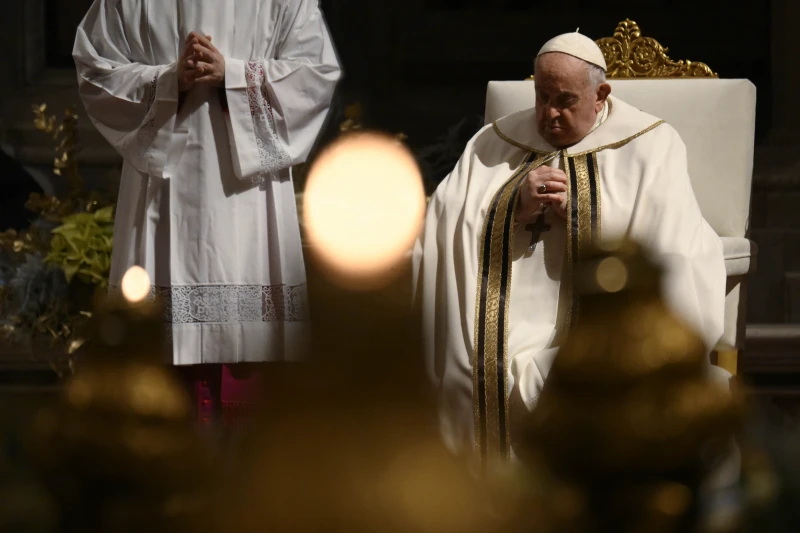
Pope Francis prays during Christmas Mass in St. Peter’s Basilica on Dec. 24, 2023. / Vatican Media
Vatican City, Dec 24, 2023 / 18:00 pm (CNA).
Below is the full text of Pope Francis’ homily for the Solemnity of the Nativity of the Lord, delivered on Dec. 24, 2023, in St. Peter’s Basilica.
“A census of the whole earth” (cf. Lk 2:1). This was the context in which Jesus was born, and the Gospel makes a point of it. The census might have been mentioned in passing, but instead is carefully noted. And in this way, a great contrast emerges. While the emperor numbers the world’s inhabitants, God enters it almost surreptitiously. While those who exercise power seek to take their place with the great ones of history, the King of history chooses the way of littleness. None of the powerful take notice of him: only a few shepherds, relegated to the margins of social life.
The census speaks of something else. In the Scriptures, the taking of a census has negative associations. King David, tempted by large numbers and an unhealthy sense of self-sufficiency, sinned gravely by ordering a census of the people. He wanted to know how powerful he was. After some nine months, he knew how many men could wield a sword (cf. 2 Sam 24:1-9). The Lord was angered and the people suffered. On this night, however, Jesus, the “Son of David”, after nine months in Mary’s womb, is born in Bethlehem, the city of David. He does not impose punishment for the census, but humbly allows himself to be registered as one among many. Here we see, not a god of wrath and chastisement, but the God of mercy, who takes flesh and enters the world in weakness, heralded by the announcement: “on earth peace among those whom he favors” (Lk 2:14). Tonight, our hearts are in Bethlehem, where the Prince of Peace is once more rejected by the futile logic of war, by the clash of arms that even today prevents him from finding room in the world (cf. Lk 2:7).
The census of the whole earth, in a word, manifests the all-too-human thread that runs through history: the quest for worldly power and might, fame and glory, which measures everything in terms of success, results, numbers and figures, a world obsessed with achievement. Yet the census also manifests the way of Jesus, who comes to seek us through enfleshment. He is not the god of accomplishment, but the God of Incarnation. He does not eliminate injustice from above by a show of power, but from below, by a show of love. He does not burst on the scene with limitless power, but descends to the narrow confines of our lives. He does not shun our frailties, but makes them his own.
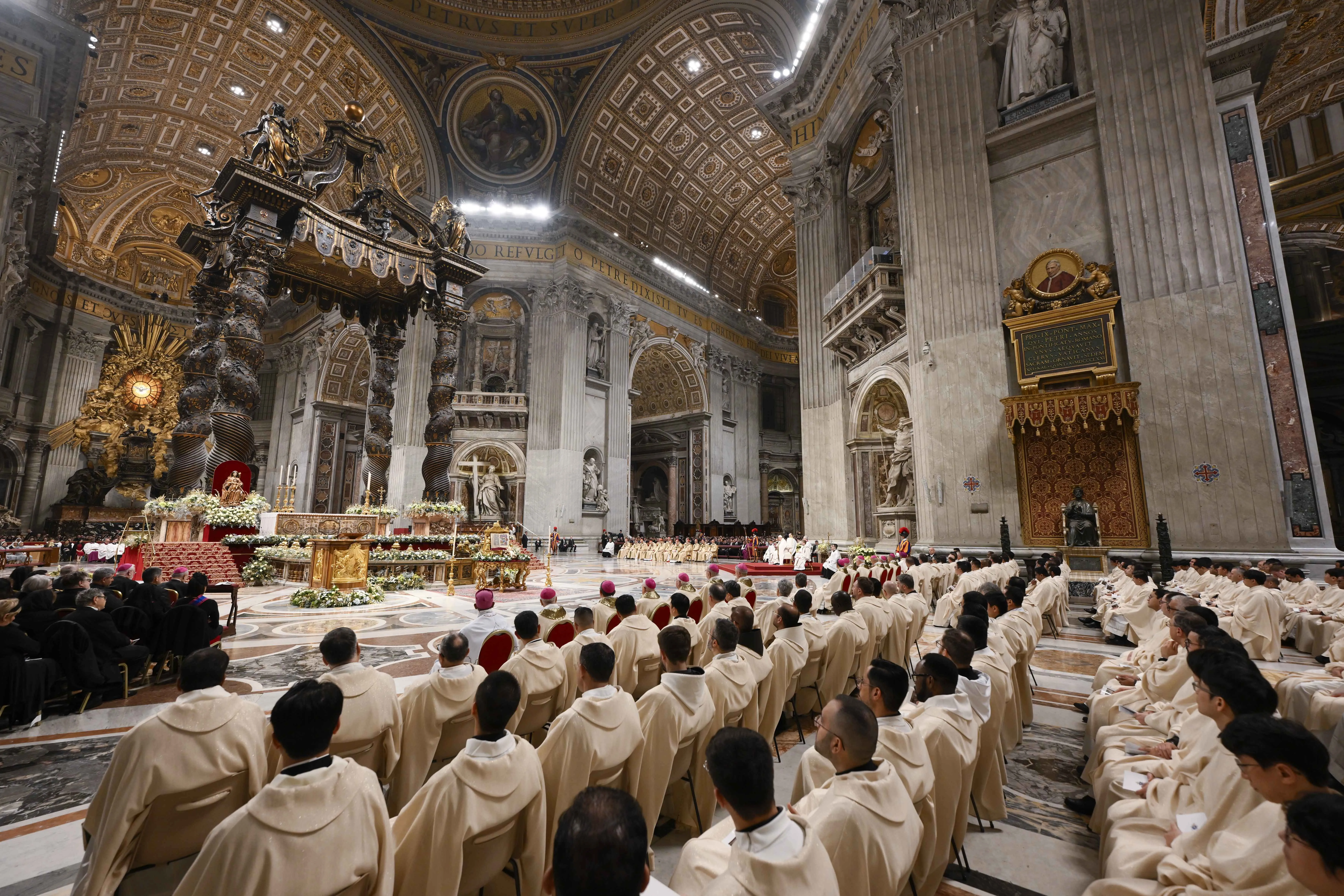
Christmas Mass in St. Peter’s Basilica on the night of Dec. 24, 2023. Vatican Media
Brothers and sisters, tonight we might ask ourselves: Which God do we believe in? In the God of incarnation or the god of achievement? Because there is always a risk that we can celebrate Christmas while thinking of God in pagan terms, as a powerful potentate in the sky; a god linked to power, worldly success, and the idolatry of consumerism. With the false image of a distant and petulant deity who treats the good well and the bad poorly; a deity made in our own image and likeness, handy for resolving our problems and removing our ills. God, on the other hand, waves no magic wand; he is no god of commerce who promises “everything all at once”. He does not save us by pushing a button, but draws near us, in order to change our world from within. Yet how deeply ingrained is the worldly notion of a distant, domineering, unbending, and powerful deity who helps his own to prevail against others! So many times this image is ingrained in us. But that is not the case: our God was born for all, during a census of the whole earth.
Let us look, then, to the “living and true God” (1 Thess 1:9). The God who is beyond all human reckoning and yet allows himself to be numbered by our accounting. The God, who revolutionizes history by becoming a part of history. The God who so respects us as to allow us to reject him; who takes away sin by taking it upon himself; who does not eliminate pain but transforms it; who does not remove problems from our lives but grants us a hope that is greater than all our problems. God so greatly desires to embrace our lives that, infinite though he is, he becomes finite for our sake. In his greatness, he chooses to become small; in his righteousness, he submits to our injustice. Brothers and sisters, this is the wonder of Christmas: not a mixture of sappy emotions and worldly contentment, but the unprecedented tenderness of a God who saves the world by becoming incarnate. Let us contemplate the Child, let us contemplate the manger, his crib, which the angels call “a sign” for us (cf. Lk 2:12). For it truly is the sign that reveals God’s face, a face of compassion and mercy, whose might is shown always and only in love. He makes himself close, tender, and compassionate. This is God’s way: closeness, compassion, tenderness.
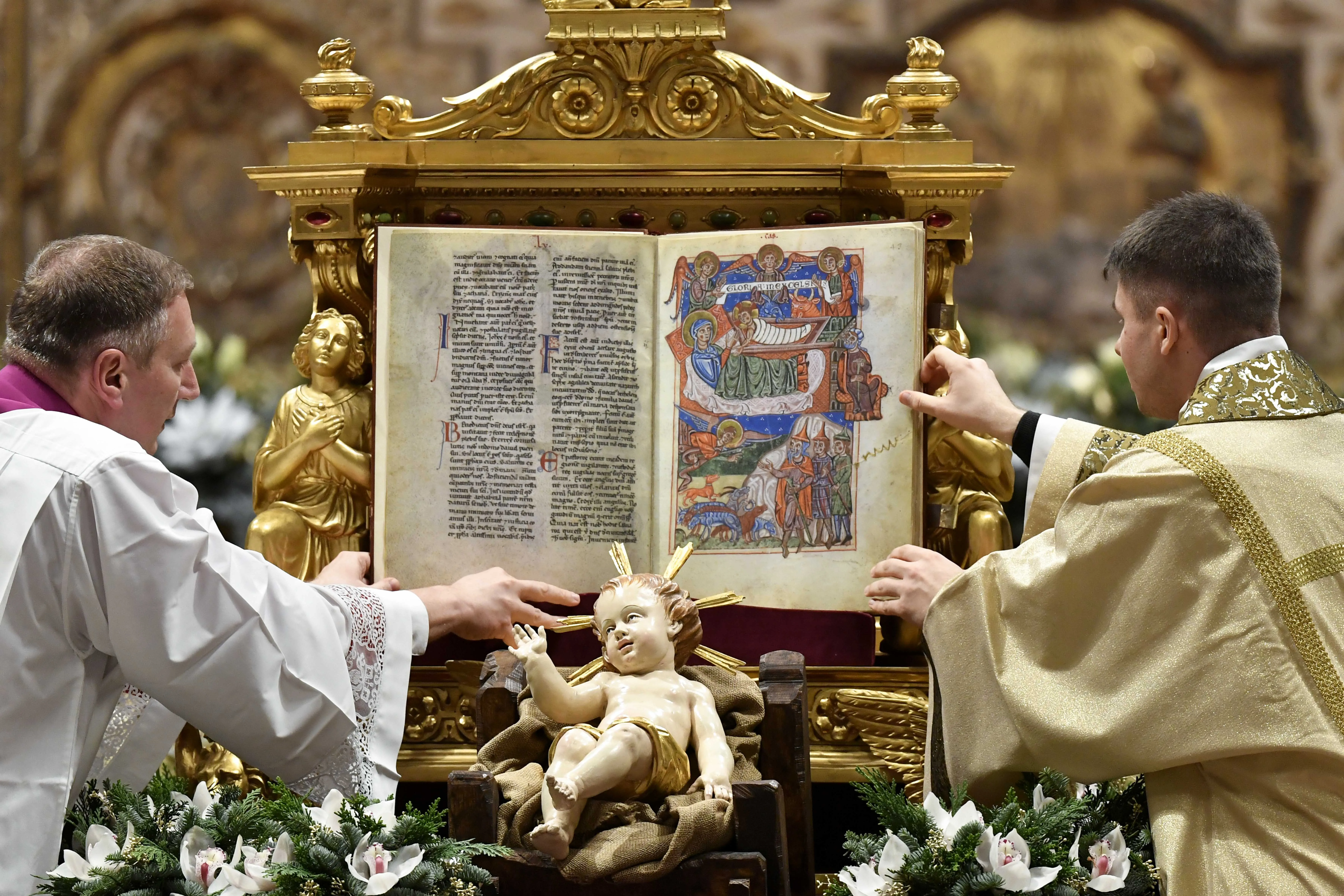
Pope Francis brings a figure of the Christ child over to the nativity scene inside of St. Peter’s Basilica at the end of Mass. Vatican Media
Sisters and brothers, let us marvel at the fact that he “became flesh” (Jn 1:14). Flesh: the very word evokes our human frailty. The Gospel uses this word to show us that God completely assumed our human condition. Why did he go to such lengths? Because he cares for us, because he loves us to the point that he considers us more precious than all else. Dear brother, dear sister, to God, who changed history in the course of a census, you are not a number, but a face. Your name is written on his heart. But if you look to your own heart, and think of your own inadequacies and this world that is so judgmental and unforgiving, you may feel it difficult to celebrate this Christmas. You may think things are going badly, or feel dissatisfied with your limitations, your failings, your problems, and your sins. Today, though, please, let Jesus take the initiative. He says to you, “For your sake, I became flesh; for your sake, I became just like you”. So why remain caught up in your troubles? Like the shepherds, who left their flocks, leave behind the prison of your sorrows and embrace the tender love of the God who became a child. Put aside your masks and your armor; cast your cares on him and he will care for you (cf. Ps 55:22). He became flesh; he is looking not for your achievements but for your open and trusting heart. In him, you will rediscover who you truly are: a beloved son or daughter of God. Now you can believe it, for tonight the Lord was born to light up your life; his eyes are alight with love for you. We have difficulty believing in this, that God’s eyes shine with love for us.
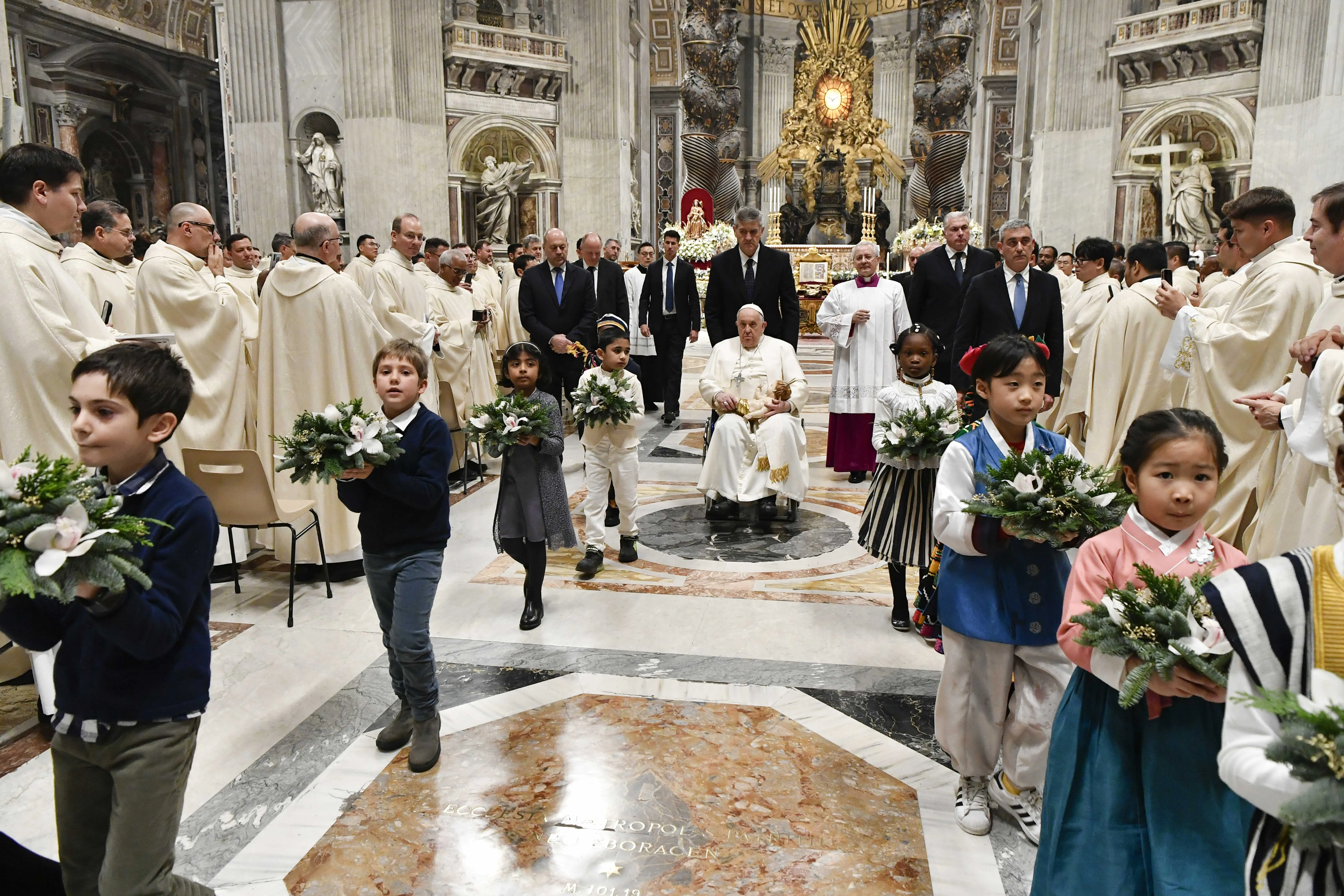
Christmas Mass in St. Peter’s Basilica on the night of Dec. 24, 2023. Vatican Media
Christ does not look at numbers, but at faces. However, who looks at him amid the many distractions and mad rush of a bustling and indifferent world? Who is watching? In Bethlehem, as crowds of people were caught up in the excitement of the census, coming and going, filling the inns, and engaged in petty conversation, a few were close to Jesus: Mary and Joseph, the shepherds, and then the Magi.
Let us learn from them. They stood gazing upon Jesus, with their hearts set on him. They did not speak, they worshiped. Tonight, brothers and sisters, is a time of adoration, of worship.
Worship is the way to embrace the Incarnation. For it is in silence that Jesus, the Word of the Father, becomes flesh in our lives. Let us do as they did, in Bethlehem, a town whose name means “House of Bread”. Let us stand before him who is the Bread of Life. Let us rediscover worship, for to worship is not to waste time, but to make our time a dwelling place for God. It is to let the seed of the Incarnation bloom within us; it is to cooperate in the work of the Lord, who, like leaven, changes the world. To worship is to intercede, to make reparation, to allow God to realign history. As a great teller of epic tales once wrote to his son, “I put before you the one great thing to love on earth: the Blessed Sacrament… There you will find romance, glory, honor, fidelity, and the true way of all your loves on earth” (J.R.R. TOLKIEN, Letter 43, March 1941).
Brothers and sisters, tonight love changes history. Make us believe, Lord, in the power of your love, so different from the power of the world. Lord, make us, like Mary, Joseph, the shepherds, and the Magi, gather around you and worship you. As you conform us ever more to yourself, we shall bear witness before the world to the beauty of your countenance.
CNA Staff, Jun 7, 2024 / 17:45 pm (CNA).
Archbishop Gregory Hartmayer of Atlanta was elected chairman of the board of the National Catholic Educational Association (N… […]
Discalced Carmelite sisters from the Mount Carmel Monastery in Port Tobacco, Maryland. / Screenshot from EWTN News In Depth
Denver Newsroom, Jul 21, 2022 / 16:00 pm (CNA).
Nestled in the farmland of Port Tobacco, Maryland stands the oldest Carm… […]
8 Comments
“Relief for celibates?” What happens when those “celibates” shortly thereafter become addicted to porn (and they will)? And where is the relief for the exploited women (and children perhaps?) acting in the porn?
Remove this guy from having any contact with with his “line of work” in the Catholic Church!
One wonders about Fr. Backhaus possibly counseling porn in the confessional, and if this advice constitutes “solicitation” and merits the canonical penalty of, what, excommunication?
And, who says he’s actually a psychologist? The more credible psychological insight is that addictions are an unhealthy response to a deeper and lacking sense of real belonging. A real psychologist-priest, especially, would be intent on healing the pain, not throwing gasoline of the fire.
Idiot. Maybe he should be laicized where he then could become an advisor to the like-minded German “synodal way.”
…the German priest says that ‘the consumption of explicit sexual representations can have a relieving effect, it can’t be denied.’
Choosing pornography rather than grace causes grace — the presence of God in the soul– to depart. The demons now have a place in which to dwell. Has the German priest not read the scripture on the legion of demons leaving the possessed man and entering swine which then commit mass suicide? Is this German priest an apostatic, rationalist, historicist who does not believe that this scripture says what it says? This cannot be denied except by those who choose demonic delusion.
Of greater concern of scandalous behavior is that of Fr Backhaus’ bishop Felix Genn of Munster. By what rationale does a Catholic bishop, Apostolic defender of the faith permit this priest to serve his diocese?
Perhaps the answer lies in Pope Francis’ 2013 removal of Cardinal Joachim Meisner from the Congregation for Bishops replacing Meisner with Genn.
“…the somewhat dirty connotation”
Oh my goodness. It would be hard to make this stuff up. You don’t know whether to laugh or cry. Maybe both I suppose.





“Relief for celibates?” What happens when those “celibates” shortly thereafter become addicted to porn (and they will)? And where is the relief for the exploited women (and children perhaps?) acting in the porn?
Remove this guy from having any contact with with his “line of work” in the Catholic Church!
One wonders about Fr. Backhaus possibly counseling porn in the confessional, and if this advice constitutes “solicitation” and merits the canonical penalty of, what, excommunication?
And, who says he’s actually a psychologist? The more credible psychological insight is that addictions are an unhealthy response to a deeper and lacking sense of real belonging. A real psychologist-priest, especially, would be intent on healing the pain, not throwing gasoline of the fire.
Idiot. Maybe he should be laicized where he then could become an advisor to the like-minded German “synodal way.”
The man’s a complete fool!
…the German priest says that ‘the consumption of explicit sexual representations can have a relieving effect, it can’t be denied.’
Choosing pornography rather than grace causes grace — the presence of God in the soul– to depart. The demons now have a place in which to dwell. Has the German priest not read the scripture on the legion of demons leaving the possessed man and entering swine which then commit mass suicide? Is this German priest an apostatic, rationalist, historicist who does not believe that this scripture says what it says? This cannot be denied except by those who choose demonic delusion.
Of greater concern of scandalous behavior is that of Fr Backhaus’ bishop Felix Genn of Munster. By what rationale does a Catholic bishop, Apostolic defender of the faith permit this priest to serve his diocese?
Perhaps the answer lies in Pope Francis’ 2013 removal of Cardinal Joachim Meisner from the Congregation for Bishops replacing Meisner with Genn.
“…the somewhat dirty connotation”
Oh my goodness. It would be hard to make this stuff up. You don’t know whether to laugh or cry. Maybe both I suppose.
What’s the difference between a German Priest and a Jesuit Priest? If you look hard enough you can still find faithful Jesuits.
The late Hugh Hefner approach in his pseudo-intellectual ‘philosophy’ where biology is manifest.