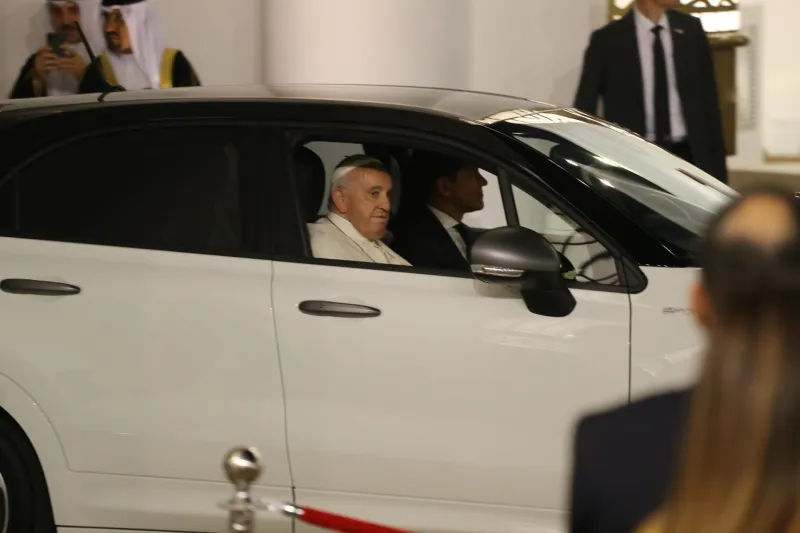
Pope Francis arriving in Bahrain, Nov. 3, 2022 / Daniel Ibáñez / CNA
Rome Newsroom, Nov 3, 2022 / 08:37 am (CNA).
Pope Francis landed in the Kingdom of Bahrain Thursday, becoming the first pope to visit the Muslim island nation located in the Persian Gulf.
On the flight from Rome Nov. 3, the pope told journalists aboard the papal plane it is “an interesting trip [that will] make us think about sharing good news.”
Francis, who usually walks around the plane to greet media members, said he was in a lot of pain, and asked journalists to approach him where he was seated instead.
Pope Francis is visiting Bahrain Nov. 3-6. Located to the east of Saudi Arabia and west of Qatar, the country has a total population of 1.5 million, according to a 2022 estimate by the CIA World Factbook.
There are around 161,000 Catholics in Bahrain, many of whom are migrants from Asia, particularly the Philippines and India, according to 2020 Vatican statistics. There are two Catholic churches and 20 Catholic priests.
The visit’s theme is “Peace on earth to people of goodwill,” inspired by Luke 2:14, and will include meetings with both Muslim leaders and the small Christian community.
The population is more than 70% Muslim, with the majority belonging to the Shiite branch of Islam, the country’s state religion.
Speaking to journalists aboard the flight Nov. 3, Cardinal Miguel Ángel Ayuso Guixot, president of the Pontifical Council for Interreligious Dialogue, said he hopes the papal visit will help improve the situation between Sunni and Shia Muslims in Bahrain.
While Shia Muslims are the majority of the population, Bahrain’s royal family belongs to the Sunni branch of Islam, leading to protracted sectarian tension in the country. Human rights groups have also accused the government of committing abuses against both the Shia majority and migrant workers, and of unfair imprisonments.
Cardinal Ayuso said Bahrain’s King Hamad bin Isa Al Khalifa is the only person in the country with the power to release Shia political prisoners. After landing in the country, Pope Francis’s first appointment will be a private meeting with the king.
The pope will also address members of the government and civil society on Nov. 3.
On the second day of the visit, the pope will give the closing speech at the Bahrain Forum for Dialogue: East and West for Human Coexistence.
Ahmed el-Tayeb, the grand imam of al-Azhar, is also traveling to Bahrain to participate in the forum with Pope Francis. The religious leaders most recently met in September at an interreligious summit in Kazakhstan.
Francis will meet privately with el-Tayeb before speaking to members of the Muslim Council of Elders at the mosque of Sakhir Royal Palace.
The day will close with an ecumenical meeting and prayer for peace in Our Lady of Arabia Cathedral, consecrated on Dec. 10, 2021. The ark-shaped Catholic cathedral seats 2,300 people and was built as part of a 95,000-square-foot complex.
On Nov. 5, Pope Francis will celebrate Mass at Bahrain National Stadium and meet with youth. His final morning, Nov. 6, will consist of a prayer meeting and Angelus with local Catholics at Sacred Heart Church in Manama.
Before leaving Rome, in the afternoon on Nov. 2, Pope Francis visited the Basilica of St. Mary Major to pray for the success of the trip through the intercession of Our Lady Salus Populi Romani.
It was Francis’ 100th visit to the historic Roman icon.
Alexey Gotovsky contributed to this report.
If you value the news and views Catholic World Report provides, please consider donating to support our efforts. Your contribution will help us continue to make CWR available to all readers worldwide for free, without a subscription. Thank you for your generosity!
Click here for more information on donating to CWR. Click here to sign up for our newsletter.
Harare, Zimbabwe, May 30, 2018 / 10:08 pm (CNA/EWTN News).- A group devoted to John Bradburne, a lay missionary to what is now Zimbabwe in the 1970s, is raising money to fund an investigation into his life and virtues, in view of opening his cause for beatification.
The group, led by Bradburne’s neice, Celia Brigstocke, hopes to raise GBP 20,000 ($26,600) for the investigation.
Bradburne was born in 1921 in England, the son of an Anglican clergyman. He served in the British army in World War II, and he converted to Catholicism in 1947 after staying with the Benedictines of Buckfast Abbey.
He wished to become a monk at Buckfast, but had not been long enough in the Church, and he became a wanderer throughout Europe and the Middle East. He was a prolific poet. He stayed at other Benedictine abbeys, with Carthusians, the Congregation of Our Lady of Sion, tried living as a hermit on Dartmoor in England, and became a Third Order Franciscan in 1956.
Through a Jesuit friend in the British colony of Southern Rhodesia (present-day Zimbabwe), Bradburne came to serve at the Mutemwa Leper Settlement, spending the last 10 years of his life there.
Southern Rhodesia declared independence in 1965, and the Rhodesian Bush War was fought from 1964 to 1979 among the white minority government; the Marxist Zimbabwe People’s Revolutionary Army; and the Zimbabwe African National Union (ZANU).
As ZANU forces approached Mutemwa, Bradburne was urged to leave, but he insisted on remaining. He was kidnapped, and murdered Sept. 5, 1979.
He had confided in a Franciscan priest that his wishes were to serve leprosy patients, to die a martyr, and to be buried in the habit of St. Francis.
The Catholic faithful gathered in the Cenacle in Jerusalem for the Mass of the Lord’s Supper that the Franciscan friars celebrated on Holy Thursday, March 28, 2024. The Cenacle is at the center of strong tensions and disputes regarding ownership and rights of access and celebration. An ancient tradition places King David’s tomb here and over the centuries Jews and Muslims have leveraged this to first expel the Franciscans and then to prevent Christian worship, which they deemed sacrilegious. / Credit: Marinella Bandini
Jerusalem, Mar 28, 2024 / 17:15 pm (CNA).
On Holy Thursday, the doors of the Cenacle in Jerusalem were opened to welcome the Franciscans of the Custody of the Holy Land. In this “Upper Room,” called the Cenacle in the Holy Land, Jesus had his Last Supper, washed his apostles’ feet, and instituted the Eucharist.
It was here that the Franciscans celebrated the Mass of the Lord’s Supper, reenacting those same gestures. (At the Basilica of the Holy Sepulcher, however, the celebration is held on Thursday morning due to the Status Quo. Here is Cardinal Pierbattista Pizzaballa’s homily from that Mass.)
Cardinal Pierbattista Pizzaballa, the Latin Patriarch of Jerusalem, kisses the feet of a Franciscan friar during the “Washing of the Feet” ritual at the Mass of the Lord’s Supper celebrated at the Holy Sepulchre on Holy Thursday. The celebration is held on Thursday morning due to the Status Quo. March 28, 2024. Courtesy of the Custody of the Holy Land
The custos of the Holy Land, Father Francesco Patton, presided over the Eucharistic celebration at the Cenacle. In his homily, before washing the feet of six teachers and six students from the Terra Sancta School in Jerusalem, he emphasized the value of the “new commandment” that Jesus gave to his apostles here: “As I have loved you, so you also should love one another” (Jn 13:34).
“To love means to give oneself and to serve,” he said. “In this celebration, we want to nourish ourselves with Jesus because if he is alive within us, then we too will become capable of loving one another as he loved us. And we also want to learn from Jesus not to be served but to serve.”
Some students from the Terra Sancta School in Jerusalem who took part in the “Washing of the Feet” ritual during the Mass of the Lord’s Supper celebrated at the Cenacle in Jerusalem on Holy Thursday, March 28, 2024. Addressing them specifically in his homily, the Custos of the Holy Land emphasized the value of the “new commandment” that Jesus gave to his apostles here: “As I have loved you, so you also should love one another” (John 13:34). Credit: Marinella Bandini
Holy Thursday is the only day, along with Pentecost Sunday, when the Franciscans have the right to gather in the Upper Room to pray. Usually, it is a liturgy of the word, but since 2021 they have celebrated Mass. Outside, Israeli Army personnel ensure security.
The Cenacle is at the center of strong tensions and disputes regarding ownership and rights of access and celebration. An ancient tradition places King David’s tomb here, and over the centuries, Jews and Muslims have leveraged this place to first expel the Franciscans and then to prevent Christian worship, which they deem sacrilegious.
Father Narciso Klimas, historian and archivist of the Custody of the Holy Land, explained to CNA: “The Custody has all the documents confirming our ownership of Mount Zion.” Even today, traces of Christian presence are visible, both in the architecture of the place and in some symbols.
“The presence of the Franciscans at the Cenacle,” Klimas explained, “dates back to 1342, but as early as 1333, the rulers of Naples, Robert of Anjou and Sancha of Majorca, acquired the land and donated it to the friars. This was the first headquarters of the Custody of the Holy Land.” To this day, the official title of the Custos of the Holy Land is “Guardian of Mount Zion and the Holy Sepulchre.”
Father Francesco Patton, custos of the Holy Land, incenses the altar at the beginning of the Mass of the Lord’s Supper that the Franciscan friars celebrated inside the Cenacle in Jerusalem on Holy Thursday, March 28, 2024. This is the only day, along with Pentecost Sunday, that the Franciscans have the right to gather here to pray. Usually, it is a liturgy of the word, but since 2021 they have celebrated Mass. Credit: Marinella Bandini
In 1421, a rabbi submitted a petition to the local emirs, claiming the right for Muslims and Jews to this place due to the presence of King David’s tomb. One hundred years later, Klimas continued, “the Ottomans used this argument to gradually expel the Franciscans, until in 1551 the sultan decreed the total expulsion of the Franciscans from Mount Zion.” The Cenacle first became a mosque and later, in the lower part, also a synagogue.
“Since then,” Klimas recounted, “the Franciscans have never stopped attempting to regain possession of the Cenacle. The friars have always tried to ensure a presence, at least on Holy Thursday and Pentecost, sometimes even with methods that are not exactly orthodox (such as bribing the local guardian).”
Something began to change in the 19th century, during the time of the Ottoman Sultan Abdülmecid. Since then, the Franciscans have had the right to pray at the Cenacle on Holy Thursday and Pentecost. After a failed attempt in the 1930s to regain control of it, the friars managed to purchase adjacent land where they built the convent of San Francesco “ad Coenaculum” (next to the Cenacle).
In 1948, with the founding of the State of Israel, the entire Mount Zion came under Israeli control, and until today, the Israeli state owns the entire complex of the Cenacle. The neighborhood has a strong Jewish religious character and is characterized by the presence of synagogues and rabbinical schools.
The Franciscan friars and the faithful in the Armenian Cathedral of St. James in Jerusalem after the Mass of the Lord’s Supper celebrated at the Cenacle. Here, the friars commemorate the hospitality they received here in the 16th century. After being expelled from the Cenacle, the Franciscans were welcomed by the Armenians for seven years while the convent of St. Saviour was purchased, to this day the headquarters of the Custody of the Holy Land. March 28, 2024. Credit: Marinella Bandini
“Even if the Cenacle cannot return to our hands,” Klimas explained, “we ask at least to celebrate regularly, even with pilgrims, without the need for special permits.”
Negotiations on these matters (taxation and property) have been ongoing for over 25 years between the Holy See and the State of Israel, following the signing of the Fundamental Agreement in 1993 and the agreement recognizing the legal personality of the Catholic Church in Israel in 1997.
Despite the slow pace of diplomatic negotiations, some practical progress can be observed informally. The ability to celebrate Mass on Holy Thursday at the Cenacle is among these developments. Permissions to access the site on other special occasions are usually granted without significant issues as well.
After the Mass at the Cenacle, as tradition dictates, the Franciscans proceeded in a procession to three churches in two other symbolic places: the Armenian churches of St. James and of the Holy Archangels (of the Armenian Apostolic Church), and the Syro-Orthodox Church of St. Mark.
The Franciscan friars and the faithful in the Armenian Church of the Holy Archangels in Jerusalem after the Mass of the Lord’s Supper celebrated at the Cenacle on March 28, 2024. Friars and faithful pray together and receive the blessing from the representative of the Armenian Apostolic Church. Credit: Marinella Bandini
This yearly visit commemorates the hospitality the friars received in the 16th century. After being expelled from the Cenacle, the Franciscans were welcomed by the Armenians for seven years while the convent of St. Saviour was purchased, to this day the headquarters of the Custody of the Holy Land. Friars and faithful prayed together and received the blessing from the representative of the Armenian Apostolic Church.
The Syriac Orthodox Church of St. Mark is said to be built on the house of Mary, the mother of the evangelist Mark. According to Syriac tradition, this is the place where Jesus had the Last Supper. Here as well, those present prayed together and were able to listen to the Lord’s Prayer sung in Aramaic by one of the monks, who then gave a blessing.
The Franciscan friars and the faithful in the Syro-Orthodox church of St. Mark in Jerusalem after the Mass of the Lord’s Supper celebrated at the Cenacle on March 28, 2024. According to Syriac tradition, this is the upper room where Jesus had the Last Supper. Here as well, those present pray together and listen to the Lord’s Prayer sung in Aramaic by one of the monks, who then gives the blessing. Credit: Marinella Bandini
May God bless all the inhabitants living and working in the Kingdom of Bahrain.