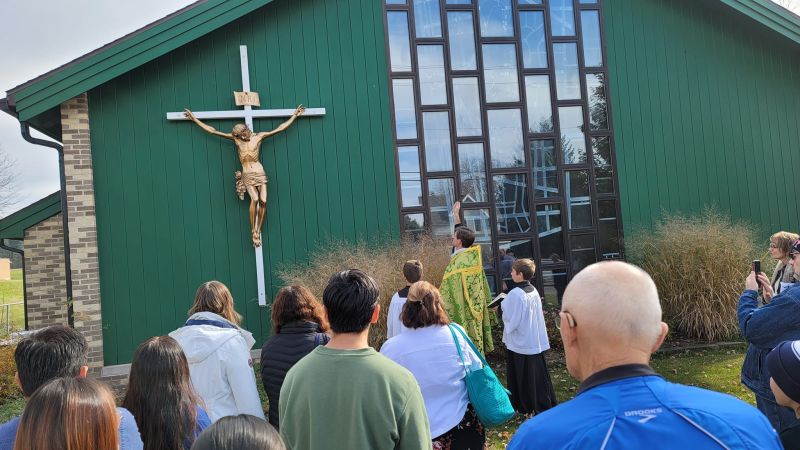
 St. Patrick’s Church in Cottage Grove, Wisconsin / St. Patrick’s Facebook page
St. Louis, Mo., Apr 3, 2023 / 14:00 pm (CNA).
The Diocese of Madison clarified late last week that the Church does not endorse nor oppose specific political candidates after a Wisconsin pastor urged parishioners in his weekly parish bulletin message to vote against state Supreme Court candidate Janet Protasiewicz, who is openly pro-abortion.
“The Catholic Church’s involvement in public life doesn’t extend to endorsing candidates for election to public office nor calling for their defeat and thus refrains from partisan political activities. The Church does encourage voter registration and encourages Catholics, as citizens, to vote and to be civically engaged,” the diocese said in a statement sent to CNA.
“However, the Church also has both a duty and a right to call attention to the moral and religious dimensions of public issues, measuring social policies and political activities against the natural moral law and Gospel values. Since the first century, the Church has consistently affirmed the moral evil of every procured abortion. Direct abortion, that is to say, abortion willed either as an end or a means, is gravely contrary to the moral law in its respect for all human life.”
The diocese’s response comes after Father Brian Dulli, pastor of St. Patrick’s Church in Cottage Grove, Wisconsin, urged his parishioners to vote against the pro-abortion candidate in Tuesday’s Wisconsin Supreme Court election, a race that observers say could have major effects on the legality of abortion in the state.
As reported by Wisconsin Public Radio, an attorney with the activist group Freedom from Religion Foundation, which is based in Madison, wrote to the IRS last week to complain about the bulletin, asking the IRS to revoke St. Patrick’s 501(c)3 nonprofit status.
The April 4 election is between former Wisconsin Supreme Court Justice Daniel Kelly and current Milwaukee judge Protasiewicz. Protasiewicz has spoken openly about her pro-abortion views while insisting that she has made “no promises” to pro-abortion groups that she will seek to overturn the state’s current abortion ban.
In a March 26 parish bulletin, Dulli urged Catholics not to vote for Protasiewicz, saying she has “tried to make this race entirely an effort to legalize abortion in the state of Wisconsin.”
“Abortion is the intentional taking of a human life. It is murder. Our Catholic faith is clear that this is grave sin. It should never be controversial among Catholics to say that you can never intentionally take any action that knowingly will help in the taking of a human life. You cannot publicly support abortion or abortion advocates and remain a Catholic in good standing,” Dulli wrote.
“As a Catholic, I urge you, for the salvation of your soul; do not vote for her [Protasiewicz] in the Supreme Court race on April 4,” he continued.
“I encourage you to study the race carefully and form you [sic] conscience correctly in accordance with the truths of the Catholic faith.”
In his April 2 bulletin message, Dulli acknowledged that the March 26 bulletin “got much more exposure than usual” and reiterated that “given a choice between any two people, we must say ‘absolutely not’ to the person who says abortion should be on the table.”
“We need to say no to a system that demands human sacrifice of the unborn be on the table. Jesus said that we will be judged by what we do to the least among us. Babies are the littlest and least. If someone consents to the killing of unborn children, they will not stop at the destruction of you or your family,” Dulli wrote.
“Haven’t we seen enough destruction now to know it?”
Reached by CNA on Monday, Dulli declined to comment further, saying he believes the situation has been “talked about enough.”
What’s Tuesday’s election all about?
The 2023 Wisconsin judicial race, which might have remained obscure in other years even within Wisconsin, is garnering national media attention and record fundraising numbers for the candidates. The reasons have to do with a prediction — both among pro-life and pro-abortion groups — that the winner of the election could tip the scales in Wisconsin when it comes to the state’s current abortion ban.
Wisconsin is the only state in the nation with a pre-Roe v. Wade abortion ban in effect, at least on paper. Wisconsin’s ban, which is contained in Section 940.04 of the Wisconsin Statutes and dates to 1849, allows abortion only to save the life of the mother. The state’s Democratic governor and attorney general have said they will not enforce the ban and are currently suing in an attempt to have it overturned.
The law was previously unenforceable following the Roe v. Wade decision in 1973, but Roe’s overturning last year allowed the statute to come into effect. So far, it has not been blocked in court, as has happened with pre-Roe bans in West Virginia and Michigan.
Pro-abortion groups within and outside Wisconsin have identified the state Supreme Court race as the key to getting 940.04 overturned. Gov. Tony Evers, along with Wisconsin Attorney General Josh Kaul, announced a lawsuit last year to attempt to overturn the law, arguing that it has been superseded by subsequent legislation and cannot be enforced.
The lawsuit is likely to be ultimately decided by the state Supreme Court, which has had a 4-3 conservative majority for the past decade and a half. The current election will determine who will sit in the open seat being vacated by retiring conservative justice Patience Roggensack. The winner will serve a 10-year term.
Pro-life advocates worry that should the state Supreme Court obtain a pro-choice majority, the state’s pre-Roe ban could be declared unconstitutional, as happened last year in neighboring Michigan.
Who are the candidates?
Kelly is a former Wisconsin Supreme Court justice who served on the court from his appointment by then-Gov. Scott Walker in 2016 until he was voted out in 2020. He describes himself as a “constitutional conservative” and on his campaign website charges that his opponents are “judicial activists who seek to impose their own political agenda on our state.”
Amid a contentious campaign, Kelly has earned the endorsement of three statewide pro-life groups — Wisconsin Family Action, Pro-Life Wisconsin, and Wisconsin Right to Life. He said during a recent debate that his numerous endorsements from pro-life groups came about after having conversations with them about his pledge to uphold the Constitution, not because of any promise to keep the abortion ban in place.
In contrast, Protasiewicz has garnered endorsements from numerous top Democrats in Wisconsin as well as from pro-abortion groups such as NARAL, Planned Parenthood, and EMILY’s List. Protasiewicz currently is a judge for Branch 24 of the Milwaukee County Circuit Court in Wisconsin, having been elected to that court in 2014.
Protasiewicz has insisted she has made “no promises” to pro-abortion groups such as Planned Parenthood and EMILY’s List but also has made no bones about her pro-choice views. “My personal opinion is that [it] should be the woman’s right to make the reproductive health decisions, period,” she said during a March 21 debate.
What have Catholic leaders said?
At least two of the state’s bishops, including Bishop Donald Hying of Madison, have reiterated to Catholics that the right to life is a foundational issue that should form their consciences as they decide how to vote on Tuesday.
“Without the right to be born and to live, every other right is worthless,” Hying wrote in a March 30 letter.
“Do we want to live in a country that welcomes the wonder of every human life, supports marriages and families, helps the needy and suffering, seeks justice for all, and builds a civilization of love, or, do we want a society which aborts its children, leaves struggling parents without support, and lives a radical autonomy with no reference to the dignity of life and the common good? Do we elect civic leaders who stand on the unshakeable moral principle that every human life is sacred and of immeasurable worth, or, do we elect those who disregard the fundamental dignity of life and advocate for taking the life of the most innocent in the womb? Such questions we should ask ourselves as we exercise our moral and civic duty to vote.”
Archbishop Jerome Listecki of Milwaukee also issued a letter, dated March 28, urging Catholics to vote for candidates that uphold the right to life.
“The killing of the innocent has never been supported by Catholic Church teachings. As citizens, we have an obligation to support the laws that protect the innocent. We must take our responsibility, as citizens before God’s judgment, for the times we have supported the destruction of the innocent. We must also take responsibility for the lack of support for the protection of the innocent when we vote for candidates and laws that liberalize abortion laws,” Listecki wrote.
“There is nothing enlightened about an individual who fails to realize that the denial of the right to life for the most vulnerable among us is an attack on the dignity and personal value of every citizen. I could not and would not support a candidate whose position on life is contrary to the teachings of the Church — a position contrary to the teachings and love of Jesus.”
[…]






In Metaphysics and Theology (item #6), Michael Hanby concludes this about rebuilding (not simply restoring) access to reality: “It will mean keeping alive the memory of what it has meant to be human and coming to terms with the real depths of what we no longer believe, that its ubiquitous presence might be rediscovered in the longing engendered by its apparent absence.”
On this insight, and as an aid to “memory”, Whittaker Chambers offered this:
“It is idle to talk about the wreck of Western civilization. It is already a wreck from within. That is why we can hope to do little more now than snatch a fingernail of a saint from the rack or a handful of ashes from the faggots, and bury them secretly in a flowerpot against the day, ages hence, when a few men begin again to dare to believe that there was once something else, that something else is thinkable, and need some evidence of what it was, and the fortifying knowledge that there were those who, at the great nightfall, took loving thought to preserve the tokens of hope and truth”(Whittaker Chambers, author of “Witness,” 1952; in a letter to William Buckley, August 5, 1954, in the collection “Cold Friday,” 1964).
@Metaphysics and Theology. De Lubac’s view, “If traditionalism is a kind of ‘extrinsicism from above’ that pretends to view history from without and thereby fails to comprehend it, historicism is a kind of ‘extrinsicism from below’ that eliminates every form of transcendence—God, being, nature, an ontological conception of truth—from both its apprehension of the world and its order of intellectual operations” has similarity to Blondel although appears the more concise, apparently viable insight [as compared to a presumably more liberal minded Blondel who advocates a middle position].
Extrinsicism is emphasis on external praxis to the detriment of comprehending the principles determining praxis. As de Lubac perceives historicism’s elimination of God, being et al and Hanby in politics. Old hand Krauthammer understood this, “Politics, the crooked timber of our communal lives, dominates everything because, in the end, everything lives or dies by politics. You can have the most advanced and efflorescent of cultures. Get your politics wrong, however, and everything stands to be swept away. Politics is the moat, the walls, beyond which lie the barbarians” (Charles Krauthammer Things That Matter).
Although I believe Hanby may have got it wrong. If he perceives traditionalism to include a traditional theological political posture. A true traditional [person] is the opposite of the definition of extrinsicism. Because it’s the very comprehension and living interiorly principles that motivate his practice.
@”There is no hope for it, that is, unless we are able to ‘comprehend on our own time on thought’ in the light of a truth, a Logos, that transcends all times” (Hanby). Michael Hanby is clearly correct. Although, the impression is his favor of Maurice Blondel’s middle road extrinsicism and historicity.
While his final commendation is correct, a renewal of the Catholic mind, that does not require an ingenious intellectual diagram, ‘to comprehend on our own time on thought’. Rather, simply put, all that’s required is actually being Catholic.