Vatican City, Sep 27, 2020 / 06:53 am (CNA).-
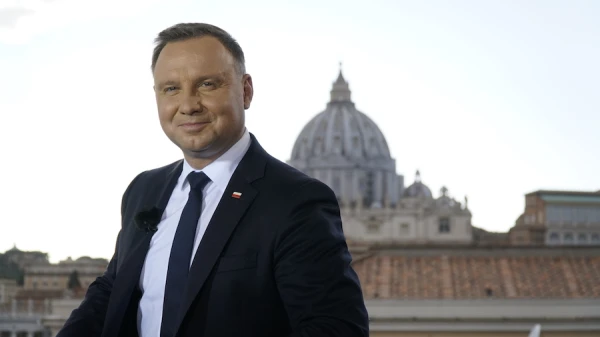
On Sept. 25, EWTN News spoke with Poland’s President Andrzej Duda, who met with Pope Francis during a visit to Rome.
Duda spoke about his own Catholic faith, Pope St. John Paul II, secularization, and his efforts to promote the family.
Below is the full text of that interview:
President Duda, you grew up in the south of Poland in a Catholic family. How was your life of faith in the family, how did you live the Catholic faith and how have you brought that to your presidency? Has it been a challenge?
Indeed I was raised in a family that has always been Catholic, for generations. That’s the type of family I grew up in. This connection to the Church, to the Catholic Christian community, was always a fact, from the beginning of my life. And it always was very important in my home for my parents and grandparents. As a child I was an altar boy. I served Mass at church in Krakow and in Stary Sacz, where my father was born, where my grandparents used to live at that time. I simply grew up in this atmosphere. This was always important. And you could easily say that I was absorbing these values.
Christian values form the deep, deep, deep history of Poland because in Stary Sacz there is a monastery established by St. Kinga, many centuries ago. And this tradition still remains. This tradition of this very uncommonly strong Catholicism – I would say a conservative Catholicism – because there is a Poor Clare monastery – and they are cloistered nuns. So, this Catholicism there is very, very strong.
Tell me about your specific devotion to St. Bobola and to other saints in Poland.
I can tell you openly that I was born on May 16, 1972 which is the feast day of St. Andrew Bobola. And, among other reasons, it was because it was the feast of St. Andrew Bobola that my parents gave me the name Andrew in order for St. Andrew Bobola to be my patron saint.
So, there is this special attachment and later I grew up in this particularly patriotic atmosphere. I was active in boy scouts, who were very patriotic. St. Andrew Bobola was a man who died not just for the faith. Not only was he violently murdered by Cossacks because he was a Catholic clergyman but he also died for Poland and Polish ideals, so you could say that he was a believer, a priest and a patriot.
You’re also from Krakow. John Paul II was there for many years. What was your relationship with John Paul II?
We call this generation of ours, the generation of kids who were born in the 70s and the beginning of the 80s and also those born in the 60s, “the JPII generation”… John Paul the Second. We grew up with the pilgrimages of the Holy Father. And Krakow was the place that the Holy Father, during the history of his pontificate visited most often. It was, after all, his city. He was the metropolitan of Krakow and the cardinal of Krakow before he became pope. He especially loved to meet the youth in Krakow.
He always had time for the youth and we as children were brought by our parents to meetings with him and then as young people we went by ourselves underneath the famous papal window on Franciszkanska Street and to the fields of Krakow where he said the Holy Masses, attended by millions of people. And this was always incredible. And the Holy Father did the greatest thing you could do for the Poles at that time, namely, he showed to my parents’ generation how many people in Poland think alike.
During the dark time of communism, in 1979, he came on a pilgrimage to Poland and people gathered and saw that there were millions of them. And that millions of these people are of the faith and they think alike. They were listening to him at that time. And it was the beginning of the changes in Poland.
After that, in 1980, Solidarnosc was created. This year we are celebrating the 40th anniversary of Solidarnosc. And that was the beginning of the end of communism. Despite the imposition of martial law, all of this could not be stopped. The Holy Father was here [in Rome] and was vigilant all the time. And that’s how we have freedom, because of him. There’s no doubt about it.
You’ve made defending and promoting the traditional family a big part of your platform in Poland. You spoke about it with the pope today. You took part in a march for the family back in Poland earlier this week. If we look at your policies, you’re constantly defending the family and this is in the face of the European Union which often speaks poorly of Poland for defending this values, speaking in other terms, asking for you to take on abortion rights or defend same sex marriage, or other things like this. What do you think the European Union is asking of you, personally and as a president, and what is Poland’s response?
You are touching on a very important issue.
The family in my presidency and in my life has an immense value and in my view of the state, every state, but first of all obviously the Polish State. What is there to say but that there is no nation, no State without a family that has children, which in turn causes the renewal of generations, which means that the nation remains and it can create a State. So, if someone thinks of himself as a Polish patriot, if someone thinks that Poland should remain, that our nation should exist, then there should be no doubt that the family in all of this has a fundamental meaning. That’s how I approach this.
I try to proclaim these views not just in Poland, and build this legal and systemic framework so that the family can grow best, have the most children, be supported by the Polish state, just as the Polish Constitution stipulates.
The Polish Constitution orders the State to particularly defend the family.
Marriage, according to the Polish Constitution, is a union between a man and a woman. And the parents have the right to raise the children according to their convictions. These are the fundamental rights written into the Polish constitution. So, I only act according to the Polish constitution. And I do not hesitate to talk about it at the European Union. But I work, I serve Poland, that is my duty. And how politicians in other countries, other presidents approach this, that’s their prerogative. And it’s their societies who hold them accountable. That’s my approach. And this is also a Christian approach.
And this is, in my opinion, the most deeply correct approach.
You made news for picking up a host that fell on the ground during Mass, the Eucharist when it fell on the ground. We saw that across the world. You’ve also made it a point to defend the Eucharist. There’s an artistic performance in Spain that’s desecrating the hosts, the Eucharist and Poland has sent a representative to the Human Rights Court of Europe to defend [the Eucharist]. How is this part of your policies?
Our religion tells us to be docile. Our Catholic religion tells us even to love our enemies. This is what Jesus taught us. This is very difficult, but everyone should try and every one of us should live as best as possible.
And I think this is abused by various sorts of performers who are inimical to Christianity and Catholicism. And you gave an example of that. He knows that he can afford to do that because Catholics, Christians will not hurt him in any way because of that. And so he has this cheap courage.
The birthrate in Poland is rising after some efforts that you’ve made, but only slightly and it’s still not at the point where it will replace itself, the population of Poland. You also are promoting family, education, you spoke about that with the Pope today as well. What’s the long game in Poland for defending Poland against the secularization that’s happening across Europe and how are you going to carry that out?
I told the Holy Father today that I believe that at this time when from all sides we are being pushed by this anti-Catholic, anti-Christian propaganda – some would say liberal leftist [propaganda], where there is this very strong pressure to imbue other values, especially into the young people, completely opposite to the values that we read about in the Sacred Scriptures, the Bible – it is simply our duty as people of faith to pronounce our values steadfastly, constantly and unceasingly and try with all our strength to stem these other currents which in my conviction destroy the traditional family, destroy the human being as it is best understood. They disrupt traditional upbringing. I think we should [pronounce our values] despite everything, do our duty, and that’s what I do.
How are you working with other neighboring countries to defend Christianity, also in places where it is persecuted?
Many times, also in the European parliament, I participated in passing various acts of declarative character but also legislative ones pertaining to the defense of Christians, especially in the Middle East where they are in danger or in Asia, southeast Asia, there are many such places where people are being persecuted for their religious beliefs, but Poland right now, as it is governed by the United Right [coalition], while I am president we really pay close attention to that.
We are now a member of the Human Rights Council. We pay attention to these issues. We were the non-permanent member of the security council of the UN. And, a year ago, we passed a resolution pertaining to those who are being persecuted for their religious beliefs. We stress this problem because we believe we have to talk about it.
President Duda also offered a message to the viewers of EWTN Polska:
Heartfelt greetings to all the viewers of EWTN Poland. Thank you for watching Catholic television. I think that this TV station carries the values that are important for us. Here in this place, our Holy Father John Paul II served God, the Church and Poland. This year we celebrate the 100th anniversary of his birth. I would like you to sometimes take in your hand the sermons the Holy Father gave us, his words he spoke to us. I would like you to sometimes look on the Internet and on YouTube or some other channels find the words spoken by the Holy Father, because it is important to remind ourselves of them in order to know what path we Poles, we people of faith, we Catholics, should follow through life. I very cordially invite you to do that. Thank you for your attention, thank you for listening. All the best, everybody.

[…]




Why does the Holy Father NOT insist on the advance of the pro-life agenda and the whole-life agenda and NOT insert those agendas on their own account, when he collaborates with the anti-life and abortionist forces?
And why is he exclusionist when he collaborates with them?
https://www.lifesitenews.com/news/vatican-reaffirms-commitment-to-paris-climate-agreement-despite-inclusion-of-pro-abortion-agenda/?utm_source=featured-news&utm_campaign=catholic
Hopefully I am wrong, but I fear a little of Martin Luther’s ‘Sin Boldly’, “sin can separate us from Him, even if we were to kill or commit adultery a thousand times each day”, creeping into Pope Francis’ homily.
“For only the Lord can give us confirmation of what we are worth. He tells us this every day from the cross: he died for us, to show us how precious we are in his eyes. There is no obstacle or failure that can prevent his tender embrace,” he said.
Anyway, let’s look at what Jesus told St. Faustina through locution. Jesus has given the passwords of Jesus’ Divine Mercy, to His ‘Representatives’ who are our Catholic Priests, and they are to use Jesus’ passwords to absolve us of our sins, in Jesus’ Sacrament of Reconciliation. According to Jesus, in His locutions to St. Faustina, the near future does not look very good for anyone who does not go to Confession.
“At the end of his general audience, Pope Francis recalled that the Church celebrates the feast of Saint Faustina Kowalska on Oct. 5. “Through her, God directed the world to seek salvation in his mercy…””
Divine Mercy in My Soul, 1146
Write: before I come as a just Judge, I first open wide the door of My mercy. He who refuses to pass through the door of My mercy must pass through the door of My justice.
Divine Mercy in My Soul, 1448
Tell souls where they are to look for solace; that is, in the Tribunal of Mercy (the Sacrament of Reconciliation). There the greatest miracles take place (and) incessantly repeated. To avail oneself of this miracle, it is not necessary to go on a great pilgrimage or to carry out some external ceremony; it suffices to come with faith to the feet of My representative and to reveal to him one’s misery, and the miracle of Divine Mercy will be fully demonstrated. Were a soul like a decaying corpse so that from a human standpoint, there would be no (hope of) restoration and everything would already be lost, it is not so with God. The miracle of Divine Mercy restores that soul in full. Oh, how miserable are those who do not take advantage of the miracle of God’s mercy! You will call out in vain, but it will be too late.
Divine Mercy in My Soul, 965
Jesus looked at me and said, Souls perish in spite of My bitter Passion. I am giving them the last hope of salvation; that is, the Feast of My Mercy. If they will not adore My mercy, they will perish for all eternity. Secretary of My mercy, write, tell souls about this great mercy of Mine, because the awful day, the day of My justice, is near.
Divine Mercy in My Soul, 635, The Blessed Virgin Mary
you have to speak to the world about His great mercy and prepare the world for the Second Coming of Him who will come, not as a merciful Savior, but as a just Judge. Oh, how terrible is that day! Determined is the day of justice, the day of divine wrath. The angels tremble before it. Speak to souls about this great mercy while it is still the time for [granting] mercy. If you keep silent now, you will be answering for a great number of souls on that terrible day. …
Divine Mercy in My Soul, 699
I desire that the Feast of Mercy be a refuge and shelter for all souls, and especially for poor sinners. On that day the very depths of My tender mercy are open. I pour out a whole ocean of graces upon those souls who approach the fount of My mercy. The soul that will go to Confession and receive Holy Communion shall obtain complete forgiveness of sins and punishment. On that day all the divine floodgates through which grace flow are opened. Let no soul fear to draw near to Me, even though its sins be as scarlet.
Divine Mercy in My Soul, 299-300
I desire that the first Sunday after Easter be the Feast of Mercy. Ask of my faithful servant [Father Sopocko] that, on this day, he tell the whole world of My great mercy; that whoever approaches the Fount of Life on this day will be granted complete remission of sins and punishment.
Divine Mercy in My Soul, 848
Write down these words, My daughter. Speak to the world about My mercy; let all mankind recognize My unfathomable mercy. It is a sign for the end times; after it will come the day of justice.
Divine Mercy in My Soul, 1728
Tell sinners that no one shall escape My Hand; if they run away from My Merciful Heart, they will fall into My Just Hands.
http://www.apocalypseangel.com/married.html
Meaningless, contradictory, shallow, New Age blather… a spiritual “hack” indeed.
You echo the words of the teacher.
Ecclesiastes 1:2 Meaningless! Meaningless! says the Teacher, vanity of vanities! Everything is meaningless.
Yet, you will want to know that God speaks to you personally:
Psalm 14:1 To the choirmaster. Of David. The fool says in his heart, “There is no God.” They are corrupt, they do abominable deeds, there is none who does good.
Romans 1:21- For although they knew God, they did not honour him as God or give thanks to him, but they became futile in their thinking, and their foolish hearts were darkened. Claiming to be wise, they became fools,
What a scathing indictment, not at all complimentary, yet there is hope.
Matthew 11:28 Come to me, all who labor and are heavy laden, and I will give you rest.
John 6:37 All that the Father gives me will come to me, and whoever comes to me I will never cast out.
May the Lord draw near to you and bless you.
Jesuits, after a 200-year history of admirable Catholic witness, were set upon by rationalists and were unable to master them and repel the onslaught. They could not meet the rigorous demands that presented, let alone shore up the examples of their own martyrs; and so eventualities overtook them and they got suppressed. They lost that battle and needless-to-say many souls that went down miserably.
One of the lessons they have to draw from that is, they were effectively protected by the Russian and Prussian Monarchies. There are other lessons I could identify but I am not Jesuit; and really and truly that is a work proper to them.
Let them catch the wind I am raising.
Which was worse for them, being taken by surprise or being suppressed? Being outmoded or being outdone? And both occurring simultaneously in those past days and confecting together to the same end -being victim or being prey?
https://www.catholicnewsagency.com/news/252482/pope-francis-saints-do-not-come-from-a-parallel-universe
Saint Faustina Kowalska – Pray for us.
What is this one may postulate? Another may ask, did Saint Faustina die for our sins?
Where is the Lord Jesus, someone may inquire, has he been left outside?
1 Timothy 2:5 For there is one God, and there is one mediator between God and men, the man Christ Jesus,
Ephesians 6:18 Praying at all times in the Spirit, with all prayer and supplication. To that end keep alert with all perseverance, making supplication for all the saints,
Matthew 6:9-13 Pray then like this: “Our Father in heaven, hallowed be your name. Your kingdom come, your will be done, on earth as it is in heaven. Give us this day our daily bread, and forgive us our debts, as we also have forgiven our debtors. And lead us not into temptation, but deliver us from evil.
1 John 5:14-15 And this is the confidence that we have toward him, that if we ask anything according to his will he hears us. And if we know that he hears us in whatever we ask, we know that we have the requests that we have asked of him.
What think you Sir? Is our fidelity to Jesus or is He a merely a footnote from a bygone era?
May the Lord bless you with wisdom and the peace that passes all understanding.