 Pope Francis says Mass in St. Peter’s Basilica, Dec. 24, 2021 / Vatican Media
Washington, D.C. Newsroom, Jan 5, 2022 / 17:00 pm (CNA).
“And I keep my Christmas lights on, on my front porch all year long/and I know all the words to every Charlie Daniels song…”
While Gretchen Wilson was probably (hopefully?) not being literal in the lyrics to her 2004 Grammy Award-winning single “Redneck Woman,” she actually has a bit of a point. There’s nothing wrong with keeping the Christmas decorations up longer than December and keeping the Christmas spirit flowing past December 25.
But just how many days is Christmas? When should you finally take those lights off the porch, or remove the tree? Read on for some of the arguments for and against commonly agreed-upon end dates for Christmas.
“Christmas is one day”
This, of course, is the simplest answer. Christmas is typically celebrated on Dec. 25 for most of the world, and on Jan. 7 for Churches using the Julian calendar, and on Jan. 6 for yet another, considerably smaller, part of the world. On this day, the liturgy celebrated is the “Feast of the Nativity of Our Lord.” Priests wear white vestments on Christmas, which is different from the violet they wear during Advent.
So there you have it. Christmas is one day, either at the end of December or in the first week of January.
Or is it?
“Christmas is eight days”
There’s also an argument to be made that Christmas is eight crazy nights eight days long. The Church regards Christmas as an octave, or eight-day celebration. The octave of Christmas begins on the Feast of the Nativity of Our Lord and concludes on the Solemnity of Mary, Mother of God on Jan. 1.
During the eight days of Christmas, clergy wear white, except during the St. Stephen’s Day and the Feast of the Holy Innocents, when they wear red.
In a liturgical sense, Christmas is eight days.
But wait, there’s myrrh!
“Christmas is 12 days”
We’ve all heard the Christmas carol “Twelve Days of Christmas.” While it’s unclear as to why someone would give someone 23 separate birds, a pear tree, and the services of 50 people over a 12-day period, there actually is a liturgical precedent for claiming that Christmas is 12 days long.
Twelve days after Christmas is the Feast of the Epiphany. This day marks when the Magi arrived to Jesus, Mary, and Joseph, and gave Jesus the gifts of gold, frankincense, and myrrh.
In the Latin Rite of the Catholic Church, Epiphany celebrates the revelation that Jesus was the Son of God. It focuses primarily on this revelation to the Three Wise Men, but also in his baptism in the Jordan River and at the wedding at Cana.
In the Eastern rites of the Catholic Church, Theophany – as Epiphany is known in the East – commemorates the manifestation of Jesus’ divinity at his Baptism in the River Jordan.
But here’s where it gets a little confusing: While the traditional date for the feast is Jan. 6, in the United States, the celebration of Epiphany is moved to the second Sunday after Christmas in the Novus Ordo.
During the 12 days of Christmas, clergy wear white, except during the St. Stephen’s Day and the Feast of the Holy Innocents, when they wear red.
So, there. By the liturgical calendar, one can argue Christmas is also 12 days.
“Christmas ends January 13”
In the usus antiquior of the Roman rite, per the general rubrics of the Roman Breviary, “Christmastide” includes both “the season of Christmas” – the 12 days seen earlier – and “the season of Epiphany” – the eight days from the Epiphany on Jan. 6 to the commemoration of the Baptism of the Lord on Jan. 13.
And what is now called the season of Epiphany was, until 1955, observed as the Octave of the Epiphany.
What do the U.S. bishops say?
According to the United States Conference of Catholic Bishops, the liturgical season of Christmas ends with the celebration of the Baptism of the Lord.
The Baptism of Christ, which the USCCB states is the end of Christmas, is observed on the first Sunday after Jan. 6 in the Novus Ordo.
After the Baptism of Christ, clergy are to wear the green vestments of Ordinary Time.
What about other customs?
“Christmas is from the day after Thanksgiving until Jan. 15”
In the eyes of my condominium association, that is.
While most places do not have a hard-and-fast date like my complex, it is not uncommon for regions to have either secular or religious traditions centered around Christmas decorations.
For instance, in Colorado, it is supposedly customary to keep Christmas lights up until after the National Western Stock Show, which goes until the third week of January.
In parts of the world that do not observe Thanksgiving in November, Christmas markets open around the second week of November, kicking off the holiday season.
In these cases, Christmas is synonymous with “start of winter. Ish.”
In the liturgical calendar, clergy wear violet and rose vestments during Advent, followed by the white and red of the Octave of Christmas.
Does the celebration of Christmas always have to start in winter?
Here’s looking at you, Southern Hemisphere.
“Christmas goes from mid-October until after the first week of January”
This is only true if you are decorating a Disney theme park.
There is no liturgical or traditional basis for this timeline. However, the decorations are nice, the mood is festive, and I’m not going to complain.
What’s the absolute last possible concrete day of Christmas?
“Christmas is until Candlemas”
Now we’re talking.
Candlemas, or the Feast of the Presentation of the Lord, is Feb. 2. On this day, many Catholics bring candles to the church to be blessed. They can then light these candles at home during prayer or difficult times as a symbol of Jesus Christ, the Light of the World.
Candlemas is the last day that the Alma Redemptoris Mater is the Marian antiphon appended to hours of the Divine Office. The Alma Redemptoris Mater is used from the beginning of Advent through Feb. 2, and so Candlemas has come to be associated with the close of the Christmas season.
Candlemas is still observed with public, Christmas-esque celebrations throughout the world, including in Peru, Puerto Rico, France, and Belgium.
On the other hand, Septuagesima Sunday – which is definitely not part of Christmas – has been known to fall before Feb. 2, giving the lie to the ‘Christmas is until Candlemas’ party.
Is that all, though?
“If there is love in your heart and your mind, you will feel like Christmas all the time”
Now you’re just singing the lyrics to Faith Hill’s “Where Are You Christmas.”
To be clear, this song is a bop, but it is not exactly relevant for this discussion. Using this line is an excuse, albeit a very creative excuse, for why there’s still a wreath on your door in June. By this point, you’re well into Ordinary Time, and it’s time to put the decorations away.
There should, however, be love in your heart and in your mind at all times, as you are a child of God and loved by your creator.
So when does Christmas end? When should the decorations come down?
That is largely a personal call, based on your own traditions, customs, and other factors. For safety reasons, CNA recommends that you take your tree down as soon as it starts shedding a ton of pine needles, but other than that, there’s an argument for leaving things up as late as Feb. 2. Of course, your neighbors may disagree, but that’s a them problem, not a you problem.
Merry Christmas!
[…]


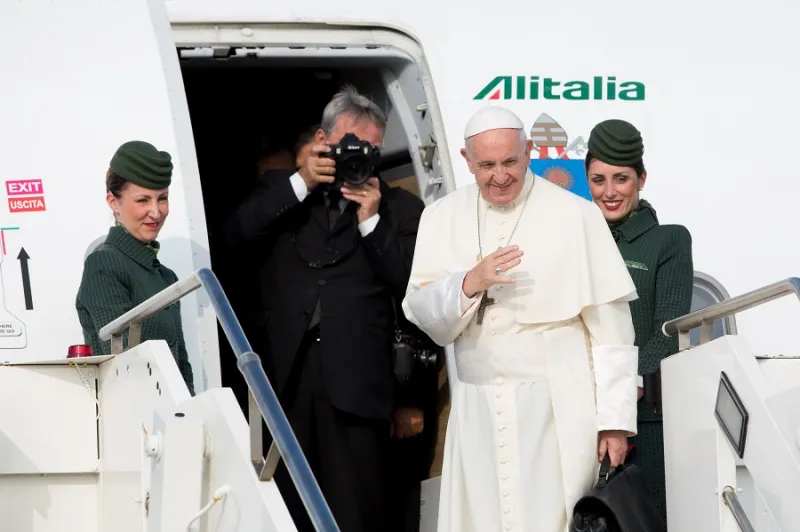



He is bound to have some nice things to say about Islam! Will He speak of Jesus as the only way of salvation though?
John 14:6 Jesus said to him, “I am the way, and the truth, and the life. No one comes to the Father except through me.
Acts 24:14 But this I confess to you, that according to the Way, which they call a sect, I worship the God of our fathers, believing everything laid down by the Law and written in the Prophets,
Isaiah 30:21 And your ears shall hear a word behind you, saying, “This is the way, walk in it,” when you turn to the right or when you turn to the left.
Acts 18:24-25 Now a Jew named Apollos, a native of Alexandria, came to Ephesus. He was an eloquent man, competent in the Scriptures. He had been instructed in the way of the Lord. And being fervent in spirit, he spoke and taught accurately the things concerning Jesus, though he knew only the baptism of John.
Proverbs 12:28 In the path of righteousness is life, and in its pathway there is no death.
Dialogue is the way forward. “Bahrain Forum for Dialogue: East and West for Human Coexistence” – is a fine initiative.