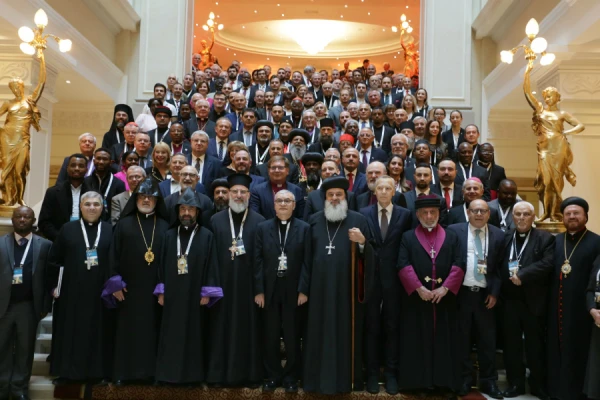
Budapest, Hungary, Nov 26, 2019 / 03:00 pm (CNA).- Patriarchs, cardinals, politicians, and Christians from across the globe are in Budapest this week for the International Conference on Christian Persecution.
“We have 245 million reasons to be here. This is how many people are persecuted daily because of their Christian belief,” Hungarian State Secretary for the Aid of Persecuted Christians Tristan Azbel said Nov. 26 as he opened the conference.
Azbel has been a driving force behind Hungary Helps, a government initiative to provide international aid specifically to persecuted Christian communities in the Middle East — distinguishing Hungary from most European governments.
Archbishop Bashar Warda of Erbil, Iraq, told CNA that he hopes to see more European leaders acknowledge and respond to the fact that Christians are being persecuted in the Middle East.
“I would ask the European leaders to realize the fact that Christians are being persecuted because until now this voice is still weak,” Warda said. “Hungary and Poland have done the right thing to say clearly and loudly: Christians are being persecuted.”
Since the Hungarian government convened the first International Conference on Christian Persecution in 2017, the event has doubled in size to 650 participants from over 40 countries.
“What brings us together is the cause of persecuted Christians in the Middle East, and our search for the elements that bring about these dire situations for the most ancient Christian communities of the East,” Gewargis III, Patriarch of the Assyrian Church of the East, said at the conference.
The conference, meeting Nov. 26-28, has drawn many Syrian, Iraqi, and Lebanese Christian leaders, including Patriarch of the Syriac Orthodox Church of Antioch Ignatius Aphrem II, Chaldean Catholic Archbishop of Mosul Najeeb Michaeel, and Rev. Joseph Kassab, head of the Evangelical Community of Syria and Lebanon.
About to begin #ICCP_Budapest as hall fills with people who engage helping persecuted Christians. And here’s our three greek-catholic bishops! @HungaryHelps pic.twitter.com/Qhjdg7GpzL
— Eduard Habsburg (@EduardHabsburg) November 26, 2019
Off-the-record conversations were held on “day zero” of the conference Nov. 25 on the Islamic landscape in “a post-ISIS world,” and the role of NGOs in aiding persecuted communities.
Bishop and Primate of the Armenian Orthodox Diocese of Damascus Armash Nalbandian highlighted in his address that the targeted persecution of Christians is still a very current threat in Syria.
“Not even one month ago, a gunman shot dead Fr. Hovsep Bedoyan the head of the Armenian Catholic community in Syria, Qamishli, near the border of Turkey and his father, Abraham Bedoyan … The attack was claimed by the Islamic State group,” Nalbandian said.
“The local media reported three bombings in Qamishli, which occurred the same day of the assassination, and were also claimed by ISIS, showed concern that militants were also coordinated attacks against Christians in the city,” he added.
Catholic speakers at the conference include Cardinal Peter Erdő, Primate of Hungary and Archbishop of Budapest; Cardinal Gerhard Ludwig Mueller, former prefect of the Congregation of the Doctrine of Faith, Archbishop Antoine Camilleri, apostolic nuncio to Ethiopia, Bishop Oliver Dashe Doeme of Maiduguri, Nigeria, Bishop Matthew Hassan Kukah of Sokoto, Nigeria, and Archbishop Ephram Yousif Mansoor of Baghdad, who represented Syriac Catholic Patriarch of Antioch Ignatius Joseph III Younan at the conference.
Join #Rome Correspondent for @cnalive Courtney Mares, @catholicourtney on the ground in #Budapest for the #ICCP_Budapest 2nd International Conference on #ChristianPersecution. Experience the Sights & Sounds in solidarity with our #Christian brothers & sisters. #Catholic pic.twitter.com/kkbLkTtaSp
— EWTN Vatican (@EWTNVatican) November 26, 2019
Hungarian Prime Minister Viktor Orban gave the plenary address to the conference. U.S. President Donald Trump also wrote a letter to the conference participants, which was read aloud by his assistant Joe Grogan.
The Hungarian and the U.S. governments agreed in November to jointly fund rebuilding projects in Qaraqosh, the largest city in Iraq with a Christian majority.
“Hungarians believe Christian values lead to peace and happiness and this is why our Constitution states that protection of Christianity is an obligation for the Hungarian state, it obligates us to protect Christian communities throughout the world suffering persecution,” Orban said.
“The Hungarians amount to 0.12% of the population of the world. Is there any point for a country of such a size to stand up for the protection of Christians? Our answer is yes,” the prime minister said.
Billy Graham Evangelistic Association Vice President Viktor Hamm reminded the conference that the Hungarian people themselves suffered Christian persecution in the not too distant past under Soviet occupation.
Hamm himself was born in a Soviet labor camp in what is now northwest Russia. “My grandfather was executed by the Soviet regime. My father spent years in the gulags,” he said.
Evangelical Pastor Andrew Brunson was also present at the conference at a Thanksgiving Gala Dinner. Brunson was released in Oct. 2018 after being imprisoned for two years in Turkey.
“The cross that carried the body of the savior of the world, and that inspired the lives of saints and pastors in the Church for 2 millennia continues today to be the guiding light … that prompts today disciples of the Lord to partake in his cross,” Cardinal Mueller said at the conference.
“Be promoters of peace, and continue the silent witness of the Lord’s presence in the world,” he said.
 […]
[…]


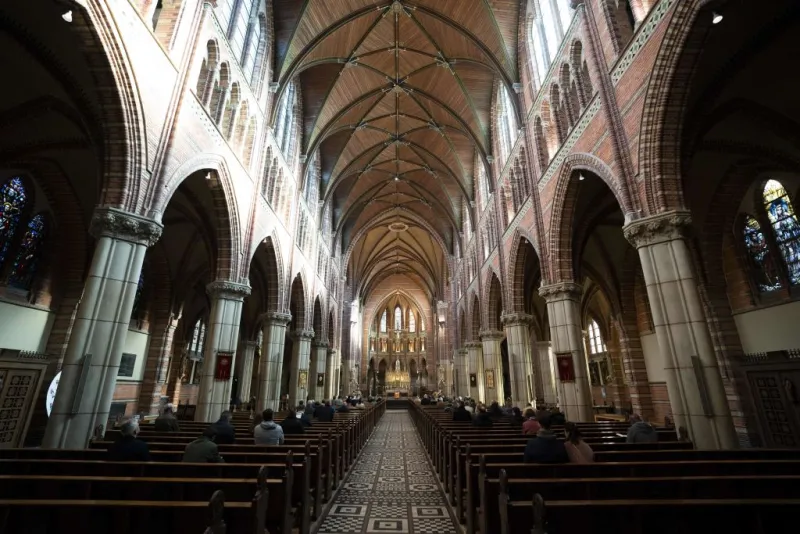


Shape of things to come.
Have they tried the TLM? Rumour has it that may bring in the younger set.
Gilberta: This is a common illogical and misleading falsehood that you should get rid of and deceptively advanced by promoters of the old pre-Vatican II Mass, that the Vatican II Mass attendance declines whereas with the Tridentine Mass attendance increases. There is totally no connection. Decrease in mass attendance is a result of a complex of social factors and can never be singularly attributed to the Vatican II Mass. Just take a look at the surging numbers and faith of emerging Catholic communities in Africa and Asia, they are nourished and sustained by the Vatican II Mass.
You shouldn’t comment on the subject if you are so devoid of knowledge as to believe there are such things as a “pre-Vatican II Mass” and a “Vatican II Mass.” They don’t exist. As far as your condescension goes, the prior suggestion was valid. Many Catholics do perfer to worship God instead of themselves.
DD;
You have no idea what you’re talking about. Have you ever even been to a Latin Mass? I have. There are people there who come 100 miles each way for the Mass, NOT wanting to go to the NO Mass a few miles away.
Deacon Dom,
I think the point is more about demographics. Traditional/Conservative Catholics are the only Catholic population in the West increasing demographically. Have you attended a TLM recently? They are full to overflowing with young families & numerous children in a similar way that Amish & Mennonite churches are. Hasidic communities also.
Western cultural Catholics are contracepting themselves into a virtual oblivion just like the popular culture that surrounds them.
Africa & Asia are different from the West & what works in those regions may look different also. But their surging numbers are fueled by people actually choosing to reproduce themselves. That’s what’s lacking in Holland & the West.
Good point Gilberta.
🙂
I offered the TLM for the first time on my ordination date in 2020. Such a relief to have full focus on whom I’m offering and not to play with the congregation with the banality of music that is so soul destroying! Great thing about the TLM is this focus on Christ and not the lame inaudible response to the prayers!
Interesting to see the response to my comment.
Today’s article (Sept. 7) in The Catholic Thing would seem to bolster the theory that the ditching of the TLM, in which Holland apparently played a role, wasn’t exactly a brilliant (or VII-mandated) move.