


Los Angeles, Calif., Sep 5, 2022 / 08:00 am (CNA).
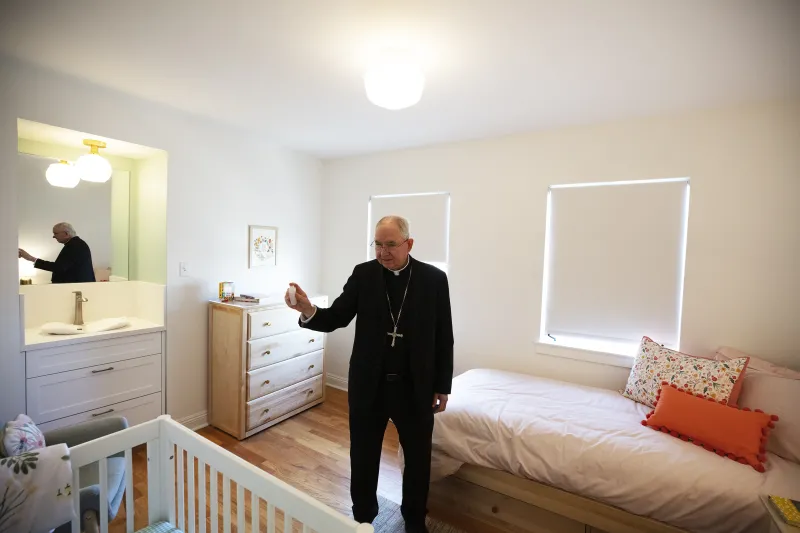
After undergoing extensive renovations, adding new furniture, and opening its doors to homeless pregnant women, the Pico Home was just missing one more thing: a blessing.
On Friday, Aug. 19, Archbishop José H. Gomez visited the former convent in the Mid-City area of Los Angeles to do the honors himself.
“It’s a gift beyond what we could have ever imagined,” said Sarah Wilson, executive director for Harvest Home, a local nonprofit residential program that operates the home.
The opening of the home, made possible through a partnership between the archdiocese’s Office of Life, Justice, and Peace (OLJP) and Harvest Home, comes amid a renewed focus on helping pregnant women and their babies after the recent U.S. Supreme Court Dobbs v. Mississippi ruling, which overturned the federal right to abortion given by Roe v. Wade nearly 50 years ago.
The Los Angeles County Department of Public Health estimated that some 5,000 women are homeless at some point during their pregnancies in the county. But in the city of Los Angeles, there are reportedly only 70 shelter beds for women who are pregnant and in crisis. And plans from state lawmakers to make California a “sanctuary” for out-of-state women seeking abortions only adds to the urgency.
The 18-bedroom residence is Harvest Home’s second in the Los Angeles area and is being leased from the archdiocese for $100 a month. Two babies have already been born to guest mothers at the house since opening earlier this summer.
“Harvest Home stands in the gap to provide vital housing and critical service to these pregnant women who are in crisis and have few options for housing and support,” said Wilson. “We are honored to open the Pico Home to triple our reach.”
That Friday morning, Archbishop Gomez sprinkled holy water as he walked through the building’s halls and rooms, including two larger rooms for pregnant mothers with other, older children, some already in school.
The Pico Home offers what staff call “wraparound care” that goes beyond shelter and includes things like cooking lessons and counseling for the single mothers.
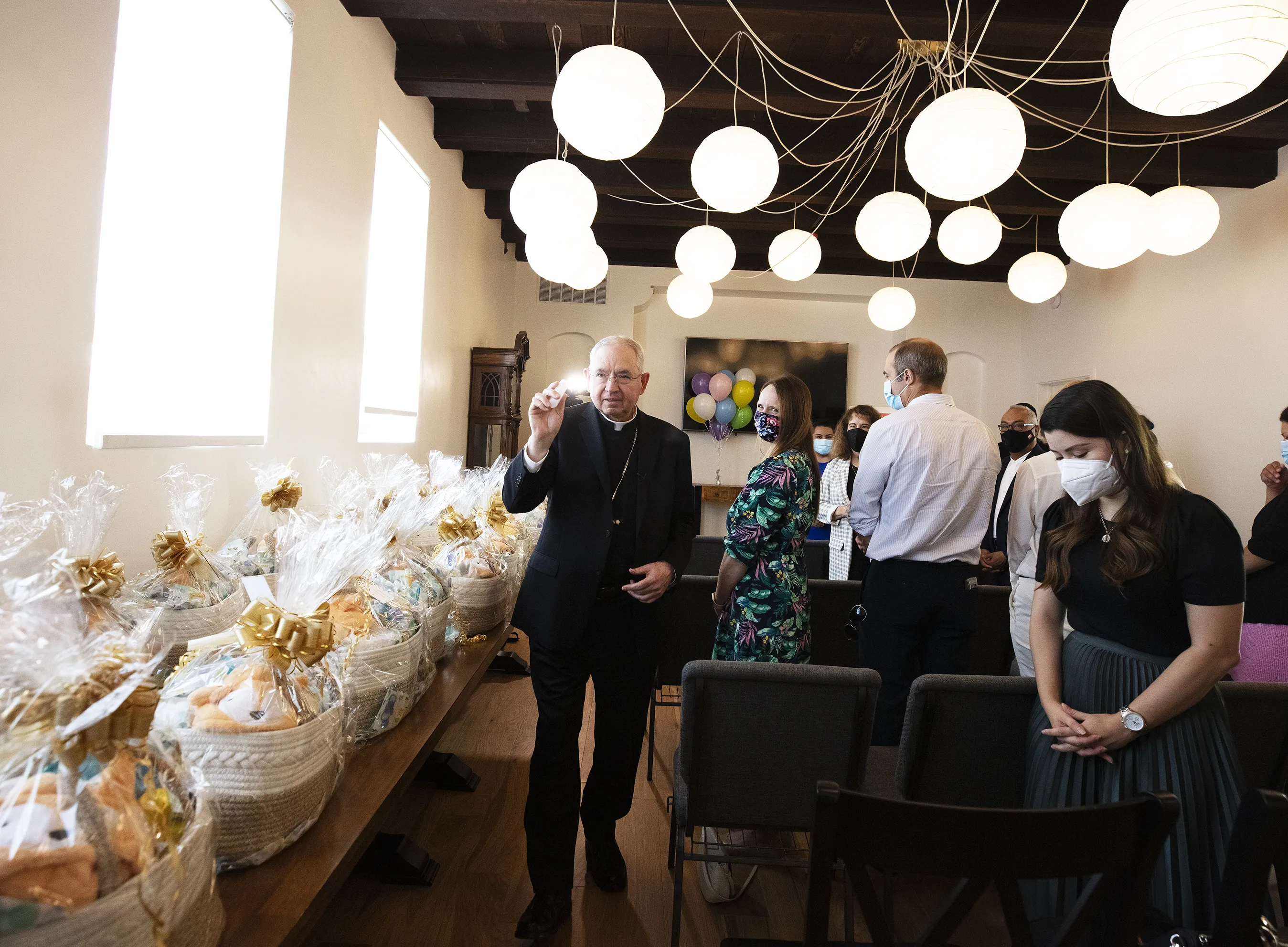
According to OLJP senior director Michael Donaldson, it’s about “making sure that these moms are successful in entering the world.”
“It’s a regaining of their human dignity, and their purpose in society … that they have a place in this world,” said Donaldson.
Archbishop Gomez said he was glad to see the fruits of the collaboration in person, calling it “a beautiful work of compassion and care for our most vulnerable neighbors.
“Let us continue to pray for these women and their children and let us continue to commit ourselves to building a Los Angeles where every life is cherished and protected,” he added.
For more information about the Pico Home, including donation and volunteer opportunities, visit HarvestHomeLA.org.
This article was originally published by Angelus News, and is reprinted here with permission.
If you value the news and views Catholic World Report provides, please consider donating to support our efforts. Your contribution will help us continue to make CWR available to all readers worldwide for free, without a subscription. Thank you for your generosity!
Click here for more information on donating to CWR. Click here to sign up for our newsletter.



Praise God for this but I wonder how the convent came to be unused?
Praise be to God. May this home be a blessing to all who reside there.
James 1:17 Every good gift and every perfect gift is from above, coming down from the Father of lights with whom there is no variation or shadow due to change.
Philippians 4:19 And my God will supply every need of yours according to his riches in glory in Christ Jesus.
Malachi 3:10 Bring the full tithe into the storehouse, that there may be food in my house. And thereby put me to the test, says the Lord of hosts, if I will not open the windows of heaven for you and pour down for you a blessing until there is no more need.
Ephesians 1:3 Blessed be the God and Father of our Lord Jesus Christ, who has blessed us in Christ with every spiritual blessing in the heavenly places,
2 Corinthians 9:8 And God is able to make all grace abound to you, so that having all sufficiency in all things at all times, you may abound in every good work.
Numbers 6:24-26 The Lord bless you and keep you; the Lord make his face to shine upon you and be gracious to you; the Lord lift up his countenance upon you and give you peace.
I was wondering what happened to the Holy Faith Sisters who had occupied the LA convent & why it was empty & I found this online. I suppose it’s a familiar story. They’d probably been able to keep their doors open in LA offering this sort of stuff:
“September 7 @ 2:30 pm – 3:30 pm Sold Out €15
Margaret Aylward Centre
Tai Chi with Moira Langan
The ancient Chinese art of Tai Chi with self-paced gentle movements known as “Meditation in Motion”. Moira has had an interest in holistic therapies for many years. She is qualified as a Reflexologist, Massage Therapist, Indian Head Massage Therapist. A qualified Tai Chi Instructor for…”
“Listen to the Voice of Creation and Brother River Meditation – a three minute reflection of nature sounds and visuals on the theme of the Season of Creation 2022. ”
https://holyfaithsisters.org/