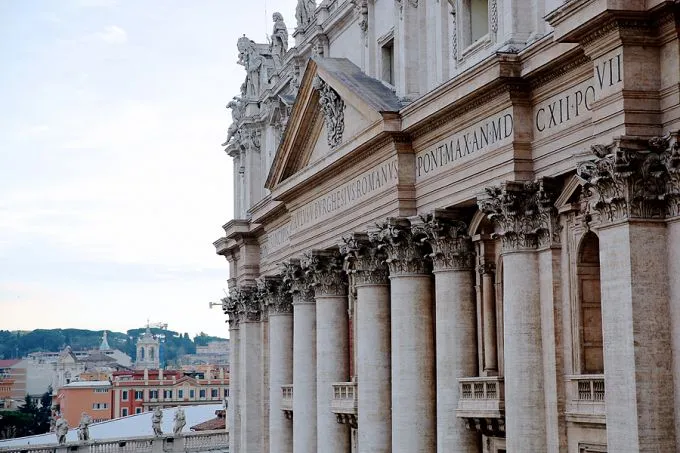
A view of the facade of St. Peter’s Basilica from the Vatican’s Apostolic Palace. / Lauren Cater/CNA.
CNA Newsroom, Jul 22, 2022 / 03:02 am (CNA).
The Holy See intervened in the German “Synodal Way” on July 21, 2022, warning of a “threat to the unity of the Church”.
Below is the full text of the statement in a working translation into English, provided by CNA:
“In order to safeguard the freedom of the People of God and the exercise of the episcopal ministry, it seems necessary to clarify that the ‘Synodal Way’ in Germany does not have the power to compel bishops and the faithful to adopt new forms of governance and new orientations of doctrine and morals.
It would not be lawful to initiate in the dioceses, prior to an agreed understanding at the level of the universal Church, new official structures or doctrines, which would constitute a violation of ecclesial communion and a threat to the unity of the Church. In this sense, the Holy Father called to mind in his letter to the pilgrim people of God in Germany: the universal Church lives in and of the particular Churches, just as the particular Churches live and flourish in and from the universal Church. If they find themselves separated from the entire ecclesial body, they weaken, rot and die. Hence the need always to ensure communion with the whole body of the Church.”[1] Therefore, it is desirable that the proposals made by the Particular Churches in Germany may be incorporated into the synodal process on which the universal Church is undertaking, in order to contribute to mutual enrichment and to bear witness to the unity with which the Body of the Church manifests its fidelity to Christ the Lord.”
If you value the news and views Catholic World Report provides, please consider donating to support our efforts. Your contribution will help us continue to make CWR available to all readers worldwide for free, without a subscription. Thank you for your generosity!
Click here for more information on donating to CWR. Click here to sign up for our newsletter.
Chilean judge Eduardo Vio Grossi, the only pro-life judge serving at the Inter-American Court of Human Rights (IACHR), died Dec. 3, 2022, at the age of 78. / Credit: Flickr de la OEA (CC BY-NC-ND 2.0)
Vatican City, Feb 8, 2022 / 05:00 am (CNA).
Pope emeritus Benedict XVI personally requested forgiveness from abuse survivors on Tuesday in a letter responding to a report that faulted his handling o… […]
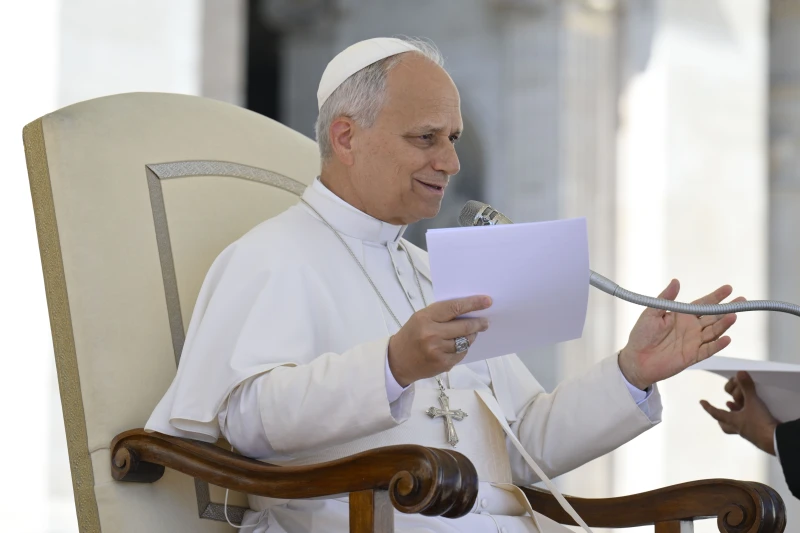
Pope Leo XIV addresses thousands of Church and civil lawyers, judges, and others who work in the legal environment during the Jubilee of Workers of Justice, part of the yearlong Jubilee of Hope, in St. Peter’s Square on Sept. 20, 2025. / Credit: Vatican Media.
Vatican City, Sep 20, 2025 / 10:30 am (CNA).
Forgiveness is fundamental to the virtue of justice, Pope Leo XIV said to thousands of legal professionals gathered in Rome for the Jubilee of Workers of Justice on Saturday.
“It is the power of forgiveness, which is proper to the commandment of love, that emerges as a constitutive element of a justice capable of combining the supernatural with the human,” the pope said in St. Peter’s Square on Sept. 20.
Leo, who has a doctorate in Church law, explained that the evangelical virtue of justice is not a distraction from human justice, but “questions and redesigns it: It provokes it to go even further, because it pushes it towards the search for reconciliation.”
“Evil, in fact, must not only be punished, but also repaired, and to this end, a profound gaze toward the good of individuals and the common good is necessary,” he urged Church and civil lawyers, judges, and others who work in the legal environment.
“This is an arduous task, but not impossible for those who, aware that they are performing a more demanding service than others, are committed to leading an irreproachable life,” the pope added.
Pope Leo XIV addresses thousands of legal professionals gathered in St. Peter’s Square for the Jubilee of Workers of Justice on Sept. 20, 2025. Credit: Vatican Media.
An estimated 20,000 people from 100 countries took part in the Jubilee of Workers of Justice, part of the yearlong Jubilee of Hope, including a large number of pilgrims from the United States and Canada. U.S. Supreme Court Justice Samuel Alito was also in attendance.
Joshua McCaig, a lawyer and founding president of the Catholic Bar Association, traveled to Rome for the jubilee with a delegation of over 50 legal professionals from the U.S.
He told EWTN News he hopes the event “will be an opportunity for us all to reflect on what more we can do for the common good.”
“The Catholic Church brings resources, brings hope, brings community, brings values that are instilled in the teachings of Jesus Christ to help all individuals — but also those in the legal profession — further develop an understanding of how this world should be and the role we should play in it,” he said.
Before the audience with the pope, Archbishop Juan Ignacio Arrieta, secretary of the Dicastery for Legislative Texts, gave a lecture on the theme of “Iustitia Imago Dei: the operator of justice, instrument of hope.”
“Those who administer justice in the Church must also be pastors. … They must respect justice, but they are pastors who must also watch over the good of souls,” Arrieta told EWTN News this week.
In his message, Pope Leo emphasized that the function of justice “is indispensable both for the orderly development of society and as a cardinal virtue that inspires and guides the conscience of every man and woman.”
“Striving for justice, therefore, requires being able to love it as a reality that can only be achieved through constant attention, radical disinterest, and assiduous discernment,” he said.
He noted that the Jubilee of Workers of Justice is a chance to also reflect on an overlooked aspect of justice, the reality that many countries and people “hunger and thirst for justice” because their living conditions are gravely unjust and inhuman.
The pontiff cited St. Augustine, calling the saint’s words “timeless truths” to apply to the current international situation.
“’Without justice,’” the pope quoted, “’the state cannot be administered; it is impossible to have law in a state where there is no true justice. An act performed according to law is certainly performed according to justice, and it is impossible to perform an act according to law that is performed against justice […] A state where there is no justice is not a state. Justice is, in fact, the virtue that distributes to each his due. Therefore, it is not human justice that takes man away from the true God.’”
“May the challenging words of St. Augustine inspire each of us to always express the exercise of justice in the service of the people to the best of our ability, with our gaze turned to God, so as to fully respect justice, law, and the dignity of persons,” Leo said.
Matteo Ciofi, EWTN News Nightly Vatican producer, and Victoria Cardiel, Vatican Correspondent for ACI Prensa/EWTN News, contributed to this report.
Is this only a rebuke, or is it also an instruction manual, in effect, on how to invert and radicalize the Church, i.e., a warning to keep the cart behind the horse, but not to change course?
What is it, exactly, in these “proposals made by the Particular Churches in Germany” that can contribute to “mutual enrichment”? Is it confusion of the successors of the Apostles with a radicalized laity? Is it the call to upend (!) the Catechism to endorse the homosexual lifestyle? Also, other sexual immoralities (equity!)? Is it female ordinations (vs Ordinatio Sacerdotalis, 1994), cleverly combined with short shelf-life ordinations of males (the “throwaway society”!)? Or, overall, is it a pseudo-synodal and ambulatory, go-with-the-flow Magisterium (historicism baptized!) fully in step with globalized Secularism and worse?
The very short statement successfully avoids creating martyrs (and triggering a rerun of the Reformation), while Batzing now agrees to proceed (proceduralism over content!) within the universality of the Church.
Butt, encouraged (?) by the prospect that–under the like-minded synodal-relator Cardinal Hollerich–artfully ambiguous words will be “discerned” to neither endorse NOR clearly reject (!) the Satanic elements that have claimed a welcoming climate change (!) in Germany. Synodal “synthesis.”
Traditional Catholics are crushed mercilessly, while the Germans are invited to fold their heresies into the synod on synodality. And we already know that the general relator personally chosen by PF, Cardinal Hollerich, agrees with the Germans! PF expresses zero disapproval of any of the heresies the Germans are proposing, he simply wants them to advance their agenda through his worldwide synod. He gives the impression that everything the Germans want can be achieved if the rest of the Church goes along with them.




Is this only a rebuke, or is it also an instruction manual, in effect, on how to invert and radicalize the Church, i.e., a warning to keep the cart behind the horse, but not to change course?
What is it, exactly, in these “proposals made by the Particular Churches in Germany” that can contribute to “mutual enrichment”? Is it confusion of the successors of the Apostles with a radicalized laity? Is it the call to upend (!) the Catechism to endorse the homosexual lifestyle? Also, other sexual immoralities (equity!)? Is it female ordinations (vs Ordinatio Sacerdotalis, 1994), cleverly combined with short shelf-life ordinations of males (the “throwaway society”!)? Or, overall, is it a pseudo-synodal and ambulatory, go-with-the-flow Magisterium (historicism baptized!) fully in step with globalized Secularism and worse?
The very short statement successfully avoids creating martyrs (and triggering a rerun of the Reformation), while Batzing now agrees to proceed (proceduralism over content!) within the universality of the Church.
Butt, encouraged (?) by the prospect that–under the like-minded synodal-relator Cardinal Hollerich–artfully ambiguous words will be “discerned” to neither endorse NOR clearly reject (!) the Satanic elements that have claimed a welcoming climate change (!) in Germany. Synodal “synthesis.”
Weak.
Traditional Catholics are crushed mercilessly, while the Germans are invited to fold their heresies into the synod on synodality. And we already know that the general relator personally chosen by PF, Cardinal Hollerich, agrees with the Germans! PF expresses zero disapproval of any of the heresies the Germans are proposing, he simply wants them to advance their agenda through his worldwide synod. He gives the impression that everything the Germans want can be achieved if the rest of the Church goes along with them.