Archbishop Luis José Rueda Aparicio / Credit: Archdiocese of Bogotá
Denver Newsroom, Jul 6, 2022 / 18:00 pm (CNA).
The president of the Colombian bishops’ conference and archbishop of Bogotá, Luis José Rueda Aparicio, said during his opening address to the bishops’ plenary assembly July 4 that “it’s our duty to be bishops and pastors of the Church in Colombia in difficult times” that test the ability to continue sowing hope among the people.
The bishop’s 113th plenary assembly began July 4 and will conclude July 8. The Colombian bishops will examine the national summary of the Synod on Synodality, convened by Pope Francis.
In his address, Rueda asked the bishops: “How can we be witnesses to the hope of the Kingdom when laws go against the value of human life, especially in the stages of greater fragility such as the phase in the womb or the end-of-life phase?”
The archbishop said that “they can classify us as naïve promoters of hope. But hope is a theological virtue.”
“If we cultivate hope, people and communities find the meaning of life and the strength to advance along the paths of the Kingdom of God,” he said.
“The ecclesial, social, and environmental moment in which the country finds itself,” the prelate noted, “requires from the bishops three human and Christian attitudes that shape our apostolic ministry today: discernment, service, and hope.”
Discernment, he explained, “is proper to those who have decided to follow Jesus.” He pointed out that Christ doesn’t give a precise direction but rather challenges his disciples to set out on the way, because “he prefers that we advance and learn, that we have the experience of following him.”
“Following leads us out of vanity,” which leads to self-sufficiency, when Christ requires humility, he said.
Discernment “facilitates the service we have as a Church to be a seed and expand the Kingdom of God present in earthly realities,” he said.
Rueda recalled that “the Church that goes out on mission is above all a Church of servants out of love, servants of the Kingdom of God.”
Christ “spoke of service and revealed himself with the sincere actions of a servant,” he said. “He taught his disciples that, although the great ones of the world lord it over others, the relationships of his disciples won’t be like that. These must be different; they will be distinguished by always looking for the last place, the place of servants.”
Rueda noted that “evangelization is, above all, a work of service to a wounded humanity; it is to bring the vitality of the good news to the whole world, like leaven in the dough.”
“The figure that Pope Francis teaches us about the Church as a field hospital is beautiful and challenging; the Samaritan and merciful Church has a vital, close, supportive presence,” he said.
Rueda invited his fellow bishops to “return to the joy of service” because “it liberates from the trappings of self-sufficiency” and that “when the Church sees itself in an attitude of service it becomes more attractive, more convincing, less institutional, and more missionary.”
“Brother bishops, let’s ask ourselves these days if we are being seen as servants of the kingdom, after the manner of Jesus of Nazareth or Mary who set out to offer her time, her greeting, and her faith with joy and generosity,” he said.
Rueda encouraged the bishops to listen to each particular Church during the plenary assembly because it is in them “and in the communion of the ecclesiastical province where it is discerned with greater clarity what the Lord wants from us.”
“Let us allow ourselves to be renewed by the Holy Spirit! We are called to journey in missionary synodality. The People of God asks us bishops to lead the communal discernment, service driven by love, realistic and hopeful serenity,” he said.
This story was first published by ACI Prensa, CNA’s Spanish-language news partner. It has been translated and adapted by CNA.
If you value the news and views Catholic World Report provides, please consider donating to support our efforts. Your contribution will help us continue to make CWR available to all readers worldwide for free, without a subscription. Thank you for your generosity!
Click here for more information on donating to CWR. Click here to sign up for our newsletter.
Leon is a baby boy cared for and loved at Mary’s Shelter, a pro-life maternity home in Fredericksburg, Virginia. / Courtesy of Mary’s Shelter
Washington, D.C. Newsroom, May 24, 2022 / 13:15 pm (CNA).
Amid a shortage of baby formula in the U.S., experts recommend parents scour smaller drug stores, check online, and join social media groups sharing information.
But here’s another, perhaps lesser-known, option they can also turn to for help: pregnancy resource centers.
Nearly 3,000 pro-life pregnancy centers serve millions of people each year in the United States. They offer women and parents in need everything from health care and material assistance to educational classes and job support — at little to no cost. Right now, for many of these centers, their work also includes connecting struggling families to baby formula.
One center in Michigan, an affiliate of Heartbeat International, a pro-life pregnancy resource center network, revealed to CNA that it has a surplus of formula.
“At this time, we haven’t heard of formula shortages at the pregnancy centers,” Andrea Trudden, vice president of communications and marketing at Heartbeat International, told CNA. “Quite the contrary, actually!”
Trudden recommended families turn to their local pregnancy help organizations for assistance and use OptionLine.org as a tool to find the center closest to them.
“Since pregnancy centers are equipped to help pregnant women and new families with practical resources such as diapers and formula,” Trudden said, “they have been able to step into that gap during this time.”
Some pro-life maternity homes in states such as Virginia and North Carolina said mothers are in desperate need and exploring all of their options, including feeding their babies with formula samples. But, these homes tell CNA, they are walking with mothers in their search, every step of the way.
What is this shortage about?
The nationwide baby formula shortage was caused, and then exacerbated, by a series of factors: supply-chain issues, recalls, the closure of a major production plant in February, and even U.S. trade policy. The result, data-firm company Datasembly found, is that more than 40 percent of baby formulas were out of stock in early May.
Babies with special needs and allergies rely on formula, along with babies in general. According to data from the Centers for Disease Control and Prevention (CDC), 63.3% of infants were exclusively breastfeeding seven days after birth in 2018. Three months after birth, only 46.3% of infants exclusively breastfed. Six months after birth, that percentage changed to 25.8%
The trouble with formula began partially with the Covid-19 pandemic. Parents stockpiled baby formula at the beginning, which increased production, only to later discover that they had a surplus to use up, which decreased production.
After consuming formula from an Abbott plant in Sturgis, Michigan, four babies became sick, including two who died, from bacterial infections. This led to a recall and the plant shutting down in February.
These incidents exposed the formula market as one not structurally prepared for emergencies, with just four companies largely in control of supply in the United States. U.S. and regulatory trade policy only added to the problem, restricting the exchange of formula internationally, The Atlantic reported.
Months into the shortage, the Food and Drug Administration (FDA) has reached an agreement with Abbott, one of the largest U.S. baby formula manufacturers, to reopen its Sturgis plant in the coming weeks. President Joe Biden invoked the Defense Production Act to prioritize the production of formula. And, in the meantime, the U.S. military has begun importing formula from Europe.
Members of Congress on both sides of the aisle have called for action. Senate Democrats are pushing a bill that would send $28 million in emergency funding to the FDA. Congress passed, and Biden signed into law, a bill to expand access to formula for lower-income families during emergencies.
In the meantime, before the shelves are fully stocked once more, pregnancy centers and maternity homes around the country are helping parents in need.
“I have never seen this much formula. We have an overflow!” Lois Stoll, a volunteer who manages the formula supply at the center, said in a press release. The center, one of Heartbeat International’s 1,857 affiliate locations, accumulated its surplus over the last two years, during the pandemic.
“It really is the result of an unexpected set of circumstances,” Bryce Asberg, the executive director, added in the release. “During the COVID-19 pandemic, the number of clients fell but donations continued to come in.”
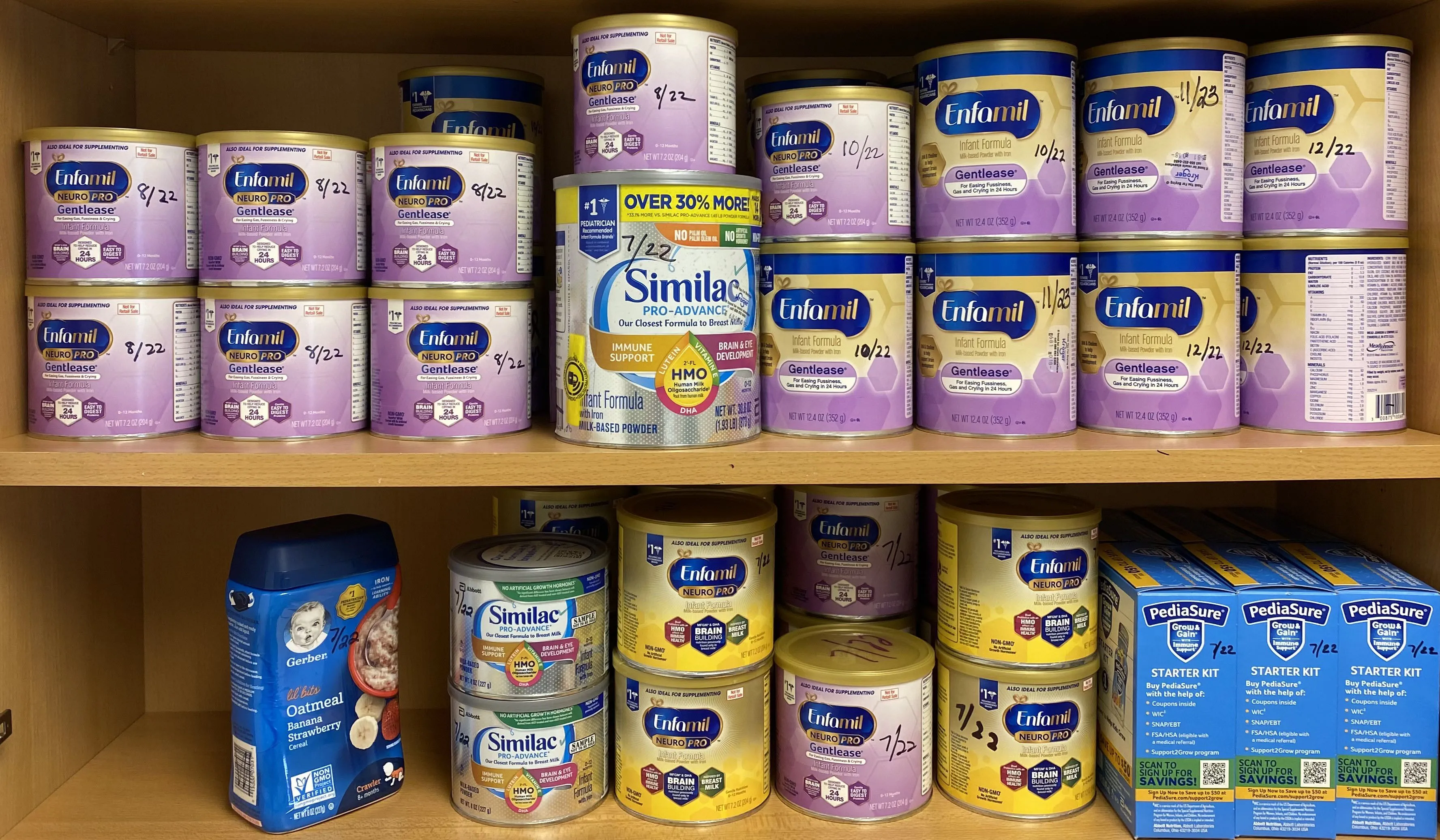
Baby formula is stored on shelves at Helping Hands Pregnancy Resource Center in Hillsdale, Michigan. Courtesy of Helping Hands
Asberg told CNA that the center has been running a material assistance program for several years where it provides mothers and families with baby clothes, diapers, wipes, and baby food or formula.
“We still offer all those items to clients who come in, but recently we have noticed a surge of interest in formula,” he said. “God has been building our supply of formula for many months, and we didn’t know why we had so much. Now we do!”
Washington, D.C.
In Washington, D.C., Janet Durig, the executive director of Capitol Hill Pregnancy Center, said that her center also has baby formula on hand.
“We’ve had some phone calls seeking help and we’ve had formula to give them,” she told CNA. But, she emphasized, the supply is limited because they rely on donations.
“We have it to help people on a limited basis and are helping people on a limited basis,” she said, adding that the center welcomes donations of unopened bottles or cans of formula as long as they have not expired.
Connecticut
Leticia Velasquez, executive director and co-founder of Pathways Pregnancy in Norwich, Connecticut, encouraged moms and families to reach out if they need formula.
She told CNA that the three-year-old center is there for any woman or mom in need.
“We just say, ‘How can we fill the need? That’s what we’re here for,’” she said. “We definitely stand with them in any crisis, whether it be a formula shortage or an unplanned pregnancy.”
Parents in eastern Connecticut looking for baby formula can text the center at (860) 222-4505.
North Carolina
Debbie Capen, the executive director of MiraVia, said that the baby formula shortage is affecting her group’s work in supporting and providing resources to new moms in need. The Catholic nonprofit runs an outreach center in Charlotte and a free college residence at nearby Belmont Abbey College where a pregnant student — from any university or college — can stay until her child turns two years old.
“Yes, the mothers we serve are very concerned about the baby formula shortage,” Capen told CNA. “We always encourage breastfeeding for our expectant mothers, but for those who cannot breastfeed, they usually rely on vouchers for baby formula through the USDA’s WIC program.”
The U.S. Department of Agriculture’s WIC program, also known as the “Special Supplementation Nutrition Program for Women, Infants and Children,” offers federal grants to states for supplemental foods, health care referrals, and nutrition education for low-income pregnant and postpartum women, and young children at nutritional risk.
Capen highlighted that WIC only covers one specific brand of formula, which means that moms must pay full price for any other label. Formula is at a premium price right now, she added, which only puts more stress on their limited resources.
In each state, baby formula manufacturers bid for exclusive rights to provide formula to WIC participants in that state. In return, they offer the state discounts, or rebates. For those who rely on WIC, this means that they face limited options.
In response to the scarcity, the mothers at MiraVia are turning to alternatives: food pantries and the MiraVia community.
“They communicate with our staff and each other when they find formula at a certain location, as well as contact stores to find out when shipments are expected,” Capen said. “They substitute with generic brands when possible and reach out to their pediatricians for recommendations and even free samples.”
Capen listed some ways that people can help during this shortage, beginning with communication and the sharing of resources.
“For example, you can help by searching posts on social media and community apps like NextDoor or OfferUp to find those with formula and suggest where it can be donated,” she said. “Remind friends and family not to stockpile so that the supply of formula can flow to those in most urgent need. If you are pregnant and have received free samples of formula, donate what you won’t use to food pantries or programs for new mothers.”
Virginia
Kathleen Wilson, the executive director of Mary’s Shelter, a faith-centered maternity home in Fredericksburg, Virginia, agreed that “our moms have had many difficulties.”
She told CNA about one of their mothers who gave birth to her fourth baby three months ago. At first, she used a formula brand called Enfamil Reguline. After it became unavailable, she began switching between brands and using whatever she can find, Wilson said. The mother has also tried ordering on Amazon and turned to her pediatrician for samples.
Yaretzi is a baby girl cared for and loved at Mary’s Shelter, a pro-life maternity home in Fredericksburg, Virginia. Courtesy of Mary’s Shelter
“This is a mom who is trying to hold down a job, with an infant and other children to tend to,” Wilson stressed the “very difficult” situation.
Wilson said that two of the other mothers spent days driving around at one point to try to find formula for their babies. When necessary, they are also turning to sample packets of baby formula.
“Our staff and volunteers have been assisting with this and picking up and delivering formula when they can get their hands on it,” Wilson said, adding that donors have also pitched in.
“We are blessed with wonderful donors,” she said. “A friend just stopped in this morning with two cans of formula that he was able to find.”
“If donors are willing and can find formula, we would be thrilled to take their donation,” she said, concluding that she is “praying this comes to an end soon.”
Pope Francis greets endurance athlete Michael Haddad at the general audience in the San Damaso Courtyard of the Apostolic Palace, June 2, 2021. / Vatican Media.
CNA Staff, Jun 2, 2021 / 12:00 pm (CNA).
Pope Francis on Wednesday met with a paraly… […]
Guadalajara, Mexico, Oct 4, 2018 / 12:00 am (CNA).- After an event featuring abortion rights activists was held at a Mexican Jesuit university, the president of the Mexican bishops’ conference reiterated that the Church opposes abortion, and said that he had no prior knowledge of the event and that this forum was not authorized by the Church.
Abortion is illegal in Mexico. However, in 2007 Mexico City, the country’s capital, decriminalized abortion for up to 12 weeks for any reason. By some estimates, there have been two million abortions there since that time.
In his communiqué entitled “No to Abortion,” Cardinal Francisco Robles Ortega stated “Our position as believers is founded on both Sacred Scripture and the magisterium of the Church as well as natural law and what science has demonstrated regarding the beginning of the existence of the human being,”
“Serious scientific studies prove the existence of a life, of a different person, from the moment of conception. Respect for life must not be subject to a debate, nor some eagerness for ‘openness’ or to be ‘cutting edge,’ even less so for questions of taste or feelings, as if respect for life could depend on what some people feel or think,” the prelate pointed out.
Nor can respect for life, he added, “be subject to the arbitrariness of personal conscience alone, because the conscience must be objectively formed and because what it in question is the life of an innocent person.”
“When we talk about this issue—and we don’t accept abortion—it’s not a matter of intolerance or rejecting dialogue, but of coherence with the right of every person to live, especially if it’s an innocent person, the one yet to be born,” Cardinal Ortega pointed out.
The controversial university program was held Sept. 26 at the ITESO (Institute of Technology and Higher Studies of the West), Jesuit University of Guadalajara. It was entitled “Dialogue concerning the Right to Decide,” and featured three presenters wearing the green kerchief of the pro-abortion movement in Latin America. The speakers were affiliated with organizations that promote the legalization of abortion in Mexico and other countries in the world: CLADEM, the Latin American and Caribbean Committee for the Defense of Women’s Rights; GIRE, the Informational Group on Chosen Reproduction, and Catholic Women for the Right to Decide.
CLADEM campaigns for legalized abortion throughout Latin America. GIRE has reportedly received more than $100 million dollars from the International Planned Parenthood Federation over the last ten years. Catholic Women for the Right to Decide (Catholics for Choice in the U.S.) has been condemned by bishops in various parts of the world.
At the center of the controversy is the Jesuit priest and outgoing rector of the university, Fr. José Morales Orozco.
In defending the university’s decision to hold the event, Fr. Orozco stated that “ITESO is for life, is against abortion, but before that it is for freedom of conscience,” explaining that “people have every right and obligation to decide in conscience what they see and nobody can judge, only God.”
In a statement to ACI Prensa, CNA’s Spanish language sister agency, and ITESO spokesman said that “human life is sacred and always must be cared for and respected” and pointed out that Orozco “at the activity made it clear that the university is for life and against abortion, and for freedom of conscience.”
ITESO “dialogues with people of different religious and political beliefs, different ethnic and cultural origins. A respectful exchange of ideas is brought about with those who think differently because this is how the reflection of the university is developed and deepened and knowledge is increased.”
The university added that “abortion is one of the five main causes of maternal death, and these cases occur especially with poor women. It’s an issue that must be reviewed and discussed from the ethical and moral point of view, as well as its implication in terms of social justice and public health policy.”
Nevertheless, there was no presenter at the forum to explain the Church’s teaching or its basis in the sciences.
In response to the event, the president for the National Front for the Family for the state of Jalisco, Jaime Cedillo, demanded that ITESO not be a “platform to promote” abortion advocates.
Speaking to ACI Prensa, Cedillo criticized that the event at the Jesuit university was used “as a promotion of an international movement sponsored by large organizations that promote abortion.”
“At an educational institution like the university, which has a Christian inspiration, it can’t lend itself as a platform for the culture of abortion,” he noted.
Cedillo expressed his dismay that the position against abortion was not presented in order to open the doors to “a healthy debate at the university.”
He added that if a university “defends a clear position, obviously it can’t led itself to a scenario that openly promotes something to the contrary.”
This article was originally published by our sister agency, ACI Prensa. It has been translated and adapted by CNA.







Leave a Reply