Opinion: Pope Francis flounders on the Ukrainian front
Observers inside Ukraine and around the world may be forgiven the impression Pope Francis is trying perhaps a little too hard to understand, and could perhaps pay more attention to what he isn’t doing.
Pope Francis meets with the editors of 10 European Jesuit magazines and Father Arturo Sosa, superior general of the Jesuits, May 19, 2022, in the library of the Apostolic Palace at the Vatican. The pope responded to the editors' questions about the war in Ukraine, the current state of the Catholic Church and how he makes decisions when a diocese is experiencing turmoil. (CNS photo/Vatican Media)
It’s tough to say how bad things are for Pope Francis, vis á vis Ukraine, but things are bad. Just this week, the leader of the Ukrainian Greek Catholic Church, Archbishop Sviatoslav Shevchuk, remarked to the effect that anyone taking the positions Francis has taken on Russia’s invasion of his country is either a patsy or a stooge. The Latin rite bishop of Kyiv, Bishop Vitaliy Krivitsky, this week effectively told Francis he’s not welcome in the city or the country, because of security concerns and because “some portion of the [Ukrainian] population did not take kindly to certain of the pope’s words, which were held to be errant.”
Archbishop Shevchuk made his comments in a video message — he’s been releasing such messages regularly since the war began on February 24th — that did not name Pope Francis directly. But he left little room for wonder whether Francis was among those he criticized. “Anyone who thinks that some external cause has provoked Russia into military aggression is either in the grip of Russian propaganda,” Shevchuk said in his Wednesday video message, “or is simply and deliberately deceiving the world.”
Those remarks followed some from Pope Francis, who told a group of European Jesuit affairs magazine editors he believed NATO’s “barking at Russia’s door” had something to do with Russia’s behavior, or at least that Russia felt threatened by what it perceives as the alliance’s encroachments on territory Russia sees as its backyard. The pope’s words appeared in a Q&A piece run by La Civiltá Cattolica earlier this week, but they were not the first such comments he has made.
Also in the La Civiltá Cattolica piece, Pope Francis said that there are “no metaphysical good guys and bad guys” in the Ukraine conflict. That may well be the case — it is still pretty unlikely that Vladimir Putin is the actual Antichrist -— but besides Putin, there really aren’t any other contenders for that role involved in the conflict. In any case, it doesn’t take much imagination or empathy to understand why Ukrainians would not appreciate the remark. After all, Putin sent his army into their country unprovoked. Pope Francis has decried the “ferocity, the cruelty” of the Russian soldiers who are the tools of Putin’s policy, but he hasn’t called Putin the aggressor and hasn’t said that Russia is in the wrong.
It’s reasonable for Ukrainians to be nonplussed at his reticence to do so, and unconvinced by his insistence on the complexities of geopolitics. “Someone might say to me at this point: ‘So, you are pro-Putin!’ No, I am not,” Francis offered the Jesuit editors, unsolicited. “It would be simplistic and wrong to say such a thing.” Francis went on to say he is “simply against reducing complexity to the distinction between good guys and bad guys without reasoning about roots and interests, which are very complex.” Fine, but Russia still invaded Ukraine, and is still prosecuting an atrocious war of aggression on Ukrainian soil, without any plausible casus belli.
Bishop Krivitskiy’s remarks were as interesting for their bluntness as they were for where they appeared: in Avvenire, the official newspaper of the Italian bishops.
Bishop Krivitskiy prefaced his report of the cold reception the pope’s remarks had received, with a rehearsal of the serious security challenges a papal visit would entail. He could have left it there. “[W]ith respect to the outbreak of the conflict,” Krivitskiy went on to offer in the interview that ran on Friday, “some portion of the [Ukrainian] population did not take kindly to certain of the pope’s words, which were held to be errant.” The word I’ve rendered as “errant” was errate in Italian, which could be merely “incorrect” but is really somewhere between “mistaken” and “erroneous” and at any rate wide culpably wide of the mark.
“Therefore, Bishop Krivitsky continued, “it is necessary to rebuild a ‘consensus’ around [the pope’s] visit.” He added, “All this makes me say that we need time.”
At a press conference on Thursday, NATO Secretary General Jens Stoltenberg fielded a question from the Frankfurter Allgemeine Zeitung about Pope Francis’s position. “NATO is a defensive alliance,” Stoltenberg said, “and the war in Ukraine is President Putin’s war.” Stoltenberg acknowledged that NATO has been equipping and training Ukraine’s armed forces for years. “It’s first and foremost the bravery, the courage of the Ukrainian Armed Forced that are now able to fight back against the invading Russian forces,” Stoltenberg said. “But NATO’s support is also making a huge difference on the battleground every day.” The battle is in Ukraine, which Russia, you know, invaded.
Popes are men like others, and they make mistakes. If Pope Francis’s remarks at the audience on Sunday are any indication, he isn’t quite ready to admit he’s made one over the war in Ukraine. “Let’s not forget the battered Ukrainian people at this time, a people that is suffering,” he said. The pope’s solicitude for the suffering, however, is not in doubt. “I would like to invite you all to ask yourselves a question,” he continued. “What am I doing today for the Ukrainian people?” ”
“Do I pray?” he asked. “Do I act? Do I try to understand? What do I do today for Ukrainians?”
He could, for example, acknowledge the fact of Russian a!ggression, even if he is “too far away” — as he says he is — from the conflict to know whether other powers ought to be arming Ukraine. That would be a start toward building the “consensus” needed to make him welcome again. “Answer that question within your hearts,” Pope Francis said after the Angelus. It’s good advice.
If you value the news and views Catholic World Report provides, please consider donating to support our efforts. Your contribution will help us continue to make CWR available to all readers worldwide for free, without a subscription. Thank you for your generosity!
Click here for more information on donating to CWR. Click here to sign up for our newsletter.
Vatican City, Dec 6, 2020 / 06:40 am (CNA).- We should ask God for the gift of conversion this Advent, Pope Francis said in his Angelus address Sunday.
Speaking from a window overlooking a rainswept St. Peter’s Square Dec. 6, the pope described … […]
Pope Francis at the general audience in St. Peter’s Square, Oct. 5, 2016. / Credit: Daniel Ibanez/CNA
CNA Staff, Mar 13, 2024 / 12:00 pm (CNA).
March 13 marks the anniversary of the election of Pope Francis as the 266th successor of St. Peter. Here is a timeline of key events during his papacy:
2013
March 13 — About two weeks after Pope Benedict XVI steps down from the papacy, Cardinal Jorge Bergoglio is elected pope. He takes the papal name Francis in honor of St. Francis of Assisi and proclaims from the central balcony of St. Peter’s Basilica: “Let us begin this journey, the bishop and people, this journey of the Church of Rome, which presides in charity over all the Churches, a journey of brotherhood in love, of mutual trust. Let us always pray for one another.”
March 14 — The day after he begins his pontificate, Pope Francis returns to his hotel to personally pay his hotel bill and collect his luggage.
July 8 — Pope Francis visits Italy’s island of Lampedusa and meets with a group of 50 migrants, most of whom are young men from Somalia and Eritrea. The island, which is about 200 miles off the coast of Tunisia, is a common entry point for migrants who flee parts of Africa and the Middle East to enter Europe. This is the pope’s first pastoral visit outside of Rome and sets the stage for making reaching out to the peripheries a significant focus.
Pope Francis gives the Wednesday general audience in St. Peter’s Square on Oct. 2, 2013. Elise Harris/CNA.
July 23-28 — Pope Francis visits Rio de Janeiro, Brazil, to participate in World Youth Day 2013. More than 3 million people from around the world attend the event.
July 29 — On the return flight from Brazil, Pope Francis gives his first papal news conference and sparks controversy by saying “if a person is gay and seeks God and has goodwill, who am I to judge?” The phrase is prompted by a reporter asking the pope a question about priests who have homosexual attraction.
Nov. 24 — Pope Francis publishes his first apostolic exhortation Evangelii Gaudium (The Joy of the Gospel). The document illustrates the pope’s vision for how to approach evangelization in the modern world.
2014
Feb. 22 — Pope Francis holds his first papal consistory to appoint 19 new cardinals, including ones from countries in the developing world that have never previously been represented in the College of Cardinals, such as Haiti.
March 22 — Pope Francis creates the Pontifical Commission for the Protection of Minors. The commission works to protect the dignity of minors and vulnerable adults, such as the victims of sexual abuse.
Pope Francis greets pilgrims during his general audience on Nov. 29, 2014. Bohumil Petrik/CNA.
Oct. 5 — The Synod on the Family begins. The bishops discuss a variety of concerns, including single-parent homes, cohabitation, homosexual adoption of children, and interreligious marriages.
Dec. 6 — After facing some pushback for his efforts to reform the Roman Curia, Pope Francis discusses his opinion in an interview with La Nacion, an Argentine news outlet: “Resistance is now evident. And that is a good sign for me, getting the resistance out into the open, no stealthy mumbling when there is disagreement. It’s healthy to get things out into the open, it’s very healthy.”
2015
Jan. 18 — To conclude a trip to Asia, Pope Francis celebrates Mass in Manila, Philippines. Approximately 6 million to 7 million people attend the record-setting Mass, despite heavy rain.
March 23 — Pope Francis visits Naples, Italy, to show the Church’s commitment to helping the fight against corruption and organized crime in the city.
May 24 — To emphasize the Church’s mission to combat global warming and care for the environment, Pope Francis publishes the encyclical Laudato Si’, which urges people to take care of the environment and encourages political action to address climate problems.
Pope Francis at a Wednesday general audience in St. Peter’s Square on June 17, 2015. Bohumil Petrik.
Sept. 19-22 — Pope Francis visits Cuba and meets with Fidel Castro in the first papal visit to the country since Pope John Paul II in 1998. During his homily, Francis discusses the dignity of the human person: “Being a Christian entails promoting the dignity of our brothers and sisters, fighting for it, living for it.”
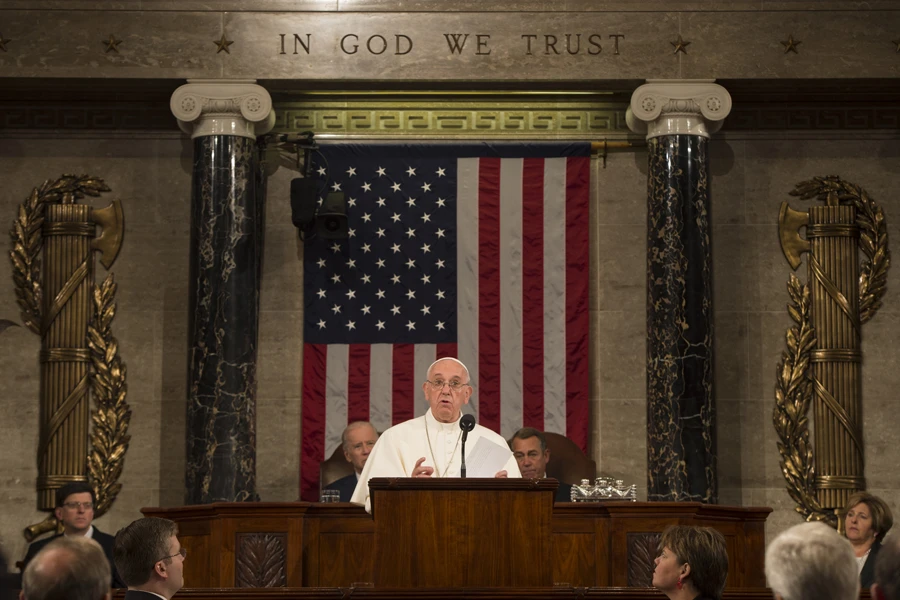
Sept. 22-27 — After departing from Cuba, Pope Francis makes his first papal visit to the United States. In Washington, D.C., he speaks to a joint session of Congress, in which he urges lawmakers to work toward promoting the common good, and canonizes the Franciscan missionary St. Junípero Serra. He also attends the World Meeting of Families in Philadelphia, which focuses on celebrating the gift of the family.
Pope Francis speaks to the U.S. Congress in Washington, D.C. on Sept. 24, 2015. . L’Osservatore Romano.
Oct. 4 — Pope Francis begins the second Synod on the Family to address issues within the modern family, such as single-parent homes, cohabitation, poverty, and abuse.
Oct. 18 — The pope canonizes St. Louis Martin and St. Marie-Azélie “Zelie” Guérin. The married couple were parents to five nuns, including St. Therese of Lisieux. They are the first married couple to be canonized together.
Dec. 8 — Pope Francis’ Jubilee Year of Mercy begins. The year focuses on God’s mercy and forgiveness and people’s redemption from sin. The pope delegates certain priests in each diocese to be Missionaries of Mercy who have the authority to forgive sins that are usually reserved for the Holy See.
2016
March 19 — Pope Francis publishes the apostolic exhortation Amoris Laetitia, which discusses a wide variety of issues facing the modern family based on discussions from the two synods on the family. The pope garners significant controversy from within the Church for comments he makes in Chapter 8 about Communion for the divorced and remarried.
April 16 — After visiting refugees on the Greek island of Lesbos, Pope Francis allows three Muslim refugee families to join him on his flight back to Rome. He says the move was not a political statement.
Pope Francis at the General Audience in St. Peter’s Square, Feb. 24, 2016. Daniel Ibanez/CNA.
July 26-31 — Pope Francis visits Krakow, Poland, as part of the World Youth Day festivities. About 3 million young Catholic pilgrims from around the world attend.
Sept. 4 — The pope canonizes St. Teresa of Calcutta, who is also known as Mother Teresa. The saint, a nun from Albania, dedicated her life to missionary and charity work, primarily in India.
Sept. 30-Oct. 2 — Pope Francis visits Georgia and Azerbaijan on his 16th trip outside of Rome since the start of his papacy. His trip focuses on Catholic relations with Orthodox Christians and Muslims.
Oct. 4 — Pope Francis makes a surprise visit to Amatrice, Italy, to pray for the victims of an earthquake in central Italy that killed nearly 300 people.
2017
May 12-13 — In another papal trip, Francis travels to Fatima, Portugal, to visit the Shrine of Our Lady of Fatima. May 13 marks the 100th anniversary of the first Marian apparition to three children in the city.
July 11 — Pope Francis adds another category of Christian life suitable for the consideration of sainthood: “offering of life.” The category is distinct from martyrdom, which only applies to someone who is killed for his or her faith. The new category applies to those who died prematurely through an offering of their life to God and neighbor.
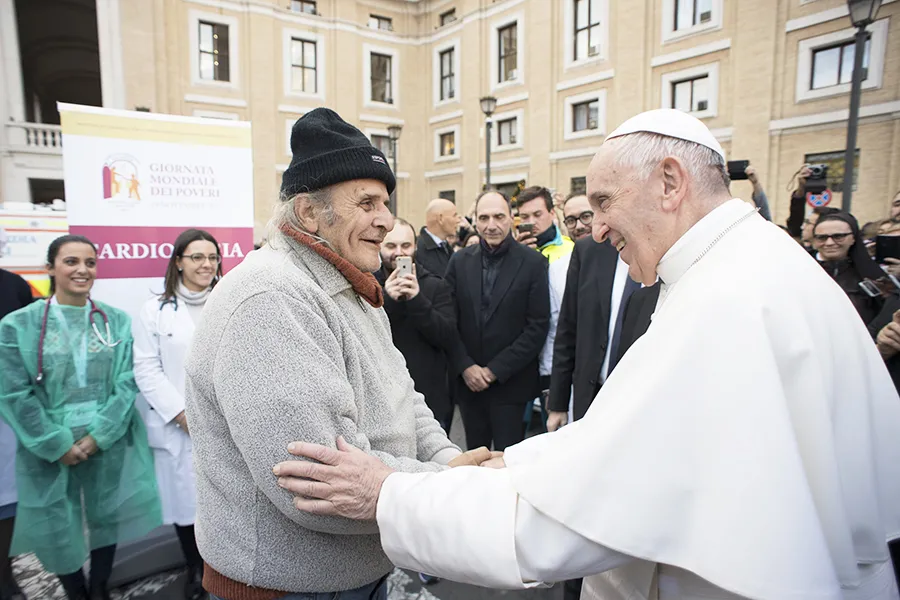
Pope Francis greets a participant in the World Day of the Poor in Rome, Nov. 16, 2017. L’Osservatore Romano.
Nov. 19 — On the first-ever World Day of the Poor, Pope Francis eats lunch with 4,000 poor and people in need in Rome.
Nov. 27-Dec. 2 — In another trip to Asia, Pope Francis travels to Myanmar and Bangladesh. He visits landmarks and meets with government officials, Catholic clergy, and Buddhist monks. He also preaches the Gospel and promotes peace in the region.
2018
Jan. 15-21 — The pope takes another trip to Latin America, this time visiting Chile and Peru. The pontiff meets with government officials and members of the clergy while urging the faithful to remain close to the clergy and reject secularism. The Chilean visit leads to controversy over Chilean clergy sex abuse scandals.
Aug. 2 — The Vatican formally revises No. 2267 of the Catechism of the Catholic Church, which concerns the death penalty. The previous text suggested the death penalty could be permissible in certain circumstances, but the revision states that the death penalty is “inadmissible.”
Aug. 25 — Archbishop Carlo Viganò, former papal nuncio to the United States, publishes an 11-page letter calling for the resignation of Pope Francis and accusing him and other Vatican officials of covering up sexual abuse including allegations against former Cardinal Theodore McCarrick. The pope initially does not directly respond to the letter, but nine months after its publication he denies having prior knowledge about McCarrick’s conduct.
Aug. 25-26 — Pope Francis visits Dublin, Ireland, to attend the World Meeting of Families. The theme is “the Gospel of family, joy for the world.”
Pope Francis at the 2018 World Meeting of Families in Ireland. Daniel Ibanez/CNA.
Oct. 3-28 — The Synod on Young People, the Faith, and Vocational Discernment takes place. The synod focuses on best practices to teach the faith to young people and to help them discern God’s will.
2019
Jan. 22-27 — The third World Youth Day during Pope Francis’ pontificate takes place during these six days in Panama City, Panama. Young Catholics from around the world gather for the event, with approximately 3 million people in attendance.
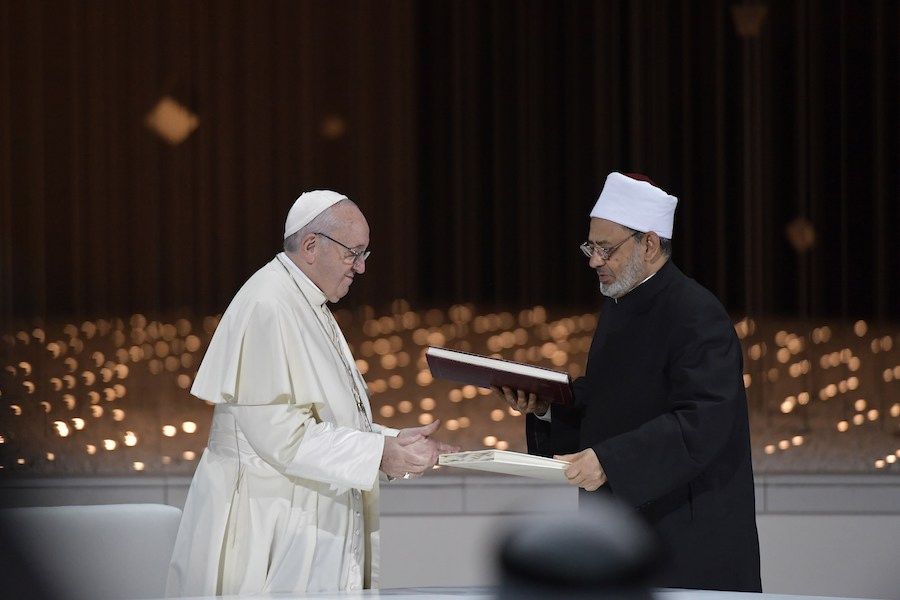
Feb. 4 — Pope Francis signs a joint document in with Sheikh Ahmed el-Tayeb, the grand imam of Al-Azhar, in Abu Dhabi, United Arab Emirates, titled the “Document on Human Fraternity for World Peace and Living Together.” The document focuses on people of different faiths uniting together to live peacefully and advance a culture of mutual respect.
Pope Francis and Ahmed el-Tayeb, grand imam of al-Azhar, signed a joint declaration on human fraternity during an interreligious meeting in Abu Dhabi, UAE, Feb. 4, 2019. Vatican Media.
Feb. 21-24 — The Meeting on the Protection of Minors in the Church, which is labeled the Vatican Sexual Abuse Summit, takes place. The meeting focuses on sexual abuse scandals in the Church and emphasizes responsibility, accountability, and transparency.
Oct. 6-27 — The Church holds the Synod of Bishops for the Pan-Amazon region, which is also known as the Amazon Synod. The synod is meant to present ways in which the Church can better evangelize the Amazon region but leads to controversy when carved images of a pregnant Amazonian woman, referred to by the pope as Pachamama, are used in several events and displayed in a basilica near the Vatican.
Oct. 13 — St. John Henry Newman, an Anglican convert to Catholicism and a cardinal, is canonized by Pope Francis. Newman’s writings inspired Catholic student associations at nonreligious colleges and universities in the United States and other countries.
2020
March 15 — Pope Francis takes a walking pilgrimage in Rome to the chapel of the crucifix and prays for an end to the COVID-19 pandemic. The crucifix was carried through Rome during the plague of 1522.
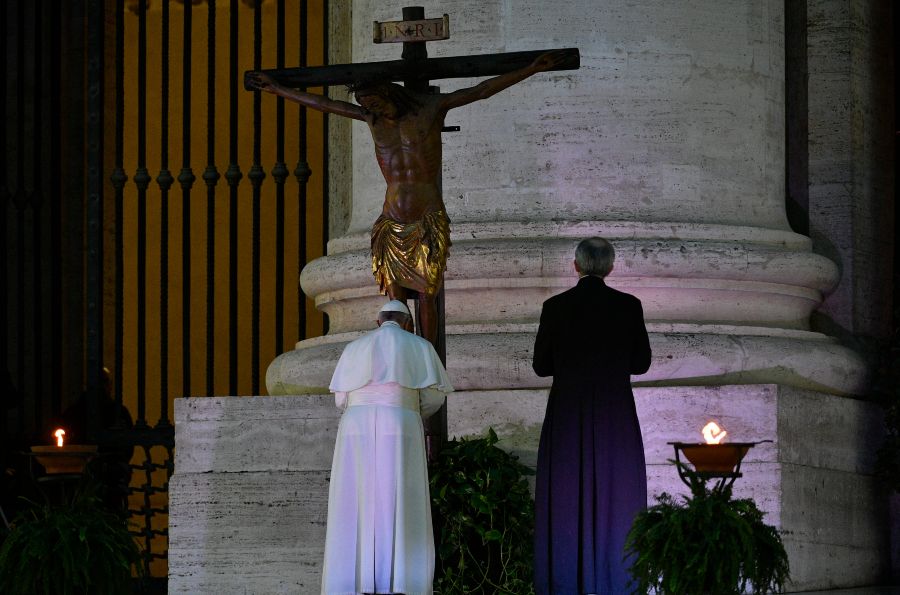
March 27 — Pope Francis gives an extraordinary “urbi et orbi” blessing in an empty and rain-covered St. Peter’s Square, praying for the world during the coronavirus pandemic.
Pope Francis venerates the miraculous crucifix of San Marcello al Corso in St. Peter’s Square during his Urbi et Orbi blessing, March 27, 2020. Vatican Media.
2021
March 5-8 — In his first papal trip since the start of the COVID-19 pandemic, Pope Francis becomes the first pope to visit Iraq. On his trip, he signs a joint statement with Grand Ayatollah Ali al-Sistani condemning extremism and promoting peace.
July 3 — Cardinal Giovanni Angelo Becciu, who was elevated to the College of Cardinals by Pope Francis, is indicted in a Vatican court for embezzlement, money laundering, and other crimes. The pope gives approval for the indictment.
July 4 — Pope Francis undergoes colon surgery for diverticulitis, a common condition in older people. The Vatican releases a statement that assures the pope “reacted well” to the surgery. Francis is released from the hospital after 10 days.
July 16 — Pope Francis issues a motu proprio titled Traditionis Custodes. The document imposes heavy restrictions on the celebration of the Traditional Latin Mass.
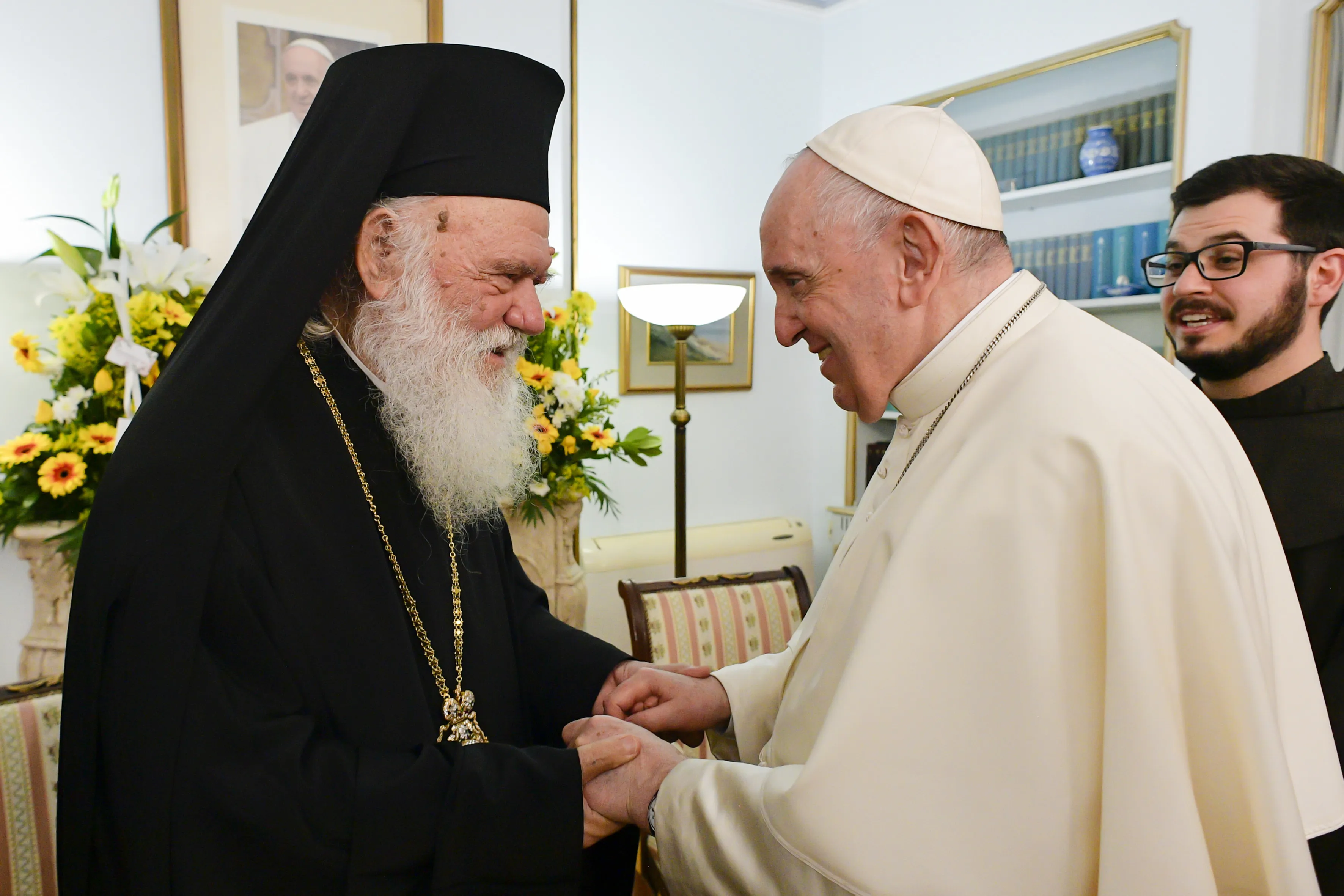
Dec. 2-6 — The pope travels to Cyprus and Greece. The trip includes another visit to the Greek island of Lesbos to meet with migrants.
Pope Francis greets His Beatitude Ieronymos II in Athens, Greece on Dec. 5, 2021. Vatican Media
2022
Jan. 11 — Pope Francis makes a surprise visit to a record store in Rome called StereoSound. The pope, who has an affinity for classical music, blesses the newly renovated store.
March 19 — The pope promulgates Praedicate Evangelium, which reforms the Roman Curia. The reforms emphasize evangelization and establish more opportunities for the laity to be in leadership positions.
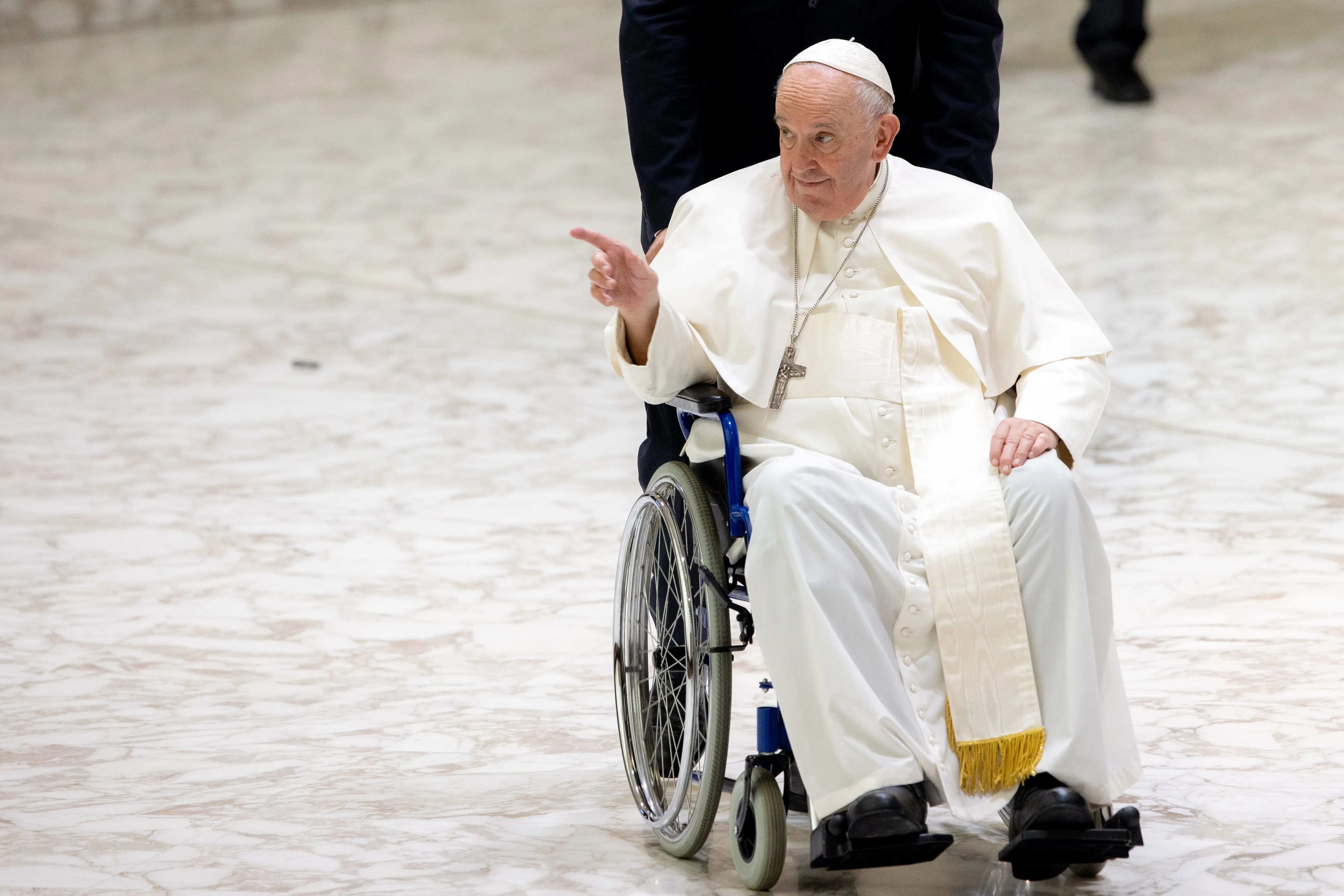
May 5 — Pope Francis is seen in a wheelchair for the first time in public and begins to use one more frequently. The pope has been suffering from knee problems for months.
Pope Francis greeted the crowd in a wheelchair at the end of his general audience on Aug. 3, 2022. Daniel Ibanez/CNA
July 24-30 — In his first papal visit to Canada, Pope Francis apologizes for the harsh treatment of the indigenous Canadians, saying many Christians and members of the Catholic Church were complicit.
2023
Jan. 31-Feb. 5 — Pope Francis travels to the Democratic Republic of Congo and South Sudan. During his visit, the pope condemns political violence in the countries and promotes peace. He also participates in an ecumenical prayer service with Anglican Archbishop of Canterbury Justin Welby and Moderator of the Church of Scotland Iain Greenshields.
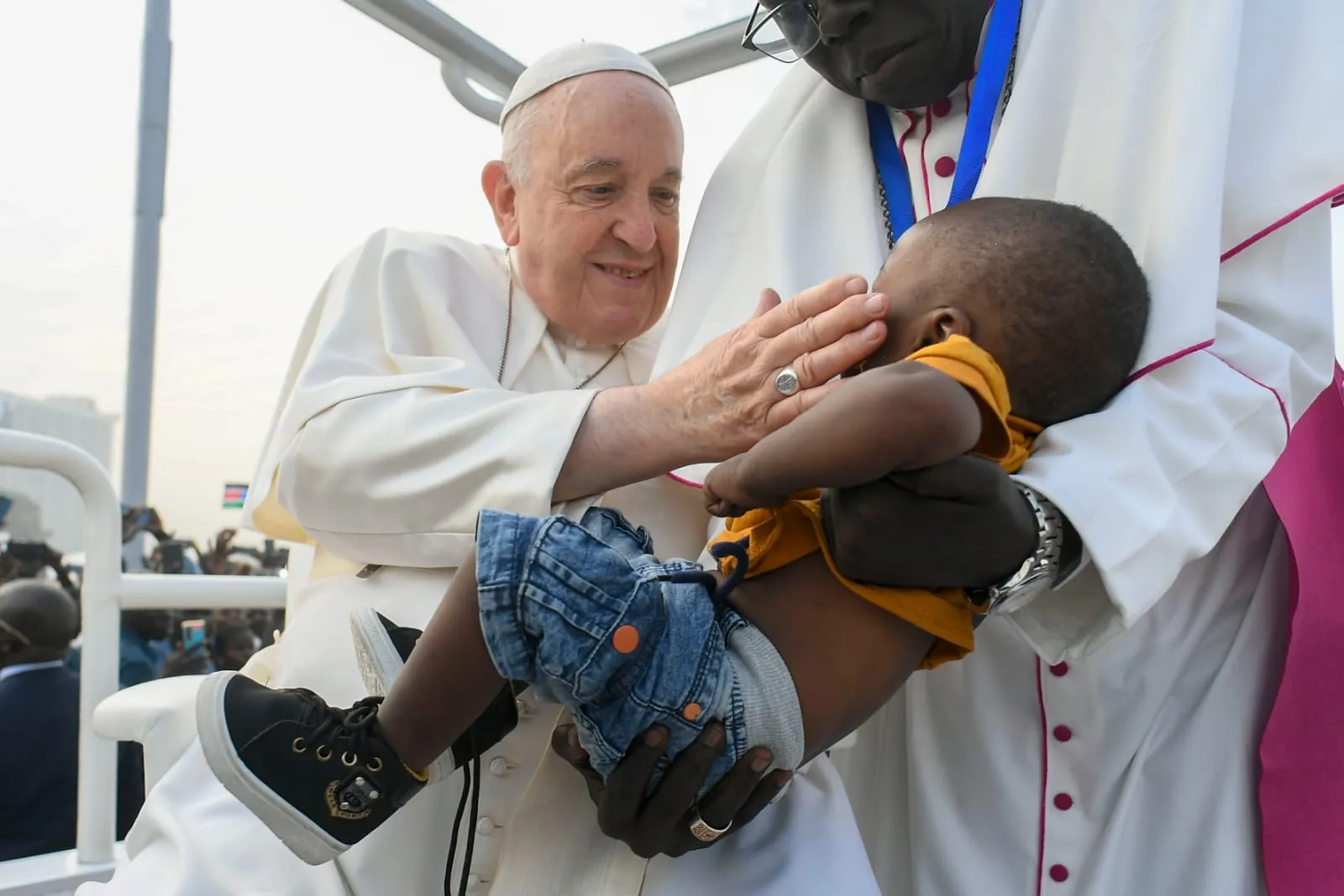
Pope Francis greets a young boy a Mass in Juba, South Sudan on Feb. 5, 2023. Vatican Media
March 29-April 1 — Pope Francis is hospitalized for a respiratory infection. During his stay at Rome’s Gemelli Hospital, he visits the pediatric cancer ward and baptizes a newborn baby.
April 5 — The pope appears in the Disney documentary “The Pope: Answers,” which is in Spanish, answering six “hot-button” issues from members of Gen Z from various backgrounds. The group discusses immigration, depression, abortion, clergy sexual and psychological abuse, transgenderism, pornography, and loss of faith.
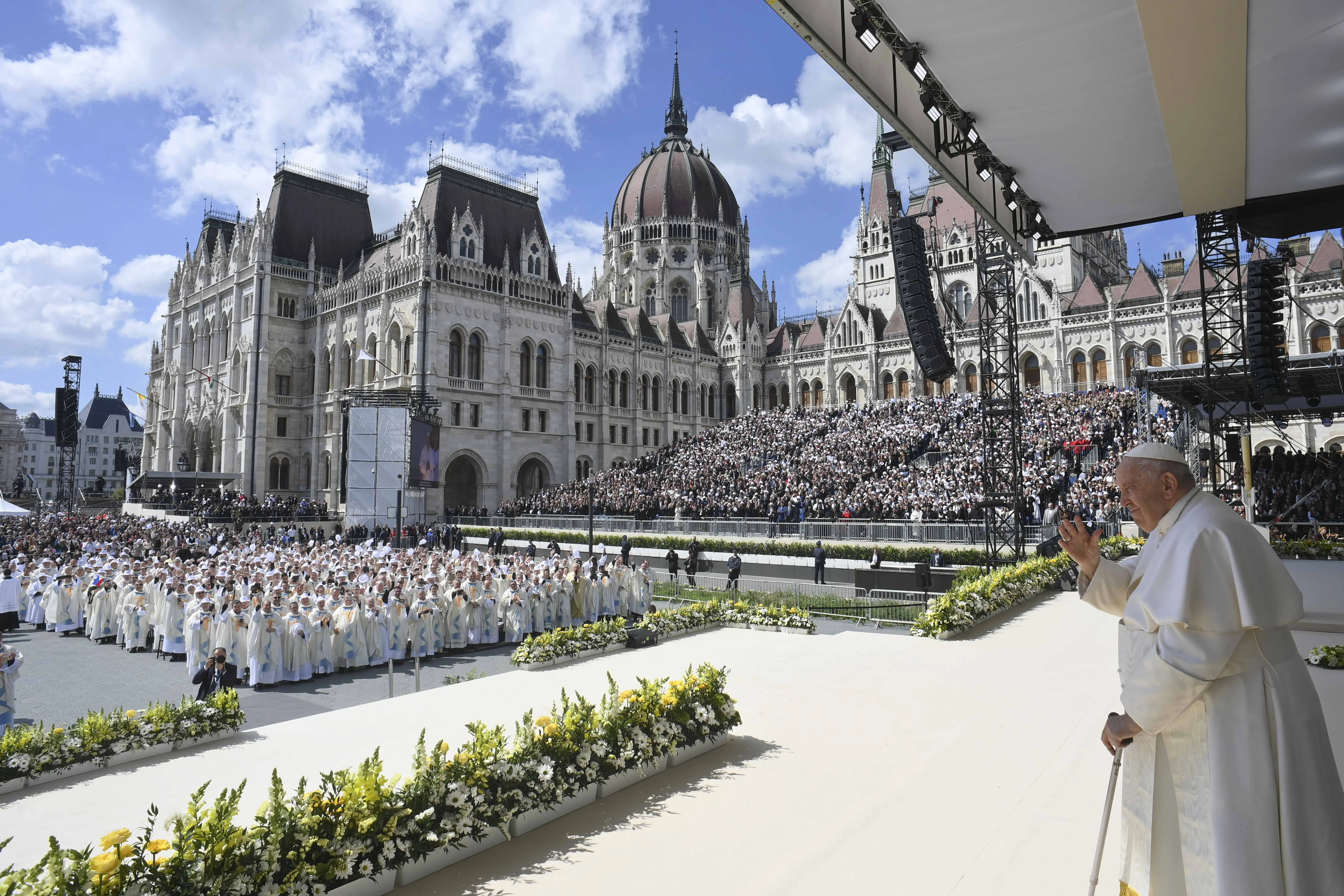
April 28-30 — Pope Francis visits Hungary to meet with government officials, civil society members, bishops, priests, seminarians, Jesuits, consecrated men and women, and pastoral workers. He celebrates Mass on the final day of the trip in Kossuth Lajos Square.
Pope Francis stands on an altar erected outside the Parliament Building in Budapest’s Kossuth Lajos’ Square during a public outdoor Mass on April 30, 2023. Vatican Media
June 7 — The Vatican announces that Pope Francis will undergo abdominal surgery that afternoon under general anesthesia due to a hernia that is causing painful, recurring, and worsening symptoms. In his general audience that morning before the surgery, Francis says he intends to publish an apostolic letter on St. Thérèse of Lisieux, “patroness of the missions,” to mark the 150th anniversary of her birth.
June 15 — After successful surgery and a week of recovery, Pope Francis is released from Gemelli Hospital.
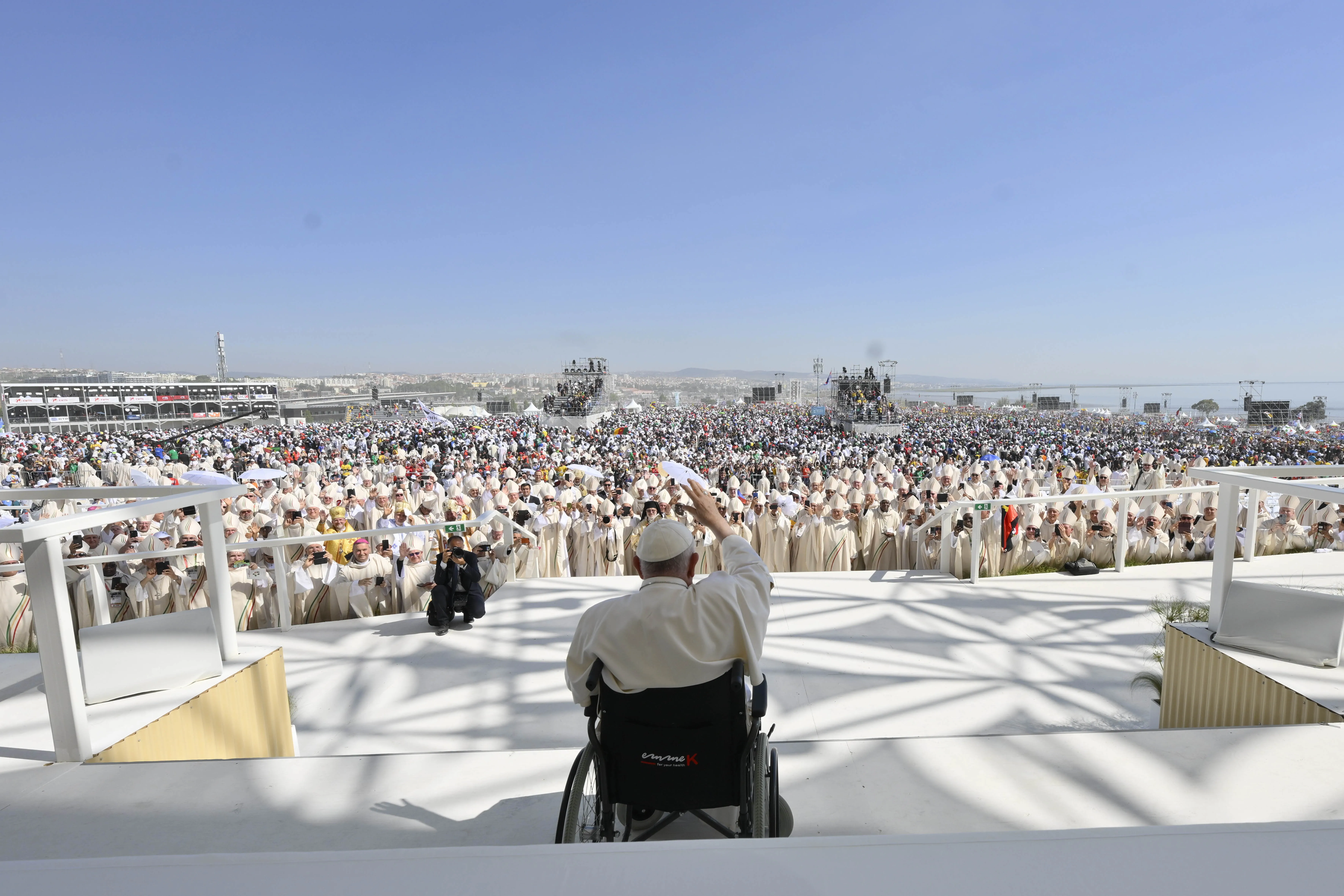
Aug. 2-6 — Pope Francis travels to Lisbon, Portugal, for World Youth Day 2023, taking place from Aug. 1-6. He meets with Church and civil leaders ahead of presiding at the welcoming Mass and Stations of the Cross. He also hears the confessions of several pilgrims. On Aug. 5, he visits the Shrine of Our Lady of Fátima, where he prays the rosary with young people with disabilities. That evening he presides over the vigil and on Sunday, Aug. 6, he celebrates the closing Mass, where he urges the 1.5 million young people present to “be not afraid,” echoing the words of the founder of World Youth Days, St. John Paul II.
Pope Francis waves at the crowd of 1.5 million people who attended the closing Mass of World Youth Day 2023 in Lisbon, Portugal on Aug. 6, 2023. Vatican Media.
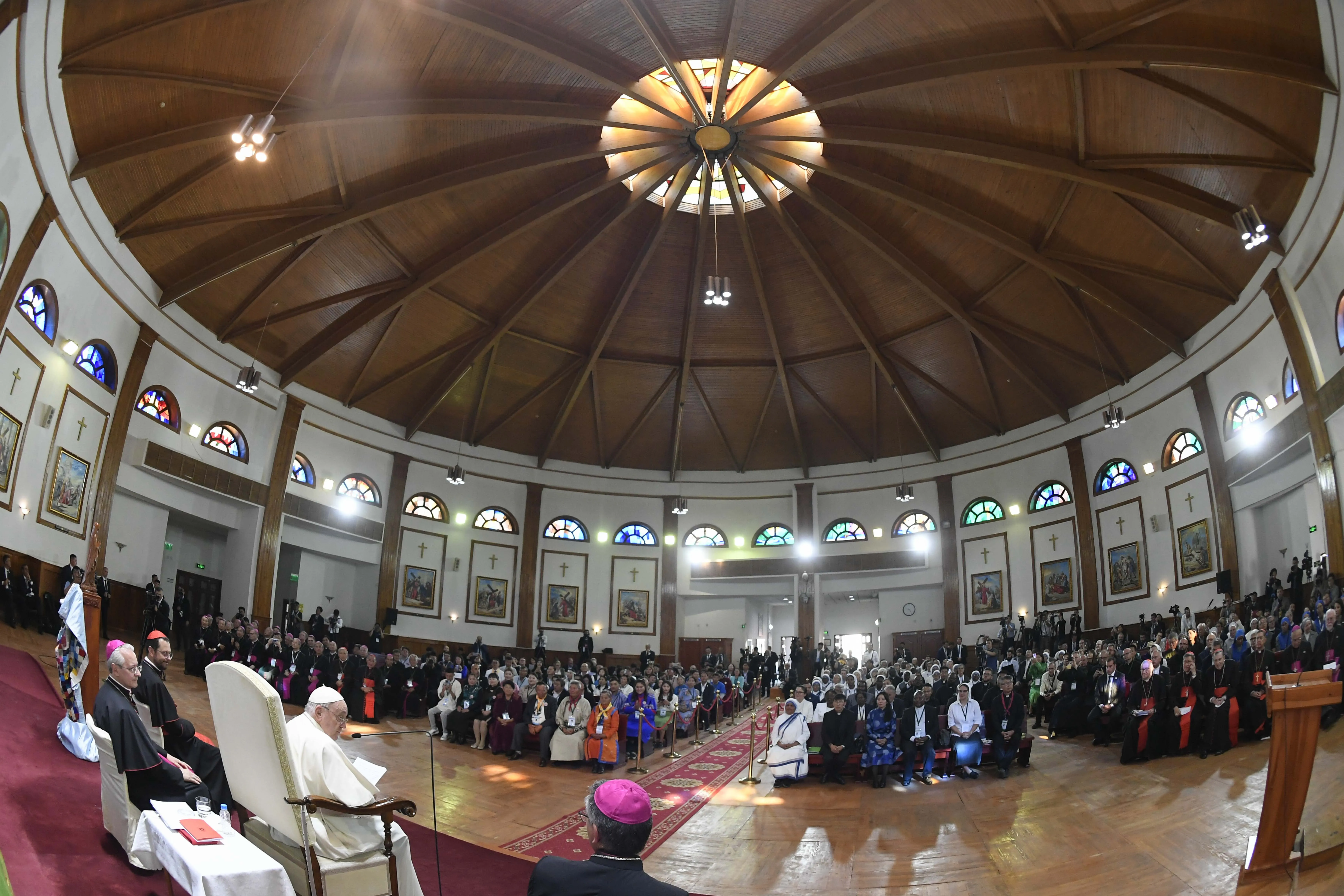
Aug. 31-Sept. 4 — Pope Francis travels to Mongolia, the world’s most sparsely populated sovereign country. The trip makes Francis the first pope to visit the Asian country that shares a 2,880-mile border with China, its most significant economic partner. Mongolia has a population of about 1,300 Catholics in a country of more than 3 million people.
Pope Francis meets with local priests and religious of Mongolia, which includes only 25 priests (19 religious and six diocesan), 33 women religious, and one bishop — Cardinal Giorgio Marengo — in Ulaanbaatar’s Cathedral of Sts. Peter and Paul on Sept. 2, 2023. Credit: Vatican Media
Sept. 22-23 — On a two-day trip to Marseille, France, Pope Francis meets with local civil and religious leaders and participates in the Mediterranean Encounter, a gathering of some 120 young people of various creeds with bishops from 30 countries.
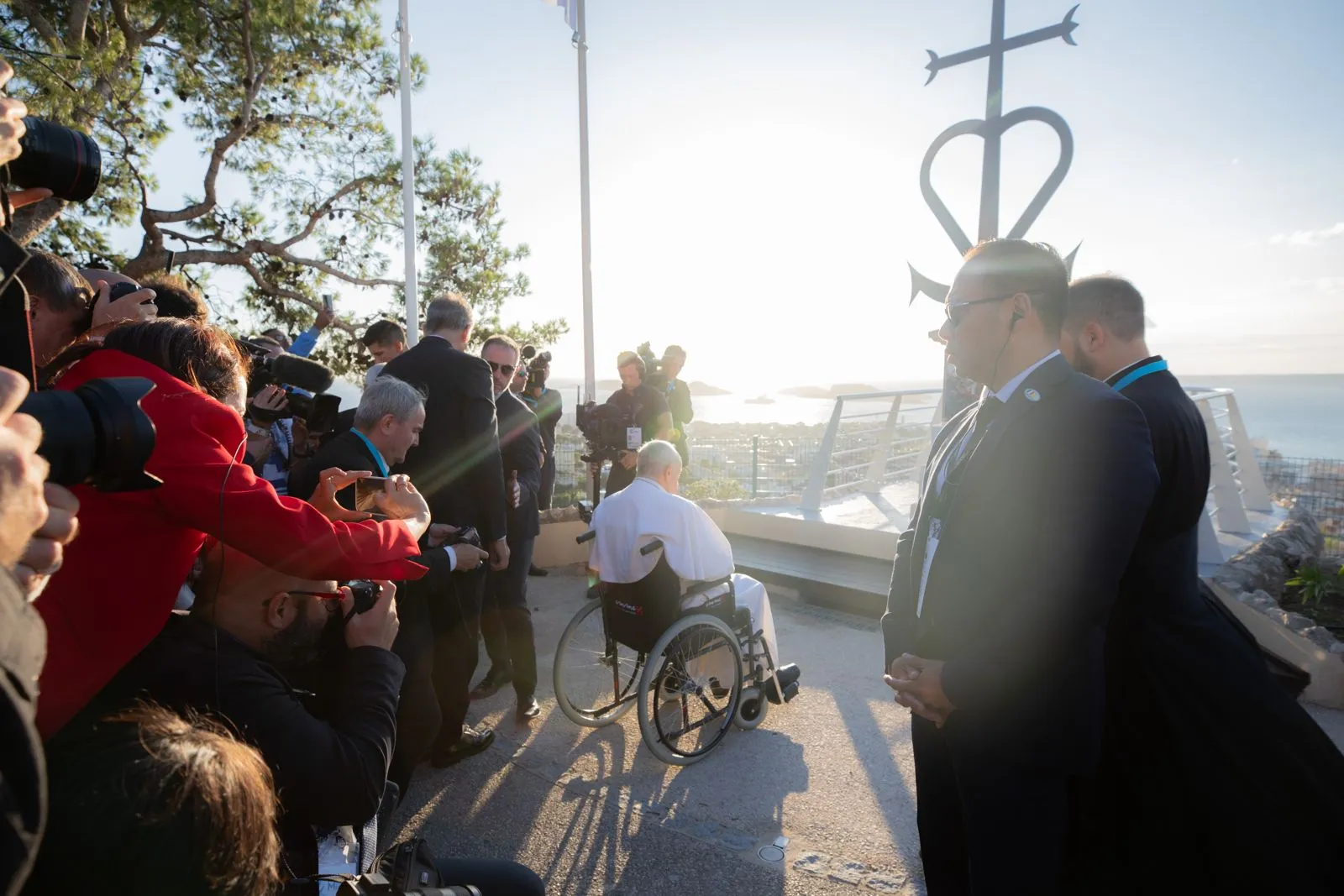
Pope Francis asks for a moment of silence at a memorial dedicated to sailors and migrants lost at sea on the first of a two-day visit to Marseille, France, Sept. 22, 2023. A Camargue cross, which comes from the Camargue area of France, represents the three theological virtues of faith, hope, and charity. The three tridents represent faith, the anchor represents hope, and the heart represents charity. Credit: Daniel Ibañez/CNA
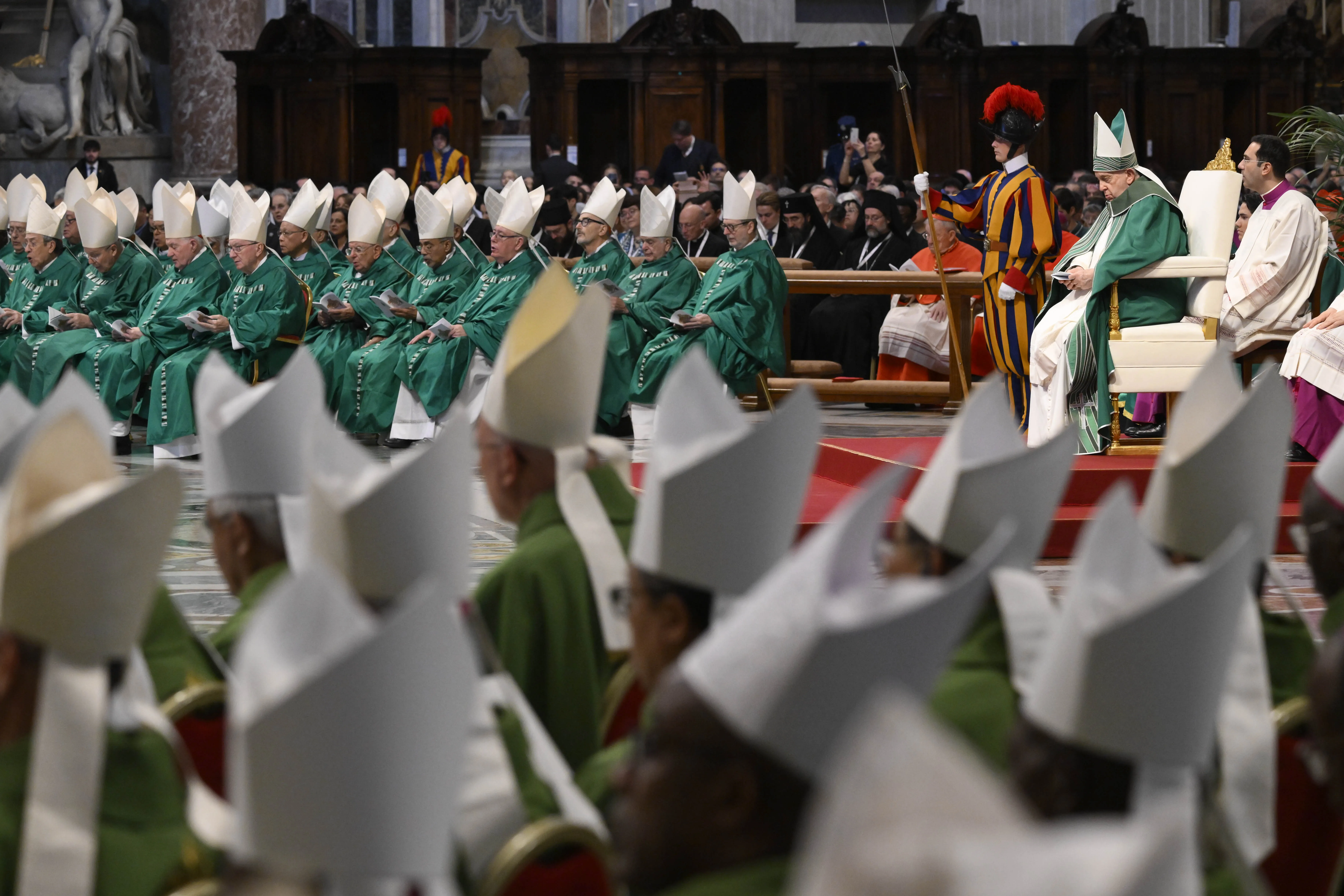
Oct. 4-29 — The Vatican hosts the first of two monthlong global assemblies of the Synod on Synodality, initiated by Pope Francis in 2021 to enhance the communion, participation, and mission of the Church. Pope Francis celebrates the closing Mass of the synod at St. Peter’s Basilica on Oct. 29. The second and final global assembly will take place at the Vatican in October 2024.
Pope Francis at the Synod on Synodality’s closing Mass in St. Peter’s Basilica on Oct. 29, 2023. Vatican Media
Nov. 25 — Pope Francis visits the hospital briefly for precautionary testing after coming down with the flu earlier in the day. Although he still participates in scheduled activities, other officials read his prepared remarks. The Vatican on Nov. 28 cancels the pope’s planned Dec. 1–3 trip to Dubai for the COP28 climate conference, where he was scheduled to deliver a speech, due to his illness.
Dec. 18 — The Dicastery for the Doctrine of the Faith issues the declaration Fiducia Supplicans, which authorizes nonliturgical blessings for same-sex couples and couples in “irregular situations.” Various bishops from around the world voice both support for and criticism of the document.
2024
Jan. 4 — Amid widespread backlash to Fiducia Supplicans, Cardinal Victor Manuel Fernández, prefect of the Dicastery for the Doctrine of the Faith, publishes a five-page press release that refers to Fiducia Supplicans as “perennial doctrine” and underlines that pastoral blessings of couples in irregular situations should not be “an endorsement of the life led by those who request them.”
Jan. 14 — Pope Francis for the first time responds publicly to questions about Fiducia Supplicans in an interview on an Italian television show. The pope underlines that “the Lord blesses everyone” and that a blessing is an invitation to enter into a conversation “to see what the road is that the Lord proposes to them.”
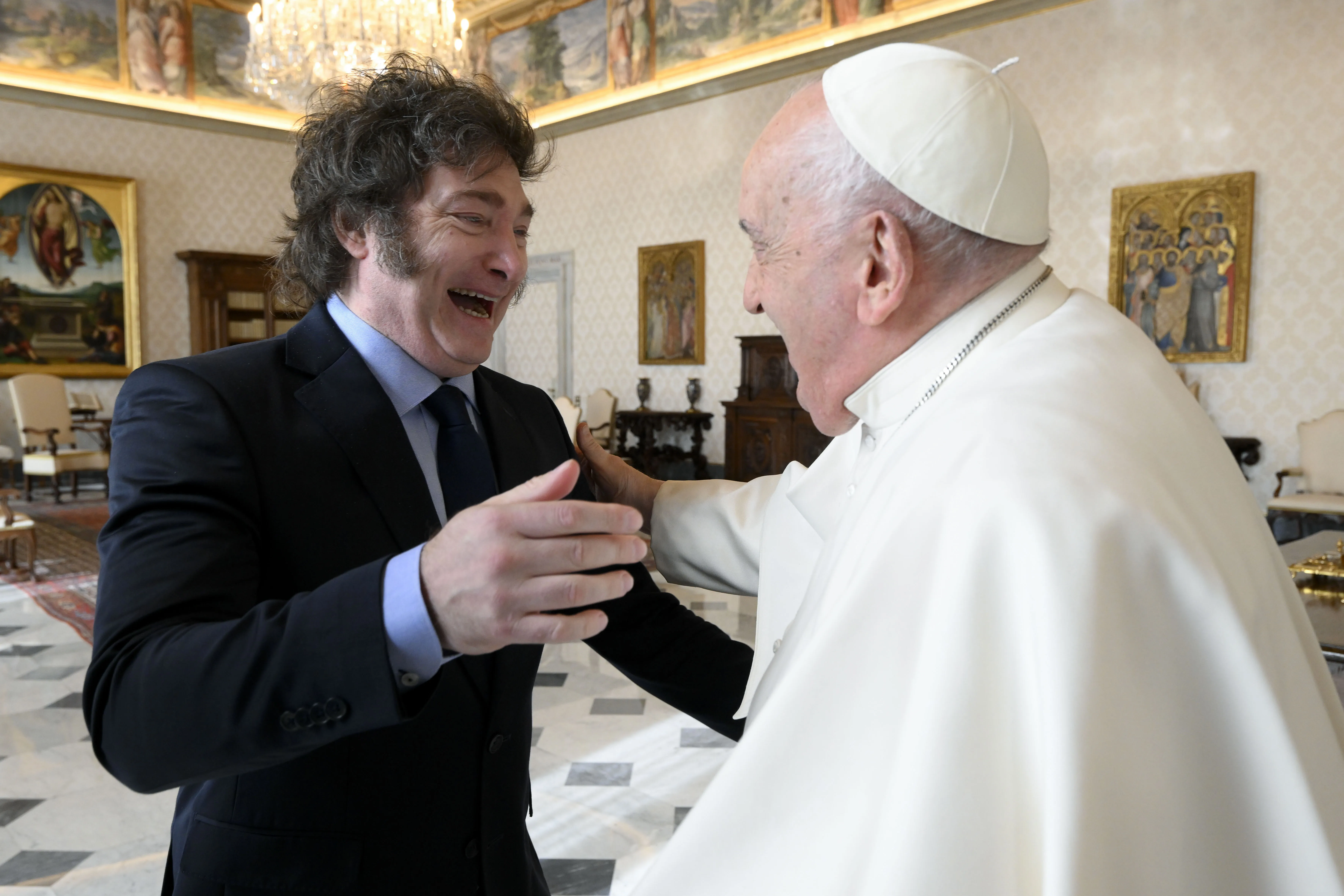
Feb. 11 — In a ceremony attended by Argentine president Javier Milei, Pope Francis canonizes María Antonia of St. Joseph — known affectionately in the pope’s home country as “Mama Antula” — in a Mass at St. Peter’s Basilica. The president and the former archbishop of Buenos Aires embrace after the ceremony. Pope Francis, who has not returned to his homeland since becoming pope in 2013, has said he wants to visit Argentina in the second half of this year.
Pope Francis meets with Argentina President Javier Milei in a private audience on Feb. 12, 2024, at the Vatican. Credit: Vatican Media
Feb. 28 — After canceling audiences the previous Saturday and having an aide read his prepared remarks at his Wednesday audience due to a “mild flu,” Pope Francis visits the hospital for diagnostic tests but returns to the Vatican afterward.
March 2 — Despite having an aide read his speech “because of bronchitis,” the pope presides over the inauguration of the 95th Judicial Year of the Vatican City State and maintains a full schedule.
March 13 — Pope Francis celebrates 11 years as Supreme Pontiff of the Roman Catholic Church.
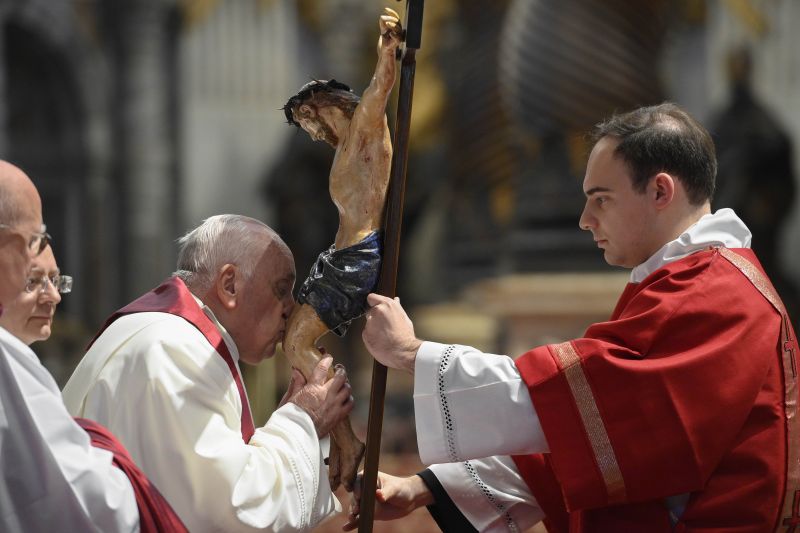
Pope Francis kisses the crucifix at the Liturgy of the Lord’s Passion in St. Peter’s Basilica on April 7, 2023. / Vatican Media
Vatican City, Apr 7, 2023 / 12:00 pm (CNA).
At the Vatican’s Good Friday liturgy, the papal preacher warned against the danger of believers being drawn into the “vortex of nihilism” by the post-modern world’s “total relativism.”
Cardinal Raniero Cantalamessa, O.F.M. Cap., compared Friedrich Nietzsche’s words “God is dead” with the Catholic Church’s proclamation of the death of Christ as he preached at the Liturgy of the Lord’s Passion on April 7 in St. Peter’s Basilica in the presence of Pope Francis.
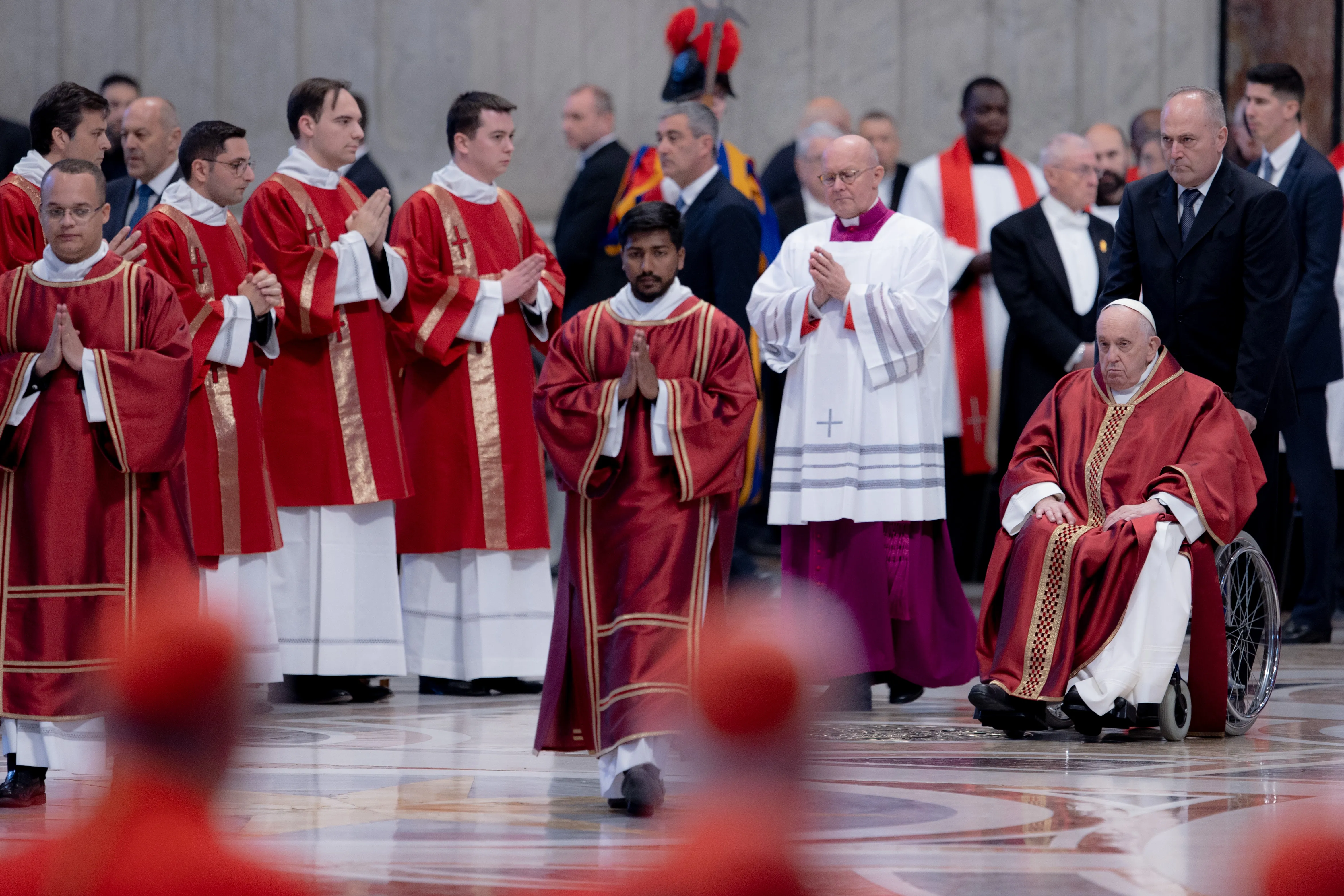
At the beginning of the liturgy, Pope Francis arrived at the basilica dressed in red vestments in a wheelchair. Unlike in previous years, he was unable to lay prostrate but spent a moment in silent prayer before the main altar at the beginning of the liturgy.
Pope Francis arrives at the Liturgy of the Lord’s Passion in St. Peter’s Basilica on Good Friday on April 7, 2023. Daniel Ibanez/CNA
The Vatican announced earlier in the day that the 86-year-old pope, who was hospitalized with bronchitis last week, will not be attending the Stations of the Cross at the Colosseum on Friday night due to cold weather.
In his homily, Cantalamessa noted that the Catholic Church has proclaimed the death of Christ for 2,000 years. He said: “At every Mass, after the consecration, we say or sing: ‘We proclaim your death, O Lord, and profess your Resurrection until you come again.’”
“Yet another ‘death of God’ has been proclaimed for a century and a half in our de-Christianized Western world. When, among cultivated people, one speaks of the ‘death of God,’ it is this other death of God – ideological and rather than historical – that is meant. To keep up with the times, some theologians hastened to build a theology around it: ‘The theology of the death of God.’”
“We cannot pretend to ignore the existence of this different narrative, without leaving prey to suspicion many believers,” he added.
Cantalamessa, who was made a cardinal in 2020 in recognition of his more than 40 years as Preacher of the Papal Household, said that he chose to speak about this topic “to keep believers – who knows, perhaps even just one or two university students – from being drawn into this vortex of nihilism which is the true ‘black hole’ of the spiritual universe.”
Pope Francis prays during the Liturgy of the Lord’s Passion in St. Peter’s Basilica on April 7, 2023. Daniel Ibanez/CNA
With relativism in the fields of ethics, philosophy, art, and religion, “nothing more is solid; everything is liquid, or even vaporous,” the cardinal said.
“As believers, it is our duty to show what there is behind, or underneath, that proclamation, namely the flicker of an ancient flame, the sudden eruption of a volcano that has never been extinguished since the beginning of the world,” he said.
After the homily, a deacon and Pope Francis read the 11 Good Friday Solemn Intercessions, which included prayers for the Jewish people, those who do not believe in God, and those suffering from war.
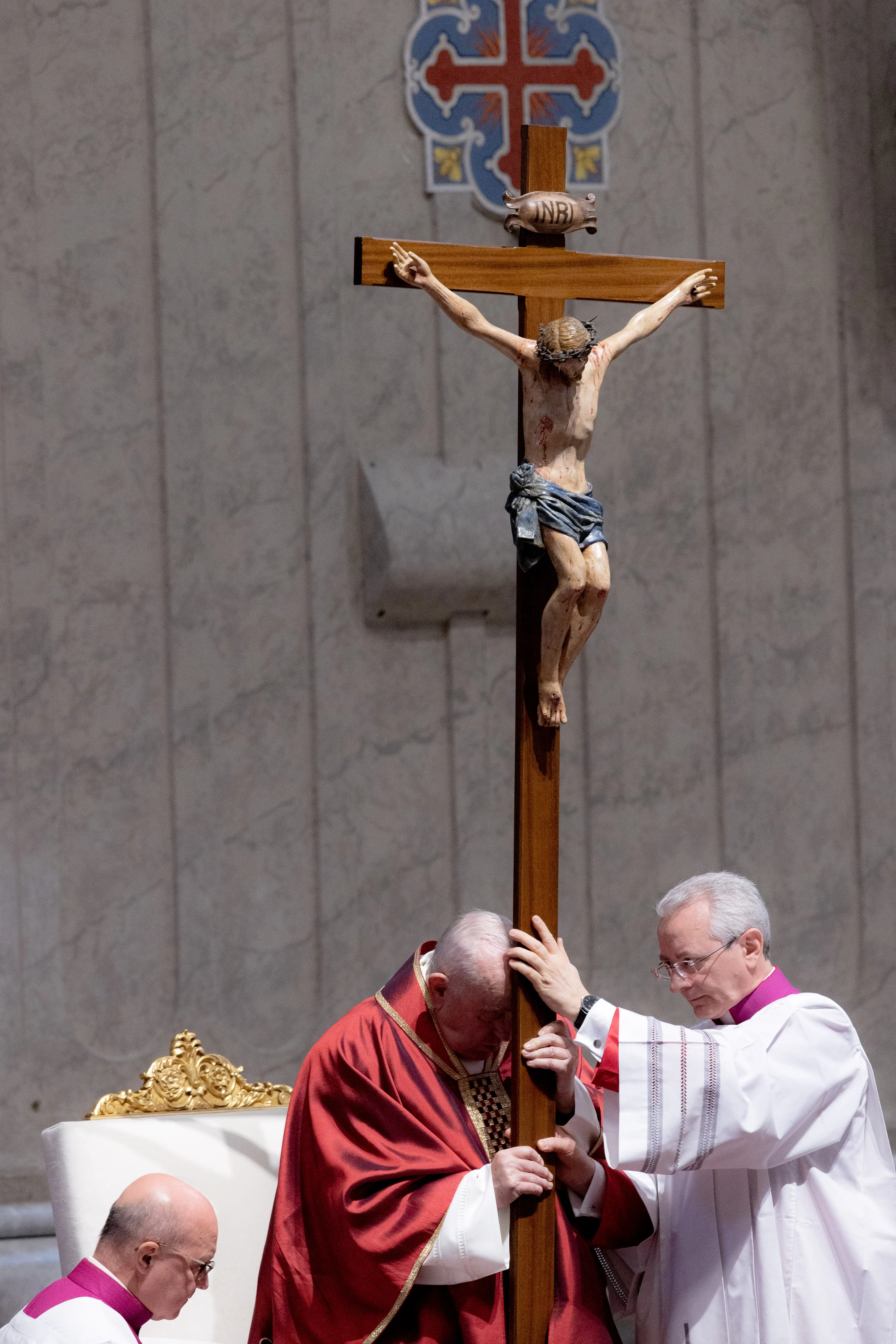
The Adoration of the Cross then took place, followed by the recitation of the Our Father and Holy Communion. Pope Francis kissed the crucifix after spending a moment in silent adoration standing at the foot of the cross.
Pope Francis adores the Holy Cross during the Liturgy of the Lord’s Passion on April 7, 2023. Daniel Ibanez/CNA
During his homily, Cantalamessa urged Christians to heed a warning from Dante Alighieri, who wrote in the Divine Comedy: “‘Christians, be ye more serious in your movements; Be ye not like a feather at each wind, And think not every water washes you.’”
The cardinal said: “Let us, therefore, continue to repeat, with heartfelt gratitude and more convinced than ever, the words we proclaim at every Mass: ‘We proclaim your death, O Lord, and profess your Resurrection until you come again.’”
Were a higher wisdom to concur that there was provocation, then there would still be the deeper question whether the provocation, itself, was provoked–as from 1945 to 1991, and again in 2014. And maybe even back to the non-Russian Genghis Khan.
Is there in play here a certain kind of generic mindset? And was it identified by Pope Benedict XVI when he remarked that the error of “consequentialism” is that it dissolves into an endless “calculus” of ever-more indeterminate causes and effects?
It’s almost as if the elementary clarity of human thought requires the kind of moral absolutes affirmed in Veritatis Splendor, much neglected since 2013.
Fluidity in the meaning of binary and indissoluble marriage, for example, seems to find its counterpart in the fluidity of reducing geopolitical events into the endless layering of who provoked whom first. Meanwhile, the (provoking…) buildup of tanks and regiments crossed a line (!) widely known in the imperfect and yet modern world to be a national border.
“Pope Benedict XVI when he remarked that the error of consequentialism is that it dissolves into an endless calculus of ever-more indeterminate causes and effects?” (Peter Beaulieu). We can’t in actual conflict consider a hyperintellectual rationale of indeterminate consequentialism that dissolves into amoral inertia. That based on the inherent right to self defense, and the obligation to defend the weak when mortally threatened.
That said, a poor pontiff can’t always be wrong. Odds are he’ll be right on occasion and so, he is not floundering. NATO Secretary General Jens Stoltenberg revealed the major cause for Russia’s initial opposition to Ukraine policy and manifest relations with a hostile Nato arming Ukraine for years.
As the eminent Don Corleone adjudicates Russia had cause for protest but committed a terrible transgression in the invasion. This was indeed confirmed by the editor consigliere. Catholic doctrine on just cause for war can never be preemptive, as was the rationale for Bush 43’s Iraq invasion. Unless [in my opinion] an invasion was clearly imminent and survival depended on a right to make a first defensive assault as Israel has in the past. Can we come to the aid of a nation under unjust attack? Yes. Britain and France were justified in declaring war on Germany for attacking Poland. USSR simultaneous invasion of Poland should have been condemned by the allies. A right to self defense is often a complex matter and cannot be effectively addressed by simplistic maxims.
Francis may be a terrible pope, a wicked man, and a heretic, but on Ukraine he’s actually spot-on. The Ukrainian government is corrupt and is not respecter of self-determination: just ask the people of Crimea and the Donbas, whose right to independence and/or affiliation with Russia has been brutally suppressed by the tyrants of Kiev. How do you think the United States would react to Russia doing to us what we do to Russia via NATO and other military alliances with its neighbors, to say nothing of the anti-democratic violent coup of 2014 and the Kiev government’s forcible suppression of opposition political parties? This does not justify Putin’s invasion — but a broken clock is right twice a day, and so is Francis when he suggests there are no simple good and bad guys and Putin does not bear sole responsibility for things having come this far.
If Nato acted as an existential threat to Russia, by arming for years the Ukrainians who at best are corrupt and at worst nazis, not of the neo type, I believe the Pope thinks this is a just intervention but is too scared or too wise to say. The writer states that Putin is the only candidate for old 666 in this drama. I’m always amazed at how devout Catholics trust certain Catholic leaders in international affairs who are clearly not in a state of grace but won’t trust them to educate their children or run womens health. If they are so mendacious with an innocent child why trust them on this. I can think of one candidate and his son who make Lutin look like a Seraph.
In 1994, following the collapse of the Soviet Union, Ukraine agreed to give up all of the nuclear weapons that had been deployed in its territory in exchange for Russia’s guarantee to respect Ukrainian territorial integrity. Unfortunately, Russia’s behavior since then has indicated that its neighbors to the west can’t trust the Putin regime, as the 2008 Russian assault on Georgia demonstrated.
“Putin does not bear sole responsibility for things having come this far.”
Wrong
He ORDERED the invasion, he is responsible for the fact that it still goes on – he IS responsible for this carnage, all of which qualifies him as a bad guy.
No one “made him” do it, but that does not mean he was not needlessly provoked.
There is no such thing as “provoked” in a Catholic understanding of morality, especially from the subject discussed by juvenile speculation, that being a pacifist association like NATO.
The Ukrainians have been murdering ethnic Russians in the Donbass since 2014. Russia helped broker a peace deal called the Minsk Accord which called for an end to the violence in the Donbass Nd respect for Russian culture. Although they signed the accord, the Ukrainians never honoured it and continued the violence. So, Francis might well be the worst pope in history, but he’s right bout this.
It’s not accurate to “the Ukrainians,” I think. The killing did indeed continue sporadically, but at the hands of the neo-fascist Azov battalion, which operated independently of the Ukrainian government. If we get beneath the vague general labels such as “the Ukrainians” or “the Russians,” I think we can find a great deal of dismay and heartache among both groups, especially since there is a great deal of intermarriage between them.
Actually, didn’t the current president of Ukraine, Volodymyr Zelensky, run and win as a reform candidate, vowing to clean up the very corruption and cronyism you decry? Ukraine did indeed have its own version of the corrupt plutocracy that currently rules Russia, although at least some of them, such as Viktor Yanukovych, were also stooges of Vladimir Putin’s. It’s no accident that he now lives in Russia. Finally, don’t you think all of the talk of Ukraine being run by “Nazis” is a bit strange, given the fact that Zelensky is Jewish? I personally have a hard time imagining that “Nazis” would elect a Jewish president, don’t you?
Pope Francis has, on many occasions, condemned Russia’s aggression labelling it a “violation of the principle of the self-determination of peoples.” He condemned the Russian troops who were brutal, cruel and ferocious. We also know that he consecrated Ukraine to the Immaculate Heart of Mary. So, there is no doubt where his sympathy lies.
We also know that rightwing American conservatives have been regularly saying that western efforts to bring Ukraine into the NATO group is partly to blame for Russia’s aggressive action. Trump, Tucker, Candice, Tulsi and many more. Tulsi, now a conservative, said: “Putin has made clear all along that their security, in his mind, is what’s at stake here.” Prelates like Vigano and Sarah have also been blind-sided by Putin’s apparent spirituality, and the predicament he claims to have been placed in by the west. Well, most of us know how the Americans reacted when they believed that Russia was trying to bring big guns into Cuba.
Perhaps, this might be the reason for Pope Francis’ belief that NATO’s “barking at Russia’s door” had something to do with Russia’s behavior. To a certain extent he might be right. However, there is no doubt that Pope Francis detests this Russian aggression regardless of the circumstances that lead to it. In this regard, he has not floundered. He prays a lot, I believe, for those suffering in the conflict. There are Christians and others on both sides of the conflict.
Perhaps what we see here is the non-European hand of a trusted papal advisor…
Archbishop Victor Manuel Fernandez of Argentina “has been called Francis’ ‘primary ghostwriter’ and estrecho collaborador (‘close collaborator’). He has had a major hand in Evangeli gaudium and Amoris Laetitia, and likely wrote Laudato si. He is credited for a skill in seeing and trying to reconcile varied points of view, a needed skill in today’s vexingly complex world (Wikipedia).
But, even to the point of papering-over contradictions? Does “time is greater than space” really upstage the space of Ukrainian national sovereignty? Does the morally ambivalent Chapter 8 (and fn. 351) of Amoris Laetitia really build a bridge? Laudato si, well, this one really does turn the lights on, although the convoluted momentum of the world culture and politics probably does await the Mary touch (as the “undoer of knots”).
Now, as for the complexity of Ukraine and the collision of worldviews, this, from an historic and instructive precedent: “Eppur si muove” (Galileo). The tanks. This reader returns to my earlier point, above.
I agree with you on most of this, but one correction to: “Tulsi, now a conservative”. Tulsi Gabbard has always been a conservative Democrat, as conservative as they come these days, in a very, very liberal state. She was even publicly opposed to abortion at one point but abandoned it to have any chance in the Democrat primaries. Shame on her for that, and shame on the Democrat party for driving out almost every single “conservative” from their ranks. Only in West Virginia and Louisiana can any still survive.
The pope us actually right to try to stay out of escalating things further, regardless of what his subordinates in the Curia are claiming about the conflict.
Bergoglio the Great Appeaser or tyrants and heretics flounders yet again. I cannot think of a single initiative he has pushed during his entire Papacy that hasn’t been a dismal failure.
Not even when Francis gratuitously insults old ladies for wearing lace, or insults whomever he insults for whatever petulant mood he’s in on any given day. I suppose a personality devotee regards it as new form of blessing.
G’day Australia, what you say is far from the truth, mate, and so I cannot go along with you. Pope Francis has not done more harm than good. He has, in fact, done a lot of good.
Go at it, Malware. Give us this list of the ‘good’.
Keeping in mind:
The China accord
Death Penalty fiasco
Refusing to clarify Amoris Laetitia
Absurd attack on the traditional Mass and traditionalists
Same absurdity on restorationists
Claiming often to want to decentralize the Vatican but then going after lay associations
Rewarding heterodox bishops
Purposely ignoring orthodox bishops
Congratulating Fr. Martin continuously on homosexual acceptance but quiet on consummation
Refusing even once in his pontificate to give an exhortation/encyclical on morality in the Catechism of the Catholic Church
The ongoing schismatic German Synod that Francis refuses to confront but publicly urges on
The same with Malta and Austria
How many endangered souls is this Pope responsible for in remaining absolutely passive when the entire German episcopate has been giving the Holy Eucharist to anyone who wants it, and continues to do so by their own words and actions, sans Scriptural grave warnings on sinful acceptance
The promised financial transparency that is anything but
German bishops ‘blessing’ homosexual unions in German churches
Not confronting the same in Italy recently
Says one thing about abortion, but another to Biden and Pelosi
Continues to give no public support to Cordileone
Has taken apart John Paul II’s Institute in Rome rendering it a hollow shell
Ignores Theology of the Body in scattered comments on sexual morality
Cardinal Hollerich and his heterodoxy is met by the silence of Francis
Just a slight sampler.
Well Ram jet, You have one it already.
The China deal was very much appreciated by Catholics inside China who wish that westerners do not interfere in their attempt to unify the Catholics in China. And, what you failed to mention is that the deal was accompanied by Pope Francis asking for the world to pray for the Chinese Catholics whom in placed under the protection of Mary. Yes, so strategically, it was a good deal under the circumstances.
Death penalty fiasco? As a pro-life Catholic, the Pope simply taught the Church’s deep-seated belief.
There was a response to the ideologues questions. However, no response was needed as there was no ambiguity or error.
So, you see I could go on, but I will leave it at that.
This Pope muddies the waters of Catholic morality with his comments when it pertains to marriage and sexuality. Why are we surprised when he muddies the waters of geopolitical conflict with comments?
For him, there is no right or wrong, good guys and bad guys when it pertains to his woke allies but, when it pertains to those who hold orthodox beliefs and practices in the Church, you can surely count on there being good guys and bad guys.
Francis has no trouble picking his enemies out in the Church but is unclear about where the blame should lie when it comes to the Russian invasion of an independent country. The problem with Francis is that he has a terminal case of logorrhea.
The other problem here is the way naive Western Catholics fetishize the Eastern Churches, as if they are enclaves of a more pure, mystical Catholicism free of stain. That’s not true. For the most part, the bishops of the Ukrainian Catholic Churches are not disinterested pastors, but bloodthirsty nationalist warmongers, who will stop at nothing — no number of corpses — to realize their dream of a forcibly-united Ukraine integrated into a left-liberal Europe. Anything said by a Ukrainian bishop needs to be read with that in mind.
‘ One soul can make a diffrence for the world ‘ – words of The Lord to St.Faustina , similar theme in the Divine Will and Flame of Love devotions ..hopefully , there are many in all Churches who do not neglect these intentionally, as ‘not ours ‘,also for closer relationship as deeper respect , gratitude and trust – towards the Holy Father too .. such as in his wisdom in seeing the need to do things discreetly as on the occasion of the wedding at Cana,to thus also bring freedom from the polluting vapors of contempt from the neigbors too ..
Carnality with its cruel bestial nature is opposite of same – not hesitating to try to use church and faith, the people entrusted to the care , to serve the tyrannical abusive nature – having become blinded to the God given mission of helping families and nations to be set free from such fallen traits and its spirits , yet being themselves often blinded , choosing instead to cater to the envious ,carnal desires in pomposity and pride , not hesitating to try to destroy those whom the enemy in his lies point out as threats .
Iraq – Ukraine – ? as mysterious sequels , of having neglected the prophetic words and role of St.John Paul 11 … ? the lesson – not to repeat the mistake and instead to heed to even the hidden lessons sent by The Spirit through the Holy Father .. not to be against .. which might in turn put the needed rope of trust in the leviathan too, just as on the occasion of the walls tumbling down ..
True , the walls may be lot more interior, even more callous in our times and not sparing many ..
to be broken in The Precious Blood , called forth for by many more , with deeper trust , to counter the blood shed – both interior and otherwise ..
May such be the fruits of the Eucharistic revival , to spread acorss in speed of Flames, burning away all that need to be , to help persons to marvel at the interior Life of The Lord , as revealed and given for ourtimes as the Divine Will writings of S.O.G Luisa .. https://www.queenofthedivinewill.org/wp-content/uploads/2020/01/Little-Catechism-of-the-Divine-Will-1.pdf
The fruits of all these good efforts in The Church ,to dispel the lukewarmness , hardness of hearts that has afflicted many all through , manifested even as demands to cave in to the carnal spirits from the very ones who are destined for the front lines against such .
The Holy Father , beloved son of The Mother knows to entrust all to her , knowing her role for these times – much , much to be grateful for that alone -which , in turn may be the means to bring down the walls ..
Well, Francis is consistent if nothing else. His whole papacy is just one long episode of ambiguity and floundering, so his position on Ukraine is entirely predictable. Nothing new there, sad to say.
That is what some people would like to make believe. I find absolutely nothing ambiguous about Pope Francis’ statements.
Tell me what is ambiguous about this statement as it appeared in rferl.org. :Roman Catholic Pope Francis has denounced the Russian invasion of Ukraine as a “macabre regression of humanity.”
Francis has lamented the war several times since Russia invaded Ukraine on February 24.“May the weapons fall silent,” he said during a Mass on April 27, “so that those who have the power to stop the war hear the cry for peace coming from all of humanity.”
Pope Francis has several times denounced the invasion and the suffering it has caused. Some of you will never be satisfied.
President Zelensky is calling for an expansion of war 1. in the Ukraine scenario and 2. for other parts of the world. Pope Francis must expose that ideologue.
They need a better approach than the one where they always fall prostrate in front of Zelensky and await to hear the ideologue cry, “Enough! More!”
For once you’re right. He unambiguously denies immutable truth. He denies the perfection of God. As a process theologian, he insists God is in the process of learning how to be God. And he insists that moral truth can change over the course of time.
I am right on this. And Zelensky has been found out; but not only has he been found out, Divine Providence also makes it at the same time show how stubborn you and others are and want to be. If you prefer to commiserate the poor Ukrainians and help Zelensky and cheer him on over it, at their expense, for the price of your tears and sop – too bad for you, you will not be able to say you didn’t have your day in court.
Mal, it must be the apocalypse! This reader “gets” what Baker is getting at, but also concurs (!) that he is “not right,” at least not exactly….
To be more exactly “right,” he might have said that Pope Francis toes the line formally while informally signaling otherwise, in practice. As in the moral fluidity nested in Amoris Laetitia (Chapter 8 and fn. 351)—the opening for later controversies following Pope Francis’ refusal to respond to the clarifying dubia.
This reader also questions the workable-but-ambiguous “four principles” floated into Evangelii Gaudium—apart from the stable moral principles in Veritatis Splendor. What do the new and exploitable principles in Evangelii Gaudium actually mean?
First, when is “realities are more important than ideas [concepts?]” at risk of “Nominalism” (exemptions from universal moral norms)?
Second, when is “time is greater than space” at risk of “Historicism” (the contradictory “paradigm shift”)?
Third, when is “the whole is greater than the part” at risk of “globalism” as an ideology (the Fundamental Option, Proportionalism/Consequentialism)?
Fourth, when is “unity prevails over conflict” at risk of “Clericalism” (absorbing subsidiarity into false solidarity)?
Instead, the Church holds that there is a unity between divine revelation and our inborn moral law, and between these and actual practice. As is reaffirmed, therefore, in the Catechism—a teaching re homosexual activity (etc.) which the German “synodal way” now openly conspires to overturn, i.e., first the media-darling James Martin, and now the clericalist Marx, Batzing, Hollerich & Co. No longer a crucial grounding or distinction between what the Church IS and what the Church DOES (councils and synods)? The fluid synodal process IS the message?
So, Mal, perhaps we can notice with you that while Pope Francis FORMALLY affirms—or does not deny traditional truths and morality—and with Baker that he at the same time INFORMALLY and repeatedly seems to (!) signal, enable and amputate accommodations, exemptions and contradictions in practice.
Quo vadis? In our unprecedented historical period of secularist/nihilistic deconstruction, instead of such a chameleon Church, how to affirm BOTH mercy AND truth—and how to strive COHERENTLY to “be perfect as your heavenly Father is perfect” (Mt 5:48)?
“I find absolutely nothing ambiguous about Pope Francis’ statements.”
Then you obviously haven’t been paying close attention. It’s unfortunate and disconcerting to see how deeply your ideological commitments blind you to seeing what’s obvious to everone else. What’s true is true whether you believe it or not. Stop defending the indefensible.
February 24, 2022 paxchristiusa Statements
Pax Christi USA’s statement on Russia’s invasion of Ukraine
Pax Christi USA condemns the Russian invasion and bombardment of cities throughout Ukraine that commenced earlier today. As St. John Paul II said in 2003 in response to the build-up and subsequent war in Iraq, “War is always a defeat for humanity.” The invasion of Ukraine is a direct violation of international law. The death and destruction already unleashed has only frustrated the hope for a just resolution of differences. To continue this war will only undermine long-term peace for the region. War does not solve the historical and political challenges at the root of this conflict; war is not the vehicle for creating a just peace.
Pax Christi USA is particularly troubled by Russia’s heavy-handed allusions to its nuclear weapons arsenal and the implied threat of the use of nuclear weapons in the conflict. As explained by the International Campaign Against Nuclear Weapons, such threats are prohibited by the Treaty on the Prohibition of Nuclear Weapons and elevates the risk of a massive humanitarian catastrophe.
Pax Christi USA urges the international community to stand united against the invasion of Ukraine and in support of diplomacy and dialogue to bring this crisis to an end. We urge the United States and NATO to refrain from pursuing military responses and to pursue solutions that address the context and complexity of the root causes which gave rise to the crisis in the first place. It should not be lost that in addition to Russian aggression, the expansion of NATO with the proliferation of bases, the continued manufacturing of weapons of war, and the reliance on security upheld by military power has played a significant role in the events building up to this current crisis. This war is additional evidence of the failure of policies predicated on the threat of violence to deliver the peace and dignity the human family deserves.
We urge political leaders, the media and influential voices within the U.S. Catholic community to refuse to beat the drums of war and to not support efforts to justify U.S. or NATO military action nor increase the flow of arms into the conflict. Such a response will only assure that the current violence will spiral ever more deeply and make even more unlikely the possibilities for an end to this war through dialogue and diplomacy.
We implore members of the Pax Christi USA community, U.S. Catholics, and people of faith everywhere to join together in the day of prayer and fasting for peace in Ukraine called for by Pope Francis on March 2, Ash Wednesday. We encourage our community to publicly vigil in support of peace on this day.
Our hearts are with all those in Ukraine who tremble in fear at the violence which has overturned their lives. Our hearts break for the losses already experienced, the suffering, displacement and death that cannot be erased. We stand with the people of Ukraine and all who are crying out for peace, and we join our voices to the plea of Pope Francis, “War, never again!”
________________________________________
10 thoughts on “Pax Christi USA’s statement on Russia’s invasion of Ukraine” […]
I doubt many Ukrainians put much hope in the Vatican providing any serious help to their cause. Francis’s and Parolin’s idea of diplomacy is to flatter tyrants and cut deals with the most repressive regimes that put their suffering populations in even worse positions than they were before. If the holy and much abler popes of the first half of the 20th century could not prevent or stop either of the World Wars, then there is little reason to think the Vatican of the New World Order can end this one, even if it really cared to.
Francis is correct to say that there are no good guys among the main players in the Ukrainian war. Putin is an aggressor and not the champion of Christianity. The Biden Administration and the EU helped provoke the war and have done much to prolong it. They are quite willing to fight to the last Ukrainian to weaken Russia. Nor does the corrupt Ukrainian government do the people it abuses and exploits any favors by refusing to negotiate a settlement to a conflict it is almost certain to lose. Likely, the only question is how bad the ultimate terms will be for Ukraine. The longer the conflict drags on, the more territory and independence it will have to forfeit (not to mention the additional death and destruction). If the situation gets too hot, the degenerate Zelensky and his oligarch backers will be on a flight to Tel Aviv with their ill-gotten billions. The only “good guys” are the innocents dying on both sides because of the immoral agendas of our wicked global elite.
What a bunch of rubbish. How did Biden “provoke” Russia? And what “provocation” could justify the wholesale and indiscriminate killing of civilians, the displacement of 15 million Ukrainians, the use of cluster bombs to flatten schools, hospitals, and apartment buildings? A Ukrainian dug himself out of a grave after being buried alive with his two brothers, but not before having to listen to one of them exhale his final breath as he lay dying on top of him. Did you not see the family cut down by a Russian mortar as they tried to flee to safety, the two kids sprawled on the ground amongst their suitcases next to their parent and their dog barking from a crate? The Russian brutality and wanton disregard for humanity is well documented from multiple media outlets and voluminous. I see Russian propagandist trolls infiltrating the WSJ comment board spreading disinformation and talking about blame being on “both sides” – it’s unfortunate to see some of their craft on display here as well.
SUPPLEMENT https://catholic-link.org/9-ways-not-to-participate-in-anothers-sin
[…] 4. By provocation
We must be careful to never provoke someone into sin, for example, by teasing someone for not joining us in bad behavior, or by irritating someone to the point that he punches you, or by introducing some topic of conversation that draws your friend into gossip. […]
Great sampler Ramjet. (I had one of those when I was 10.) But I’ll add clarity to your sampler. Francis doesn’t ignore orthodox prelates, he persecutes many of them just for being orthodox. And he has clarified Amoris Laetitia. He’s unambiguously pro-relativism. And to expand your point of his frivolous disregard for Eucharistic sacrilege, he was publicly all giddy when he knowingly shared it with Protestants and atheists, mocking anyone beforehand who might criticize his decision afterwards. And lets not forget his interrupting a Mass so he could yell at Cardinal Mueller for investigating an prelate accused of abuse because that prelate was friendly to Francis’ globalist agenda.
Fallibility is a mark of the man of the world. The church should proclaim eternal spiritual truths as a panacea for the care worn man.
As substandard as he may be, it could be worse and some may argue that it was in times past! We need to pray for him and speak the truth in love. If he continually fails the test of godliness and refuses to repent, there is a remedy.
In the remote past hunter-gatherers were used to killing. Times have changed and wise people have framed and put laws in place. Nowadays hunting and killing fellow humans or other living beings cannot be our way of proceeding.






Were a higher wisdom to concur that there was provocation, then there would still be the deeper question whether the provocation, itself, was provoked–as from 1945 to 1991, and again in 2014. And maybe even back to the non-Russian Genghis Khan.
Is there in play here a certain kind of generic mindset? And was it identified by Pope Benedict XVI when he remarked that the error of “consequentialism” is that it dissolves into an endless “calculus” of ever-more indeterminate causes and effects?
It’s almost as if the elementary clarity of human thought requires the kind of moral absolutes affirmed in Veritatis Splendor, much neglected since 2013.
Fluidity in the meaning of binary and indissoluble marriage, for example, seems to find its counterpart in the fluidity of reducing geopolitical events into the endless layering of who provoked whom first. Meanwhile, the (provoking…) buildup of tanks and regiments crossed a line (!) widely known in the imperfect and yet modern world to be a national border.
“Pope Benedict XVI when he remarked that the error of consequentialism is that it dissolves into an endless calculus of ever-more indeterminate causes and effects?” (Peter Beaulieu). We can’t in actual conflict consider a hyperintellectual rationale of indeterminate consequentialism that dissolves into amoral inertia. That based on the inherent right to self defense, and the obligation to defend the weak when mortally threatened.
That said, a poor pontiff can’t always be wrong. Odds are he’ll be right on occasion and so, he is not floundering. NATO Secretary General Jens Stoltenberg revealed the major cause for Russia’s initial opposition to Ukraine policy and manifest relations with a hostile Nato arming Ukraine for years.
As the eminent Don Corleone adjudicates Russia had cause for protest but committed a terrible transgression in the invasion. This was indeed confirmed by the editor consigliere. Catholic doctrine on just cause for war can never be preemptive, as was the rationale for Bush 43’s Iraq invasion. Unless [in my opinion] an invasion was clearly imminent and survival depended on a right to make a first defensive assault as Israel has in the past. Can we come to the aid of a nation under unjust attack? Yes. Britain and France were justified in declaring war on Germany for attacking Poland. USSR simultaneous invasion of Poland should have been condemned by the allies. A right to self defense is often a complex matter and cannot be effectively addressed by simplistic maxims.
Francis may be a terrible pope, a wicked man, and a heretic, but on Ukraine he’s actually spot-on. The Ukrainian government is corrupt and is not respecter of self-determination: just ask the people of Crimea and the Donbas, whose right to independence and/or affiliation with Russia has been brutally suppressed by the tyrants of Kiev. How do you think the United States would react to Russia doing to us what we do to Russia via NATO and other military alliances with its neighbors, to say nothing of the anti-democratic violent coup of 2014 and the Kiev government’s forcible suppression of opposition political parties? This does not justify Putin’s invasion — but a broken clock is right twice a day, and so is Francis when he suggests there are no simple good and bad guys and Putin does not bear sole responsibility for things having come this far.
“This does not justify Putin’s invasion —…”
There you go. That’s kind of the main point here.
If Nato acted as an existential threat to Russia, by arming for years the Ukrainians who at best are corrupt and at worst nazis, not of the neo type, I believe the Pope thinks this is a just intervention but is too scared or too wise to say. The writer states that Putin is the only candidate for old 666 in this drama. I’m always amazed at how devout Catholics trust certain Catholic leaders in international affairs who are clearly not in a state of grace but won’t trust them to educate their children or run womens health. If they are so mendacious with an innocent child why trust them on this. I can think of one candidate and his son who make Lutin look like a Seraph.
In 1994, following the collapse of the Soviet Union, Ukraine agreed to give up all of the nuclear weapons that had been deployed in its territory in exchange for Russia’s guarantee to respect Ukrainian territorial integrity. Unfortunately, Russia’s behavior since then has indicated that its neighbors to the west can’t trust the Putin regime, as the 2008 Russian assault on Georgia demonstrated.
“Putin does not bear sole responsibility for things having come this far.”
Wrong
He ORDERED the invasion, he is responsible for the fact that it still goes on – he IS responsible for this carnage, all of which qualifies him as a bad guy.
He was provoked.
You made me do it is for little children.
No one “made him” do it, but that does not mean he was not needlessly provoked.
There is no such thing as “provoked” in a Catholic understanding of morality, especially from the subject discussed by juvenile speculation, that being a pacifist association like NATO.
The Ukrainians have been murdering ethnic Russians in the Donbass since 2014. Russia helped broker a peace deal called the Minsk Accord which called for an end to the violence in the Donbass Nd respect for Russian culture. Although they signed the accord, the Ukrainians never honoured it and continued the violence. So, Francis might well be the worst pope in history, but he’s right bout this.
It’s not accurate to “the Ukrainians,” I think. The killing did indeed continue sporadically, but at the hands of the neo-fascist Azov battalion, which operated independently of the Ukrainian government. If we get beneath the vague general labels such as “the Ukrainians” or “the Russians,” I think we can find a great deal of dismay and heartache among both groups, especially since there is a great deal of intermarriage between them.
Actually, didn’t the current president of Ukraine, Volodymyr Zelensky, run and win as a reform candidate, vowing to clean up the very corruption and cronyism you decry? Ukraine did indeed have its own version of the corrupt plutocracy that currently rules Russia, although at least some of them, such as Viktor Yanukovych, were also stooges of Vladimir Putin’s. It’s no accident that he now lives in Russia. Finally, don’t you think all of the talk of Ukraine being run by “Nazis” is a bit strange, given the fact that Zelensky is Jewish? I personally have a hard time imagining that “Nazis” would elect a Jewish president, don’t you?
Pope Francis has, on many occasions, condemned Russia’s aggression labelling it a “violation of the principle of the self-determination of peoples.” He condemned the Russian troops who were brutal, cruel and ferocious. We also know that he consecrated Ukraine to the Immaculate Heart of Mary. So, there is no doubt where his sympathy lies.
We also know that rightwing American conservatives have been regularly saying that western efforts to bring Ukraine into the NATO group is partly to blame for Russia’s aggressive action. Trump, Tucker, Candice, Tulsi and many more. Tulsi, now a conservative, said: “Putin has made clear all along that their security, in his mind, is what’s at stake here.” Prelates like Vigano and Sarah have also been blind-sided by Putin’s apparent spirituality, and the predicament he claims to have been placed in by the west. Well, most of us know how the Americans reacted when they believed that Russia was trying to bring big guns into Cuba.
Perhaps, this might be the reason for Pope Francis’ belief that NATO’s “barking at Russia’s door” had something to do with Russia’s behavior. To a certain extent he might be right. However, there is no doubt that Pope Francis detests this Russian aggression regardless of the circumstances that lead to it. In this regard, he has not floundered. He prays a lot, I believe, for those suffering in the conflict. There are Christians and others on both sides of the conflict.
Perhaps what we see here is the non-European hand of a trusted papal advisor…
Archbishop Victor Manuel Fernandez of Argentina “has been called Francis’ ‘primary ghostwriter’ and estrecho collaborador (‘close collaborator’). He has had a major hand in Evangeli gaudium and Amoris Laetitia, and likely wrote Laudato si. He is credited for a skill in seeing and trying to reconcile varied points of view, a needed skill in today’s vexingly complex world (Wikipedia).
But, even to the point of papering-over contradictions? Does “time is greater than space” really upstage the space of Ukrainian national sovereignty? Does the morally ambivalent Chapter 8 (and fn. 351) of Amoris Laetitia really build a bridge? Laudato si, well, this one really does turn the lights on, although the convoluted momentum of the world culture and politics probably does await the Mary touch (as the “undoer of knots”).
Now, as for the complexity of Ukraine and the collision of worldviews, this, from an historic and instructive precedent: “Eppur si muove” (Galileo). The tanks. This reader returns to my earlier point, above.
I agree with you on most of this, but one correction to: “Tulsi, now a conservative”. Tulsi Gabbard has always been a conservative Democrat, as conservative as they come these days, in a very, very liberal state. She was even publicly opposed to abortion at one point but abandoned it to have any chance in the Democrat primaries. Shame on her for that, and shame on the Democrat party for driving out almost every single “conservative” from their ranks. Only in West Virginia and Louisiana can any still survive.
The pope us actually right to try to stay out of escalating things further, regardless of what his subordinates in the Curia are claiming about the conflict.
Muito triste e preocupante a situação. Deviam ter cedido logo, pois devido ao poderio do Putin deu em ruína quase total.
Bergoglio the Great Appeaser or tyrants and heretics flounders yet again. I cannot think of a single initiative he has pushed during his entire Papacy that hasn’t been a dismal failure.
Either you are absolutely right, or your thinking is a dismal failure.
The Eternal Mal, who can never admit the possibility that the present Bishop of Rome has done more harm than good.
Not even when Francis gratuitously insults old ladies for wearing lace, or insults whomever he insults for whatever petulant mood he’s in on any given day. I suppose a personality devotee regards it as new form of blessing.
Exactly! “The party is always right,” as the Bolsheviks used to say.
G’day Australia, what you say is far from the truth, mate, and so I cannot go along with you. Pope Francis has not done more harm than good. He has, in fact, done a lot of good.
Go at it, Malware. Give us this list of the ‘good’.
Keeping in mind:
The China accord
Death Penalty fiasco
Refusing to clarify Amoris Laetitia
Absurd attack on the traditional Mass and traditionalists
Same absurdity on restorationists
Claiming often to want to decentralize the Vatican but then going after lay associations
Rewarding heterodox bishops
Purposely ignoring orthodox bishops
Congratulating Fr. Martin continuously on homosexual acceptance but quiet on consummation
Refusing even once in his pontificate to give an exhortation/encyclical on morality in the Catechism of the Catholic Church
The ongoing schismatic German Synod that Francis refuses to confront but publicly urges on
The same with Malta and Austria
How many endangered souls is this Pope responsible for in remaining absolutely passive when the entire German episcopate has been giving the Holy Eucharist to anyone who wants it, and continues to do so by their own words and actions, sans Scriptural grave warnings on sinful acceptance
The promised financial transparency that is anything but
German bishops ‘blessing’ homosexual unions in German churches
Not confronting the same in Italy recently
Says one thing about abortion, but another to Biden and Pelosi
Continues to give no public support to Cordileone
Has taken apart John Paul II’s Institute in Rome rendering it a hollow shell
Ignores Theology of the Body in scattered comments on sexual morality
Cardinal Hollerich and his heterodoxy is met by the silence of Francis
Just a slight sampler.
Well Ram jet, You have one it already.
The China deal was very much appreciated by Catholics inside China who wish that westerners do not interfere in their attempt to unify the Catholics in China. And, what you failed to mention is that the deal was accompanied by Pope Francis asking for the world to pray for the Chinese Catholics whom in placed under the protection of Mary. Yes, so strategically, it was a good deal under the circumstances.
Death penalty fiasco? As a pro-life Catholic, the Pope simply taught the Church’s deep-seated belief.
There was a response to the ideologues questions. However, no response was needed as there was no ambiguity or error.
So, you see I could go on, but I will leave it at that.
Good point, Johann.
By his fruits you will know him.
And Bergoglio’s fruits are entirely inedible.
This Pope muddies the waters of Catholic morality with his comments when it pertains to marriage and sexuality. Why are we surprised when he muddies the waters of geopolitical conflict with comments?
For him, there is no right or wrong, good guys and bad guys when it pertains to his woke allies but, when it pertains to those who hold orthodox beliefs and practices in the Church, you can surely count on there being good guys and bad guys.
Francis has no trouble picking his enemies out in the Church but is unclear about where the blame should lie when it comes to the Russian invasion of an independent country. The problem with Francis is that he has a terminal case of logorrhea.
Papal infallibility at its’ finest.
The other problem here is the way naive Western Catholics fetishize the Eastern Churches, as if they are enclaves of a more pure, mystical Catholicism free of stain. That’s not true. For the most part, the bishops of the Ukrainian Catholic Churches are not disinterested pastors, but bloodthirsty nationalist warmongers, who will stop at nothing — no number of corpses — to realize their dream of a forcibly-united Ukraine integrated into a left-liberal Europe. Anything said by a Ukrainian bishop needs to be read with that in mind.
‘ One soul can make a diffrence for the world ‘ – words of The Lord to St.Faustina , similar theme in the Divine Will and Flame of Love devotions ..hopefully , there are many in all Churches who do not neglect these intentionally, as ‘not ours ‘,also for closer relationship as deeper respect , gratitude and trust – towards the Holy Father too .. such as in his wisdom in seeing the need to do things discreetly as on the occasion of the wedding at Cana,to thus also bring freedom from the polluting vapors of contempt from the neigbors too ..
Carnality with its cruel bestial nature is opposite of same – not hesitating to try to use church and faith, the people entrusted to the care , to serve the tyrannical abusive nature – having become blinded to the God given mission of helping families and nations to be set free from such fallen traits and its spirits , yet being themselves often blinded , choosing instead to cater to the envious ,carnal desires in pomposity and pride , not hesitating to try to destroy those whom the enemy in his lies point out as threats .
Iraq – Ukraine – ? as mysterious sequels , of having neglected the prophetic words and role of St.John Paul 11 … ? the lesson – not to repeat the mistake and instead to heed to even the hidden lessons sent by The Spirit through the Holy Father .. not to be against .. which might in turn put the needed rope of trust in the leviathan too, just as on the occasion of the walls tumbling down ..
True , the walls may be lot more interior, even more callous in our times and not sparing many ..
to be broken in The Precious Blood , called forth for by many more , with deeper trust , to counter the blood shed – both interior and otherwise ..
May such be the fruits of the Eucharistic revival , to spread acorss in speed of Flames, burning away all that need to be , to help persons to marvel at the interior Life of The Lord , as revealed and given for ourtimes as the Divine Will writings of S.O.G Luisa ..
https://www.queenofthedivinewill.org/wp-content/uploads/2020/01/Little-Catechism-of-the-Divine-Will-1.pdf
The fruits of all these good efforts in The Church ,to dispel the lukewarmness , hardness of hearts that has afflicted many all through , manifested even as demands to cave in to the carnal spirits from the very ones who are destined for the front lines against such .
http://www.preghiereagesuemaria.it/DV-inglese/THE%20BLESSED%20VIRGIN%20MARY%20IN%20THE%20KINGDOM%20OF%20THE%20DIVINE%20WILL%20%20FINAL%20EDITION%202014.pdf
The Holy Father , beloved son of The Mother knows to entrust all to her , knowing her role for these times – much , much to be grateful for that alone -which , in turn may be the means to bring down the walls ..
FIAT !
Well, Francis is consistent if nothing else. His whole papacy is just one long episode of ambiguity and floundering, so his position on Ukraine is entirely predictable. Nothing new there, sad to say.
That is what some people would like to make believe. I find absolutely nothing ambiguous about Pope Francis’ statements.
Tell me what is ambiguous about this statement as it appeared in rferl.org. :Roman Catholic Pope Francis has denounced the Russian invasion of Ukraine as a “macabre regression of humanity.”
Francis has lamented the war several times since Russia invaded Ukraine on February 24.“May the weapons fall silent,” he said during a Mass on April 27, “so that those who have the power to stop the war hear the cry for peace coming from all of humanity.”
Pope Francis has several times denounced the invasion and the suffering it has caused. Some of you will never be satisfied.
President Zelensky is calling for an expansion of war 1. in the Ukraine scenario and 2. for other parts of the world. Pope Francis must expose that ideologue.
They need a better approach than the one where they always fall prostrate in front of Zelensky and await to hear the ideologue cry, “Enough! More!”
For once you’re right. He unambiguously denies immutable truth. He denies the perfection of God. As a process theologian, he insists God is in the process of learning how to be God. And he insists that moral truth can change over the course of time.
Even now you are not right.
I am right on this. And Zelensky has been found out; but not only has he been found out, Divine Providence also makes it at the same time show how stubborn you and others are and want to be. If you prefer to commiserate the poor Ukrainians and help Zelensky and cheer him on over it, at their expense, for the price of your tears and sop – too bad for you, you will not be able to say you didn’t have your day in court.
He actually is. You’re just not able to see past your ideological commitments to recognize it.
Mal, it must be the apocalypse! This reader “gets” what Baker is getting at, but also concurs (!) that he is “not right,” at least not exactly….
To be more exactly “right,” he might have said that Pope Francis toes the line formally while informally signaling otherwise, in practice. As in the moral fluidity nested in Amoris Laetitia (Chapter 8 and fn. 351)—the opening for later controversies following Pope Francis’ refusal to respond to the clarifying dubia.
This reader also questions the workable-but-ambiguous “four principles” floated into Evangelii Gaudium—apart from the stable moral principles in Veritatis Splendor. What do the new and exploitable principles in Evangelii Gaudium actually mean?
First, when is “realities are more important than ideas [concepts?]” at risk of “Nominalism” (exemptions from universal moral norms)?
Second, when is “time is greater than space” at risk of “Historicism” (the contradictory “paradigm shift”)?
Third, when is “the whole is greater than the part” at risk of “globalism” as an ideology (the Fundamental Option, Proportionalism/Consequentialism)?
Fourth, when is “unity prevails over conflict” at risk of “Clericalism” (absorbing subsidiarity into false solidarity)?
Instead, the Church holds that there is a unity between divine revelation and our inborn moral law, and between these and actual practice. As is reaffirmed, therefore, in the Catechism—a teaching re homosexual activity (etc.) which the German “synodal way” now openly conspires to overturn, i.e., first the media-darling James Martin, and now the clericalist Marx, Batzing, Hollerich & Co. No longer a crucial grounding or distinction between what the Church IS and what the Church DOES (councils and synods)? The fluid synodal process IS the message?
So, Mal, perhaps we can notice with you that while Pope Francis FORMALLY affirms—or does not deny traditional truths and morality—and with Baker that he at the same time INFORMALLY and repeatedly seems to (!) signal, enable and amputate accommodations, exemptions and contradictions in practice.
Quo vadis? In our unprecedented historical period of secularist/nihilistic deconstruction, instead of such a chameleon Church, how to affirm BOTH mercy AND truth—and how to strive COHERENTLY to “be perfect as your heavenly Father is perfect” (Mt 5:48)?
“I find absolutely nothing ambiguous about Pope Francis’ statements.”
Then you obviously haven’t been paying close attention. It’s unfortunate and disconcerting to see how deeply your ideological commitments blind you to seeing what’s obvious to everone else. What’s true is true whether you believe it or not. Stop defending the indefensible.
https://paxchristiusa.org/2022/02/24/pax-christi-usas-statement-on-russians-invasion-of-ukraine
February 24, 2022 paxchristiusa Statements
Pax Christi USA’s statement on Russia’s invasion of Ukraine
Pax Christi USA condemns the Russian invasion and bombardment of cities throughout Ukraine that commenced earlier today. As St. John Paul II said in 2003 in response to the build-up and subsequent war in Iraq, “War is always a defeat for humanity.” The invasion of Ukraine is a direct violation of international law. The death and destruction already unleashed has only frustrated the hope for a just resolution of differences. To continue this war will only undermine long-term peace for the region. War does not solve the historical and political challenges at the root of this conflict; war is not the vehicle for creating a just peace.
Pax Christi USA is particularly troubled by Russia’s heavy-handed allusions to its nuclear weapons arsenal and the implied threat of the use of nuclear weapons in the conflict. As explained by the International Campaign Against Nuclear Weapons, such threats are prohibited by the Treaty on the Prohibition of Nuclear Weapons and elevates the risk of a massive humanitarian catastrophe.
Pax Christi USA urges the international community to stand united against the invasion of Ukraine and in support of diplomacy and dialogue to bring this crisis to an end. We urge the United States and NATO to refrain from pursuing military responses and to pursue solutions that address the context and complexity of the root causes which gave rise to the crisis in the first place. It should not be lost that in addition to Russian aggression, the expansion of NATO with the proliferation of bases, the continued manufacturing of weapons of war, and the reliance on security upheld by military power has played a significant role in the events building up to this current crisis. This war is additional evidence of the failure of policies predicated on the threat of violence to deliver the peace and dignity the human family deserves.
We urge political leaders, the media and influential voices within the U.S. Catholic community to refuse to beat the drums of war and to not support efforts to justify U.S. or NATO military action nor increase the flow of arms into the conflict. Such a response will only assure that the current violence will spiral ever more deeply and make even more unlikely the possibilities for an end to this war through dialogue and diplomacy.
We implore members of the Pax Christi USA community, U.S. Catholics, and people of faith everywhere to join together in the day of prayer and fasting for peace in Ukraine called for by Pope Francis on March 2, Ash Wednesday. We encourage our community to publicly vigil in support of peace on this day.
Our hearts are with all those in Ukraine who tremble in fear at the violence which has overturned their lives. Our hearts break for the losses already experienced, the suffering, displacement and death that cannot be erased. We stand with the people of Ukraine and all who are crying out for peace, and we join our voices to the plea of Pope Francis, “War, never again!”
________________________________________
10 thoughts on “Pax Christi USA’s statement on Russia’s invasion of Ukraine” […]
I doubt many Ukrainians put much hope in the Vatican providing any serious help to their cause. Francis’s and Parolin’s idea of diplomacy is to flatter tyrants and cut deals with the most repressive regimes that put their suffering populations in even worse positions than they were before. If the holy and much abler popes of the first half of the 20th century could not prevent or stop either of the World Wars, then there is little reason to think the Vatican of the New World Order can end this one, even if it really cared to.
Francis is correct to say that there are no good guys among the main players in the Ukrainian war. Putin is an aggressor and not the champion of Christianity. The Biden Administration and the EU helped provoke the war and have done much to prolong it. They are quite willing to fight to the last Ukrainian to weaken Russia. Nor does the corrupt Ukrainian government do the people it abuses and exploits any favors by refusing to negotiate a settlement to a conflict it is almost certain to lose. Likely, the only question is how bad the ultimate terms will be for Ukraine. The longer the conflict drags on, the more territory and independence it will have to forfeit (not to mention the additional death and destruction). If the situation gets too hot, the degenerate Zelensky and his oligarch backers will be on a flight to Tel Aviv with their ill-gotten billions. The only “good guys” are the innocents dying on both sides because of the immoral agendas of our wicked global elite.
What a bunch of rubbish. How did Biden “provoke” Russia? And what “provocation” could justify the wholesale and indiscriminate killing of civilians, the displacement of 15 million Ukrainians, the use of cluster bombs to flatten schools, hospitals, and apartment buildings? A Ukrainian dug himself out of a grave after being buried alive with his two brothers, but not before having to listen to one of them exhale his final breath as he lay dying on top of him. Did you not see the family cut down by a Russian mortar as they tried to flee to safety, the two kids sprawled on the ground amongst their suitcases next to their parent and their dog barking from a crate? The Russian brutality and wanton disregard for humanity is well documented from multiple media outlets and voluminous. I see Russian propagandist trolls infiltrating the WSJ comment board spreading disinformation and talking about blame being on “both sides” – it’s unfortunate to see some of their craft on display here as well.
SUPPLEMENT
https://catholic-link.org/9-ways-not-to-participate-in-anothers-sin
[…] 4. By provocation
We must be careful to never provoke someone into sin, for example, by teasing someone for not joining us in bad behavior, or by irritating someone to the point that he punches you, or by introducing some topic of conversation that draws your friend into gossip. […]
Great sampler Ramjet. (I had one of those when I was 10.) But I’ll add clarity to your sampler. Francis doesn’t ignore orthodox prelates, he persecutes many of them just for being orthodox. And he has clarified Amoris Laetitia. He’s unambiguously pro-relativism. And to expand your point of his frivolous disregard for Eucharistic sacrilege, he was publicly all giddy when he knowingly shared it with Protestants and atheists, mocking anyone beforehand who might criticize his decision afterwards. And lets not forget his interrupting a Mass so he could yell at Cardinal Mueller for investigating an prelate accused of abuse because that prelate was friendly to Francis’ globalist agenda.
Fallibility is a mark of the man of the world. The church should proclaim eternal spiritual truths as a panacea for the care worn man.
As substandard as he may be, it could be worse and some may argue that it was in times past! We need to pray for him and speak the truth in love. If he continually fails the test of godliness and refuses to repent, there is a remedy.
In the remote past hunter-gatherers were used to killing. Times have changed and wise people have framed and put laws in place. Nowadays hunting and killing fellow humans or other living beings cannot be our way of proceeding.