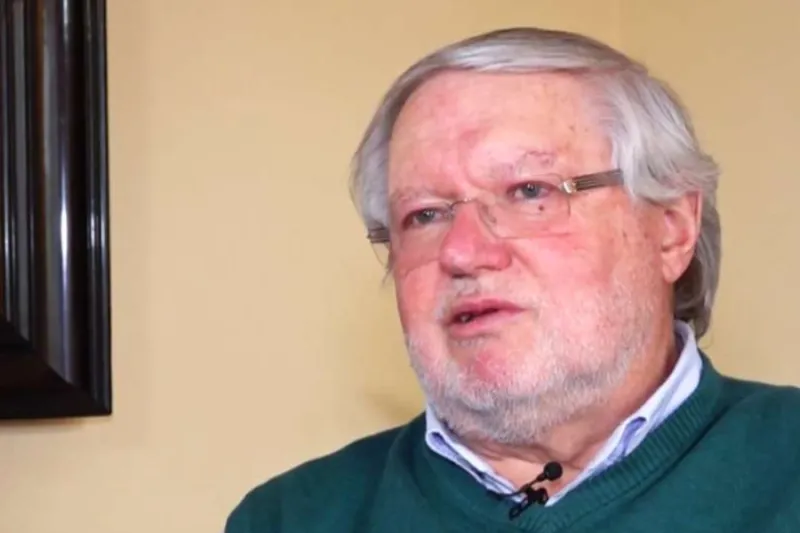
Anselm Bilgri / Screenshot from TV BAYERN LIVE* YouTube channel.
Munich, Germany, May 18, 2022 / 10:51 am (CNA).
Pope Francis has dismissed a prominent German former monk from the clerical state in the wake of his continued celebration of weddings and baptisms after leaving the Catholic Church.
The Archdiocese of Munich and Freising on May 18 confirmed to CNA Deutsch, CNA’s German-language news partner, “that Anselm Bilgri has been dismissed from the clerical state by the Vatican.”
A diocesan spokesperson added that it was “normal procedure” for this to be communicated by the local archdiocese.
“This is also the route taken in less prominent cases,” the spokesperson said.
Bilgri is a well-known figure in the German-speaking Catholic world. He was ordained a priest by the future Benedict XVI in 1980. As a Benedictine monk and prior of the scenic monastery of Andechs, famous for its Bavarian brewery, Bilgri soon became known to a wider public.
After he was not elected as the new abbot by the monks of Andechs in 2003, Bilgri took a sabbatical, before announcing he was leaving the monastery. He spent several years working as a consultant and life coach.
In 2007, the German magazine Stern labeled him a “Manager Messiah,” but his request to be incardinated in the Munich archdiocese was rejected by the then archbishop, Cardinal Friedrich Wetter.
In December 2020, Bilgri formally left the Catholic Church. He joined Germany’s Old Catholic community.
Old Catholics belong to a movement originating primarily in the Netherlands, Germany, and Switzerland, consisting of Catholics who were excommunicated over their refusal to acknowledge papal authority in dogmatic matters following the First Vatican Council.
In Old Catholic communities, women can be ordained, remarriage after divorce is possible, and homosexual unions are blessed.
In March 2021, Bilgri came out as homosexual and announced that he was marrying “his long-term boyfriend,” a man almost 30 years his junior. The ceremony was officiated by the mayor of Munich.
Speaking to the German tabloid Bild, the 68-year-old Bilgri accused the Archdiocese of Munich and Freising of having “snitched” on him, saying that the pope had “punitively dismissed” him from the clergy for “persisting in Church schism.”
Bilgri told the tabloid: “They tattled on me in Rome. And requested that the pope react. Absolutely ridiculous. I left the Church a long time ago.”
But Bilgri’s departure from the Church and his continued actions as a priest are two separate things, a canon law expert told CNA.
“By leaving the Church and joining the ‘Old Catholics,’ Mr. Bilgri has committed the delict of schism,” said Father Stefan Mückl, a canon law professor at the Pontifical University of the Holy Cross, on May 18.
“This results in excommunication as a penalty. However, excommunication is intended to induce the perpetrator to insight and repentance,” Mückl explained.
“The persistence in a schismatic community, and, aggravatingly, the exercise of priestly functions in it, realizes further canonical delicts, such as persistence in schism despite admonition, as well as sacrilegious acts such as the administration of sacraments despite excommunication.”
“In addition, there is also the ‘marriage’ with another person, which obviously is also a delict for a cleric, punishable among other things by dismissal from the clerical state,” the professor told CNA.
Mückl emphasized that in Bilgri’s case, dismissal from the clerical state was an expiatory punishment, which, moreover, had a permanent character.
“The point here is to atone for behavior that is intolerable for the ecclesiastical community with an appropriate punishment,” he said.
“Mr. Bilgri has rightly earned this punishment after all that he has done publicly and non-publicly. Nevertheless, the call remains for him to repent and reconcile with the Church — for the sake of his own salvation.”
If you value the news and views Catholic World Report provides, please consider donating to support our efforts. Your contribution will help us continue to make CWR available to all readers worldwide for free, without a subscription. Thank you for your generosity!
Click here for more information on donating to CWR. Click here to sign up for our newsletter.
Archbishop Zbigņevs Stankevičs of Riga, Latvia (left), speaking during a Catholic conference in Warsaw in May 2022 on the natural law legacy of John Paul II (right.) / Photos by Lisa Johnston and L’Osservatore Romano
Warsaw, Poland, Jun 9, 2022 / 09:17 am (CNA).
Constant cooperation and dialogue among Catholic, Lutherans, Orthodox, and other Christian denominations have been crucial to protect life and family in the Baltic nation of Latvia, Archbishop Zbigņevs Stankevičs of Riga, Latvia, said during a recent Catholic conference in Warsaw.
In his speech, Stankevičs shared his personal ecumenical experience in Latvia as an example of how the concept of natural law proposed by St. John Paul II can serve as the basis for ecumenical cooperation in defending human values.
The metropolitan archbishop, based in Latvia’s capital, is no stranger to ecumenical work and thought. In 2001, he became the first bishop consecrated in a Lutheran church since the split from Protestantism in the 1500s. The unusual move, which occurred in the church of Evangelical Lutheran Cathedral in Riga, formerly the Catholic Cathedral of St. Mary, signaled the beginning of Stankevičs’ cooperation with the Lutheran church in Latvia, a cooperation that would ultimately become a partnership in the cause of life and the family. Since 2012, the archbishop has served on the Pontifical Council for Promoting Christian Unity.
“I would like to present this ecumenical cooperation in three experiences in my country: the abortion debate, the civil unions discussion, and the so-called Istanbul convention,” Stankevičs began.
Entering the abortion debate
Ordained as a priest in 1996, Stankevičs struggled to find proper consultation for Catholic couples on natural family planning. It was then that he decided to create a small center that provided natural family planning under the motto “let us protect the miracle [of fertility].”
This involvement in the world of natural family planning would lead him into the heart of the abortion debate in Latvian society, and, ultimately, to the conclusion that moral discussions in the public square benefit from a basis in natural law, something emphasized in the teachings of John Paul II.
“I knew that theological arguments would not work for a secular audience, so I wanted to show that Catholic arguments are not opposed to legal, scientific, and universal arguments, but rather are in harmony with them,” Stankevičs said.
“[A] few years later our parliament introduced the discussion to legalize abortion. No one was doing anything so I decided to do something. I consulted some experts and presented a proposal that was published in the most important secular newspaper in Latvia,” the archbishop said.
Stankevičs’ article, “Why I was Lucky,” used both biological and theological arguments to defend human life. He noted that his own mother, when pregnant with him, was under pressure to get an abortion; “but she was a believer, a Catholic, so she refused the pressure.”
After the Latvian parliament legalized abortion in 2002, the different Christian confessions decided to start working together to protect the right to life and the family.
In Latvia, Catholics comprise 25% of the population, Lutherans 34.2%, and Russian Orthodox 17%, with other smaller, mostly Christian denominations making up the remainder.
“We started to work together by the initiative of a businessman in Riga, a non-believer who wanted to promote awareness about the humanity of the unborn,” the archbishop recalled.
“Bringing all Christians together in a truly ecumenical effort ended up bearing good fruits because we worked together in promoting a culture of life: From more than 7,000 abortions per year in 2002, we were able to bring it down to 2,000 by 2020,” he said.
Map of Riga, the capital of Latvia. Shutterstock
Ecumenical defense of marriage, family
Regarding the legislation on civil unions, another area where Stankevičs has rallied ecumenical groups around natural law defense of marriage, the archbishop said that he has seen the tension surrounding LGBT issues mount in Latvian society as increased pressure is brought to bear to legalize same-sex unions.
Invited to a debate on a popular Latvian television show called “One vs. One” after Pope Francis’ remark “who am I to judge?” was widely interpreted in Latvian society as approving homosexual unions, Stankevičs “had the opportunity to explain the teachings of the Catholic Church and what was the real meaning of the Holy Father’s words.”
After that episode, in dialogue with other Christian leaders, Stankevičs proposed a law aimed at reducing political tensions in the country without jeopardizing the traditional concept of the family.
The legislation proposed by the ecumenical group of Christians would have created binding regulations aimed at protecting any kind of common household; “for example, two old persons living together to help one another, or one old and one young person who decide to live together.”
“The law would benefit any household, including homosexual couples, but would not affect the concept of [the] natural family,” Stankevičs explained. “Unfortunately the media manipulated my proposal, and the Agency France Presse presented me internationally as if I was in favor of gay marriage.”
In 2020, the Constitutional Court in Latvia decided a case in favor of legalizing homosexual couples and ordered the parliament to pass legislation according to this decision.
In response, the Latvian Men’s Association started a campaign to introduce an amendment to the Latvian constitution, to clarify the concept of family. The Latvian constitution in 2005 proclaimed that marriage is only between a man and a woman, but left a legal void regarding the definition of family, which the court wanted to interpret to include homosexual unions.
The Latvian bishops’ conference supported the amendment presented by the Men’s Association, “but most importantly,” Stankevičs explained, “we put together an ecumenical statement signed by the leaders of 10 different Christian denominations supporting the idea that the family should be based on the marriage between a man and a woman. The president of the Latvian Jewish community, a good friend, also joined the statement.”
The Freedom Monument in Riga, Latvia, honors soldiers who died during the Latvian War of Independence (1918-1920). Shutterstock
According to Stankevičs, something strange happened next. “The Minister of Justice created a committee to discuss the demand of the constitutional court, and it included several Christian representatives, including three from the Catholic Church, which worked for a year.” But ignoring all the discussions and proposals, the Minister of Justice ended up sending a proposal to parliament that was a full recognition of homosexual couples as marriage.
The response was also ecumenical: Christian leaders sent a letter encouraging the parliament to ignore the government’s proposal.
According to Stankevičs, the proposal has already passed one round of votes “and it is very likely that it will be approved in a second round of votes, with the support of the New Conservative party. But we Christians continue to work together.”
Preventing gender ideology
The third field of ecumenical cooperation mentioned by Stankevičs concerned the Istanbul Convention, a European treaty which the Latvian government signed but ultimately did not ratify.
The treaty was introduced as an international legal instrument that recognizes violence against women as a violation of human rights and a form of discrimination against women.
The convention claims to cover various forms of gender-based violence against women, but Christian communities in Latvia have criticized the heavy use of gender ideology in both the framing and the language of the document.
The word “gender,” for instance, is defined as “the socially constructed roles, behaviors, activities, and attributes that a given society considers appropriate for women and men,” a definition that allows gender to be defined independent of biological sex and therefore opens the document to the question of whether it really is aimed at the protection of women.
Christian communities also question the biased nature of the committee designated to enforce the convention.
The governments of Slovakia and Bulgaria refused to ratify the convention, while Poland, Lithuania, and Croatia expressed reservations about the convention though it was ultimately ratified in those countries, a move the government of Poland is attempting to reverse.
“When we found out that the Latvian parliament was going to ratify it, I went to the parliament and presented the common Christian position,” Stankevičs explained. As a consequence of that visit, the Latvian parliament decided not to ratify the convention, Stankevičs said, crediting the appeal to the unity provided by the common Christian position argued via natural law.
“In conclusion,” the archbishop said, “I can say that in Latvia we continue to defend the true nature of life and family. But if we Catholics would act alone, we would not have the impact that we have as one Christian majority. That unity is the reason why the government takes us seriously.”
Vatican City, May 1, 2022 / 08:16 am (CNA).
Christians must ask themselves whether they are like St. Peter, who after his encounter with Jesus tried to return to fishing, but only found “empty nets” until he rushed back to the ri… […]
A Catholic bishop in Switzerland has defended giving Holy Communion to two Protestant church representatives and a Protestant politician at his installation Mass.
Leave a Reply
