Pope Francis on Palm Sunday 2022 / Daniel Ibanez/CNA. See CNA article for full slideshow.
Vatican City, Apr 10, 2022 / 06:10 am (CNA).
Pope Francis said on Palm Sunday 2022 that nothing is impossible for God, who has the power to end the war in Ukraine, even if it looks like the end is not near. He also urged the laying down of weapons for a permanent “Easter truce.”
At the end of Mass in St. Peter’s Square on April 10, the pope said: “Nothing is impossible for God. He can even bring an end to a war whose end is not in sight, a war that daily places before our eyes heinous massacres and atrocious cruelty committed against defenseless civilians. Let us pray about this.”
Francis’ comments about war were made at the end of Mass, right before he led an estimated 65,000 people in praying the Angelus.
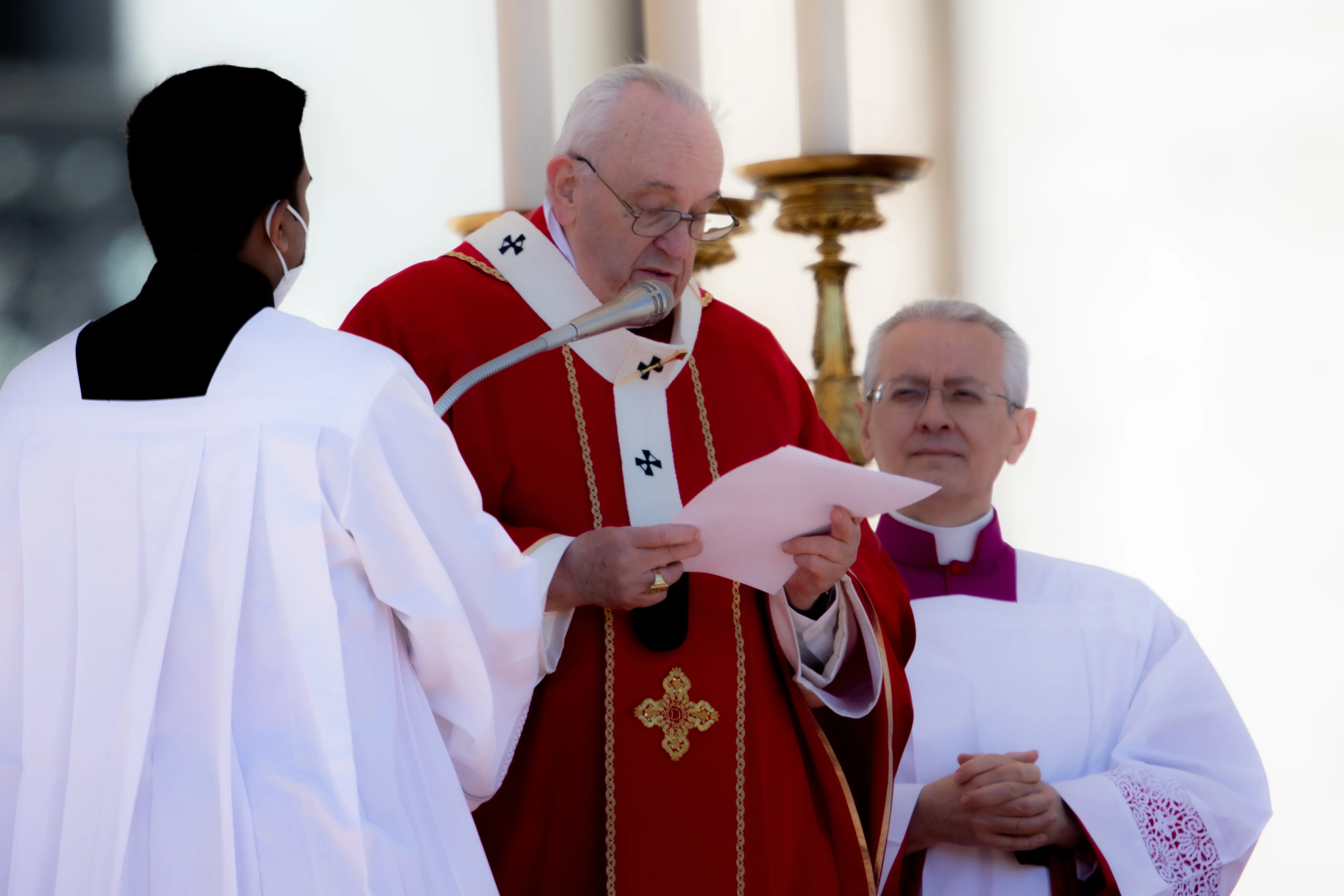
Pope Francis on Palm Sunday 2022. Daniel Ibanez/CNA
“In a moment, we will turn to the Blessed Mother with the Angelus Prayer. It was the Angel of the Lord himself who said to Mary in the Annunciation: ‘Nothing is impossible for God,’” the pope said.
Pope Francis reminded pilgrims that Easter is coming soon. “We are preparing to celebrate the victory of the Lord Jesus Christ over sin and death — over sin and death — not over someone and against someone else.”
“Let the weapons be put down,” he urged. “Let the Easter truce begin.”
“But not to provide more weapons and pick up the combat again — no — a truce that will lead to peace, through real negotiation that is even disposed to some sacrifice for the good of the people. In fact, what victory is there in planting a flag on a pile of rubble?” he said.
“But today, there is a war. Why does one want to win like this, according to the way of the world?” Francis continued. “This is only the way to lose. Why not allow Him to win? Christ bore his cross to free us from the dominion of evil. He died so that life, love, peace might reign.”
“Nothing is impossible for God. We entrust this to Him through the intercession of the Virgin Mary.”
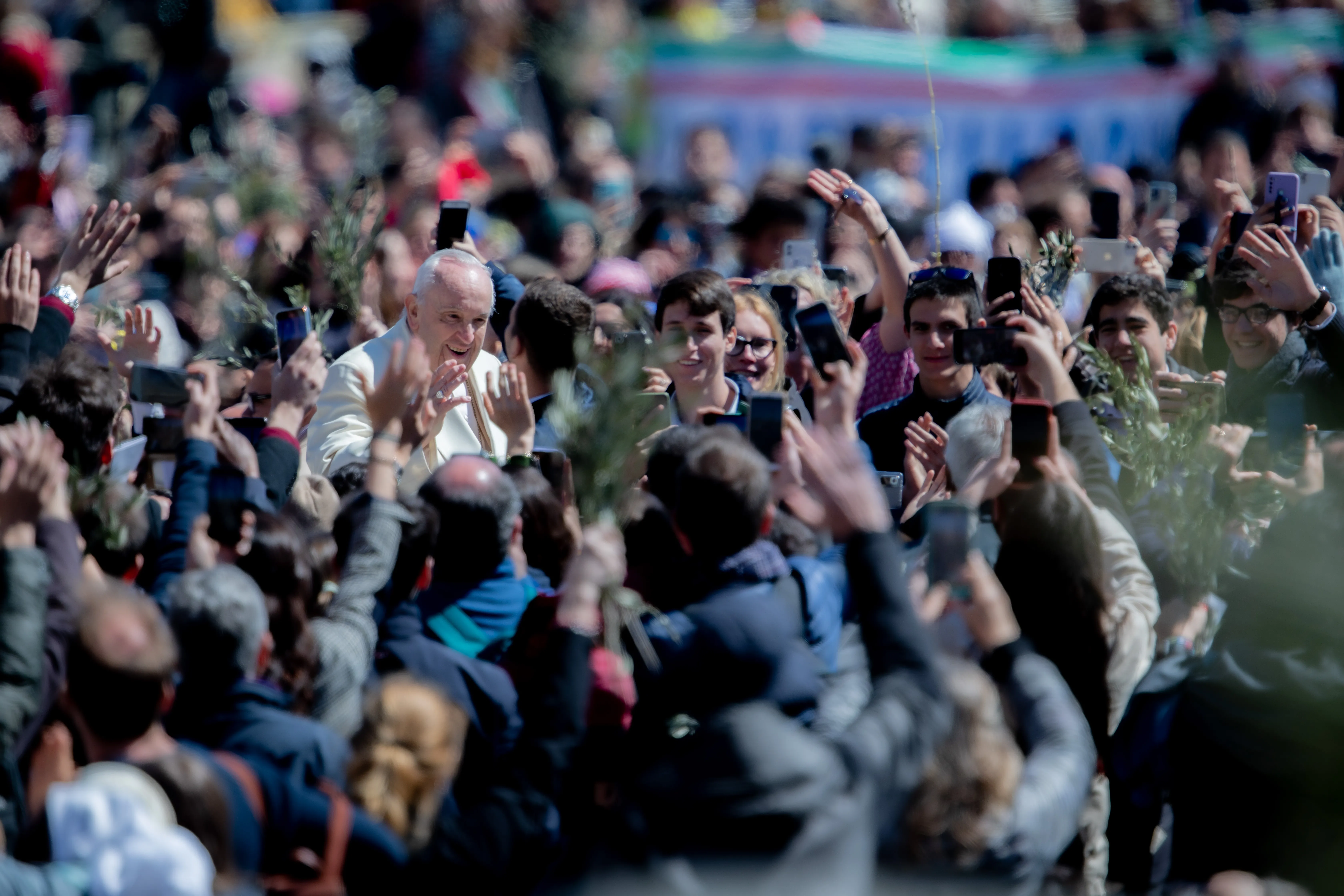
Pope Francis on Palm Sunday 2022. Daniel Ibanez/CNA
After the prayer and the final blessing of Mass, Pope Francis greeted the crowds as he took a spin around St. Peter’s Square in the popemobile.
Palm Sunday 2022 Mass was Francis’ first public liturgy in St. Peter’s Square in over two years, since the outbreak of the COVID-19 pandemic.
In his homily, he said “Christ is crucified yet another time” in the folly of war.
If you value the news and views Catholic World Report provides, please consider donating to support our efforts. Your contribution will help us continue to make CWR available to all readers worldwide for free, without a subscription. Thank you for your generosity!
Click here for more information on donating to CWR. Click here to sign up for our newsletter.
Pope Francis greets a crowd of an estimated 25,000 people gathered in St. Peter’s Square in Rome for his Regina Caeli address on May 22, 2022. / Vatican Media
Vatican City, May 22, 2022 / 07:33 am (CNA).
In his Sunday Regina Caeli address, Pope Francis reflected on Jesus’ words to the disciples at the Last Supper in the Gospel reading from John: “Peace I leave with you; my peace I give to you.”
Speaking to an estimated 25,000 pilgrims gathered on a bright day in St. Peter’s Square in Rome, the pope noted that Jesus also makes a point to add, “Not as the world gives do I give it to you” (John 14:27).
“What is this peace that the world does not know and the Lord gives us?” Pope Francis asked.
“This peace is the Holy Spirit, the same Spirit of Jesus. It is the presence of God in us, it is God’s ‘power of peace,'” he explained. “It is He, the Holy Spirit, who disarms the heart and fills it with serenity. It is He, the Holy Spirit, who loosens rigidity and extinguishes the temptations to attack others. It is He, the Holy Spirit, who reminds us that there are brothers and sisters beside us, not obstacles or adversaries.
“It is He, the Holy Spirit, who gives us the strength to forgive, to begin again, to set out anew because we cannot do this with our own strength. And it is with Him, with the Holy Spirit, that we become men and women of peace,” Pope Francis said.
“This is the source of the peace Jesus gives us,” he added. “For no one can leave others peace if they do not have it within themselves. No one can give peace unless that person is at peace.”
Pilgrims at St. Peter’s Square in Rome on May 22, 2022. In his Regina Caeli address, Pope Francis spoke about the peace of Christ. Vatican Media
Pope Francis said, “Let us learn to say every day: ‘Lord, give me your peace, give me your Holy Spirit.’ This is a beautiful prayer. Shall we say it together? ‘Lord, give me your peace, give me your Holy Spirit.’”
Again encouraging the crowd to pray with him, he said, “I didn’t hear it well. One more time: ‘Lord, give me your peace, give me your Holy Spirit.’”
Focusing on the context of Gospel reading, Pope Francis observed that Jesus’ words to his apostles are “a sort of testament.”
The pope said, “Jesus bids farewell with words expressing affection and serenity. But he does so in a moment that is anything but serene,” referring to Judas’ unfolding betrayal and Peter’s imminent denial that he even knows Jesus.
“The Lord knows this, and yet, he does not rebuke, he does not use severe words, he does not give harsh speeches,” Pope Francis said. “Rather than demonstrate agitation, he remains kind till the end.”
He continued, “There is a proverb that says you die the way you have lived. In effect, the last hours of Jesus’ life are like the essence of his entire life. He feels fear and pain, but does not give way to resentment or protesting. He does not allow himself to become bitter, he does not vent, he is not impatient. He is at peace, a peace that comes from his meek heart accustomed to trust.”
In so doing, “Jesus demonstrates that meekness is possible,” the pope observed.
“He incarnated it specifically in the most difficult moment, and he wants us to behave that way too, since we too are heirs of his peace,” he said. “He wants us to be meek, open, available to listen, capable of defusing tensions and weaving harmony. This is witnessing to Jesus and is worth more than a thousand words and many sermons. The witness of peace.”
Pope Francis invited all disciples of Jesus to reflect on whether they behave in this way.
“Do we ease tensions, and defuse conflicts? Are we too at odds with someone, always ready to react, explode, or do we know how to respond nonviolently, do we know how to respond with peaceful actions? How do I react?” he asked.
“Certainly, this meekness is not easy,” while adding ,“How difficult it is, at every level, to defuse conflicts!”
Jesus understands this. He knows “that we need help, that we need a gift,” the pope explained.
“Peace, which is our obligation, is first of all a gift of God.”
Pope Francis said that “no sin, no failure, no grudge should discourage us from insistently asking for this gift from the Holy Spirit who gives us peace.”
“The more we feel our hearts are agitated, the more we sense we are nervous, impatient, angry inside, the more we need to ask the Lord for the Spirit of peace,” he said.
Pilgrims gather at St. Peter’s Square in Rome on May 22, 2022, for Pope Francis’ Regina Caeli address. Vatican Media
Pope Francis invited the crowd to pray with him, “Lord, give me your peace, give me your Holy Spirit.” He added, “And let us also ask this for those who live next to us, for those we meet each day, and for the leaders of nations.”
After praying the Regina Caeli at noon, Pope Francis commented on the beatification in Lyon, France, later on Sunday of Pauline Marie Jericot, who founded the Society of the Propagation of the Faith for the support of the missions in the early 19th century. The pope called her “a courageous woman, attentive to the changes taking place at the time, and had a universal vision regarding the Church’s mission.”
Pope Francis continued: “May her example enkindle in everyone the desire to participate through prayer and charity in the spread of the Gospel throughout the world.”
Pope Francis also noted that Sunday marked the beginning of “Laudato Si’ Week,” a weeklong reflection inspired by his 2015 encyclical on the environment. He called the observance an opportunity “to listen ever more attentively to the cry of the Earth which urges us to act together in taking care of our common home.”
Pope Francis also mentioned that May 24 marks the Feast day of Mary Help of Christians, who is “particularly dear to Catholics in China.”
He added that Mary Help of Christians is the patroness for Chinese Catholics and is located in the Shrine of Sheshan in Shanghai in addition to many churches and homes throughout the country.
“This happy occasion offers me the opportunity to assure them once again of my spiritual closeness” to believers in China, he said.
“I am attentively and actively following the often complex life and situations of the faithful and pastors, and I pray every day for them,” he said.
“I invite all of you to unite yourselves in this prayer so that the Church in China, in freedom and tranquility, might live in effective communion with the universal Church, and might exercise its mission of proclaiming the Gospel to everyone, and thus offer a positive contribution to the spiritual and material progress of society as well.”
Pope Francis also greeted participants in Italy’s annual pro-life demonstration, titled Scegliamo la vita, or in English, “Let’s Choose Life.”
“I thank you for your dedication in promoting life and defending conscientious objection, which there are often attempts to limit,” Pope Francis said.
“Sadly, in these last years, there has been a change in the common mentality, and today we are more and more led to think that life is a good at our complete disposal, that we can choose to manipulate, to give birth or take life as we please, as if it were the exclusive consequence of individual choice,” the pope said.
“Let us remember that life is a gift from God! It is always sacred and inviolable, and we cannot silence the voice of conscience,” he concluded.
Daniel J. Mahoney holds the Augustine Chair in Distinguished Scholarship at Assumption College, where he is a Professor of Politics. He received his B.A. from the College of Holy Cross and his M.A. and Ph.D. from […]
1 Comment
We read that Pope Francis “urged the laying down of weapons for a permanent ‘Easter truce’ and that “[n]othing is impossible for God.” We have historical precedents for what seems naively simplistic…
Dating from a Church council in France in A.D. 975, the Truce of God restricted warfare, with holidays assigned to several dates and seasons of the year having Christian religious significance. In pre-secularist A.D. 1139 the Second Council of the Lateran even imposed the penalty of excommunication for breaking the truce. Yet, in the trenches of the First World War, also, the guns fell silent on Christmas Eve of 1914. Combatants found themselves singing Christmas carols and sharing camaraderie, first among themselves and then together across the cratered No Man’s Land, not unlike the invaded Ukraine today in the north, east and south.
And–not to discount the similar and mindless zealotry of jihad–while the medieval Truce was to be applied only between Christian combatants, it also appears in crusader history in the Holy Land. Interludes for gift exchanges and tournaments. Western armies caring for and returning Muslim children captured in battle. And of the Muslims, Oliverisu Scholasticus, a member of a defeated Frankish army, offers this striking report:
“Who could doubt that such goodness, friendship and charity came from God. Men whose parents, sons and daughters, brothers and sisters had died in agony at our hands, whose lands we took, whom we drove naked from their homes, revived us with their own food when we were dying of hunger, and showered us with kindness even while we were in their power” (Friedrich Heer, The Medieval World, 1963, p. 144).
So, with the intervention of God, why not something so simple as an Easter truce, and then peace and just restitution for the war crimes and “pile of rubble”?
We read that Pope Francis “urged the laying down of weapons for a permanent ‘Easter truce’ and that “[n]othing is impossible for God.” We have historical precedents for what seems naively simplistic…
Dating from a Church council in France in A.D. 975, the Truce of God restricted warfare, with holidays assigned to several dates and seasons of the year having Christian religious significance. In pre-secularist A.D. 1139 the Second Council of the Lateran even imposed the penalty of excommunication for breaking the truce. Yet, in the trenches of the First World War, also, the guns fell silent on Christmas Eve of 1914. Combatants found themselves singing Christmas carols and sharing camaraderie, first among themselves and then together across the cratered No Man’s Land, not unlike the invaded Ukraine today in the north, east and south.
And–not to discount the similar and mindless zealotry of jihad–while the medieval Truce was to be applied only between Christian combatants, it also appears in crusader history in the Holy Land. Interludes for gift exchanges and tournaments. Western armies caring for and returning Muslim children captured in battle. And of the Muslims, Oliverisu Scholasticus, a member of a defeated Frankish army, offers this striking report:
“Who could doubt that such goodness, friendship and charity came from God. Men whose parents, sons and daughters, brothers and sisters had died in agony at our hands, whose lands we took, whom we drove naked from their homes, revived us with their own food when we were dying of hunger, and showered us with kindness even while we were in their power” (Friedrich Heer, The Medieval World, 1963, p. 144).
So, with the intervention of God, why not something so simple as an Easter truce, and then peace and just restitution for the war crimes and “pile of rubble”?
