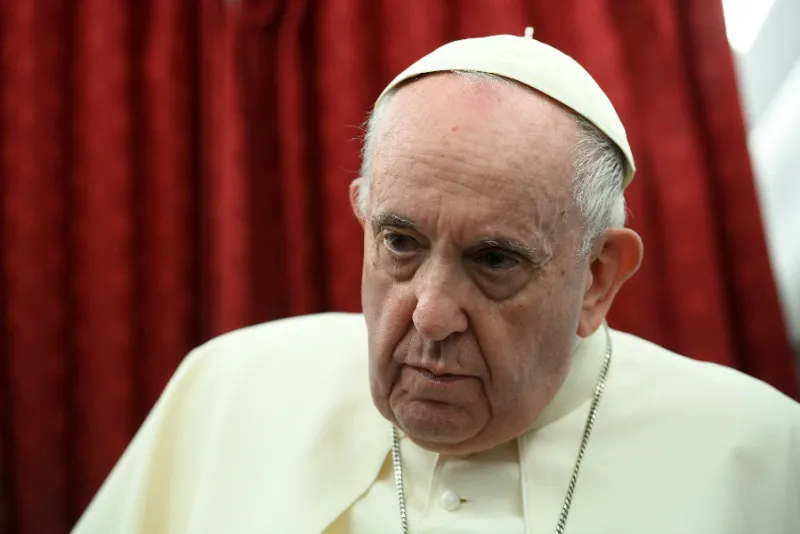
Pope Francis speaks during an in-flight press conference from Malta, April 3, 2022. / Vatican Media.
Rome, Italy, Apr 3, 2022 / 15:00 pm (CNA).
Pope Francis was asked on Sunday whether he intended to travel to Ukraine and if he had a message for Russian President Vladimir Putin.
In response, the pope said that it was still a possibility that he could visit Ukraine’s war-torn capital, and he continued to denounce Russia’s invasion without mentioning Putin by name.
Speaking to journalists on his return flight from Malta, he confirmed that he was considering a trip to Kyiv, which has faced bombardment since the full-scale invasion on Feb. 24.
The pope told a reporter as he left Rome for Malta on April 2 that the visit remained “on the table.”
During his in-flight press conference on April 3, he underlined that he was “available” to make the journey.
He said: “It’s there as one of the proposals that arrived, but I don’t know if it can be done, if it’s worthwhile to do it, and if doing it will be for the best or if it will be useful and I should do it. It’s all up in the air, right?”
The pope said that he had not heard media reports on Sunday about alleged atrocities against civilians committed by Russian forces in Bucha, a city northwest of Kyiv.
News organizations reported that at least 20 bodies dressed in civilian clothing were found in a single street when Ukrainian forces retook the city following the withdrawal of Russian combatants.
“Thank you for telling me this news from today that I did not know,” the pope said. “War is always a cruelty, an inhumane thing that goes against the human spirit — I don’t say Christian, human. It is the spirit of Cain that is said to go there.”
The pope added that his envoy, the papal almoner Cardinal Konrad Krajewski, was likely to travel to Poland to meet Ukrainian refugees at the invitation of Polish President Andrzej Duda. Krajewski has visited Ukraine twice since February.
A message for Putin?
Pope Francis was asked whether he had spoken to Putin since Feb. 24 and, if not, what would he would say to him today. In his reply, the pope continued his policy of not mentioning the Russian leader by name, referring to him as “the president of Russia.”
He said: “The things I have said to the authorities of each side are public. None of the things I said are confidential for me. When I spoke with the patriarch [Kirill], he then gave a good declaration of that which we said to each other.”
“I spoke to the president of Russia at the end of the year, when he called to wish me a happy birthday. We spoke. I spoke to the president of Ukraine twice.”
According to the Kremlin, Putin phoned the pope in December to congratulate him on his 85th birthday.
Pressed to say what his message to the Russian president would be today, the pope answered: “The messages that I have given to all the authorities are those that I gave publicly. I don’t do doublespeak. I always say the same.”
He then went on to speak about just and unjust wars, reflecting on the Second World War, the United Nations, Mahatma Gandhi, and his own appeal for peace in his 2020 encyclicalFratelli tutti.
A summit with Patriarch Kirill?
Pope Francis also told journalists that he was considering a face-to-face summit with Patriarch Kirill of Moscow and All Russia.
The pope said that the meeting with the head of the Russian Orthodox Church could take place in the Middle East. It would be their second encounter since their historic meeting at Havana airport in Cuba in 2016.
The pope and the patriarch discussed the conflict during a video conference call on March 16.
Patriarch Kirill, who is considered close to Putin, has faced widespread criticism for his stance on the Ukraine war.
He has received appeals from Catholic bishops across Europe to speak out against the invasion.
If you value the news and views Catholic World Report provides, please consider donating to support our efforts. Your contribution will help us continue to make CWR available to all readers worldwide for free, without a subscription. Thank you for your generosity!
Click here for more information on donating to CWR. Click here to sign up for our newsletter.
The Catholic faithful gathered in the Cenacle in Jerusalem for the Mass of the Lord’s Supper that the Franciscan friars celebrated on Holy Thursday, March 28, 2024. The Cenacle is at the center of strong tensions and disputes regarding ownership and rights of access and celebration. An ancient tradition places King David’s tomb here and over the centuries Jews and Muslims have leveraged this to first expel the Franciscans and then to prevent Christian worship, which they deemed sacrilegious. / Credit: Marinella Bandini
Jerusalem, Mar 28, 2024 / 17:15 pm (CNA).
On Holy Thursday, the doors of the Cenacle in Jerusalem were opened to welcome the Franciscans of the Custody of the Holy Land. In this “Upper Room,” called the Cenacle in the Holy Land, Jesus had his Last Supper, washed his apostles’ feet, and instituted the Eucharist.
It was here that the Franciscans celebrated the Mass of the Lord’s Supper, reenacting those same gestures. (At the Basilica of the Holy Sepulcher, however, the celebration is held on Thursday morning due to the Status Quo. Here is Cardinal Pierbattista Pizzaballa’s homily from that Mass.)
Cardinal Pierbattista Pizzaballa, the Latin Patriarch of Jerusalem, kisses the feet of a Franciscan friar during the “Washing of the Feet” ritual at the Mass of the Lord’s Supper celebrated at the Holy Sepulchre on Holy Thursday. The celebration is held on Thursday morning due to the Status Quo. March 28, 2024. Courtesy of the Custody of the Holy Land
The custos of the Holy Land, Father Francesco Patton, presided over the Eucharistic celebration at the Cenacle. In his homily, before washing the feet of six teachers and six students from the Terra Sancta School in Jerusalem, he emphasized the value of the “new commandment” that Jesus gave to his apostles here: “As I have loved you, so you also should love one another” (Jn 13:34).
“To love means to give oneself and to serve,” he said. “In this celebration, we want to nourish ourselves with Jesus because if he is alive within us, then we too will become capable of loving one another as he loved us. And we also want to learn from Jesus not to be served but to serve.”
Some students from the Terra Sancta School in Jerusalem who took part in the “Washing of the Feet” ritual during the Mass of the Lord’s Supper celebrated at the Cenacle in Jerusalem on Holy Thursday, March 28, 2024. Addressing them specifically in his homily, the Custos of the Holy Land emphasized the value of the “new commandment” that Jesus gave to his apostles here: “As I have loved you, so you also should love one another” (John 13:34). Credit: Marinella Bandini
Holy Thursday is the only day, along with Pentecost Sunday, when the Franciscans have the right to gather in the Upper Room to pray. Usually, it is a liturgy of the word, but since 2021 they have celebrated Mass. Outside, Israeli Army personnel ensure security.
The Cenacle is at the center of strong tensions and disputes regarding ownership and rights of access and celebration. An ancient tradition places King David’s tomb here, and over the centuries, Jews and Muslims have leveraged this place to first expel the Franciscans and then to prevent Christian worship, which they deem sacrilegious.
Father Narciso Klimas, historian and archivist of the Custody of the Holy Land, explained to CNA: “The Custody has all the documents confirming our ownership of Mount Zion.” Even today, traces of Christian presence are visible, both in the architecture of the place and in some symbols.
“The presence of the Franciscans at the Cenacle,” Klimas explained, “dates back to 1342, but as early as 1333, the rulers of Naples, Robert of Anjou and Sancha of Majorca, acquired the land and donated it to the friars. This was the first headquarters of the Custody of the Holy Land.” To this day, the official title of the Custos of the Holy Land is “Guardian of Mount Zion and the Holy Sepulchre.”
Father Francesco Patton, custos of the Holy Land, incenses the altar at the beginning of the Mass of the Lord’s Supper that the Franciscan friars celebrated inside the Cenacle in Jerusalem on Holy Thursday, March 28, 2024. This is the only day, along with Pentecost Sunday, that the Franciscans have the right to gather here to pray. Usually, it is a liturgy of the word, but since 2021 they have celebrated Mass. Credit: Marinella Bandini
In 1421, a rabbi submitted a petition to the local emirs, claiming the right for Muslims and Jews to this place due to the presence of King David’s tomb. One hundred years later, Klimas continued, “the Ottomans used this argument to gradually expel the Franciscans, until in 1551 the sultan decreed the total expulsion of the Franciscans from Mount Zion.” The Cenacle first became a mosque and later, in the lower part, also a synagogue.
“Since then,” Klimas recounted, “the Franciscans have never stopped attempting to regain possession of the Cenacle. The friars have always tried to ensure a presence, at least on Holy Thursday and Pentecost, sometimes even with methods that are not exactly orthodox (such as bribing the local guardian).”
Something began to change in the 19th century, during the time of the Ottoman Sultan Abdülmecid. Since then, the Franciscans have had the right to pray at the Cenacle on Holy Thursday and Pentecost. After a failed attempt in the 1930s to regain control of it, the friars managed to purchase adjacent land where they built the convent of San Francesco “ad Coenaculum” (next to the Cenacle).
In 1948, with the founding of the State of Israel, the entire Mount Zion came under Israeli control, and until today, the Israeli state owns the entire complex of the Cenacle. The neighborhood has a strong Jewish religious character and is characterized by the presence of synagogues and rabbinical schools.
The Franciscan friars and the faithful in the Armenian Cathedral of St. James in Jerusalem after the Mass of the Lord’s Supper celebrated at the Cenacle. Here, the friars commemorate the hospitality they received here in the 16th century. After being expelled from the Cenacle, the Franciscans were welcomed by the Armenians for seven years while the convent of St. Saviour was purchased, to this day the headquarters of the Custody of the Holy Land. March 28, 2024. Credit: Marinella Bandini
“Even if the Cenacle cannot return to our hands,” Klimas explained, “we ask at least to celebrate regularly, even with pilgrims, without the need for special permits.”
Negotiations on these matters (taxation and property) have been ongoing for over 25 years between the Holy See and the State of Israel, following the signing of the Fundamental Agreement in 1993 and the agreement recognizing the legal personality of the Catholic Church in Israel in 1997.
Despite the slow pace of diplomatic negotiations, some practical progress can be observed informally. The ability to celebrate Mass on Holy Thursday at the Cenacle is among these developments. Permissions to access the site on other special occasions are usually granted without significant issues as well.
After the Mass at the Cenacle, as tradition dictates, the Franciscans proceeded in a procession to three churches in two other symbolic places: the Armenian churches of St. James and of the Holy Archangels (of the Armenian Apostolic Church), and the Syro-Orthodox Church of St. Mark.
The Franciscan friars and the faithful in the Armenian Church of the Holy Archangels in Jerusalem after the Mass of the Lord’s Supper celebrated at the Cenacle on March 28, 2024. Friars and faithful pray together and receive the blessing from the representative of the Armenian Apostolic Church. Credit: Marinella Bandini
This yearly visit commemorates the hospitality the friars received in the 16th century. After being expelled from the Cenacle, the Franciscans were welcomed by the Armenians for seven years while the convent of St. Saviour was purchased, to this day the headquarters of the Custody of the Holy Land. Friars and faithful prayed together and received the blessing from the representative of the Armenian Apostolic Church.
The Syriac Orthodox Church of St. Mark is said to be built on the house of Mary, the mother of the evangelist Mark. According to Syriac tradition, this is the place where Jesus had the Last Supper. Here as well, those present prayed together and were able to listen to the Lord’s Prayer sung in Aramaic by one of the monks, who then gave a blessing.
The Franciscan friars and the faithful in the Syro-Orthodox church of St. Mark in Jerusalem after the Mass of the Lord’s Supper celebrated at the Cenacle on March 28, 2024. According to Syriac tradition, this is the upper room where Jesus had the Last Supper. Here as well, those present pray together and listen to the Lord’s Prayer sung in Aramaic by one of the monks, who then gives the blessing. Credit: Marinella Bandini
CNA Staff, Sep 2, 2020 / 08:00 pm (CNA).- The Catholic bishops of Belarus are calling for prayers that one of their archbishops, who was blocked from re-entering the country last week, be allowed to return home.
“It is inadmissible that a bishop of the Catholic Church, who is the pastor of the faithful entrusted to him, is deprived of the opportunity to be in his own diocese and to carry in it the ministry entrusted to him by [Pope Francis],” the Belarusian bishops said Sept. 2.
Archbishop Tadeusz Kondrusiewicz of Minsk-Mohilev was attempting to enter Belarus from Poland when he was stopped by border guards and denied entry “without explanation,” the website of the Catholic Church in Belarus reported Aug. 31.
Archbishop Kondrusiewicz himself has spoken out saying that the border guards’ decision to refuse him entry to his homeland was “absolutely incomprehensible” and contravened the law. The archbishop said he visited eastern Poland to celebrate the First Communion of a relative; he is now in Białystok.
The ban on Kondrusiewicz’s reentry to the country is not only illegal, the bishops asserted, but also is detrimental to the relationship between the Catholic Church and the Belarusian state.
“The Conference of Catholic Bishops in Belarus hopes that the refusal of Archbishop Tadeusz Kondrusiewicz to enter the Republic of Belarus is only an unfortunate misunderstanding that will be resolved as soon as possible, and that such incidents will not occur in the future,” the bishops concluded, encouraging all Catholics to pray for Kondrusiewicz’s safe return.
Catholics are the second-largest religious community in Belarus after Orthodox Christians, comprising roughly 15% of the population.
Kondrusiewicz had spoken out in defense of protesters following a disputed presidential election Aug. 9.
Belarus, a country of 9.5 million people bordering Russia, Ukraine, Poland, Lithuania, and Latvia, has seen widespread protests since the incumbent Alexander Lukashenko was declared the winner of the presidential election with 80% of the vote.
Lukashenko has served as president of Belarus since the office was established in 1994, three years after the country declared independence from the Soviet Union.
Electoral officials said that the opposition candidate, Sviatlana Tsikhanouskaya, earned 10% of the vote. She was detained for several hours after complaining to the electoral committee, and has fled to Lithuania.
Police arrested thousands of demonstrators who took to the streets demanding a recount. Despite a severe crackdown, protests have continued across the country.
Last week Kondrusiewicz demanded an investigation into reports that riot police blocked the doors of a Catholic church in Minsk while clearing away protesters from a nearby square.
Archbishop Kondrusiewicz told CNA Sept. 1 that “at the present time, we are asking for prayer, not only for the Catholic Church, but for a peaceful solution for the situation in Belarus because I’m very much afraid of civil war. The situation is very, very difficult, very critical.”
He expressed appreciation “to Catholics around the world for their solidarity, for their prayers, for their moral support in this very critical time for my nation.”
“In response, the pope said that it was still a possibility that he could visit Ukraine’s war-torn capital, and he continued to denounce Russia’s invasion without mentioning Putin by name” (CNA). This statement confirms that Francis is indeed making a just judgment on the guilty party, Russia, and by unmistakable inference Putin. However, if his intention is for a just negotiated settlement, in this writers view the best outcome considering the dire consequences should either party emerge as the victor.
As pontiff, then, he fulfills justice in this not too oblique inference to Putin as the unjust aggressor. And as Pontiff, and the delicacy of relations with Russian Orthodoxy, Russia, those in opposition to a well perceived stridency in Western secularism despite his own affinity with secular globalism [Fratelli Tutti], seeking to impose itself eastward he’s dancing, as best he can while justly censuring the aggressor the dance of the non partisan diplomat.
Although Pope Francis is catching flak from most or all commentators even accused of doublespeak, in this instance his approach in a very complex, dangerous scenario is quite commendable.
“In response, the pope said that it was still a possibility that he could visit Ukraine’s war-torn capital, and he continued to denounce Russia’s invasion without mentioning Putin by name” (CNA). This statement confirms that Francis is indeed making a just judgment on the guilty party, Russia, and by unmistakable inference Putin. However, if his intention is for a just negotiated settlement, in this writers view the best outcome considering the dire consequences should either party emerge as the victor.
As pontiff, then, he fulfills justice in this not too oblique inference to Putin as the unjust aggressor. And as Pontiff, and the delicacy of relations with Russian Orthodoxy, Russia, those in opposition to a well perceived stridency in Western secularism despite his own affinity with secular globalism [Fratelli Tutti], seeking to impose itself eastward he’s dancing, as best he can while justly censuring the aggressor the dance of the non partisan diplomat.
Although Pope Francis is catching flak from most or all commentators even accused of doublespeak, in this instance his approach in a very complex, dangerous scenario is quite commendable.
