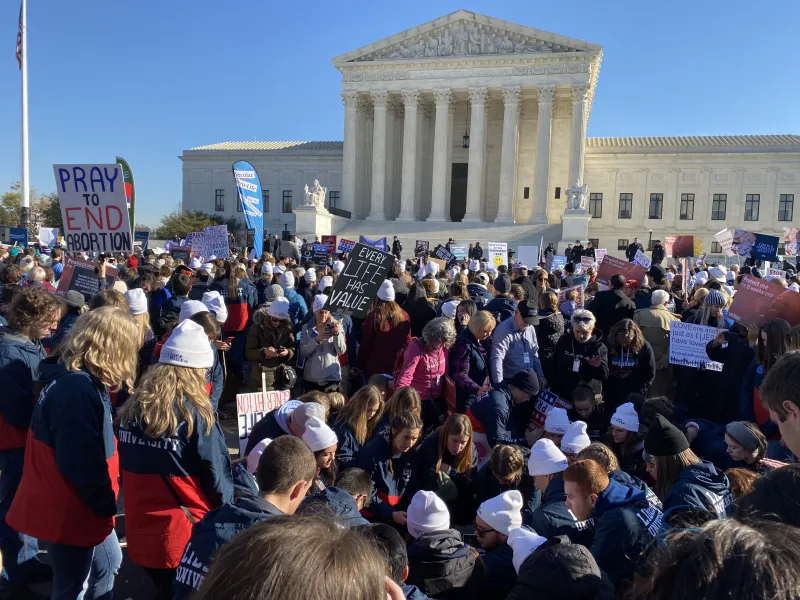
 Students from Liberty University pray in front of the U.S. Supreme Court during oral arguments in the Dobbs v. Jackson Women’s Health Organization abortion case on Dec. 1, 2021. / Katie Yoder/CNA
Washington D.C., Dec 1, 2021 / 15:40 pm (CNA).
The U.S. Supreme Court heard oral arguments about the constitutionality of Mississippi’s 15-week state abortion ban Wednesday, a high-stakes test of the settledness of legalized abortion in a deeply unsettled nation still sharply divided over the right to life.
The case, Dobbs v. Jackson Women’s Health Organization, is viewed by many Catholic leaders and pro-life groups as the best chance yet to overturn the court’s landmark 1973 Roe v. Wade decision, which has barred restrictive early-term abortion laws like Mississippi’s for the past 48 years.
Over that time, some 62 million abortions have taken place in the United States, statistics show, a grim toll the Catholic Church sees as both a grave evil and a catastrophic political failure.
Conversely, a decision that strikes down Mississippi’s 2018 law, called the Gestational Age Act, which prohibits abortions after the 15th week of gestation, would represent a devastating setback for the pro-life movement. For many years it has pinned its hopes of overturning Roe on the goal of securing a supermajority of conservative justices on the nation’s highest court, as is the case now.
With thousands of people keeping a vocal but peaceful vigil outside the Supreme Court on a bright, brisk morning in Washington, D.C., the nine justices took up the intensely anticipated case in a proceeding that lasted nearly two hours.
Among the demonstrators were four women shown in a viral video posted online swallowing pills behind a large sign that reads, “WE ARE TAKING ABORTION PILLS FOREVER,” a reference to the prescription drugs mifepristone and misoprostol that when used in combination will induce a miscarriage.
Mississippi is asking the court to do more than simply uphold the state’s abortion law; it wants the court to overturn both Roe and a later ruling that affirmed it nearly 20 years later, the 1992 case Planned Parenthood v. Casey.
Both Roe and Casey “have no basis in the Constitution,” Scott G. Stewart, the state’s solicitor general, said in his opening argument.
“They have no home in our history or traditions. They’ve damaged the democratic process. They poison the law. They’ve choked off compromise for 50 years,” he said.
In Roe, the court ruled that states could not ban abortion before viability, which the court determined to be 24 to 28 weeks into pregnancy. Casey, viewed as the “Dobbs” of its day, found that while states could regulate pre-viability abortions, they could not enforce an “undue burden.” The Casey court defined that term to mean “a substantial obstacle in the path of a woman seeking an abortion of a nonviable fetus.”
Stewart said the two cases have “kept this court at the center of a political battle that it can never resolve.”
“Nowhere else does this court recognize a right to end a human life,” he said.
A question of ‘settled’ law
Legal scholars see the court’s reluctance to overturn past rulings, even highly controversial ones, as Mississippi’s greatest hurdle in Dobbs.
As anticipated, that legal principle, known as stare decisis, loomed large Wednesday, dominating the litigants’ oral arguments and the justices’ questions. Justice Amy Coney Barrett, the newest addition to the court’s 6-3 conservative majority, said that stare decisis is “obviously the core of this case.”
The term comes from the Latin phrase, Stare decisis at non quieta movere, which means “to stand by things decided and not disturb settled points.”
Stewart, the Mississippi solicitor general, argued that legalized abortion remains an unsettled debate in the United States nearly a half-century after Roe. He argued that the issue should be left to democratically elected state legislatures, not the courts.
“The Constitution places its trust in the people. On hard issue after hard issue, the people make this country work,” he said.
“Abortion is a hard issue. It demands the best from all of us, not a judgment by just a few of us when an issue affects everyone. And when the Constitution does not take sides on it, it belongs to the people.”
In its court brief, Mississippi cites stare decisis as the reason Roe and Casey should be overturned.
“Roe and Casey are egregiously wrong. The conclusion that abortion is a constitutional right has no basis in text, structure, history, or tradition,” the brief states. Roe itself broke from precedent because it invoked “a general ‘right to privacy’ unmoored from the Constitution,” the state argues.
“Abortion is fundamentally different from any right this Court has ever endorsed. No other right involves, as abortion does, ‘the purposeful termination of a potential life,’” the brief states. “Roe broke from prior cases, Casey failed to rehabilitate it, and both recognize a right that has no basis in the Constitution.”
But Julie Rikelman, litigation director of the Center for Reproductive Rights, sharply disagreed.
“Casey and Roe were correct,” Rikelman, who represented Jackson Women’s Health, Mississippi’s last remaining abortion provider, told the justices.
She added that there is an “an especially high bar here” as the Supreme Court rejected “every possible reason” for overturning Roe when it decided Casey nearly 30 years ago.
“Mississippi’s ban on abortion two months before viability is flatly unconstitutional under decades of precedent. Mississippi asks for the court to dismantle this precedent and allow states to force women to remain pregnant and give birth against their will,” she said.
“Two generations have now relied on this right,” Rikelman continued. “And one out of every four women makes the decision to end a pregnancy.”
A third attorney arguing before the court Wednesday, U.S. Solicitor General Elizabeth B. Prelogar, representing the Biden administration in opposition to Mississippi’s abortion law, couched the Dobbs case in similar terms. She said overturning Roe and Casey would be “an unprecedented contraction of individual rights and a stark departure from principles of stare decisis.”
Credibility concerns
Liberal justices Stephen G. Breyer, Sonia Sotomayor, and Elena Kagan argued that overturning Roe and Casey would undermine the court’s integrity by signaling that its decisions were influenced by political pressure.
“Will this institution survive the stench that this creates in the public perception that the constitution and its reading are just political acts?” Sotomayor said. “I don’t see how it is possible.”
Conservative Justice Brett M. Kavanaugh, however, pushed back against that reasoning. He noted that “some of the most consequential and important” decisions in the Supreme Court’s history overturned prior rulings. He cited such cases as the historic civil rights case Brown v. Board of Education, which struck down legalized segregation, and Miranda v. Arizona, which required police to inform suspects they have a right to remain silent.
“If the court had done that in those cases (and adhered to precedent), this country would be a much different place,” Kavanaugh said. Why then, he asked Rikelman, shouldn’t the court do the same in Dobbs, if it were to deem that Roe and Casey were wrongly decided?
“Because the view that a previous precedent is wrong, your honor, has never been enough for this court to overrule, and it certainly shouldn’t be enough here, when there’s 50 years of precedent,” Rikelman responded. The court needs a “special justification” to take such a step, she argued, saying that Mississippi has failed to provide any.
Said Rikelman: “It makes the same exact arguments the court already considered and rejected in its stare decisis analysis in Casey.”
Justice Samuel A. Alito Jr., a conservative, took up a similar line of questioning with Prelogar, the U.S. solicitor general.
“Is it your argument that a case can never be overruled simply because it was egregiously wrong?” he asked.
“I think that at the very least, the state would have to come forward with some kind of materially changed circumstance or some kind of materially new argument, and Mississippi hasn’t done so in this case,” Prelogar responded.
“Really?” Alito replied. “So suppose Plessy versus Ferguson (an 1896 decision that affirmed the constitutionality of racial segregation laws) was re-argued in 1897, so nothing had changed. Would it not be sufficient to say that was an egregiously wrong decision on the day it was handed down and now it should be overruled?”
“I think it should have been overruled, but I think that the factual premise was wrong in the moment it was decided, and the court realized that and clarified that when it overruled in Brown,” Prelogar said.
“So there are circumstances in which a decision may be overruled, properly overruled, when it must be overruled simply because it was egregiously wrong at the moment it was decided?” Alito asked.
When Prelogar didn’t directly answer the question, Alito pressed again.
“Can a decision be overruled simply because it was erroneously wrong, even if nothing has changed between the time of that decision and the time when the court is called upon to consider whether it should be overruled?” he asked. “Yes or no? Can you give me a yes or no answer on that?”
“This court, no, has never overruled in that situation just based on a conclusion that the decision was wrong. It has always applied the stare decisis factors and likewise found that they warrant overruling in that instance,” Prelogar said.
Roberts cites China, North Korea
While the main focus of Wednesday’s proceeding related to stare decisis, there was also discussion of the viability standard established by Roe.
“I’d like to focus on the 15-week ban because that’s not a dramatic departure from viability,” Chief Justice John G. Roberts Jr. said in an exchange with Rikelman.
“It is the standard that the vast majority of other countries have. When you get to the viability standard (set at 24 to 28 weeks) we share that standard with the People’s Republic of China and North Korea,” he said.
In response, Rikelman said Roberts’ statement was “not correct,” arguing that “the majority of countries that permit legal access to abortion allow access right up until viability, even if they have nominal lines earlier.” She elaborated that while European countries may have 12- or 18-week limits, they allow exceptions for “broad social reasons, health reasons, socioeconomic reasons.”
A 2021 analysis by the Charlotte Lozier Institute found that 47 out of 50 European nations limit elective abortion prior to 15 weeks. Eight European nations, including Great Britain and Finland, do not allow elective abortion and instead require a specific medical or socioeconomic reason before permitting an abortion, the institute said.
The court may not announce a decision in the Dobbs case for several months. It may come at the end of its current term, in late June or early July, when major decisions are often announced.
[…]







Pope Francis will not say this because of political reasons, but I will: this war along with its sufferings is caused by the unjust desires of only one human being, Vladimir Putin.
Certainly the recent aggression rests with Mr. Putin but what interests set up the scenario in the first place & put the Ukraine in harm’s way? The Western nations haven’t been doing the Ukraine any favors by offering them false hopes.
The Ukrainians don’t appear to have a single ally which is truly sad.
The following article of March 28 by Sandro Magister is the sober and necessary antidote to this article: http://magister.blogautore.espresso.repubblica.it/2022/03/28/ukraine-is-fighting-but-for-francis-no-war-is-just/
Perhaps someone should suggest that while everyone has the right to choose personal non-violent surrender, those responsible for the Common Good and the welfare of others have no right, for example, to sacrifice the necks of the wives and children to the knife of an assailant.
On May 3, 1983 the (United States) National Conference of Catholic Bishops published the pastoral letter: “The Challenge of Peace: God’s Promise and Our Response.” In this document, the pacifist ideology of unilateral disarmament (Pax Christi) was replaced. Pope John Paul II had placed Cardinal O’Connor in a review position and required the document to be submitted to Rome two or three times for clarity on moral principles (apart from ideology) and actual prudential judgment, e.g., “…Equally important in the age of modern warfare is the recognition that the justifiable [!] reasons for using force have been restricted to instances of self-defense or defense of others under attack” (n. 214).
Also in 1983 the German and French bishops’ conferences published pastoral letters (German: “Out of Justice, Peace;” and French: “Winning the Peace”), printed together by Ignatius Press in 1984 under the editorship of James V. Schall, S.J.). The three pastorals stressed, alternatively, the danger of nuclear holocaust and the place for deterrence, the danger of Soviet weapons superiority along the then Iron Curtain, and the danger of state-sponsored Marxism. But none was pacifist.
In the interests of synodality (!) perhaps these sober assessments by bishops’ conferences should influence papal one-liners tending to criminalize self-defense (somewhere: “all wars are unjust”).
Yet, there is also the point to be made, with needed force and precision, that the lucrative arms trade does tilt toward easy escalation (anywhere) almost inevitably toward global disaster. But it is precisely at such times that one hopes for, and has a right to look forward to, from the perennial Catholic Church, very measured application of moral theology to increasingly complex, concrete circumstances. Is Putin listening? North Korea? Iran?
In the circumstances of Gethsemani, Peter was instructed not to use his sword, but was he told to never own it?
Agreed
If only more Pto-Life Christians , Catholic Christians, gather in Earnest with Discernment?
Was not evangelism of Billy Graham , Johnathan Edwards, Saint Paul, put to shame and guilt?
Wether in 1949? Or 1743? There was need!
When a man, a woman, can stay in need of redemption but not a distinguishing mark of wanting treat change
“PICK UP YOUR MAT AND WALK”, “YOUR SINS HAVE BEEN FORGIVEN”. “Now, Go and SIN no more”
Words of such force and magnitude.
What is the difference in your life? What is the difference in my life?
Let me be partially sarcastic – how long will it be until the Pope says something to which the powers-that-be at twitter take offense and cancel him, or whatever it’s called.
FYI – I have NO social media accounts, or whatever they’re called, and have no intention of changing that. If that puts me out of touch, so be it. I confine my ruminations(?) to CWR.
You’re so right. The propaganda media love Bergoglio. In 10 years I have never read so much as a word of criticism of him. Thank you for pointing this out.
Obviously you do not read widely. Sandro Magister and some rad trad anti-Pope Francis sites seem to be your sources.
As usual, your ignorance and malice are on full display. I explicitly referred to the liberal propaganda media of which you are a feckless myrmidon.
I usually read these four Catholic sites: CWR, NCRegister, wherepeteris, and Vatican news. Which ones do you consider to, be liberal? Oh, and I read mercatornet, which is not strictly a religious site, but it is more Catholic than most Catholic sites.
It’s complex! The common adage when caught between seeming offsetting principles. One humorous anecdote was the advertisement of a hapless [former] roommate standing by a pile of belongings being thrown out the apartment window by a visibly impervious woman. A passerby stops and looks at him quizzically, he responds, “It’s complicated!”.
Where do we find justice? For heroic Ukraine, as well as land grubber, cowardly giant Russia [how the entire media, US generals, both political parties view the matter for once all are unanimous]. How simple! Would that it and other issues were so easy to judge. Although Russia is [presumably by natural law itself] a perennial demon. That makes unanimity on Russia easy. How can any just claim for security from Nato [let’s not forget Nato is as a dangerous to Russia as it is to Papua New Guinea, perhaps even Pago Pago].
Now the war cry is, let’s destroy Russian ambition by destroying it’s army in Ukraine. War criminal Vladimir Putin [or is it Rasputin?] has cast his evil spell on the Russian people. Unfortunately, his policy of devastation of Ukraine by bombardment when land forces fail fulfills the prophetic vision of credentialed pundit and armchair world strategist. So the arms continue to pour into Ukraine, perhaps far more lethal in the making, the killing and misery continues on increasing scale, the war cries reaching ‘fever pitch’.
Maybe, perhaps maybe, in this one instance, Pope Francis is correct in calling war, all war bad. After all, it’s against the odds that he’s always wrong.
One wonders just who Pontiff Francis thinks he’s talking to.
Q1 – Is he suggesting that Ukrainians are immoral for fighting against a foreign army that invaded their country?
Q2 – Is he preaching to the choir so that he can say he said something about the Russian invasion of Ukraine, but has carefully calibrated the statement to be sure it is without any meaning?
Chris, although I agree Pope Francis is generally ambivalent, as he seems here, he did, for example, say to the media earlier in reference to Ukraine, “That when a country is attacked it defends itself, everyone, including civilians”. He added that Russia’s attack was a massacre. His fear of a nuclear confrontation [even a tactical nuclear exchange would be devastating for Europe and the US] has justification with an escalating proxy war. Biden is making wild comments that could cause an apparent paranoid Putin to respond.
Pope Francis has been denouncing this war right from the beginning of this invasion. He is not preaching to the choir but to the world. He is, and has always been, against war.
Malware alert! Yes and no…
Pope Francis first denounced only the “conflict”, which is different from later publicly recognizing this “invasion” (your word) as an act of “war” (your word). His earlier comments were received by many as meaning “neutrality” in the face of overt aggression (https://www.wsj.com/articles/pope-francis-laments-war-in-ukraine-without-taking-sides-11648226928).
So, yes, Pope Francis broadly denounces war; yet, the earlier non-position implied that both parties are equally guilty–that self-defense is immoral.
Pope Benedict XV likewise denounced World War I, but at least he had a plan rather than a platitude (“To the Belligerent Peoples,” August 1, 1917).
Summarizing, his propositions for that war were the need to assert moral force over material force, simultaneous disarmament, arbitration in place of conscription, free movement of people and commerce especially at sea, restitution of territories seized during the War (!), and harmony among national aspirations and with the common good (!). Dismissed at the time, parts later reappeared (without attribution) in President Wilson’s Fourteen Points of Peace (Jan. 8, 1918), one of which became the right to national self-determination.
Unlike the AT & T smartphone advertisement, it is complicated.
Upon reflection, I find that my use of the word “platitude” is inaccurate and probably unjust….Without knowing the right word, my meaning goes something like this…
First, the hair-trigger nature of modern technology with its catastrophic potential does raise novelties not in play when Augustine defined the just war.
Second, if it is true (?) that papal advisors are thinking about an exhortation amending just war theory, I would hope such a statement does not displace concrete prudential judgment with undefined “fraternity.”
Third, instead, on the application of moral theology (Catholic Social Teaching) to very convoluted circumstances on steroids, did Catholic academia abdicate its potential contributions the moment it claimed the total autonomy of the Land O’ Lakes Declaration (1967)? Overwhelmed now by administrative hyper-compartmentalization, plus the trendy ideologies of identity politics and intersectionality and STEM—who is left to help an overtaxed Pope Francis answer such modernday conundrums as subsidiarity and solidarity, both together, and the (forgotten) Common Good?
How, too, to clearly articulate both the nature and backstory of global flash points, while also affirming with courage that there is no peace without justice, and no justice without truth?
What is truth? Other than mislabeled “platitudes,” what is the knitty-gritty right word (in addition to the Word) for all of the above? What is our protection from too-simply airbrushing that all war is immoral—even measured self-defense, or deterrence against rogue-state nuclear blackmail?
One can denounce the war in different ways. Pope Francis, who condemns war in his writings, played an active role behind the scenes which only his stance allowed him to do. But since that was to no avail, he took a tougher stance. The correct strategy I thought.
Given Pope Francis’s inability exercise restraint on what he says and does in public, and repeated contradiction of existing, unchangeable Church doctrine, not only on Just War Teaching, but also other issues (such as support for homosexual unions, and his averment that Apostates “remain part of the Church”), I think it would be fair to ask about his mental state and whether he still healthy enough to hold office. Many experts have, after all, questioned the mental health of President Biden and former President Trump for the same or similar reasons.
If he is losing it, then his handlers are guilty of elder abuse by parading him around and allowing him to humiliate himself.