“The initiative proposes to reawaken enthusiasm for our faith in the gift of God and to give new zeal to the promotion of vocations,” organizers said.
According to a press release: “Bishops, clergy, laypeople and religious will meet for a moment of reflection and study on the relations between ordained ministers, and lay and religious members, with a view to harmonizing their contribution, which will be articulated and in line with the call to holiness addressed to each one.”
The three-day symposium will begin with an introduction from Pope Francis on faith and the priesthood today.
Around 500 priests, bishops, religious, and other Catholics are expected to attend.
The sessions will be chaired by the heads of dicasteries in the Roman Curia, while Cardinal Kurt Koch, president of the Vatican’s Christian unity council, will also be a featured speaker.
Theologians and other Catholic experts will present on topics including the Fathers of the Church, St. Thomas Aquinas, priestly celibacy, the pastoral challenges of the priesthood, vocational formation, and the complementarity of the different states of life.
A roundtable on women and ministry will take place on the second day, Feb. 18.
The symposium on vocations will be one of the first Vatican conferences to be held in-person since the start of the COVID-19 pandemic.
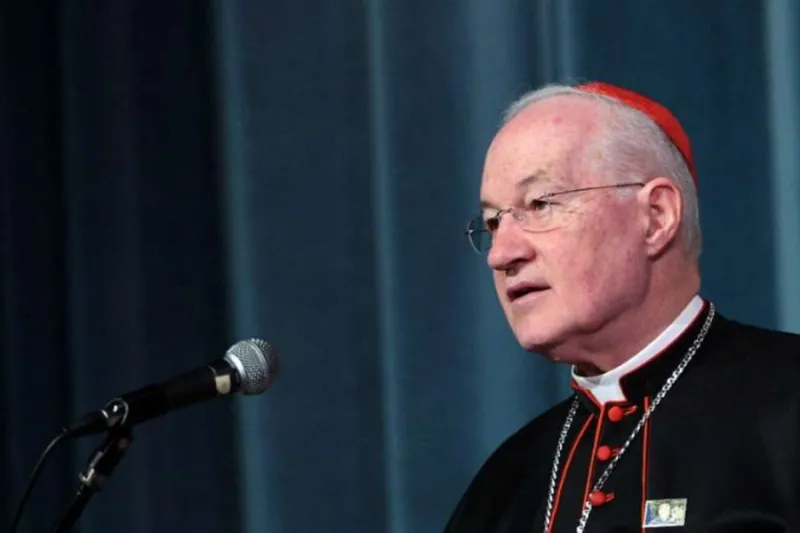
Cardinal Ouellet told Vatican News on Wednesday that the conference will address the “fundamental priesthood of the baptized and the ministerial priesthood.”
“Usually, when we think of priesthood we think of the priests and bishops and so on, but the fundamental priesthood is the priesthood of the baptized: we are part of the Body of Christ and as such, we participate in the mediation of the Church, the participation of the Church in the Priesthood of Christ,” he said.
Ouellet also explained that while priestly celibacy will be a topic at the symposium, it is not within the conference’s scope “to decide whether we will keep obligatory celibacy or not.”
Other speakers at the event will include French theologian and Dominican priest Father Serge-Thomas Bonino, German biblical scholar Robert Vorholt, Italian theologian Father Piero Coda, and French theologian and religious Sister Alexandra Diriart.
Cardinal Luis Antonio Tagle, prefect of the Congregation for the Evangelization of Peoples, will give the closing presentation on the topic of the priesthood and mission.
Each day of the symposium will include an opportunity to attend Mass.
If you value the news and views Catholic World Report provides, please consider donating to support our efforts. Your contribution will help us continue to make CWR available to all readers worldwide for free, without a subscription. Thank you for your generosity!
Click here for more information on donating to CWR. Click here to sign up for our newsletter.
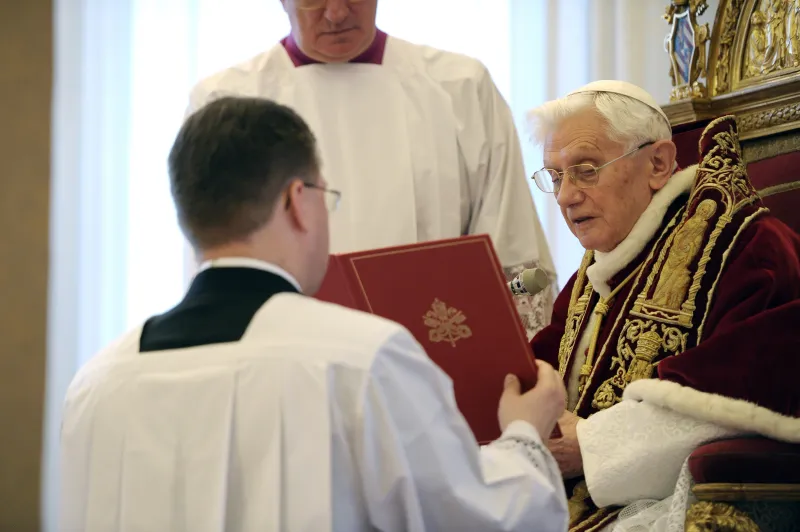
Pope Benedict XVI announced his intention to resign the papacy during a meeting of cardinals Feb. 11, 2013. The surprise announcement, which he made in Latin, took place in the Hall of the Consistory in the Vatican’s apostolic palace. / Vatican Media
Washington, D.C. Newsroom, Jan 2, 2023 / 06:00 am (CNA).
On Feb. 11, 2013, before a gathering of cardinals who had come to the Vatican expecting to hear the announcement of upcoming canonizations, Pope Benedict XVI dropped a bombshell.
After a few announcements about Church business at the conclusion of the meeting, the pope took out two sheets of paper and read a prepared statement in Latin.
“I have convoked you to this Consistory, not only for the three canonizations, but also to communicate to you a decision of great importance for the life of the Church. After having repeatedly examined my conscience before God, I have come to the certainty that my strengths, due to an advanced age, are no longer suited to an adequate exercise of the Petrine ministry,” the then 85-year-old pontiff told the gathering of the Catholic Church’s highest-ranking clergymen.
Because he spoke in Latin, the language used for official Vatican proclamations, reporters present did not at first realize that the pope had just stepped down.
‘Total surprise, total shock’
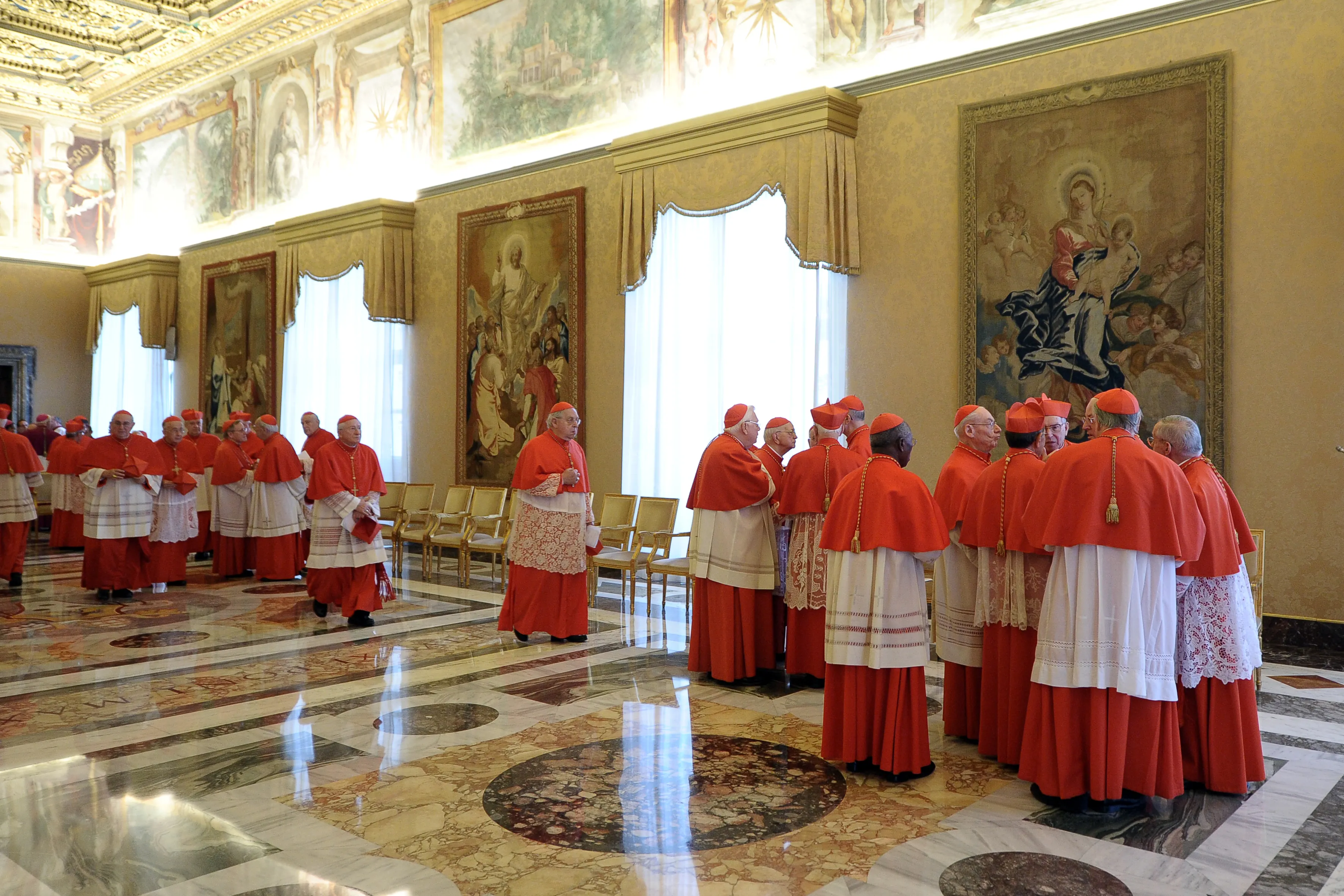
The assembled cardinals, on the other hand, who knew their Latin, reacted with stunned silence.
American Cardinal James Stafford later told CNA that the pope’s statement was received with “total surprise, total shock.”
“A cardinal who was sitting next to me said, ‘Did he resign?’ I said, ‘Yes, that’s what he did. He resigned.’ And we just all stood at our places.”
Cardinals react to Pope Benedict XVI’s announcement of his intention to resign the papacy Feb. 11, 2013. The surprise announcement, which Benedict made in Latin, took place in the Hall of the Consistory in the Vatican’s apostolic palace. Vatican Media
Nigeria’s Cardinal Francis Arinze, who was present that morning, said the announcement was a “surprise, like thunder that gives no notice that it’s coming,” reported The Catholic Telegraph.
In renouncing the papacy, Benedict became only the second pope in almost 600 years to voluntarily step down. In 1294, Pietro da Morrone, an elderly hermit, was crowned Pope Celestine V, but finding the demands of the job too much for him, he resigned after only five months.
In 1415, Pope Gregory XII also resigned, but under very different circumstances — he stepped down in order to end a crisis within the Church known as the Great Western Schism.
Title, white clothes, and papal coat of arms
What happened next with Benedict XVI was no less surprising to those who expected him to live as a retired cardinal.
In his last official statement as pope, before a general audience on Feb. 27, 2013, Pope Benedict assured the tens of thousands of people gathered to hear him speak as pope for the last time that even though he was stepping back from official duties, he would remain, in essence, pope.
“The ‘always’ is also a ‘forever’ — there can no longer be a return to the private sphere. My decision to resign the active exercise of the ministry does not revoke this,” Benedict said.
“I do not return to private life, to a life of travel, meetings, receptions, conferences, and so on. I am not abandoning the cross, but remaining in a new way at the side of the crucified Lord,” he told the crowd.
A day earlier, on Feb. 26, 2013, the director of the Vatican Press Office, Father Federico Lombardi, had silenced speculation over what Benedict would be called and what he would wear. He would, Lombardi said, retain the trappings of the papacy — most significantly, his title and dress.
“He will still be called His Holiness Benedict XVI,” Lombardi said. “But he will also be called Pope Emeritus or Roman Pontiff Emeritus.”
Lombardi said Benedict would continue to wear a white cassock but without the mozzetta, the short cape that covers the shoulders. The pope’s fisherman’s ring would be replaced by a ring from his time as cardinal. The red shoes would go as well, Lombardi said, and be replaced by a pair of brown ones.
“The city of León is known for beautiful shoes, and very comfortable shoes. And when the pope was asked what he wanted to wear he said, ‘I want the shoes from León in Mexico,’” Lombardi said at the press conference.
On May 2, the cardinal who designed Benedict’s coat of arms in 2005 told CNA that he had written the pope emeritus suggesting that his coat of arms would need to be redesigned to reflect his new status. Cardinal Andrea Cordero Lanza di Montezemolo proposed making the keys of St. Peter smaller and less prominent.
“That shows that he had a historic possession but not a current jurisdiction,” said the cardinal at the time.
Benedict, however, it seems, politely declined a new coat of arms. La Stampa reported the following year that the Vatican Publishing House’s manual of ecclesiastical heraldry in the Catholic Church contained the following note:
“Expressing deep appreciation and heartfelt gratitude to the author for the interesting study sent to him, [Benedict] made it known that he prefers not to adopt an expressive heraldic emblem of the new situation created with his renouncing of the Petrine Ministry.”
By his decision to continue to dress in white like the pope, retain the title of pope, and keep the coat of arms of his papacy, Benedict revealed that in giving up the “active exercise of the ministry,” he was not forsaking the role of pope altogether.
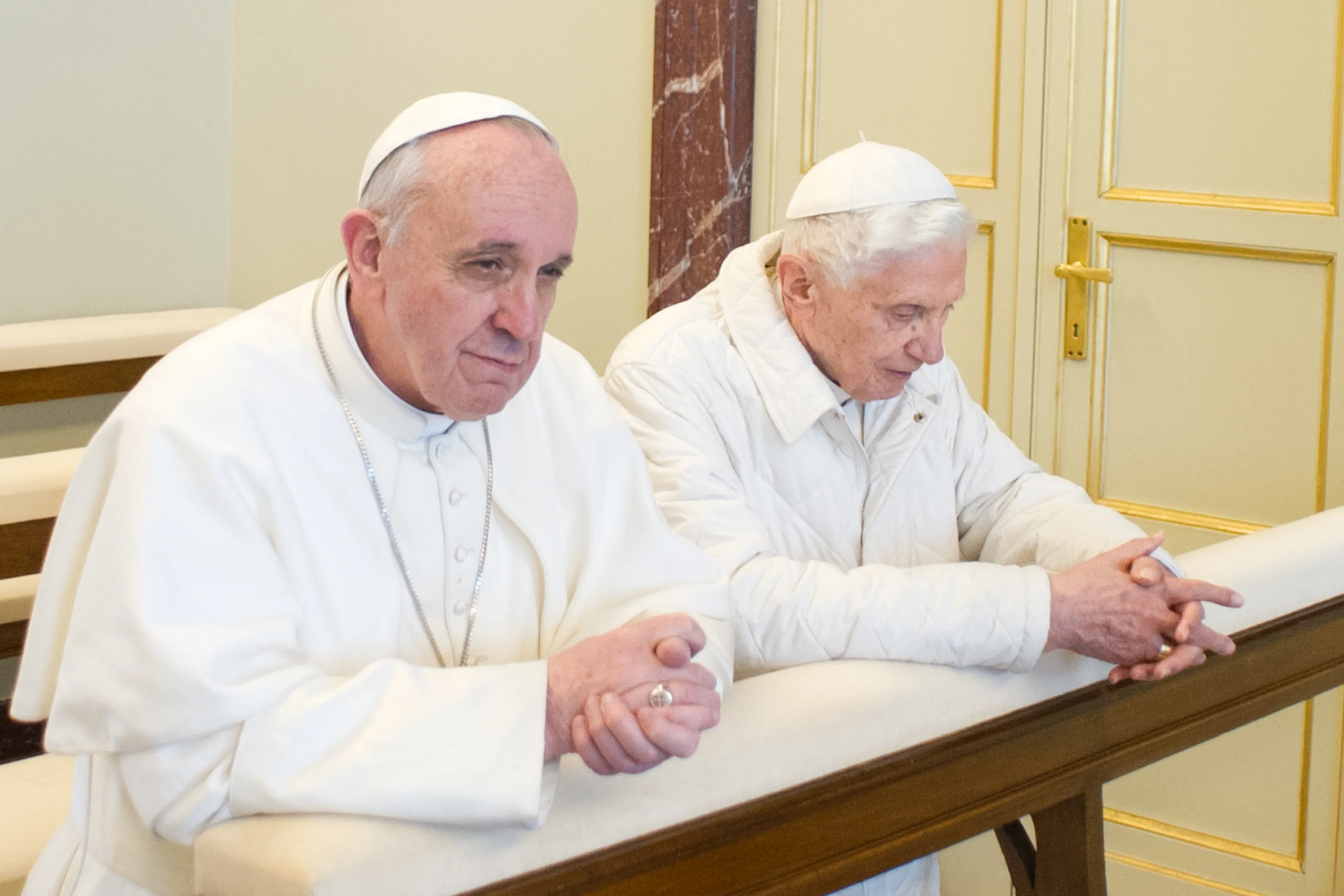
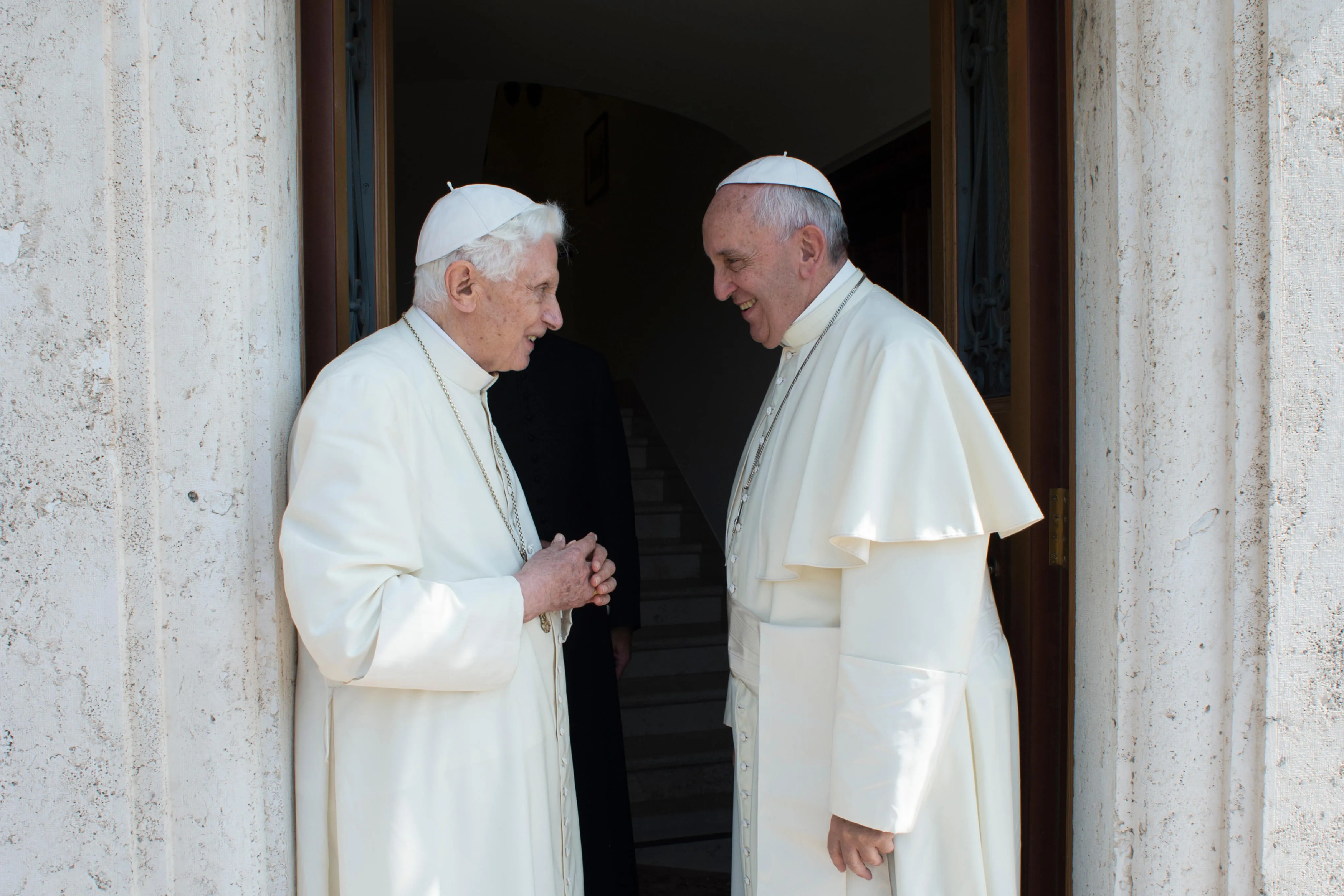
Pope Francis and Pope Emeritus Benedict XVI pray together at the papal residence in Castel Gandolfo March 23, 2013, their first meeting after Francis’ election. Vatican Media
An expanded Petrine ministry
In his 2013 announcement, Benedict clearly expressed his intention to step aside, even determining the date and time of his official departure. Nonetheless, his decision to keep the title of pope and maintain the ceremonial protocol that goes along with the papacy led some to speculate whether there were not actually “two popes.”
Benedict’s personal secretary and closest confidante, Archbishop Georg Gänswein, sought to clear up any confusion in 2016.
In a speech at the Pontifical Gregorian University in Rome on May 20, 2016, Gänswein said that Pope Francis and Benedict are not two popes “in competition” with one another but represent one “expanded” Petrine office with “an active member” and a “contemplative.”
Parsing Benedict’s speech, Gänswein explained that in stepping down, Benedict was not giving up his ministry.
“The key word in that statement is ‘munus petrinum,’ translated — as happens most of the time — with ‘Petrine ministry.’ And yet, ‘munus,’ in Latin, has a multiplicity of meanings: It can mean service, duty, guide, or gift, even prodigy. Before and after his resignation, Benedict understood and understands his task as participation in such a ‘Petrine ministry [munus],’” Gänswein said.
“He left the papal throne and yet, with the step he took on Feb. 11, 2013, he has not abandoned this ministry,” Gänswein explained, saying the latter scenario was something “quite impossible after his irrevocable acceptance of the office in April 2005.”
Benedict himself later made clear in an interview with his biographer Peter Seewald that he saw himself as continuing in his ministry. He said that a pope who steps down is like a father whose role changes, but always remains a father.
“Of course a father does not stop being father, but he is relieved of concrete responsibility. He remains a father in a deep, inward sense, in a particular relationship which has responsibility, but not with day-to-day tasks as such. It was also this way for bishops,” Benedict said.
“I think it is also clear that the pope is no superman and his mere existence is not sufficient to conduct his role, rather he likewise exercises a function.
“If he steps down, he remains in an inner sense within the responsibility he took on, but not in the function. In this respect one comes to understand that the office of the pope has lost none of its greatness, even if the humanity of the office is perhaps becoming more clearly evident,” Benedict said.
Benedict’s decision “not to abandon his ministry” inspired a cottage industry of conspiracy theories, with some questioning whether the pope emeritus truly stepped down because of his age and frailty.
George Weigel, author of the definitive biography of St. John Paul II, “Witness to Hope,” dismissed such speculation in an interview with CNA.
“I have no reason to think that there was anything more to Pope Benedict’s resignation than what he said was its cause: his conviction that he no longer had the strength, physical and intellectual, to give the Church what it needed from a pope,” he said.
“Everything else written about this is sheer speculation. Let’s take Benedict at his word,” Weigel said.
A life of prayer
In retiring to live in the Mater Ecclesiae Monastery in the Vatican Gardens, Benedict did not completely withdraw from the world. He attended public events in his new capacity as pope emeritus, received visitors, and pursued a life of fruitful study, writing, and prayer.
Pope Francis visits Pope Emeritus Benedict XVI at the Mater Ecclesiae monastery in Vatican City to exchange Christmas greetings Dec. 23, 2013. Vatican Media
Matthew Bunson, Catholic historian, author, and executive editor of EWTN News, told CNA that Benedict was determined not to exercise authority in his new role.
“He really embraced what it means to be pope emeritus, and refrained from making public comments, to instead live a life of prayer and reflection,” Bunson said.
“Benedict really was on retreat, and in prayer,” he said, “and that means we have his prayer for us as a Church.”
While becoming increasingly frail, Benedict continued to celebrate Mass daily with the other residents of the monastery and was known to enjoy spending time in the Vatican Gardens praying his daily rosary.
In the fall of 2021, more than eight years after Benedict stepped down, his private secretary, Gänswein, told Domradio in Cologne, Germany, that Benedict was “stable in his frailty.”
He described the pope emeritus as very weak physically but still clear in mind. Gänswein said he had not lost his “typical Bavarian humor.”
The meaning of Benedict’s renunciation for future popes
In 2013, after Benedict announced that he would step down as pope, Father Gianfranco Ghirlanda, a Jesuit theologian and canonist chosen by Pope Francis to be a cardinal, wrote an essay on what should happen when a pope steps down.
In the article, published in Civiltà Cattolica, Ghirlanda suggested the retiring Benedict take the title bishop emeritus of Rome.
“It is evident that the pope who has resigned is no longer pope; therefore he no longer has any power in the Church and cannot interfere in any government affair. One may wonder what title Benedict XVI will retain. We think that he should be given the title of bishop emeritus of Rome, like any other diocesan bishop who ceases,” he said.
In December 2021, at a congress on papal resignations, Ghirlanda took up the theme again.
“Having two people with the title of ‘pope,’ even if one added ’emeritus,’ it cannot be said that this might not generate confusion in public opinion,” he said.
To make clear that the pope who resigns is no longer pope, he said, he should perhaps be called “former Roman pontiff” or “former supreme pontiff.”
Pope Francis in July 2022 told reporters that if he were to retire from the papacy he would do things differently from his predecessor.
“The first experience went very well,” Pope Francis said, because Benedict XVI “is a holy and discreet man.”
In the future, however, “it would be better to define things or explain them better,” the pontiff added.
“I am the bishop of Rome. In that case I would be the bishop emeritus of Rome,” he said, and then suggested he would live in St. John Lateran Palace rather than at the Vatican.
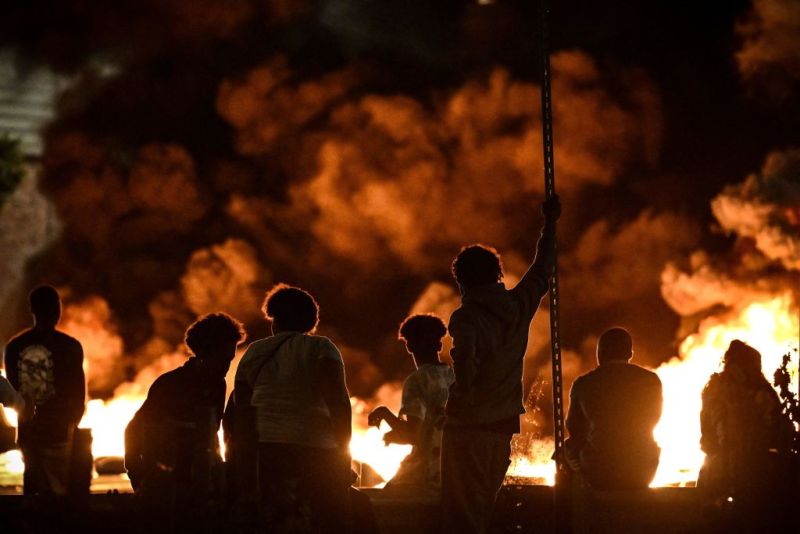
People look at burning tyres blocking a street in Bordeaux in south-western France on June 29, 2023, during riots and incidents nationwide after the killing of a 17-year-old boy by a police officer’s gunshot following a refusal to comply in a western suburb of Paris. / Philippe Lopez/AFP via Getty Images
CNA Newsroom, Jul 3, 2023 / 15:13 pm (CNA).
France’s bishops joined other religious leaders over the weekend in responding to the ongoing unrest in their country with a call for peace, dialogue, and a return to calm.
The riots, sparked by the fatal police shooting of a 17-year-old of North African origin named Nahel M. during a traffic stop in Nanterre, a suburb of Paris, have led to days of looting, attacks on public buildings, and destructive mob violence in several cities.
Some 45,000 officers were deployed across the country over the past three nights, according to the BBC. More than 150 people were arrested Sunday night, down from more than 700 the night before. The full extent of the destruction and the number of injured is still unknown.
In a joint statement, religious leaders in France expressed their sorrow over the death and violence. At the same time, they called for a return to peace. “We affirm with one voice that violence is never the right way,” the statement said, decrying attacks on schools, businesses, city halls, and transportation, noting that the residents, families, and children of these neighborhoods are the first to suffer.
The text was signed by Archbishop Éric de Moulins-Beaufort of Reims, president of the French Bishops’ Conference.
Other signatories include leaders of the Conference of Religious Leaders of France: Chems-Eddine Hafiz, rector of the Grand Mosque of Paris; Grand Rabbi Haïm Korsia, chief rabbi of France; Mohammed Moussaoui, president of the French Islamic Council; Bishop Demetrios Ploumios, president of the Assembly of Orthodox Bishops of France; Pastor Christian Krieger, president of the Protestant Federation of France; and Antony Boussemart, president of the Buddhist Union of France.
In the face of attacks on police and authorities, the signatories called for the strengthening of “necessary trust” between sectors of the population and law enforcement agencies. They encouraged politicians to work together responsibly to restore justice and peace.
“Today more than ever, may all believers be servants of peace and the common good. We are all available to contribute to this,” the statement concluded.
The French bishops have also proposed a prayer for the restoration of peace in the country, which was made available to parishes and Catholic communities in France.
The prayer reads in full in English translation:
We ask you, Lord, for the return of tranquility and peace to our country.
We entrust Nahuel to you and pray for his loved ones. May the spirit of light and peace accompany them.
We entrust to you the wounded of these nights of violence, including those whose homes and workplaces have been destroyed or damaged.
We pray, Lord, for those who work in law enforcement and public services, who are under great pressure and sometimes attacked.
Inspire us to promote dialogue and peace with believers of other Christian denominations and other religions, and with all our fellow citizens.
We ask you once again that our society, even beyond the current explosions, may clearly recognize the sources of violence and find ways to overcome them.
The endangering “laicization of the clergy and the clericalization of the laity,” a confusion already warned against in the Documents of Vatican II…
Combined with the refreshing but fluid exploratory style of the synodal documents (the Preparatory Document and the Vademecum), this event hopefully clarifies and even restores needed distinctions and responsibilities, earlier rather than later (e.g., complementarity of roles, not confusion; differing in kind as well as degree). The troubling aspect of the current form of synodality is that the “walking together” is translated into the additive politics of simply moving things along—that is, the stages of synthesis (parish, diocesan, continental, and Vatican?) are limited to “aggregated,” “compiled” and “collated feedback” and curious “minority reports.” Crockpot theology!
While the apostolic and hierarchical communion of the Church is briefly reaffirmed, here and there, in the synodal documents, nevertheless, the successors of the apostles are too-much reduced to serving “primarily as facilitators.”
At what points in the synodal process are, yes, the very likely drops of cyanide (e.g., accompaniment/accommodation of the homosexual lifestyle) removed from the composted super-synthesis at the Synod on Synodality in 2022-2023?
Certainly laity should be apostles of the faith. Although when Cardinal Ouellet poses this charisma as a theological rather than pastoral agenda to be explored, then it suggests a confluence of the priesthood of the faithful by baptism, and the ordained appointed by laying on of hands by a bishop.
What occurs when the distinction is blurred is mitigation of the explicit apostolic ministry of the ordained, and, in effect, the priesthood of Christ with which the ordained priesthood identifies. We are to look to Christ crucified both priest and victim as head of the Body and him alone.




The endangering “laicization of the clergy and the clericalization of the laity,” a confusion already warned against in the Documents of Vatican II…
Combined with the refreshing but fluid exploratory style of the synodal documents (the Preparatory Document and the Vademecum), this event hopefully clarifies and even restores needed distinctions and responsibilities, earlier rather than later (e.g., complementarity of roles, not confusion; differing in kind as well as degree). The troubling aspect of the current form of synodality is that the “walking together” is translated into the additive politics of simply moving things along—that is, the stages of synthesis (parish, diocesan, continental, and Vatican?) are limited to “aggregated,” “compiled” and “collated feedback” and curious “minority reports.” Crockpot theology!
While the apostolic and hierarchical communion of the Church is briefly reaffirmed, here and there, in the synodal documents, nevertheless, the successors of the apostles are too-much reduced to serving “primarily as facilitators.”
At what points in the synodal process are, yes, the very likely drops of cyanide (e.g., accompaniment/accommodation of the homosexual lifestyle) removed from the composted super-synthesis at the Synod on Synodality in 2022-2023?
Certainly laity should be apostles of the faith. Although when Cardinal Ouellet poses this charisma as a theological rather than pastoral agenda to be explored, then it suggests a confluence of the priesthood of the faithful by baptism, and the ordained appointed by laying on of hands by a bishop.
What occurs when the distinction is blurred is mitigation of the explicit apostolic ministry of the ordained, and, in effect, the priesthood of Christ with which the ordained priesthood identifies. We are to look to Christ crucified both priest and victim as head of the Body and him alone.