


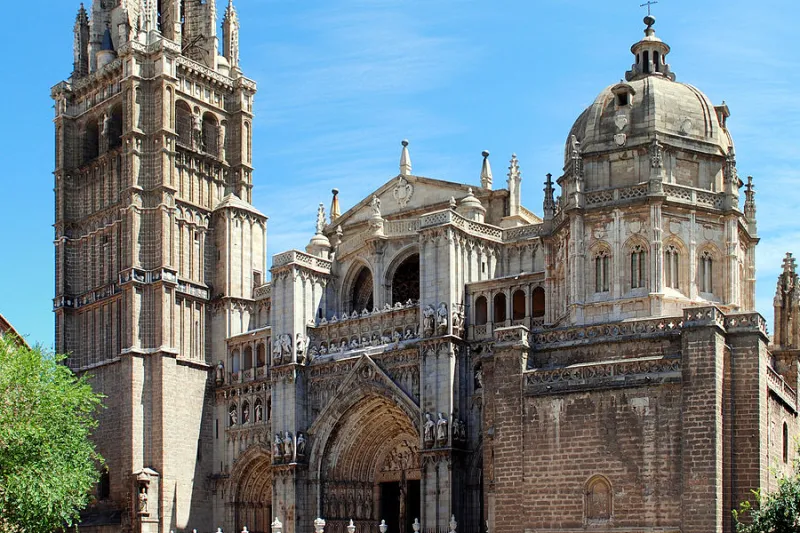
Toledo, Spain, Oct 8, 2021 / 14:39 pm (CNA).
Archbishop Francisco Cerro Chaves of Toledo apologized Friday for the improper use of the city’s cathedral in a music video, which includes sensual dance scenes within the church.
The archbishop “was absolutely unaware of the existence of this project, its content and the final result,” the Archdiocese of Toledo said Oct. 8, adding that the archbishop “deeply regrets these events and disapproves of the images recorded” in the cathedral.
Spanish rapper C. Tangana released a music video for his song “Ateo” (Atheist) Oct. 7, made with Argentine singer Nathy Peluso. In the video, both perform sensual and provocative dances inside the cathedral.
Fr. Juan Miguel Ferrer Grenesche, dean of the cathedral, justified Oct. 8 the recording of the music video in the sacred space.
Fr. Ferrer Grenesche, “the video presents the story of a conversion through human love. The lyrics of the song are precise: ‘I was an atheist, but now I believe, because a miracle like you had to come down from heaven.’”
In addition, the dean criticized “certain attitudes of intolerance,” to which, he said, “is opposed by the understanding and acceptance of the Church, as manifested in the final sequences of the video.”
On the contrary, the Archbishop of Toledo asked “humbly and sincerely for forgiveness from all the lay faithful, consecrated people and priests, who have felt justly hurt by this misuse of a sacred place.”
“From this moment, the archdiocese will work to review the procedure followed to prevent something similar from happening again,” the statement added.
“To do this, a protocol for the recording of images for public broadcasting in any church in the archdiocese will be immediately drawn up,” he concluded.
If you value the news and views Catholic World Report provides, please consider donating to support our efforts. Your contribution will help us continue to make CWR available to all readers worldwide for free, without a subscription. Thank you for your generosity!
Click here for more information on donating to CWR. Click here to sign up for our newsletter.


Right. “Love” is the excuse to do any blatantly wrong thing on earth. No standards set or expected. Disgusting. This Dean should be sent to a monastery to think for a while.
Hey, Fr. Ferrer Grenesche: One does not record a music video in a sacred space. One prays there, and maintains reverence and dignity. It’s where Our Lord is in the tabernacle. It’s not a recording studio. Duh…
In A.D. 410 Rome was sacked by Alaric; during the Reign of Terror a nude prostitute danced on the altar of Notre Dame (recast as the Temple of Reason), in St. Peter’s Basilica the Pachamama penetrates a niche in St. Peter’s, in Toledo Cathedral an atheist sings a tune called “Atheist”….do we see a pattern here?
St. Ambrose is a doctor of the Church, partly because he saw through this pattern and refused to allow his Milan Cathedral to be used by the Arians of his day, or to concede to Christianity being included in a niche of the cosmopolitan/pluralist Pantheon in Rome…
In Ambrose’s time the Emperor Valentinian hoped “a common basis between Christianity and a monotheistic Paganism could be found in the Unknowability of God.” Ambrose also differentiated the Church from State (and vice versa) by later excommunicating the Emperor Theodosius for ordering the slaughter of 7,000 innocents in Thessalonica. (Doing the arithmetic–as in “follow the science!”—that’s one ten-thousandth, or one one-hundredth of one percent, or 0.01%—of the number of innocents aborted in the United States since the 1973 fatwa, Roe v. Wade, a landmark now intended to be codified during the reign of Emperor Biden.)