




Washington, D.C. Newsroom, Sep 29, 2021 / 09:03 am (CNA).
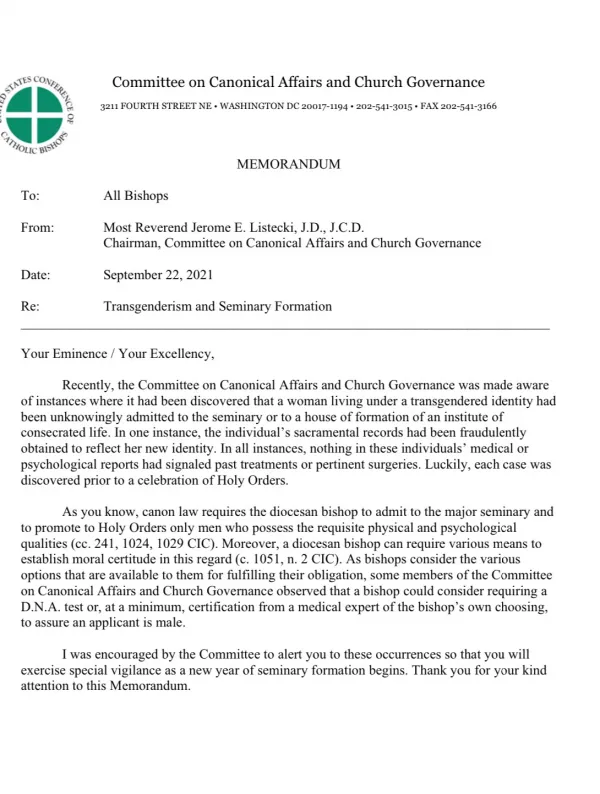
Bishops should consider requiring DNA tests or physical examinations to ensure that all seminarians are biological men, said Archbishop Jerome Listecki in a recent memo sent to the members of the United States Conference of Catholic Bishops.
“Recently, the Committee on Canonical Affairs and Church Governance was made aware of instances where it had been discovered that a woman living under a transgendered identity had been unknowingly admitted to the seminary or to a house of formation of an institute of consecrated life,” said the memo. Listecki is the chairman of the USCCB’s canonical affairs committee.
In one case, said Listecki, “the individual’s sacramental records had been fraudulently obtained to reflect her new identity.”
“In all instances, nothing in these individuals’ medical or psychological reports had signaled past treatments or pertinent surgeries,” he added. None of the biologically female seminarians received Holy Orders, said Listecki.
The archbishop’s memo does not identify which seminaries or houses of formation have enrolled a biological female who presented herself as a male, nor was it clarified if these “instances” occurred in the United States or elsewhere.
While a Catholic baptism certificate typically does not indicate the sex of the person being baptized, other Christian denominations have invited people identifying as transgender to re-affirm their baptismal promises under their new, chosen, name.
The archbishop said that he was “encouraged by the Committee” to send the memo to his brother bishops, so that they could “exercise special vigilance as a new year of seminary formation begins.”
Listecki, a doctor of canon law, noted that “canon law requires the diocesean bishop to admit to the major seminary and to promote to Holy Orders only men who possess the requisite physical and psychological qualities,” and that the bishop “can require various means to establish moral certitude in this regard.”
The memo continues: “Some members of the Committee on Canonical Affairs and Church Governance observed that a bishop could consider requiring a D.N.A. test or, at a minimum, certification from a medical expert of the bishop’s own choosing, to assure that an applicant is male.”
The USCCB declined to comment on the contents of the memo.
This is a developing story.
If you value the news and views Catholic World Report provides, please consider donating to support our efforts. Your contribution will help us continue to make CWR available to all readers worldwide for free, without a subscription. Thank you for your generosity!
Click here for more information on donating to CWR. Click here to sign up for our newsletter.


Sadly, you had to figure that some trans-genders would attempt this.I agree with this Bishop that a DNA test should be required before admission to the seminary. In addition it would not hurt if our clergy at all levels would stop soft pedaling sexual sins, including homosexuality, sexual activity outside of marriage and transgenderism, to make the church position perfectly clear on these issues.And actually SAY something on these topics from the pulpit.
Our pope has surrounded himself with morally corrupt cardinals and priests. I wonder why 🤔
If only this same level of concern existed about excluding sodomites from seminaries. And why isn’t it?
The implication here is that there aren’t physical exams provided by physicians before admission to the seminary or religious life. Why would that ever be? We need to know the candidates are reasonably healthy. While unfamiliar myself with the reconstructive surgery provided by the artisans who do these work-ups I can’t believe they aren’t easily discernable as essentially cosmetic. And then of course there are the medications required by the patient-applicants to maintain the appearance of the assumed sex. Hormones are absolutely essential. Who would pay for them? How would they get them without being deduced? This bespeaks a lack of responsible analysis of candidates which obviously predates the Halloween party we presently endure. And then there is the long lauded psychological screening. What’s up there?
The irresponsibility exhibited in this turn of events is criminal. Is there no man in any ecclesiastical position who can find their way out of a paper bag?
Well stated, James. I strongly suspect there is willful cooperation on the part of someone in the admission process … an examining physician and/or psychologist, or, God forbid, a vocation director. and, yes, it all points to incompetence of the authorities. They didn’t see this coming?
Things keep on getting sickeningly worse in this Roman Catholic Church of ours. The malodorous stench of Satan is very much present. Who will see to it that the Church is rid of Satan?
The edifice is his.
At least ten states have passed laws allowing people to change their gender/sex identity on their birth certificates. Pretty soon, they will figure out a way to fool the DNA tests. Authenticity has gone the way of horse-drawn carriages, especially now that animal waste is threatening our climate.
A DNA test would do the trick. XY equals male, XX equals female.
Rearranging the furniture does not change the DNA.
It is simpler than that. If Y is present, male. If Y is absent, female. There are rare cases of abnormal karyotype (XO, XXY, XYY, etc) but the presence of Y is determinative. In re: a previous comment, it is straightforward to make this determination unequivocally.
We’ve gone past disgrace and betrayal. We’ve now entered full mockery.
When presented with REAL science and data via the y chromosome, they will cry discrimination.
Because it’s not about the truth. It’s about pretending trans people are normal and just like you and me.
Simple fix for this”problem”: allow female entrance into ordination.
Nancy, that will never happen. Priests will only be men because Christ was a man and designed His church that way. It’s not a church law, but a divine law. The church can’t change it the way they could change, say, determining the date of a saint’s feast day. And even if they could, it wouldn’t solve the problem. We are born male or female at birth because that is how God designed our soul. Pretending otherwise is living a lie.