
Washington D.C., Jul 21, 2017 / 04:52 pm (CNA/EWTN News).- The US bishops’ representative for domestic justice has asked Senators not to vote to repeal the current health care law unless they have an alternative in place that offers acceptable levels of coverage.
“In the face of difficulties” of bringing health care legislation to the Senate floor, Bishop Frank Dewane of Venice said in a letter to senators on Thursday, “the appropriate response is not to create greater uncertainty, especially for those who can bear it least, by repealing the ACA [Affordable Care Act] without a replacement.”
“Yet,” he said July 20, “reform is still needed to address the ACA’s moral deficiencies and challenges with long-term sustainability.”
After the House passed a health care bill repealing the ACA and replacing it with provisions of the American Health Care Act (AHCA), the Senate has worked on producing a bill of its own, the Better Care Reconciliation Act (BCRA). However, the Senate has so far failed to bring a health care bill to the floor for a vote.
This week, Majority Leader Mitch McConnell (R-Ky.) announced that not only did the Senate not have the votes to pass the health care bill, but it did not have the votes required to sustain debate on repealing and replacing the ACA.
He announced that a vote would occur anyhow, on the House health care bill with an amendment attached that would repeal the current health care law but allow for a two-year transition period for stability.
A vote to repeal the Affordable Care Act is expected as soon as Tuesday. However, according to reports it is still unclear exactly which bill the Senate would vote on to replace the Affordable Care Act.
The pro-life group Susan B. Anthony List, for example, advocated on Friday that the Senate should vote either on its own health care bill or on the 2015 reconciliation bill that repealed the ACA. Those bills would end the funding of abortion coverage within the ACA, Susan B. Anthony List said.
Pro-life leaders, including Marjorie Dannenfelser, president of the Susan B. Anthony List, and Jeanne Mancini, president of the March for Life, met with Vice President Mike Pence on Friday. Mancini called it a “good meeting” and reiterated that “abortion is not health care,” referring to funding of abortion coverage under the current health care law.
Bishop Dewane had previously said that no repeal of the current health care law should be made without a suitable replacement plan. “To end coverage for those who struggle every day without an adequate alternative in place would be devastating,” Bishop Dewane said.
He said any replacement plan must be one that “protects poor and vulnerable people, including immigrants, safeguards the unborn, and supports conscience rights.” The replacement plans that have been proposed by the House and Senate are “seriously flawed, and would have harmed those most in need in unacceptable ways,” he said.
While the bishop had applauded the Hyde Amendment protections in the House bill that would have blocked the taxpayer funding of abortions through tax credits and other subsidies, he had expressed serious concern about its changes to Medicaid and other provisions. The bill, he said, would cut coverage or make it more cost-prohibitive for those who may need it most, like the elderly, the poor, and the chronically ill.
The revised Senate plan, meanwhile, was still “unacceptable,” the bishop said in a statement last Thursday.
Regarding the original Senate health care proposal, in his June 27 letter Bishop Dewane said that “at a time when tax cuts that would seem to benefit the wealthy and increases in other areas of federal spending, such as defense, are being contemplated, placing a ‘per capita cap’ on medical coverage for the poor is unconscionable.”
He added that under the bill health coverage costs could increase for many elderly and poor persons “because of decreased levels of tax credit support and higher premiums.” And, the bishop said, the bill, like its House counterpart, lacked conscience protections.
He warned that the pro-life language in the bill was laudable, but echoed concerns of other pro-lifers that the language could be stripped by the Senate Parliamentarian before it reached the Senate Floor.
The revised Senate bill contained some slight improvements like more funding to fight opioid addiction, “but more is needed to honor our moral obligation to our brothers and sisters living in poverty and to ensure that essential protections for the unborn remain in the bill,” he said last Thursday.
This week, however, the Senate bill was scuttled. Yet amid the uncertainty of what the senators may vote on next week, “the appropriate response is not to create greater uncertainty, especially for those who can bear it least, by repealing the ACA without a replacement,” Bishop Dewane said.
On Friday, Pence urged Americans to ask their senator to vote to begin the debate to repeal and replace the ACA on Tuesday.
Susan B. Anthony List, meanwhile, said the Senate should work to ensure a bill is passed which defunds Planned Parenthood and protects taxpayer funding from going to abortion coverage in federally-subsidized plans.
“The first step is voting for the motion to proceed to the House-passed bill which replaces Obamacare abortion funding with health assistance that does not include abortion coverage and redirects funding for certain abortion providers to noncontroversial community health centers,” the group’s president Marjorie Dannenfelser said in a July 20 letter to senators.
“While the House bill faces procedural hurdles, we support passage of a substitute amendment that is substantially similar to the Obamacare repeal bill sent to President Obama in January 2016,” she added.
“Obamacare has been a disaster for unborn children through its unprecedented expansion of taxpayer-funded abortion,” Dannenfelser said.
“The 2015 reconciliation bill that was sent to President Obama’s desk or the Better Care Reconciliation Act would roll back this damage and help return us to the principle that abortion is not health care.”
 […]
[…]






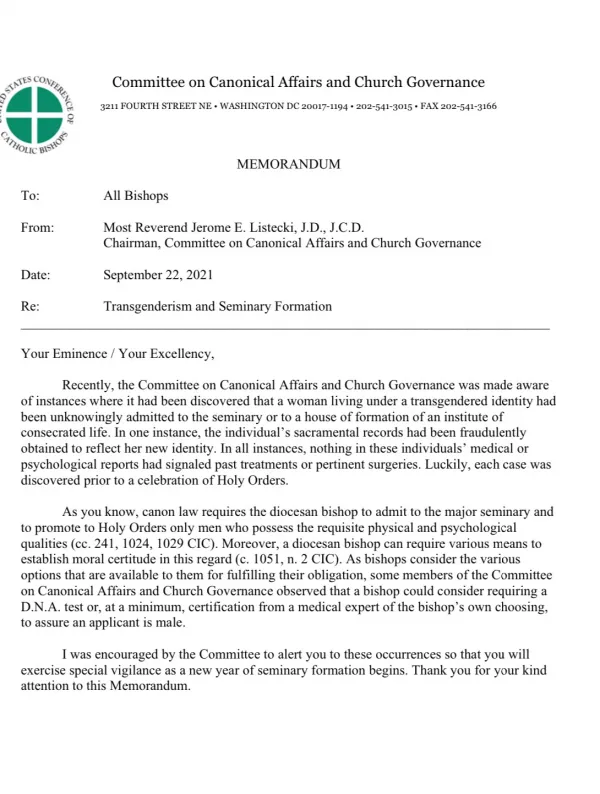
Sadly, you had to figure that some trans-genders would attempt this.I agree with this Bishop that a DNA test should be required before admission to the seminary. In addition it would not hurt if our clergy at all levels would stop soft pedaling sexual sins, including homosexuality, sexual activity outside of marriage and transgenderism, to make the church position perfectly clear on these issues.And actually SAY something on these topics from the pulpit.
Our pope has surrounded himself with morally corrupt cardinals and priests. I wonder why 🤔
If only this same level of concern existed about excluding sodomites from seminaries. And why isn’t it?
The implication here is that there aren’t physical exams provided by physicians before admission to the seminary or religious life. Why would that ever be? We need to know the candidates are reasonably healthy. While unfamiliar myself with the reconstructive surgery provided by the artisans who do these work-ups I can’t believe they aren’t easily discernable as essentially cosmetic. And then of course there are the medications required by the patient-applicants to maintain the appearance of the assumed sex. Hormones are absolutely essential. Who would pay for them? How would they get them without being deduced? This bespeaks a lack of responsible analysis of candidates which obviously predates the Halloween party we presently endure. And then there is the long lauded psychological screening. What’s up there?
The irresponsibility exhibited in this turn of events is criminal. Is there no man in any ecclesiastical position who can find their way out of a paper bag?
Well stated, James. I strongly suspect there is willful cooperation on the part of someone in the admission process … an examining physician and/or psychologist, or, God forbid, a vocation director. and, yes, it all points to incompetence of the authorities. They didn’t see this coming?
Things keep on getting sickeningly worse in this Roman Catholic Church of ours. The malodorous stench of Satan is very much present. Who will see to it that the Church is rid of Satan?
The edifice is his.
At least ten states have passed laws allowing people to change their gender/sex identity on their birth certificates. Pretty soon, they will figure out a way to fool the DNA tests. Authenticity has gone the way of horse-drawn carriages, especially now that animal waste is threatening our climate.
A DNA test would do the trick. XY equals male, XX equals female.
Rearranging the furniture does not change the DNA.
It is simpler than that. If Y is present, male. If Y is absent, female. There are rare cases of abnormal karyotype (XO, XXY, XYY, etc) but the presence of Y is determinative. In re: a previous comment, it is straightforward to make this determination unequivocally.
We’ve gone past disgrace and betrayal. We’ve now entered full mockery.
When presented with REAL science and data via the y chromosome, they will cry discrimination.
Because it’s not about the truth. It’s about pretending trans people are normal and just like you and me.
Simple fix for this”problem”: allow female entrance into ordination.
Nancy, that will never happen. Priests will only be men because Christ was a man and designed His church that way. It’s not a church law, but a divine law. The church can’t change it the way they could change, say, determining the date of a saint’s feast day. And even if they could, it wouldn’t solve the problem. We are born male or female at birth because that is how God designed our soul. Pretending otherwise is living a lie.