




Chicago, Ill., Aug 28, 2021 / 16:00 pm (CNA).
Cardinal Blase Cupich, Archbishop of Chicago, allegedly ordered a priest to cease praying the Prayer to St. Michael and the Hail Mary publicly after Mass at a parish in the Archdiocese of Chicago. The pastor of the church, Father John Trout, issued a statement saying this is not true.
Rumors started after social media posts pointed to an announcement at a livestreamed Mass at St. Joseph Catholic Church in Libertyville, Illinois.
In the video, which has now been removed, Father Emanuel Torres-Fuentes, the associate pastor, said that upon the request of Cupich, prayers to St. Michael and the Hail Mary at the end of the Mass had to stop.
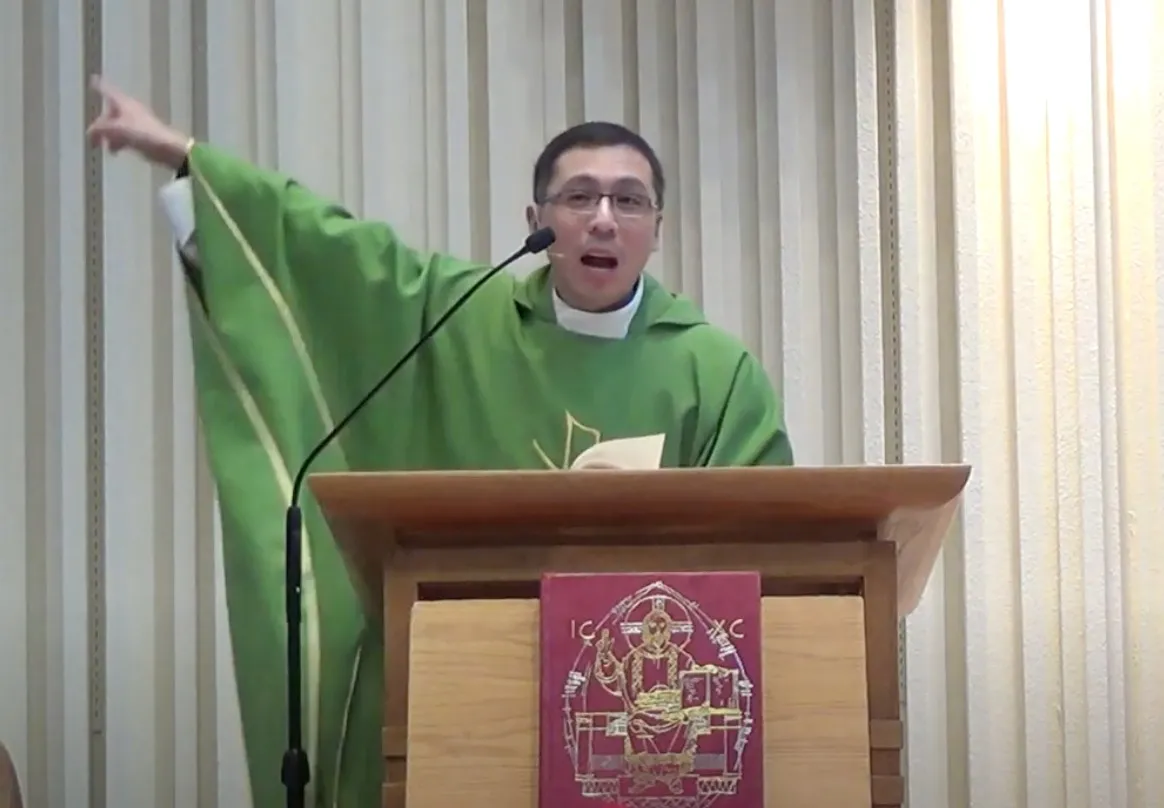
“Following the directive of Cardinal Cupich, we want to remind everyone that the prayer to Saint Michael is not to be said publicly following Mass,” says Torres-Fuentes in the video. This devotional prayer may be recited privately while being respectful of others in the church. Okay?”
“And also, you realize that I like to say Hail Mary at the end of the Eucharist. But now I was told to sing instead of the Hail Mary,” he said.
“What is the thing?” said Torres-Fuentes, who was ordained in 2018. “As a priest, I have to obey. And by obey I should [inaudible-26:54] at peace. And my heart is at peace. Okay?”
“I was reflecting on this. Now, I say okay. That’s okay. If Cardinal Cupich says this, I have to do it. Alright? But at peace. Okay? Thank you,” he said.
On Saturday afternoon, Trout offered an explanation for Torres-Fuentes’s announcement.
The statement said: “The faithful are always welcome to gather in Church for personal prayer as individual or as a group. At the same time, in accord with sound liturgical practice and in keeping with archdiocesan norms, which I personally confirmed with the Cardinal, the recitation of prayers must never interfere with, interrupt or distract from the public liturgy of the Church.”
Trout continued: “Nor can it ever become an imposition on the rest of the faithful in the Church who have a right to remain at the end of Mass to pray privately as they wish. It is also important that such prayers must always foster the unity of the Church, which is guaranteed by the Successor of Peter, for whom we never fail to show our deepest respect and devoted support as our Holy Father.”
The statement concludes by stating that Torres-Fuentes “wishes to state that he misspoke at a recent Mass when he falsely attributed statements to Cardinal Cupich. For this reason the video of that Mass has been removed to avoid any confusion.”
CNA asked Torres-Fuentes in an email who gave him the directive to cease the Prayer to St. Michael and the Hail Mary after Mass, but received no response.
Since the video of Torres-Fuentes’s statement went viral, CNA spoke to parishioners who described the circumstances.
Dan Love, a parishioner who attends daily Mass at St. Joseph’s told CNA in a phone call on Saturday that recently several parishioners began to recite the Prayer to Saint Michael after Mass publicly. He told CNA that because several of the parishioners were reciting it publicly, the rest of the attendees joined in.
“I think some parishioners just started it,” said Love, who is also a member of the local Knights of Columbus (KofC). “I guess the question is what are they praying for protection from?”
Consistently after daily Mass—which are livestreamed on Facebook—Torres-Fuentes leads the congregation in the Hail Mary prayer. The livestreams do not show the associate pastor leading the congregation or participating in the Prayer to Saint Michael.
“We’re all Catholic and we’re all called by Christ and if you feel that you need to pray for something, pray for something,” Love said. “I’m just hoping it’s praying for the healing and all the other issues we have in the world, such as the war in Afghanistan and such as the pandemic.”
Love mentioned a member of his KofC council who is in South Africa being “rampaged by the pandemic.”
“They’re fighting over food because there’s no food and people don’t have any money,” Love said. “So we’re trying to help him financially. So there’s more important calls for us as Catholics around the world than it is worried about this three or four people who can’t say the St. Michael prayer after Mass. That’s my opinion.”
Love told CNA he did not know the reasoning behind stopping the Hail Mary after Mass.
A parish secretary on Friday told CNA that Torres-Fuentes had a meeting with Cupich. Love told CNA the meeting was a luncheon with other priests and was planned weeks in advance. He mentioned that the purpose was not for Torres-Fuentes to dialogue with Cupich about the prayer announcement.
After contacting other priests in the diocese, CNA found that there was no directive sent to all parishes in the diocese referring to the recitation of the Prayer to Saint Michael or the Hail Mary following Mass.
The diocese did not respond to requests from CNA for comment.
Recitation of the Prayer to St. Michael at the conclusion of Mass was introduced in 1886 by Pope Leo XIII. As part of the liturgical reform at the Second Vatican Council, the Prayer to Saint Michael was removed.
In recent years, several parishes have reintroduced the practice.
If you value the news and views Catholic World Report provides, please consider donating to support our efforts. Your contribution will help us continue to make CWR available to all readers worldwide for free, without a subscription. Thank you for your generosity!
Click here for more information on donating to CWR. Click here to sign up for our newsletter.


Our pastor actually leads the faithful in praying St. Michael and memorare.
Ours, too, along with a prayer for St. Joseph to intercede for us.
What’s going on with you Catholic media you – CATHOLIC WORLD REPORT – people that you show NO OUTRAGE at the damage this Cdl. Cup-sick has done to our beloved Church?. Why are you not shaming him for the heretic he is? When I asked this same question of one of our ‘better’ bishops his answer: ” You don’t understand Michael, they have all the power.” I told him (and Archbishop Chaput before him, of Saint John Vianney’s response:” Anyone who is tolerant of evil when there is cause for holy anger is an immoral man” You Catholic World Report media -types are acting immorally in your lack of HOLY ANGER. Are you not aware ( you E.W.T.N , you Relevant Radio folk and all of you in the Catholic main-stream media.) how faithful, informed, catholic’s everywhere are seething at your lack of action in this regard? Your good Father Fessio said years ago; ” When I die I want there to be blood on my sword.” Hear, Hear! ! But that won’t ever happen unless you take the sword out of it’s sheath. ” If the bugle sound isn’t clear then how can the troops know to prepare for battle? ” You can’t just leave it all to Michael Voris ( God bless him ) and Fr. James Altman, our hero .and the model priest of our times.
Apparently you’re not familiar with CWR…
Blaise setting things a-blaze… Micro-management – – mitres 30 yrs behind…
Dominus flevit!
Father Zuhlsdorf has posted the original video and an update with a message from the Pastor, Father John Trout. The realist in me thinks that this might be more damage control for the diminutive Cardinal Archbishop since the Lightfoot debacle.
UPDATED – VIDEO: Priest announces he and people have been forbidden to say St. Michael Prayer and Hail Mary after Mass.
Seems like micromanagement to me. Why prohibit or discourage heartfelt prayers after Mass? It’s useless because it just alienates parishioners and reflects poorly on diocesan leadership.
Why doesn’t Cardinal Cupich lead the prayers himself, or make any effort to pray the rosary publicly with his parishioners at the Cathecral?
St. Paul teaches that Christians have “the mind of Christ.”
His Eminence Cupich has “the mind of McCarrick.”
It certainly stands to reason that a lot of the current Catholic hierarchy wouldn’t much like parishioners praying to St. Michael. As for poor Mr. Love who wonders what those who recite this prayer are asking to be protected from, apparently he has never heard the prayer, because it is self-explanatory.
That’s what I was thinking; also, EWTN does this after most masses – “protect against wickedness and snares of the devil.” etc..
(Sigh.)
Cupich’s approach to building unity is unbelievable. Absolutely comical.
It reminds me of the old satirical comment on corporate management…
“Notice to all employees: The beatings will continue until morale improves.”
This article concerned me deeply. First, Mr. Love asked, “what are they praying for?” when reciting the prayer to St. Michael. When Pope Leo XIII directed this prayer at the end of Mass, it was because God had showed him a vision of a conversation God had with the devil asking for more time to gather souls. The devil is running out of time and he knows it. The Church is in a crisis and the world is in the worse state it has ever been. The devil is a real threat to the Church and to each individual. In addition, we as Catholics are encouraged to pray for global catastrophes and problems as a parish and as an individual. However, we all should have our own personal relationship with our Lord and Savior and should be encouraged to pray to Him for personal reasons at ant time…in church or at home. In addition, the Mass was over when the two prayers were being prayed, so why all the concern? After Mass is over there is the soft “hustle-bustle” of people leaving the church, talking, cleaning up pews, etc, and people still are able to have the mind-set for personal prayers. Also the Church has taught me my whole life to have a special devotion to Our Blessed Mother. Even Jesus thought highly enough of her to take time while He was dying on the cross for us, to give His mother to us for protection and source of multiple graces. She has been sent by God multiple times in apparitions to warn us that God is displeased about the state of mankind, while she has been giving us directions on how to change…prayer, penance, sacrifice, fasting, and saying the rosary. I personally feel that one Hail Mary prayer at the end of Mass to ask Our Lady’s help is pleasing to her Son, Jesus.
Parsing is the fallback of the disingenuous. It is grievously evident in the statements recorded in this report. It serves no purpose but to magnify the theological disorder current in our Church, a disorder magnified frequently by the Cardinal himself and by his confreres in the school of deconstructionism. This is exactly where the reputation of episcopal untrustworthiness is generated. A Catholicism which articulates “…what are they praying for protection from?” is in the deepest sense clueless and fraudulent. It is not only tragic but scandalous that we find ourselves in this condition.
CWR – Nice job of creating more division., making a volcano out of a fly speck. I would expect this article from the Washington Post . Now you too?
You’re either willingly dismissing or are willfully ignorant of the fact that the diminutive Cardinal Archbishop of Chicago has a lengthy, well documented dossier of creating division, Jerry. Which is it?
Jerry –
I think that the point being made is that “His Eminence” is the divisive figure.
It’s a healthy thing to talk about Bishops who behave improperly.
The following, which Carl Olson wrote back in 2015, might prove to be edifying:
A Tale of Two Bishops
One Mad Mom weighs in as well:
Cardinal Sit-It-Out Cupich
This is just consistent with a lot of the nonsense during the “pandemic” if you don’t have your pass you can;t come to mass etc…
a little confusion at the end of a parish mass over supplication prayers is not the end of the world – the Bishop should not even comment on it – don’t we want priests who can think on their feet?
My parish in Alexandria VA began saying the prayer to Saint Michael after Mass during the time of the 2002 DC sniper. For several weeks during that time, I recall saying the prayer every time I was out in the open – putting gas in my car, walking a zigzag line into the grocery store, not letting my child out in public. The prayer to Saint Michael comforted me then and even though I no longer live in VA, I continue to recite the prayer almost every day.
Cupich. Enough said.
The same rightist conservative CNA -and also CWR, making a mountain out of a molehill if it concerns Pope Francis and his loyal cardinals and bishops. If those pro-pre-Vatican II mass who criticize the Vatican II mass as celebrated without regard for the rubrics, they should applaud the Cardinal for he is simply upholding the liturgical rules. Prayers like these are not part of the liturgical celebration and can be recited only privately and after the mass itself. Damn if you do, damn if you don’t.
Any idea what “Ite, missa est” means, Charles?
Charles Panata, I am one of those “rightest conservatives” who is fed up with the Vatican Church. They created a different religion that sickens me. Before, during, and after Mass, it’s a free for all for Modernists. Except for Trads. This new one, that of forbidding to pray a prayer considered pre-Vatican ll. It is asked what it is we are praying for deliverance from. We pray for the deliverance of the likes of Cardinal Cupich, and all those who are out to do away with the true Church. We have been coerced to follow and obey their heretical ways and accept the banal ways of the New Church. Doesn’t the Vatican ll prohibit this type of coercion? Yet that’s what has been done for 60 years. Didn’t you know that we are living in the days of the worse major problems in the Church right now? Do you imagine that we Traditionalists are stupid? Think again. We are supposed to follow Vatican ll when those giving us this order are the ones who reject the whole of Vatican ll and make up their own Council as they go along. One of the Major principles of the Council being violated against Trads is “Religious Freedom”.
Charles Pinata, As a Trad I proclaim according to Vatican ll, Religious Freedom! We are ordered to accept the whole of the Council.” What the Council said has now backfired on them.
Independent of whatever the facts are in this case, there is no such thing as a “rubric” that mandates Catholic anti-Catholic bigotry.
I don’t understand what the Cardinal’s issue might be?? Both of these prayers are quite short and would not interfere with anyone’s wish to pray quietly once completed. Gabby parishioners might be the bigger issue following Mass. At my parish the Rosary society prays immediately following a weekday Mass. So here you won’t have any quiet for 25 minutes at least. My guess is someone with an “in” complained to the Cardinal. But I can’t imagine anything stranger than a Cardinal asking the faithful NOT to pray. Especially in this day and age when the country is falling apart. Maybe the Cardinal cannot think of things to pray for, but I sure can!!
Cupich knows who his real boss is. Satan is not happy with the St. Michael Prayer and the Ave Maria.
…And do thou, O Prince of the Heavenly Host, by the power of God, thrust into hell Satan and all evil spirits who wander through the world for the ruin of souls
Anen.
“Hatred of the traditional Holy Mass is inspired by the Devil who seeks our spiritual death”-Cardinal Robert Sarah
I would add the same applies to those seeking to ban traditional Catholic prayers and devotionals like the Rosary, Ave Maria and St. Michael prayer. Since these prayers (especially the last one) are designed to protect us from the Evil One, only those who are in service of the Evil One would be opposed to their continued use.
What an incendiary headline! I wonder what is inside the article!?
“The pastor of the church, Father John Trout, issued a statement saying this is not true.”
“CNA asked Torres-Fuentes in an email who gave him the directive to cease the Prayer to St. Michael and the Hail Mary after Mass, but received no response.”
“After contacting other priests in the diocese, CNA found that there was no directive sent to all parishes in the diocese referring to the recitation of the Prayer to Saint Michael or the Hail Mary following Mass.”
What a sham of a website you guys run, LOL! **Almost** makes me feel sorry for ol’ Blase. Can you excise the ‘report’ from your URL?
Blase will gladly sell you the Brooklyn Bridge, Joseph and I’d wager that you’d eagerly write him a check.
“The mass is complete in itself. It does not need additional prayers added to it.” This statement was made by the Bishop of Hamilton, New Zealand in the 1980’s when a similar controversy broke out in my parish there. He also stated people that if people wished, they could have a prayer service 15 minutes after the end of mass thus allowing those who wished to leave to leave and not “force” them to attend a prayer service they didn’t want to attend.
It is really not clear what this article is attempting to report. At this point there is no evidence the Cardinal did in fact do what is being claimed or alleged. The priest responsible for the initial claim will not respond to CWR … How about wait for his response or at least gather more facts on this incident before reporting? Rather than a litany of he said, she said …
“The priest responsible for the initial claim will not respond to CWR.”
No, to Catholic News Agency. This is a news brief, produced by CNA, published by CWR.
“And when you pray, do not be like the hypocrites, for they love to pray standing in the synagogues and on the street corners to be seen by men. I tell you the truth, they have received their reward in full. But when you pray, go into your room, close the door and pray to your Father who is unseen. Then your Father, who sees what is done in secret, will reward you. And when you pray, do not keep on babbling like the pagans, for they think that they will be heard because of their many words. Do not be like them, for your Father knows what you need before you ask him.” Mt 6.5-8
So David, based on your remark you obviously reject the Ordinary Form with all of its accompanying vocal participation from the laity and prefer the Extraordinary Form where the laity is almost entirely silent for the entire Mass, correct?
Where two or more are gathered in My name…