
Cardinal Blase Cupich of Chicago / Daniel Ibanez/CNA
Chicago, Ill., Aug 28, 2021 / 16:00 pm (CNA).
Cardinal Blase Cupich, Archbishop of Chicago, allegedly ordered a priest to cease praying the Prayer to St. Michael and the Hail Mary publicly after Mass at a parish in the Archdiocese of Chicago. The pastor of the church, Father John Trout, issued a statement saying this is not true.
Rumors started after social media posts pointed to an announcement at a livestreamed Mass at St. Joseph Catholic Church in Libertyville, Illinois.
In the video, which has now been removed, Father Emanuel Torres-Fuentes, the associate pastor, said that upon the request of Cupich, prayers to St. Michael and the Hail Mary at the end of the Mass had to stop.
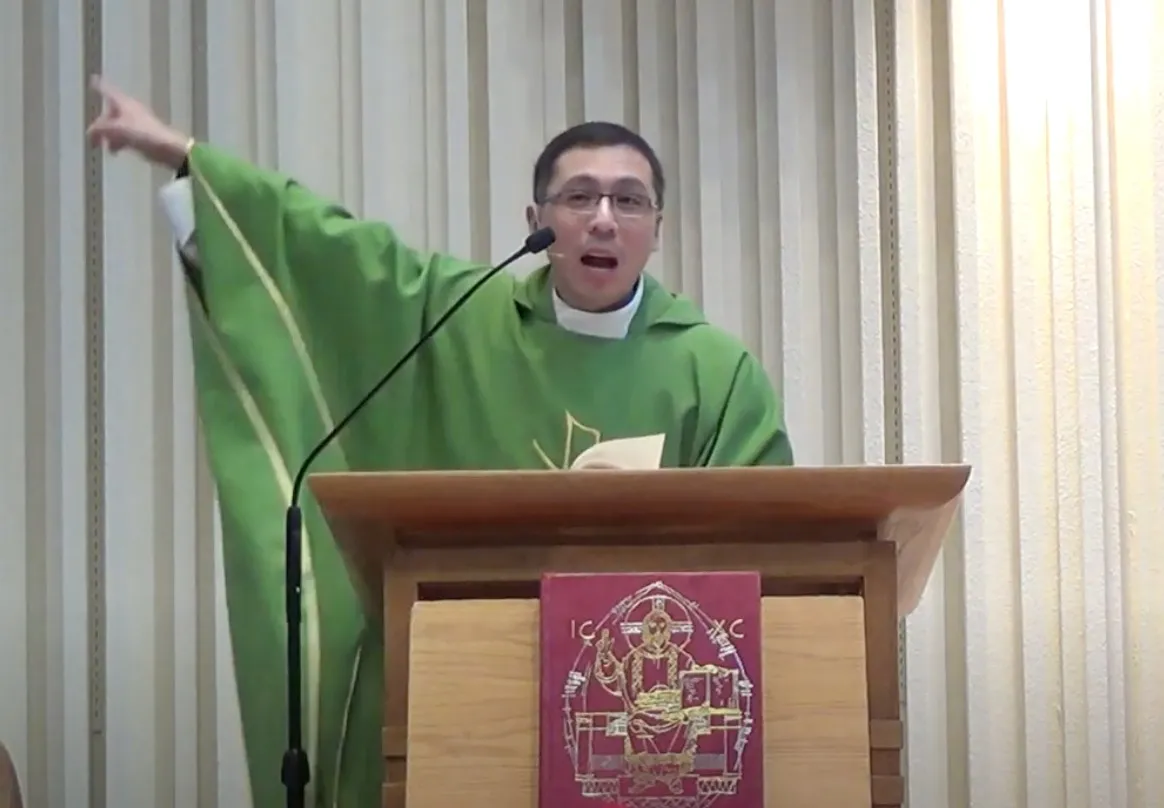
Father Emanuel Torres-Fuentes.
“Following the directive of Cardinal Cupich, we want to remind everyone that the prayer to Saint Michael is not to be said publicly following Mass,” says Torres-Fuentes in the video. This devotional prayer may be recited privately while being respectful of others in the church. Okay?”
“And also, you realize that I like to say Hail Mary at the end of the Eucharist. But now I was told to sing instead of the Hail Mary,” he said.
“What is the thing?” said Torres-Fuentes, who was ordained in 2018. “As a priest, I have to obey. And by obey I should [inaudible-26:54] at peace. And my heart is at peace. Okay?”
“I was reflecting on this. Now, I say okay. That’s okay. If Cardinal Cupich says this, I have to do it. Alright? But at peace. Okay? Thank you,” he said.
On Saturday afternoon, Trout offered an explanation for Torres-Fuentes’s announcement.
The statement said: “The faithful are always welcome to gather in Church for personal prayer as individual or as a group. At the same time, in accord with sound liturgical practice and in keeping with archdiocesan norms, which I personally confirmed with the Cardinal, the recitation of prayers must never interfere with, interrupt or distract from the public liturgy of the Church.”
Trout continued: “Nor can it ever become an imposition on the rest of the faithful in the Church who have a right to remain at the end of Mass to pray privately as they wish. It is also important that such prayers must always foster the unity of the Church, which is guaranteed by the Successor of Peter, for whom we never fail to show our deepest respect and devoted support as our Holy Father.”
The statement concludes by stating that Torres-Fuentes “wishes to state that he misspoke at a recent Mass when he falsely attributed statements to Cardinal Cupich. For this reason the video of that Mass has been removed to avoid any confusion.”
CNA asked Torres-Fuentes in an email who gave him the directive to cease the Prayer to St. Michael and the Hail Mary after Mass, but received no response.
Since the video of Torres-Fuentes’s statement went viral, CNA spoke to parishioners who described the circumstances.
Dan Love, a parishioner who attends daily Mass at St. Joseph’s told CNA in a phone call on Saturday that recently several parishioners began to recite the Prayer to Saint Michael after Mass publicly. He told CNA that because several of the parishioners were reciting it publicly, the rest of the attendees joined in.
“I think some parishioners just started it,” said Love, who is also a member of the local Knights of Columbus (KofC). “I guess the question is what are they praying for protection from?”
Consistently after daily Mass—which are livestreamed on Facebook—Torres-Fuentes leads the congregation in the Hail Mary prayer. The livestreams do not show the associate pastor leading the congregation or participating in the Prayer to Saint Michael.
“We’re all Catholic and we’re all called by Christ and if you feel that you need to pray for something, pray for something,” Love said. “I’m just hoping it’s praying for the healing and all the other issues we have in the world, such as the war in Afghanistan and such as the pandemic.”
Love mentioned a member of his KofC council who is in South Africa being “rampaged by the pandemic.”
“They’re fighting over food because there’s no food and people don’t have any money,” Love said. “So we’re trying to help him financially. So there’s more important calls for us as Catholics around the world than it is worried about this three or four people who can’t say the St. Michael prayer after Mass. That’s my opinion.”
Love told CNA he did not know the reasoning behind stopping the Hail Mary after Mass.
A parish secretary on Friday told CNA that Torres-Fuentes had a meeting with Cupich. Love told CNA the meeting was a luncheon with other priests and was planned weeks in advance. He mentioned that the purpose was not for Torres-Fuentes to dialogue with Cupich about the prayer announcement.
After contacting other priests in the diocese, CNA found that there was no directive sent to all parishes in the diocese referring to the recitation of the Prayer to Saint Michael or the Hail Mary following Mass.
The diocese did not respond to requests from CNA for comment.
Recitation of the Prayer to St. Michael at the conclusion of Mass was introduced in 1886 by Pope Leo XIII. As part of the liturgical reform at the Second Vatican Council, the Prayer to Saint Michael was removed.
In recent years, several parishes have reintroduced the practice.
If you value the news and views Catholic World Report provides, please consider donating to support our efforts. Your contribution will help us continue to make CWR available to all readers worldwide for free, without a subscription. Thank you for your generosity!
Click here for more information on donating to CWR. Click here to sign up for our newsletter.
A defining theme of Pope Francis’ papacy has been his urging of humanity to better care for the natural environment, which he has done most prominently in his landmark 2015 encyclical Laudato Si’ and numerous subsequent writings and speeches.
The pope’s emphasis on this topic — especially his foray into climate science via his recent encyclical Laudate Deum — has variously drawn both praise and consternation from Catholics in the United States, about half of whom do not share Pope Francis’ views on climate change, according to surveys.
In Laudate Deum, which was released in October as a continuation to Laudato Si’, Francis wrote that the effects of climate change “are here and increasingly evident,” warning of “immensely grave consequences for everyone” if drastic efforts are not made to reduce emissions. In the face of this, the Holy Father criticized those who “have chosen to deride [the] facts” about climate science, stating bluntly that it is “no longer possible to doubt the human — ‘anthropic’ — origin of climate change.”
The pope in the encyclical laid out his belief that there must be a “necessary transition towards clean energy sources, such as wind and solar energy, and the abandonment of fossil fuels.” This follows a call from Pope Francis in 2021 to the global community calling for the world to “achieve net zero carbon emissions as soon as possible.”
He further lamented what he called “certain dismissive and scarcely reasonable opinions [on climate change] that I encounter, even within the Catholic Church.”
In light of the new encyclical — which extensively cites the U.N.’s Intergovernmental Panel on Climate Change (IPCC) — Pope Francis was invited to speak at this week’s United Nations Climate Change Conference, known as COP28. Though the 86-year-old pope was forced to cancel his trip due to health issues, the Vatican has indicated that he aims to participate in COP28 this weekend in some fashion. It announced today that Vatican Secretary of State Cardinal Pietro Parolin will represent the pope at the conference.
While various Catholic groups have welcomed the pope’s latest encyclical, some Catholics have reacted with persistent doubts, questioning whether the pope’s policy prescriptions would actually produce the desired effects.
How do Americans feel about climate change?
According to a major survey conducted by Yale University, 72% of Americans believed in 2021 — the latest available data year — that “global warming is happening,” and 57% believe that global warming is caused by human activity.
More recent polling from the Pew Research Center, conducted in June, similarly suggests that two-thirds of U.S. adults overall say the country should prioritize developing renewable energy sources, such as wind and solar, over the expansion of the production of oil, coal, and natural gas. That same survey found that just 3 in 10 adults (31%) say the U.S. should completely phase out oil, coal, and natural gas. The Yale study found that 77% of U.S. adults support at least the funding of research into renewable energy sources.
Broken down by party affiliation, Pew found that a large majority of Democratic and Democratic-leaning independents — 90% — favor alternative energy sources, while just under half, 42%, of Republicans and Republican-leaning adults think the same. Within the Republican cohort, however, 67% of Republicans under age 30 prioritize the development of alternative energy sources, compared with the 75% of Republicans ages 65 and older who prioritize the expansion of oil, coal, and natural gas.
In terms of the expansion of alternative energy sources, two-thirds of Americans think the federal government should encourage domestic production of wind and solar power, Pew reported. Just 7% say the government should discourage this, while 26% think it should neither encourage nor discourage it.
How do America’s Catholics feel about climate change?
Surveys suggest that Catholics in the United States are slightly more likely than the U.S. population as a whole to be skeptical of climate change, despite the pope’s emphatic words in 2015 and since.
A separate Pew study suggests that 44% of U.S. Catholics say the Earth is warming mostly due to human activity, a view in line with Pope Francis’ stance. About 3 in 10 (29%) said the Earth is warming mostly due to natural patterns, while 13% said they believe there is no solid evidence the planet is getting warmer.
According to the same study, 71% of Hispanic Catholics see climate change as an extremely or very serious problem, compared with 49% of white, non-Hispanic Catholics. (There were not enough Black or Asian Catholics in the 2022 survey to analyze separately, Pew said.)
One 2015 study from Yale did suggest that soon after Laudato Si’ was released, U.S. Catholics were overall more likely to believe in climate change than before. That same study found no change, however, in the number of Americans overall who believe human activity is causing global warming.
Pope Francis’ climate priorities
Beyond his groundbreaking writings, Pope Francis has taken many actions during his pontificate to make his own — admittedly small — country, Vatican City, more sustainable, including the recent announcement of a large order of electric vehicles, construction of its own network of charging stations, a reforestation program, and the continued importation of energy coming exclusively from renewable sources.
Francis has often lamented what he sees as a tepid response from developed countries in implementing measures to curb climate change. In Laudate Deum, he urged that new multinational agreements on climate change — speaking in this case specifically about the COP28 conference — be “drastic, intense, and count on the commitment of all,” stating that “a broad change in the irresponsible lifestyle connected with the Western model would have a significant long-term impact.”
The pope lamented what he sees as the fact that when new projects related to green energy are proposed, the potential for economic growth, employment, and human promotion are thought of first rather than moral considerations such as the effects on the world’s poorest.
“It is often heard also that efforts to mitigate climate change by reducing the use of fossil fuels and developing cleaner energy sources will lead to a reduction in the number of jobs,” the pope noted.
“What is happening is that millions of people are losing their jobs due to different effects of climate change: rising sea levels, droughts, and other phenomena affecting the planet have left many people adrift. Conversely, the transition to renewable forms of energy, properly managed, as well as efforts to adapt to the damage caused by climate change, are capable of generating countless jobs in different sectors.”
‘Leave God’s creation better than we found it’
Dr. Kevin Roberts, president of the Washington, D.C.-based Heritage Foundation think tank, told CNA that he has noticed a theme of frustration and confusion among many Catholics regarding the Holy Father’s emphasis on climate change.
A self-described outdoorsman and former president of Wyoming Catholic College, Roberts spoke highly to CNA of certain aspects of Laudato Si’, particularly the pope’s insights into what he called “human ecology,” which refers to the acceptance of each person’s human body as a vital part of “accepting the entire world as a gift from the Father and our common home.”
Dr. Kevin Roberts, president of the Heritage Foundation. Courtesy of Heritage Foundation.
“I like to think [Pope Francis] personally wrote that, because I could see him saying that,” Roberts said of the passage, which appears in paragraph 155 of the encyclical. Roberts said he even makes a point to meditate on that “beautiful and moving” passage during a retreat that he does annually.
That portion of Laudato Si’ notwithstanding, Roberts said he strongly believes that it detracts from other important issues, such as direct ministry to the poor, when Pope Francis elevates care for God’s natural creation as “seemingly more important than other issues to us as Catholics.” He also said he disagrees with Pope Francis’ policy prescriptions, such as a complete phasing out of fossil fuels, contained in Laudate Deum.
“We of course want to pray for him. We’re open to the teaching that he is providing. But we also have to remember as Catholics that sometimes popes are wrong. And on this issue, it is a prudential matter. It is not a matter of morality, particularly when he’s getting into the scientific policy recommendations,” Roberts said.
Roberts said the Heritage Foundation’s research and advocacy has focused not on high-level, multinational agreements and conferences to tackle the issues posed by climate change but rather on smaller-scale, more community-based efforts. He said this policy position is, in part, due to the historical deference such multinational conglomerates of nations have given to China, the world’s largest emitter of greenhouse gases overall.
He said agreements within the U.S. itself, with businesses and all levels of government working together, have produced the best results so far when it comes to improving the environment. He also pointed to examples of constructive action that don’t involve billions of dollars, such as families making the choice to spend more time outdoors or engaging in local activities that contribute to environmental conservation and community life, such as anti-litter campaigns and community gardening. The overarching goal, he said, should be to “leave God’s creation better than we found it.”
Roberts — who said he personally believes humans likely have “very little effect” on the climate — said he was discouraged to read other portions of Laudato Si’, as well as Laudate Deum, that to him read as though they had come “straight out of the U.N.” Despite his criticisms, Roberts urged his fellow Catholics to continue to pray for the Holy Father and to listen to the pope’s moral insights.
“I just think that the proposed solutions are actually more anti-human and worse than the purported effects of climate change,” he added.
‘A far more complex issue’
Greg Sindelar, a Catholic who serves as CEO of the Texas Public Policy Foundation (TPPF), a conservative think tank that studies the energy industry, similarly expressed concerns to CNA about the potential impact of certain climate change mitigation policies on human flourishing.
Like Roberts, Sindelar spoke highly of certain aspects of the pope’s message while expressing reservations about some of the U.N.-esque solutions proposed in Laudate Deum.
“I think the pope is right about our duty as Catholics to be stewards and to care for the environment. But I think what we have to understand — what we have to balance this with — is that it cannot come at the expense of depriving people of affordable and reliable energy,” Sindelar said in an interview with CNA.
“There’s ways to be environmentally friendly without sacrificing the access that we all need to reliable and affordable energy.”
Greg Sindelar is CEO of the Texas Public Policy Foundation, a think tank in America’s leading energy-producing state. Courtesy of Texas Public Policy Foundation
Sindelar said TPPF primarily promotes cheap, reliable access to energy as a means of promoting human flourishing. The free-market-focused group is skeptical of top-down governmental intervention, both in the form of regulation and incentives or disincentives in certain areas of the energy sector.
When asked what he thinks his fellow Catholics largely think about the issue, Sindelar said many of the Catholics he hears from express the view that government policies and interventions rarely produce effective solutions and could potentially hinder access to energy for those in need.
“I think it’s a far more complex issue than just saying we need to cut emissions, and we need to transfer away from fossil fuels, and all these other things. What we need to do is figure out and ensure ways that we are providing affordable and reliable electricity to all citizens of the world,” he reiterated.
“When the pope speaks, when the Vatican speaks, it carries a lot of weight with Catholics around the world, [and] not just with Catholics … and I totally agree with him that we need to be thinking about the most marginalized and the poorest amongst us,” Sindelar continued.
“[But] by going down these policy prescription paths that he’s recommending, we’re actually going to reduce their ability to have access to that,” he asserted.
Sindelar, while disagreeing with Pope Francis’ call for an “abandonment of fossil fuels,” said he appreciates the fact that Pope Francis has spoken out about the issue of care for creation and has initiated so much public discussion.
“I think there is room for differing views and opinions on the right ways to do that,” he said.
Effective mitigation efforts
Susan Varlamoff, a retired biologist and parishioner at St. John Neumann Catholic Church in the Atlanta area, is among those Catholics who are committed to Pope Francis’ call to care for creation and to mitigate the effects of climate change. To that end, Varlamoff in 2016 created a peer-reviewed action plan for the Archdiocese of Atlanta to help Catholics put the principles contained in Laudato Si’ into action, mainly through smaller, more personal actions that people can take to reduce their energy usage.
Retired biologist Susan Varlamoff. Photo courtesy of Susan Varlamoff
The Atlanta Archdiocese’s efforts have since garnered recognition and praise, Varlamoff said, with at least 35 archdioceses now involved in an inter-diocesan network formed to exchange sustainability ideas based on the latest version of the plan from Atlanta.
“It’s fascinating to see what everybody is doing, and it’s basically based on their talents and imaginations,” Varlamoff said, noting that a large number of young people have gotten involved with their efforts.
As a scientist, Varlamoff told CNA it is clear to her that Pope Francis knows what he’s talking about when he lays out the dangers posed by inaction in the face of climate change.
“He understands the science, and he’s deeply concerned … he’s got remarkable influence as a moral leader,” she said.
“Part of what our religion asks us to do is to care for one another. We have to care for creation if we’re going to care for one another, because the earth is our natural resource system, our life support, and we cannot care for one another if we don’t have that life support.”
Responding to criticisms about the financial costs associated with certain green initiatives, Varlamoff noted that small-scale sustainable actions can actually save money. She offered the example of parishes in the Atlanta area that have drastically reduced their electric bills by installing solar panels.
“[But,] it’s not just about saving money. It’s also about reducing fossil fuels and greenhouse gas emissions, and protecting the natural resources for future generations,” she said.
Moreover, Varlamoff said, the moral imperative to improve the natural environment for future generations is worth the investment. “When [Catholics] give money, for example, for a social justice issue like Walking with Moms in Need or special needs, the payback is improving lives. We’re improving the environment here,” she emphasized.
Washington D.C., Mar 9, 2017 / 04:02 pm (CNA/EWTN News).- It sounds like something out of a sci-fi movie – being able to “upload” our minds to computers to live on after we die, to freeze our bodies only to bring them back in the future, or to pop pills to enhance our mood and intelligence.
While these may seem like impossible notions, these are the kinds of things the transhumanism and posthumanism movements are hoping for and working toward.
However, as with most technological advancements, these proposals have bioethicists and theologians questioning: just because we can, does that mean we should?
Transhumanism is a loosely-defined cultural, intellectual and technical movement that describes itself as seeking to “to overcome fundamental human limitations” including death, aging, and natural physical, mental and psychological limitations, says humanity+, a transhumanist online community.
The movement overlaps greatly with posthumanism, which posits that a new, biologically superior race is on the horizon, and could replace the human race as we know it. Posthumanists support technologies such as cryogenic freezing, mood-and-intelligence-enhancing drugs, genetic engineering, nanotechnology, bionics and “uploading” a mind to an artificial intelligence.
These movements stem from the idea that human limitations are just “technical problems” that need to be overcome, said history professor Yuval Noah Harari in a 2015 interview in “Edge,” a non-profit website devoted to the advancement of technology.
“Once you really solve a problem like direct brain-computer interface … when brains and computers can interact directly, to take just one example, that’s it, that’s the end of history, that’s the end of biology as we know it,” he said. “Nobody has a clue what will happen once you solve this.”
But is human nature a problem to be solved? Will treading into this territory completely change the way man relates to God, to their own bodies, and to one another? These are the questions many bioethicists are grappling with as they consider the morality of such technologies.
For Catholics, escaping suffering and trials by escaping human nature itself is a morally unacceptable option, according to Fr. Tadeusz Pacholczyk, Ph.D., Director of Education for the National Catholic Bioethics Center.
“Catholics cannot accept a vision of man which presupposes an outright ‘unacceptability’ of his basic human nature, nor a vision that labors to replace it with an alternate bodily structure that is engineered to be ‘post-human,’” Fr. Pacholczyk told CNA.
Instead, the “integral vision of man” accepts that man is incarnate – that humans have a body –and that “we are meant to embrace and grow through the limitations of our human nature,” he said.
“Even if our nature were to be radically re-engineered and modified,” he elaborated, “our innermost self would retain fundamental shards of incompleteness.”
The human experience is a struggle between a longing for the infinite, and learning to accept and embrace human’s finite nature, Fr. Pacholczyk explained. This longing would still exist even if technology were to significantly advance man’s material reality, because the longing for the infinite transcends the material world, he added.
Christ’s life provides the road map to transcendence – rather than transhumanism – for man’s life, “achieved through repentance, discipleship, self-denial, committed love, and generous self-giving,” said Fr. Pacholczyk. The infinite that man longs for “is effected from above through grace, rather than through the mere machinations of human cleverness or willfulness.”
Only by accepting their nature can humans re-orient themselves to “the only authentic source of redemption compatible with his essence,” which is Jesus, he added.
Peter Lawler, a bioethicist and government professor at Berry College, said while he did not think transhumanism is possible, the movement’s ideology alone can impact society.
The mindset of detaching humanity from biology contributes to a “paranoia about existence” which sees the natural world as the enemy of man, and views the body as a mere machine rather than as an integral part of a person, Lawler said.
“We’re living longer than ever,” he said. Improvements in healthcare, life expectancy and other technologies have changed the way people think about many things such as sexual morality, desired family size, and the integration of elderly people into society.
Charles Rubin, a professor of political science at Dusquenes University and author on the transhumanist movement, also takes issue with the transhumanist or posthumanist ideology. The idea of “a superior version” of human beings implies that humans are poorly-designed “creatures of evolutionary chance,” Rubin said.
“They have the very ‘thin’ understanding of what it means to be human that is in many ways characteristic of our contemporary thin ideas about self-hood,” he said. The movement also makes the assumption that “material circumstances can solve all our problems.”
“Building as they do on a thin sense of self, they risk encouraging those tendencies of contemporary thought that treat human beings instrumentally or that otherwise diminish human dignity.”
But it’s not all necessarily bad.
Some technologies that improve and even extend human life can be beneficial, so long as they don’t violate morality, Lawler noted.
“The consistent pro-life position is that we are for life,” he said, referencing Pope Benedict XVI’s 2009 encyclical, “Caritas in Veritate” (Charity in Truth).
“Technology is highly attractive because it draws us out of our physical limitations and broadens our horizon,” the Pope wrote.
Still, he cautioned, technological advancements can never trump the good of the human person – they must always be done in an ethically responsible way.
“Human freedom is authentic only when it responds to the fascination of technology with decisions that are the fruit of moral responsibility,” Pope Benedict XVI wrote.
While extending life can be acceptable, the promises of transhumanism should be critiqued, Rubin said.
What should be combated, he continued, is those who “dogmatically assert the benefits of a longer life without having ever having asked seriously the question of what constitutes a good human life.”
This article was originally published on CNA April 9, 2015.
CNA Staff, Oct 18, 2024 / 15:45 pm (CNA).
Texas Attorney General Ken Paxton is suing a doctor for reportedly violating state law by prescribing transgender drugs to underage children.A law passed by the st… […]
38 Comments
Our pastor actually leads the faithful in praying St. Michael and memorare.
What’s going on with you Catholic media you – CATHOLIC WORLD REPORT – people that you show NO OUTRAGE at the damage this Cdl. Cup-sick has done to our beloved Church?. Why are you not shaming him for the heretic he is? When I asked this same question of one of our ‘better’ bishops his answer: ” You don’t understand Michael, they have all the power.” I told him (and Archbishop Chaput before him, of Saint John Vianney’s response:” Anyone who is tolerant of evil when there is cause for holy anger is an immoral man” You Catholic World Report media -types are acting immorally in your lack of HOLY ANGER. Are you not aware ( you E.W.T.N , you Relevant Radio folk and all of you in the Catholic main-stream media.) how faithful, informed, catholic’s everywhere are seething at your lack of action in this regard? Your good Father Fessio said years ago; ” When I die I want there to be blood on my sword.” Hear, Hear! ! But that won’t ever happen unless you take the sword out of it’s sheath. ” If the bugle sound isn’t clear then how can the troops know to prepare for battle? ” You can’t just leave it all to Michael Voris ( God bless him ) and Fr. James Altman, our hero .and the model priest of our times.
Father Zuhlsdorf has posted the original video and an update with a message from the Pastor, Father John Trout. The realist in me thinks that this might be more damage control for the diminutive Cardinal Archbishop since the Lightfoot debacle.
Seems like micromanagement to me. Why prohibit or discourage heartfelt prayers after Mass? It’s useless because it just alienates parishioners and reflects poorly on diocesan leadership.
Why doesn’t Cardinal Cupich lead the prayers himself, or make any effort to pray the rosary publicly with his parishioners at the Cathecral?
It certainly stands to reason that a lot of the current Catholic hierarchy wouldn’t much like parishioners praying to St. Michael. As for poor Mr. Love who wonders what those who recite this prayer are asking to be protected from, apparently he has never heard the prayer, because it is self-explanatory.
This article concerned me deeply. First, Mr. Love asked, “what are they praying for?” when reciting the prayer to St. Michael. When Pope Leo XIII directed this prayer at the end of Mass, it was because God had showed him a vision of a conversation God had with the devil asking for more time to gather souls. The devil is running out of time and he knows it. The Church is in a crisis and the world is in the worse state it has ever been. The devil is a real threat to the Church and to each individual. In addition, we as Catholics are encouraged to pray for global catastrophes and problems as a parish and as an individual. However, we all should have our own personal relationship with our Lord and Savior and should be encouraged to pray to Him for personal reasons at ant time…in church or at home. In addition, the Mass was over when the two prayers were being prayed, so why all the concern? After Mass is over there is the soft “hustle-bustle” of people leaving the church, talking, cleaning up pews, etc, and people still are able to have the mind-set for personal prayers. Also the Church has taught me my whole life to have a special devotion to Our Blessed Mother. Even Jesus thought highly enough of her to take time while He was dying on the cross for us, to give His mother to us for protection and source of multiple graces. She has been sent by God multiple times in apparitions to warn us that God is displeased about the state of mankind, while she has been giving us directions on how to change…prayer, penance, sacrifice, fasting, and saying the rosary. I personally feel that one Hail Mary prayer at the end of Mass to ask Our Lady’s help is pleasing to her Son, Jesus.
Parsing is the fallback of the disingenuous. It is grievously evident in the statements recorded in this report. It serves no purpose but to magnify the theological disorder current in our Church, a disorder magnified frequently by the Cardinal himself and by his confreres in the school of deconstructionism. This is exactly where the reputation of episcopal untrustworthiness is generated. A Catholicism which articulates “…what are they praying for protection from?” is in the deepest sense clueless and fraudulent. It is not only tragic but scandalous that we find ourselves in this condition.
You’re either willingly dismissing or are willfully ignorant of the fact that the diminutive Cardinal Archbishop of Chicago has a lengthy, well documented dossier of creating division, Jerry. Which is it?
This is just consistent with a lot of the nonsense during the “pandemic” if you don’t have your pass you can;t come to mass etc…
a little confusion at the end of a parish mass over supplication prayers is not the end of the world – the Bishop should not even comment on it – don’t we want priests who can think on their feet?
My parish in Alexandria VA began saying the prayer to Saint Michael after Mass during the time of the 2002 DC sniper. For several weeks during that time, I recall saying the prayer every time I was out in the open – putting gas in my car, walking a zigzag line into the grocery store, not letting my child out in public. The prayer to Saint Michael comforted me then and even though I no longer live in VA, I continue to recite the prayer almost every day.
The same rightist conservative CNA -and also CWR, making a mountain out of a molehill if it concerns Pope Francis and his loyal cardinals and bishops. If those pro-pre-Vatican II mass who criticize the Vatican II mass as celebrated without regard for the rubrics, they should applaud the Cardinal for he is simply upholding the liturgical rules. Prayers like these are not part of the liturgical celebration and can be recited only privately and after the mass itself. Damn if you do, damn if you don’t.
Charles Panata, I am one of those “rightest conservatives” who is fed up with the Vatican Church. They created a different religion that sickens me. Before, during, and after Mass, it’s a free for all for Modernists. Except for Trads. This new one, that of forbidding to pray a prayer considered pre-Vatican ll. It is asked what it is we are praying for deliverance from. We pray for the deliverance of the likes of Cardinal Cupich, and all those who are out to do away with the true Church. We have been coerced to follow and obey their heretical ways and accept the banal ways of the New Church. Doesn’t the Vatican ll prohibit this type of coercion? Yet that’s what has been done for 60 years. Didn’t you know that we are living in the days of the worse major problems in the Church right now? Do you imagine that we Traditionalists are stupid? Think again. We are supposed to follow Vatican ll when those giving us this order are the ones who reject the whole of Vatican ll and make up their own Council as they go along. One of the Major principles of the Council being violated against Trads is “Religious Freedom”.
Charles Pinata, As a Trad I proclaim according to Vatican ll, Religious Freedom! We are ordered to accept the whole of the Council.” What the Council said has now backfired on them.
I don’t understand what the Cardinal’s issue might be?? Both of these prayers are quite short and would not interfere with anyone’s wish to pray quietly once completed. Gabby parishioners might be the bigger issue following Mass. At my parish the Rosary society prays immediately following a weekday Mass. So here you won’t have any quiet for 25 minutes at least. My guess is someone with an “in” complained to the Cardinal. But I can’t imagine anything stranger than a Cardinal asking the faithful NOT to pray. Especially in this day and age when the country is falling apart. Maybe the Cardinal cannot think of things to pray for, but I sure can!!
…And do thou, O Prince of the Heavenly Host, by the power of God, thrust into hell Satan and all evil spirits who wander through the world for the ruin of souls
“Hatred of the traditional Holy Mass is inspired by the Devil who seeks our spiritual death”-Cardinal Robert Sarah
I would add the same applies to those seeking to ban traditional Catholic prayers and devotionals like the Rosary, Ave Maria and St. Michael prayer. Since these prayers (especially the last one) are designed to protect us from the Evil One, only those who are in service of the Evil One would be opposed to their continued use.
What an incendiary headline! I wonder what is inside the article!?
“The pastor of the church, Father John Trout, issued a statement saying this is not true.”
“CNA asked Torres-Fuentes in an email who gave him the directive to cease the Prayer to St. Michael and the Hail Mary after Mass, but received no response.”
“After contacting other priests in the diocese, CNA found that there was no directive sent to all parishes in the diocese referring to the recitation of the Prayer to Saint Michael or the Hail Mary following Mass.”
What a sham of a website you guys run, LOL! **Almost** makes me feel sorry for ol’ Blase. Can you excise the ‘report’ from your URL?
“The mass is complete in itself. It does not need additional prayers added to it.” This statement was made by the Bishop of Hamilton, New Zealand in the 1980’s when a similar controversy broke out in my parish there. He also stated people that if people wished, they could have a prayer service 15 minutes after the end of mass thus allowing those who wished to leave to leave and not “force” them to attend a prayer service they didn’t want to attend.
It is really not clear what this article is attempting to report. At this point there is no evidence the Cardinal did in fact do what is being claimed or alleged. The priest responsible for the initial claim will not respond to CWR … How about wait for his response or at least gather more facts on this incident before reporting? Rather than a litany of he said, she said …
“And when you pray, do not be like the hypocrites, for they love to pray standing in the synagogues and on the street corners to be seen by men. I tell you the truth, they have received their reward in full. But when you pray, go into your room, close the door and pray to your Father who is unseen. Then your Father, who sees what is done in secret, will reward you. And when you pray, do not keep on babbling like the pagans, for they think that they will be heard because of their many words. Do not be like them, for your Father knows what you need before you ask him.” Mt 6.5-8
So David, based on your remark you obviously reject the Ordinary Form with all of its accompanying vocal participation from the laity and prefer the Extraordinary Form where the laity is almost entirely silent for the entire Mass, correct?
Our pastor actually leads the faithful in praying St. Michael and memorare.
Ours, too, along with a prayer for St. Joseph to intercede for us.
What’s going on with you Catholic media you – CATHOLIC WORLD REPORT – people that you show NO OUTRAGE at the damage this Cdl. Cup-sick has done to our beloved Church?. Why are you not shaming him for the heretic he is? When I asked this same question of one of our ‘better’ bishops his answer: ” You don’t understand Michael, they have all the power.” I told him (and Archbishop Chaput before him, of Saint John Vianney’s response:” Anyone who is tolerant of evil when there is cause for holy anger is an immoral man” You Catholic World Report media -types are acting immorally in your lack of HOLY ANGER. Are you not aware ( you E.W.T.N , you Relevant Radio folk and all of you in the Catholic main-stream media.) how faithful, informed, catholic’s everywhere are seething at your lack of action in this regard? Your good Father Fessio said years ago; ” When I die I want there to be blood on my sword.” Hear, Hear! ! But that won’t ever happen unless you take the sword out of it’s sheath. ” If the bugle sound isn’t clear then how can the troops know to prepare for battle? ” You can’t just leave it all to Michael Voris ( God bless him ) and Fr. James Altman, our hero .and the model priest of our times.
Apparently you’re not familiar with CWR…
Blaise setting things a-blaze… Micro-management – – mitres 30 yrs behind…
Dominus flevit!
Father Zuhlsdorf has posted the original video and an update with a message from the Pastor, Father John Trout. The realist in me thinks that this might be more damage control for the diminutive Cardinal Archbishop since the Lightfoot debacle.
UPDATED – VIDEO: Priest announces he and people have been forbidden to say St. Michael Prayer and Hail Mary after Mass.
Seems like micromanagement to me. Why prohibit or discourage heartfelt prayers after Mass? It’s useless because it just alienates parishioners and reflects poorly on diocesan leadership.
Why doesn’t Cardinal Cupich lead the prayers himself, or make any effort to pray the rosary publicly with his parishioners at the Cathecral?
St. Paul teaches that Christians have “the mind of Christ.”
His Eminence Cupich has “the mind of McCarrick.”
It certainly stands to reason that a lot of the current Catholic hierarchy wouldn’t much like parishioners praying to St. Michael. As for poor Mr. Love who wonders what those who recite this prayer are asking to be protected from, apparently he has never heard the prayer, because it is self-explanatory.
That’s what I was thinking; also, EWTN does this after most masses – “protect against wickedness and snares of the devil.” etc..
(Sigh.)
Cupich’s approach to building unity is unbelievable. Absolutely comical.
It reminds me of the old satirical comment on corporate management…
“Notice to all employees: The beatings will continue until morale improves.”
This article concerned me deeply. First, Mr. Love asked, “what are they praying for?” when reciting the prayer to St. Michael. When Pope Leo XIII directed this prayer at the end of Mass, it was because God had showed him a vision of a conversation God had with the devil asking for more time to gather souls. The devil is running out of time and he knows it. The Church is in a crisis and the world is in the worse state it has ever been. The devil is a real threat to the Church and to each individual. In addition, we as Catholics are encouraged to pray for global catastrophes and problems as a parish and as an individual. However, we all should have our own personal relationship with our Lord and Savior and should be encouraged to pray to Him for personal reasons at ant time…in church or at home. In addition, the Mass was over when the two prayers were being prayed, so why all the concern? After Mass is over there is the soft “hustle-bustle” of people leaving the church, talking, cleaning up pews, etc, and people still are able to have the mind-set for personal prayers. Also the Church has taught me my whole life to have a special devotion to Our Blessed Mother. Even Jesus thought highly enough of her to take time while He was dying on the cross for us, to give His mother to us for protection and source of multiple graces. She has been sent by God multiple times in apparitions to warn us that God is displeased about the state of mankind, while she has been giving us directions on how to change…prayer, penance, sacrifice, fasting, and saying the rosary. I personally feel that one Hail Mary prayer at the end of Mass to ask Our Lady’s help is pleasing to her Son, Jesus.
Parsing is the fallback of the disingenuous. It is grievously evident in the statements recorded in this report. It serves no purpose but to magnify the theological disorder current in our Church, a disorder magnified frequently by the Cardinal himself and by his confreres in the school of deconstructionism. This is exactly where the reputation of episcopal untrustworthiness is generated. A Catholicism which articulates “…what are they praying for protection from?” is in the deepest sense clueless and fraudulent. It is not only tragic but scandalous that we find ourselves in this condition.
CWR – Nice job of creating more division., making a volcano out of a fly speck. I would expect this article from the Washington Post . Now you too?
You’re either willingly dismissing or are willfully ignorant of the fact that the diminutive Cardinal Archbishop of Chicago has a lengthy, well documented dossier of creating division, Jerry. Which is it?
Jerry –
I think that the point being made is that “His Eminence” is the divisive figure.
It’s a healthy thing to talk about Bishops who behave improperly.
The following, which Carl Olson wrote back in 2015, might prove to be edifying:
A Tale of Two Bishops
One Mad Mom weighs in as well:
Cardinal Sit-It-Out Cupich
This is just consistent with a lot of the nonsense during the “pandemic” if you don’t have your pass you can;t come to mass etc…
a little confusion at the end of a parish mass over supplication prayers is not the end of the world – the Bishop should not even comment on it – don’t we want priests who can think on their feet?
My parish in Alexandria VA began saying the prayer to Saint Michael after Mass during the time of the 2002 DC sniper. For several weeks during that time, I recall saying the prayer every time I was out in the open – putting gas in my car, walking a zigzag line into the grocery store, not letting my child out in public. The prayer to Saint Michael comforted me then and even though I no longer live in VA, I continue to recite the prayer almost every day.
Cupich. Enough said.
The same rightist conservative CNA -and also CWR, making a mountain out of a molehill if it concerns Pope Francis and his loyal cardinals and bishops. If those pro-pre-Vatican II mass who criticize the Vatican II mass as celebrated without regard for the rubrics, they should applaud the Cardinal for he is simply upholding the liturgical rules. Prayers like these are not part of the liturgical celebration and can be recited only privately and after the mass itself. Damn if you do, damn if you don’t.
Any idea what “Ite, missa est” means, Charles?
Charles Panata, I am one of those “rightest conservatives” who is fed up with the Vatican Church. They created a different religion that sickens me. Before, during, and after Mass, it’s a free for all for Modernists. Except for Trads. This new one, that of forbidding to pray a prayer considered pre-Vatican ll. It is asked what it is we are praying for deliverance from. We pray for the deliverance of the likes of Cardinal Cupich, and all those who are out to do away with the true Church. We have been coerced to follow and obey their heretical ways and accept the banal ways of the New Church. Doesn’t the Vatican ll prohibit this type of coercion? Yet that’s what has been done for 60 years. Didn’t you know that we are living in the days of the worse major problems in the Church right now? Do you imagine that we Traditionalists are stupid? Think again. We are supposed to follow Vatican ll when those giving us this order are the ones who reject the whole of Vatican ll and make up their own Council as they go along. One of the Major principles of the Council being violated against Trads is “Religious Freedom”.
Charles Pinata, As a Trad I proclaim according to Vatican ll, Religious Freedom! We are ordered to accept the whole of the Council.” What the Council said has now backfired on them.
Independent of whatever the facts are in this case, there is no such thing as a “rubric” that mandates Catholic anti-Catholic bigotry.
I don’t understand what the Cardinal’s issue might be?? Both of these prayers are quite short and would not interfere with anyone’s wish to pray quietly once completed. Gabby parishioners might be the bigger issue following Mass. At my parish the Rosary society prays immediately following a weekday Mass. So here you won’t have any quiet for 25 minutes at least. My guess is someone with an “in” complained to the Cardinal. But I can’t imagine anything stranger than a Cardinal asking the faithful NOT to pray. Especially in this day and age when the country is falling apart. Maybe the Cardinal cannot think of things to pray for, but I sure can!!
Cupich knows who his real boss is. Satan is not happy with the St. Michael Prayer and the Ave Maria.
…And do thou, O Prince of the Heavenly Host, by the power of God, thrust into hell Satan and all evil spirits who wander through the world for the ruin of souls
Anen.
“Hatred of the traditional Holy Mass is inspired by the Devil who seeks our spiritual death”-Cardinal Robert Sarah
I would add the same applies to those seeking to ban traditional Catholic prayers and devotionals like the Rosary, Ave Maria and St. Michael prayer. Since these prayers (especially the last one) are designed to protect us from the Evil One, only those who are in service of the Evil One would be opposed to their continued use.
What an incendiary headline! I wonder what is inside the article!?
“The pastor of the church, Father John Trout, issued a statement saying this is not true.”
“CNA asked Torres-Fuentes in an email who gave him the directive to cease the Prayer to St. Michael and the Hail Mary after Mass, but received no response.”
“After contacting other priests in the diocese, CNA found that there was no directive sent to all parishes in the diocese referring to the recitation of the Prayer to Saint Michael or the Hail Mary following Mass.”
What a sham of a website you guys run, LOL! **Almost** makes me feel sorry for ol’ Blase. Can you excise the ‘report’ from your URL?
Blase will gladly sell you the Brooklyn Bridge, Joseph and I’d wager that you’d eagerly write him a check.
“The mass is complete in itself. It does not need additional prayers added to it.” This statement was made by the Bishop of Hamilton, New Zealand in the 1980’s when a similar controversy broke out in my parish there. He also stated people that if people wished, they could have a prayer service 15 minutes after the end of mass thus allowing those who wished to leave to leave and not “force” them to attend a prayer service they didn’t want to attend.
It is really not clear what this article is attempting to report. At this point there is no evidence the Cardinal did in fact do what is being claimed or alleged. The priest responsible for the initial claim will not respond to CWR … How about wait for his response or at least gather more facts on this incident before reporting? Rather than a litany of he said, she said …
“The priest responsible for the initial claim will not respond to CWR.”
No, to Catholic News Agency. This is a news brief, produced by CNA, published by CWR.
“And when you pray, do not be like the hypocrites, for they love to pray standing in the synagogues and on the street corners to be seen by men. I tell you the truth, they have received their reward in full. But when you pray, go into your room, close the door and pray to your Father who is unseen. Then your Father, who sees what is done in secret, will reward you. And when you pray, do not keep on babbling like the pagans, for they think that they will be heard because of their many words. Do not be like them, for your Father knows what you need before you ask him.” Mt 6.5-8
So David, based on your remark you obviously reject the Ordinary Form with all of its accompanying vocal participation from the laity and prefer the Extraordinary Form where the laity is almost entirely silent for the entire Mass, correct?
Where two or more are gathered in My name…
