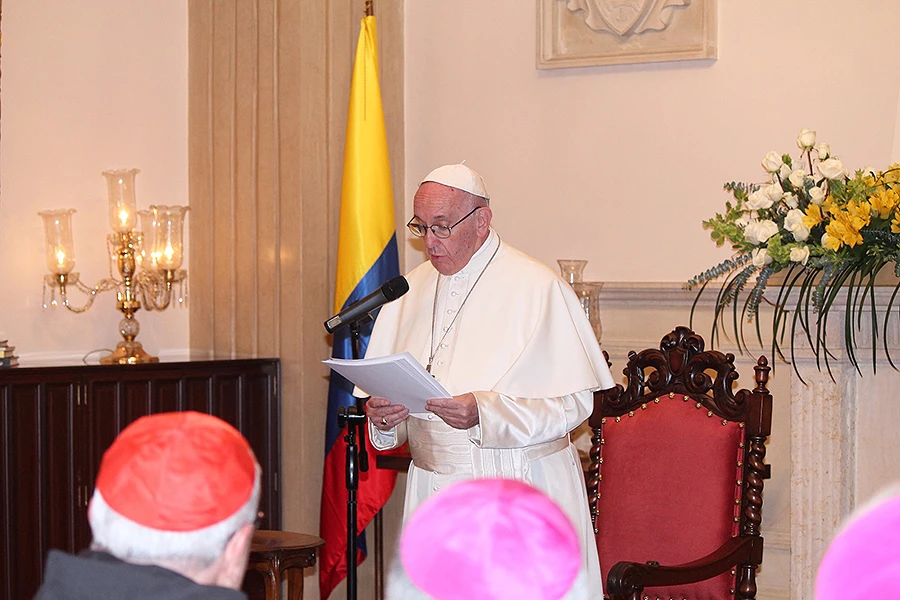
Bogotá, Colombia, Sep 7, 2017 / 02:55 pm (CNA/EWTN News).- The Catholic Church must avoid a sense of superiority and clericalism and instead teach forgiveness, reconciliation, and justice, Pope Francis said in forceful comments Thursday to a gathering of Latin American bishops.
“The Church is not present in Latin America with her suitcases in hand, ready, like so many others over time, to abandon it after having plundered it,” he said Sept. 7.
“Such people look with a sense of superiority and scorn on its mestizo face; they want to colonize its soul with the same failed and recycled visions of man and life; they repeat the same old recipes that kill the patient while lining the pockets of the doctors. They ignore the deepest concerns present in the heart of its people, the visions and the myths that give strength in spite of frequent disappointments and failures.”
He warned against those who “manipulate politics and betray hopes, leaving behind scorched land and a terrain ready for more of the same, albeit under a new guise.”
“Powerful figures and utopian dreams have promised magic solutions, instant answers, immediate effects,” he said.
The Pope spoke to the executive committee of the Latin American Episcopal Conference, known also by its Spanish acronym CELAM. He spoke at the apostolic nunciature in Bogota during his visit to Colombia.
“The Church, without human pretensions, respects the varied face of the continent, which she sees not as an impediment but rather a perennial source of wealth. She must continue working quietly to serve the true good of the men and women of Latin America,” Pope Francis said. “She must work tirelessly to build bridges, to tear down walls, to integrate diversity, to promote the culture of encounter and dialogue, to teach forgiveness and reconciliation, the sense of justice, the rejection of violence. No lasting construction in Latin America can do without this invisible, yet essential, foundation.”
“The Church appreciates like few others the deep-rooted shared wisdom that is the basis of every reality in Latin America,” the Pope continued. “She lives daily with that reserve of moral values on which the life of the continent rests.”
He advocated continued dialogue with this reality. The Church cannot lose contact with this moral foundation, this “vital humus which resides in the heart of our people.” In this soil, he said, “we see the subtle yet eloquent elements that make up its mestizo face – not merely indigenous, Hispanic, Portuguese or African, but mestizo: Latin American.”
He warned against the habitual traps this part of the world faces: a lack of focus, the squandering of the continent’s diversity, and “a constant process of disintegration.”
“To speak to this deepest soul, to speak to the most profound reality of Latin America, the Church must continually learn from Jesus. The Gospel tells us that Jesus spoke only in parables. He used images that engaged those who heard his word and made them characters in his divine stories. God’s holy and faithful people in Latin America understand no other way of speaking about him,” he said. “We are called to set out on mission not with cold and abstract concepts, but with images that keep multiplying and unfolding their power in human hearts, making them grain sown on good ground, yeast that makes the bread rise from the dough, and seed with the power to become a fruitful tree.”
The Pope warned of a “deficit of hope” in Latin America, but also pointed to Christians’ supernatural hope.
“Once you think hope is gone, it returns where you least expect it,” he said. “Our people have learned that no disappointment can crush it. It follows Christ in his meekness, even under the scourge. It knows how to rest and wait for the dawn, trusting in victory, because – deep down – it knows that it does not belong completely to this world.”
In Latin America, hope has a youthful face, he said. Some people point to young people’s alleged shortcomings and lack of motivation, and others see them as potential customers or seek to enlist them in violence and trafficking.
“Pay no attention to these caricatures of young people. Look them in the eye and seek in them the courage of hope,” Pope Francis said. “Look them in the eye and seek in them the courage of hope.”
“It is not true that they want to return to the past,” he claimed.
“It is our task us to present the young with lofty ideals and to encourage them to stake their lives on God, in imitation of the openness shown by Our Lady.”
Hope in Latin America also has a woman’s face, the Roman Pontiff reflected.
“From their lips we learned the faith, and with their milk we took on the features of our mestizo soul and our immunity to despair,” he explained. “I think of indigenous or black mothers, I think of mothers in our cities working three jobs, I think of elderly women who serve as catechists, and I think of consecrated woman and those who quietly go about doing so much good. Without women, the Church of this continent would lose its power to be continually reborn. It is women who keep patiently kindling the flame of faith.”
He stressed the grave obligation to understand, respect, appreciate, and promote women’s impact on society and the Church. He invoked the example of the women who accompanied Christ and did not abandon him at the foot of the cross.
“Please, do not let them be reduced to servants of our recalcitrant clericalism,” he said, declaring that women are on “the front lines” of the Church.
He stressed that hope must pass through the hearts, minds, and arms of the laity. He challenged a clericalism that treats the laity as children and impoverishes the identity of clerics.
Hope must also look at the world with “the eyes of the poor.”
“Hope is poor, like the grain of wheat that dies, yet has the power to disseminate God’s plans,” said the Pope.
Wealth frequently blinds us to “both the reality of the desert and the oases hidden therein,” and offers “textbook answers and repeats platitudes,” he said.
“It babbles about its own empty ideas and concerns, without even coming close to reality. I am certain that in this difficult and confused, yet provisional moment that we are experiencing, we will find the solutions to the complex problems we face in that Christian simplicity hidden to the powerful yet revealed to the lowly. The simplicity of straightforward faith in the risen Lord, the warmth of communion with him, fraternity, generosity, and the concrete solidarity that likewise wells up from our friendship with him.
The Pope stressed that God does not speak to us as if we were strangers or as if he were a solicitor delivering a personal summons, nor does he “lay down rules to be followed like certain functionaries of the sacred.”
Rather, “God speaks with the unmistakable voice of the Father to his children; he respects the mystery of man because he formed us with his own hands and gave us a meaningful purpose.”
“Our great challenge as a Church is to speak to men and women about this closeness of God, who considers us his sons and daughters, even when we reject his fatherhood,” the Pope told the bishops. “For him, we are always children to be encountered anew.”
The Gospel cannot be reduced to “a programme at the service of a trendy gnosticism, a project of social improvement, or the Church conceived as a comfortable bureaucracy, any more than she can be reduced to an organization run according to modern business models by a clerical caste.”
“The Church is the community of Jesus’ disciples. The Church is a Mystery and a People. Better yet, the Church the Mystery becomes present through God’s People,” he said.
Missionary discipleship is “a call from God for today’s busy and complicated world.” In this discipleship, the Christian is constantly setting out with Christ “in order to know how and where the Master lives.”
“Only a Church which is Bride, Mother and Servant, one that has renounced the claim to control what is not her own work but God’s, can remain with Jesus, even when the only place he can lay his head is the cross,” he said.
Closeness and encounter are the means that God uses, with the mystery of the Church being “the perennial place of this encounter.”
He told the bishops that the most essential and urgent activities are to pray and foster their relationship with the living Christ, where unity is always found: “How greatly we need to be alone with the Lord in order to encounter anew the heart of the Church’s mission … How greatly we need to be recollected, within and without! Our crowded schedules, the fragmentation of reality, the rapid pace of our lives: all these things might make us lose our focus and end up in a vacuum. Recovering unity is imperative.”
“If we do not we set out with [Christ] on our mission, we quickly become lost and risk confusing our vain needs with his cause. If our reason for setting out is not Jesus, it becomes easy to grow discouraged by the fatigue of the journey, or the resistance we meet, by constantly changing scenarios or by the weariness brought on by subtle but persistent ploys of the enemy,” he said.
Yielding to discouragement is not part of the Christian mission, and Christ “does not feed our fears.”
“The Gospel is always concrete, and never an exercise in sterile speculations. We know well the recurring temptation temptation to get lost in the byzantinism of the doctors of the law, to wonder how far we can go without losing control over our own demarcated territory or our petty portion of power.”
He stressed the importance of Christ’s encounter with persons, and how he draws near to them, talks to them, touches them, and brings them healing and salvation.
“His aim in constantly setting out is to lead the people he meets to the Father,” the Pope said. “We must never stop reflecting on this. The Church has to re-appropriate the verbs that the Word of God conjugates as he carries out his divine mission. To go forth to meet without keeping a safe distance; to take rest without being idle; to touch others without fear … We cannot let ourselves be paralyzed by our air-conditioned offices, our statistics and our strategies. We have to speak to men and women in their concrete situations.”
He summed up his message by saying the bishops must serve with passion: We need to have the passion of young lovers and of wise elders, a passion that turns ideas into viable utopias, a passion for the work of our hands, a passion that makes us constant pilgrims in our Churches … My brothers, please, I ask you for passion, the passion of evangelization.”
He commended the bishops, their local Churches, and all the people of Latin America and the Caribbean to Our Lady of Guadalupe and to Our Lady of Aparecida, the patron saint of Brazil.
“I do so, in the serene certainty that God who spoke to this continent with the mestizo and black features of his Mother, will surely make his kindly light shine in the lives of all.”
 […]
[…]



 By
By 



“ The archbishop said that “there is a philosophy of the simple daily life of the people that we have to take up again.””
This, like everything else the archbishop said on the subject, is utter and unmitigated drivel.
If he has such a poor view of the priesthood, he must be a lousy priest himself and is judging based on himself. Perhaps he should have the decency to resign and go run a parish.
Excellent comment, Lesie. I enjoy reading all your comments in the CWR. May God bless you and keep you and grant you his peace.
A man with no religious faith believes he can recreate the innate faculties of creation. When I argue with numbskull pro-aborts who call themselves “pro-choice,” I point out that they can not be “for” that which is already an innate quality of human existence. One can not be pro-choice anymore than they can be pro-eyeball or pro-earlobe. Similarly, this numbskull of a bishop can not figure out that he can not make people “more egalitarian.” We already are all equal before God, despite having different responsibilities and obligations in life. Only a non-believer can not figure out something so self-evident.
Another Commie Rat Hippie Bishop trying to “update” his flock to the seventies, whether they want to or not.
This so-called bishop is a servant of the spirit of anti-Christ, who falsely pursued ordination as priest and bishop, and lives now only to destroy the Holy Eucharist.
Men like this Bishop are counterfeit men, living double lives as parasites eating the Church alive from the inside. This Bishop and others like him should be stripped of office and laicized, opposed with fasting and prayer, and confronted as commanded by Jesus in Matthew 18, and if he refuses to admit his apostasy, he should be publicly excommunicated.
A Church that believes in the death and resurrection of Jesus would never allow such a man to speak like this from a Bishop’s chair.
He might just be a lunatic! What credibility would these “LayPastors” have and what would happen to the credibility of our Church?
The Church in Lima would be Protestant if that ever happened.
If you keep changing your country’s constitution, you’re going to run into problems.
I agree that priests have a tremendous amount of responsibility and need more priests in the parishes. But aren’t parishes shrinking? And isn’t the reason for celibacy so that bishops/priests can focus on feeding the sheep? Maybe if there were more bishops/priests being true pastors representing Christ instead of being focused on personal, political, or far left “equality” agendas, the parishes would flourish again – the Church would flourish again.
We saw what has happened to mainline Protestant churches when laity take over…they’re the churches with gay pride flags hanging next to their Christian flags…they’re the churches that support abortion and question the fundamental dogmas of the historic Church…they’re the churches that push far left ideologies. Of course I’m not sure our current bishops/priests (in general) are doing a better job at leading.
Should this man be an archbishop? I sounds like to me he wants layman to act in the person of priests which are “in persona Christi”. Am I readying this correctly.
His whole article is ridiculous and should NOT be said, especially by an archbishop!
Let us remember, Christ did NOT give the keys of heaven and the power to loose and bind on earth which will be loosed and bound in heaven, to a ““synodality”. He gave it to Peter and only Peter!
Next thing you know he will be having lay persons hearing confessions and saying Mass.
The word for this protestantism. The «poor» must be getting quite sick of being invoked for every initiative proposed by ageing prelates who remember Che Guevara.
That those who offer the Holy Sacrifice, indeed the Holy Sacrifice itself are secondary to this Great Religious Reset is evident.
Leslie I think you miss the broader issue here. The question is what is a priest and what is his main duties. A priest for sure is ordained for the Sacramental life of the Church. Many a spiritual Godly priest has been destroyed because they had no administrative skills. There are plenty of people in a parish who have expertise to worry about leaking roofs , heating and cooling problems etc. The bills that need to be paid and plenty of good capable people who can run the secretarial issues of a parish. Many parishes already have Business Managers to run the business side of a parish.
To me this upgrading the priesthood not lowering it.Just my two cents.
But…who’s gonna control the money? That seems to be paramount in the Church these days.
Or maybe “the broader point” is that a fill-in groundskeeper should not be called a “pastor.”
I agree with you, but many of us can already see where this will be heading. We are already at the mercy of our “pastoral assistant administrators” who just don’t have the parish’s best interests at heart. They wind up controlling everything to their own advantage and then we can never appeal to the “real” pastor, because he abdicates most of his decision-making powers to some ignorant wannabe priest.
Slight correction: “Wannabe priestess”
Haha! Yes, Dave, I stand corrected!
Great idea! NOT. Soon you’ll be able to name your diocesan church Congregationalist. Why stop at lay pastors on the parish level? Why not do away with bishops altogether and have laymen and women running the diocesan church? In fact, why not have a layman or woman be Pope since Francis has dispensed with his title as Vicar of Christ. I think it’s time to rename the Catholic Church and call it the Church of LCD…the Church of the Least Common Denominator.
Unfortunately. The Peruvian bishop has socialist ideas and is supportive of the new “president” (a communist linked to shinning path a el know terrorist group) whose election was questionable and surrounded by fraud.
Disconcerting is a woman presenting herself at the podium prior to Mass who announces that she’s the Leader, then after lengthy quoting of what’s already in the bulletin announces the Gospel passage, paraphrases it, then gives a brief but detailed homily. Asks for silence. Then begins reading the entrance psalm. Finally the priest enters as if a mere matter of consequence. Now it gets worse. At least in Lima. Either a priest is by ordination a pastor of the faithful or he’s not. By Christ’s transference of authority to the Apostles he alone has the authority to shepherd. Archbishop Castillo suffers the false magnanimity that priestly authority is pompous. That the Church instead of reaching toward the starry heavens should be flat and obsequious. Canon law allows bishops to entrust the pastoral care of a parish to a deacon, a person, or community of persons”. Added however is the admonition that the bishop “is to appoint some priest provided with the powers and faculties of a pastor to direct pastoral care.” This latter is too often ignored by bishops. Bishops seem more concerned with financial management and meeting more basic pastoral needs like manpower, rather than the canonical attachments that provide for better pastoral management. It downgrades the office of presbyter disheartening to many and likewise reduces laity appreciation of his role.
Fr. Peter Morello, I, for a time, was attending Mass at a parish where a nun read the Gospel at Mass and gave lengthy sermons. The parish priest was very Traditional. That really confused me. Later I learned this nun was known to be feisty and demanding. On a different but similar note, I attended a Tridentine Mass at San Juan Capistrano. I was upset that a Tridentine Mass would have female lectors. Standing for Communion only. The Old Mass and the New Mass were intermingled. I have experienced these incidents at just about every Novus Ordo Mass. These are the ones Francis should write a Motu Proprio similar to the one for the TLM. These cases cause confusion and division and are very anti-Vatican ll. The crux of the problem is that Bishops give blanket permission for such things to take place. Perhaps better, a Motu Proprio on the illicit activities of Bishops.
Much of this comes down to the same old problem. Church hierarchy and local priests afraid to assert their authority for fear of creating conflict. The church is NOT a secular institution and libbers and others of a socialist bent need to be told that loud and clear. It has never pretended to be secular, nor formally backing secular values.Recent pronouncements by the hierarchy on secular matters like immigration law add to this confusion, and has been a huge mistake.. That is not the job entrusted to them. Render to Caesar, remember? If the priest at the parish you reference was really traditional, he should NEVER have allowed a nun, no matter how feisty, to preach and read the gospel.Too bad if she didnt like it. It isnt true that having pews filled with people who are dismantling the church are better than fewer people in the pews. The hierarchy needs to grasp that and remain true to the mission, not true to secularism.
He may be an archbishop and a theology professor, but this guy knows nothing. He ought to be busted back down to a priest and be hidden away in a monastery where he can’t do any more damage with his ludicrous and anti-Catholic ideas. As Bugs Bunny used to say: “What a maroon!”
Our priests have been demoralized since Vatican ll. They no longer seem to have a ministry. It all has to be handed to the laity (woman only of course). Why would a young man who has a calling to the priesthood enter a Seminary for a lifetime of the laity being over them. I’ve seen this since the ’70s. It was done in the name of Vatican ll, yet Vatican ll never called for this demoralization of priests.
What in the world’s been going on in Latin America? It seems like things never moved past the 1970’s there. I remember getting frustrated with my Maryknoll Missionary magazine decades ago & cancelling because of the same sort of nonsense. There must be a special time warp for the Church down there. Goodness.
How come this man has not been made yet a cardinal by the Pope?
I know dozens of priests who would happily give up all their finance meetings, deferred maintenance walkthroughs, and administrative phonecalls.
I know at least one that said “if I ever lose my vocation it will be because of the endless meetings.”
I know most old folk here are fuming and blaming everything unhappy in their lives with socialism like usual, but it’s worth thinking about what exactly we ask priests to do as they manage these old, falling-apart buildings when there aren’t many of them to begin with.
Thank you for a little more perspective. While in Los Angeles I was preparing to be a Parish Life Leader, but I am now in Lima, Peru. There are communities in the Lima area, and more in the mountain regions, and “selva,” that do not have priests. I read the statement of the archbishop and I infer that he is referring to the programs similar to what Los Angeles has. I am not Liberal, progressive and much less leftist. I recommend that people making harsh statements about the archbishop read what he has stated or preached in Spanish. I do not listen to Spanish commentators interpret what is happening in the United States. I am trying to be open and forgiving of most the “news” networks in the U.S., while devouring everything stated by Dennis Prager, Mark Levin and Larry Elder.
I read the heading and went straight to the comments. Good decision.
This man was made archbishop in order to humiliate his predecessor, Cardinal Ciprani whom Francis pretended to befriend for years. ASAP Francis accepted Ciprani’s retirement letter at 75 and nominated Castillo immediately. Cardinal Ciprani had many run-ins with Castillo’s university. Hagan lo!
“Then there’s a priest who celebrates Mass for them once a week or twice on Sunday, whatever it may be; but we have to think of more egalitarian ways, closer to the people,” he said.
Please don’t resurrect this kind of thinking again. I lived this terrible scene in my parish. It’s a horrible experience and destructive. When this first started the newly ordained pastor suggested (1980) that the laity should do everything and the priest should only come and celebrate Mass. Now, forty year hence, we have three priests and they all take the same day off, while women do the Communion service and give a so called homily. Let me tell you—–this is certainly not what I would call being closer to the people—it’s just the opposite. I’m going back to my rocking chair and pray. I know God is still in the Blessed Sacrament behind locked church doors, however, my mind cannot be locked out.
Caritas in veritate when we comment. Otherwise, our Christian witness is destroyed. In Acts 6:1-15, we read that the apostles themselves chose and appointed helpers. They delegated the logistics of the charitable work of the Church to others so that they could continue to devote themselves to prayer and to the ministry of the word. As an exercise of and in affirmation of their leadership, our pastors and parish priests should be able to do the same, whether their helpers be deacons or laity.