
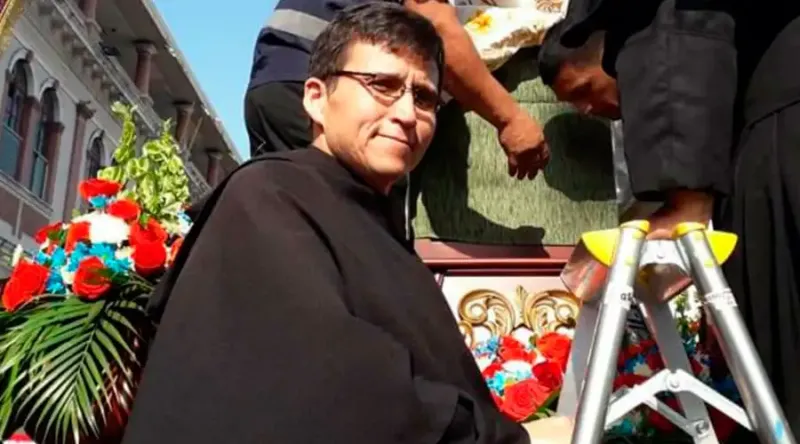
The Mayor’s Office of Guayaquil on Sunday awarded Fr. Wilson Malavé Parrales, director of the Lord of Good Hope Soup Kitchen for the Brother in Need, with the Urban Heroes Medal of Merit.
The July 25 award ceremony commemorated the 486th anniversary of the founding of the city.
The Archdiocese of Guayaquil said that the soup kitchen run by Fr. Malavé started nine years ago by feeding 80 homeless people every day in the downtown area. It currently offers meals to about 550 people Monday through Friday.
“The award is a tribute to the effort of all the brother volunteers who support the ‘Lord of Good Hope’ work of charity that has brought together all the prayer groups and benefactors in these difficult times that we are going through where there is a lot of migration, dysfunctional families, and increased drug or alcohol use,” said Fr. Malavé, who also serves as pastor of St. Augustine church.
The people served by this work of solidarity with food, clothing or a place to wash up are elderly, migrants, single mothers, street vendors, the disabled, and the homeless.
“People receive Christ through a pot that’s full of love, it’s not food but the love of those who donate the little or lot they may have for their neighbor,” the priest said.
If you value the news and views Catholic World Report provides, please consider donating to support our efforts. Your contribution will help us continue to make CWR available to all readers worldwide for free, without a subscription. Thank you for your generosity!
Click here for more information on donating to CWR. Click here to sign up for our newsletter.
Pope Francis boards his flight to Geneva June 21, 2018. / Daniel Ibáñez/CNA.
Rome Newsroom, Sep 28, 2022 / 04:57 am (CNA).
The Vatican confirmed Wednesday that Pope Francis will travel to the Kingdom of Bahrain, a Muslim island nation in the Pe… […]
Students participating in the CEDE workshop for St. John’s College High School gather for a group photo at the basilica at Catholic University of America in Washington, D.C., in November 2022. / Credit: Photo courtesy of CUA
CNA Staff, Apr 20, 2024 / 06:00 am (CNA).
When Luke Burgis moved to Silicon Valley to start a business, he never expected he would become a seminarian and then go on to launch entrepreneurship programs for Catholic students.
Burgis had attended NYU, worked on Wall Street, started several businesses in Silicon Valley, and moved to Las Vegas before deciding he wanted more meaning in his life. With the encouragement of a friend, he rekindled his Catholic faith. After five years in seminary, he ultimately discerned he would not become a priest, but he still found himself in need of deeper meaning in his work.
So he founded Catholic Entrepreneurship and Design Experience (CEDE, pronounced “seed”) in 2020 to help students across the country connect their working lives with their faith.
Four years later, CEDE is a thriving organization based at Catholic University of America (CUA) in Washington, D.C., with programs and educational materials across the world. Burgis is the entrepreneur-in-residence and assistant clinical professor of business at CUA. He has developed educational materials shared with Catholic schools and home-school communities in addition to teaching business classes at CUA.
“I didn’t understand how I could actually live out my values and be a Catholic in the business world that I was in, even after I’d had that reconversion experience,” Burgis said when asked what inspired him to found CEDE.
“But I knew that there was some gap that we had to close in Catholic education between the theoretical or the principles of Catholic social teaching and the way that it actually plays out on the ground, if you’re trying to start something,” he explained. “We launched CEDE to try to reintegrate these disciplines.”
This year, Burgis is launching a new project for CEDE — a summer entrepreneurship program for high school students. The 10-week virtual Startup Venture Challenge will teach high schoolers how to start a business.
“CEDE introduces students to basic principles of entrepreneurship within the context of Catholic social teaching and helps them understand that ultimately they are the entrepreneurs of their own lives, whether they ever start a business or not,” Burgis said.
“We’re trying to train young Catholics to think more like an entrepreneur, which means finding creative ways to solve problems or to see solutions where other people only see problems,” he said. “We think that that’s really important for all Catholics, period, and that if we had a more entrepreneurial Church, we would have a more adaptive and creative Church.”
Luke Burgis speaks at a CEDE Workshop in November 2022. Credit: Photo courtesy of CUA
But being a “Catholic entrepreneur” isn’t necessarily about starting a business, Burgis noted.
“Our goal here is not really to create more business owners,” he explained. “Our goal is to help more young Catholics in Catholic schools be equipped and confident to go out into the world, whatever their vocation is.”
Burgis wanted to connect what he learned about business with Catholic teaching.
“[At NYU] I just learned: ‘Here’s what profit is. Profit is good. Pursue it,’” he recalled. “Most of my classmates simply wanted to make as much money as they could.”
“When I left seminary, I realized that there was a real disintegration or gap between what I had learned at my Catholic schools … and what things actually look like in practice when you’re actually out there in the world trying to do things,” he explained.
CEDE’s model of education is about “experiential learning,” “creative problem-solving,” and independence and “differs” from the rules-based form of education many American students are accustomed to, Burgis said.
“That’s much of what being an entrepreneur feels like,” he said of the model. “You’re not given a roadmap, you’re not told what to do, you have to figure things out, and you have to make decisions and take responsibility for those decisions.”
Burgis said it will feel like “a challenge.”
“You’re being challenged, being given this mission,” he said. “We want to empower the students to accomplish that mission by working together and finding creative ways to solve problems on their own without being told how to do it. We actually want to make them a little uncomfortable.”
Students don’t need to have business ideas to join, as the first three weeks will be spent building up an idea. The full schedule involves a discernment stage, launching, testing, and then a resources and community stage.
“We want them to feel what it feels like to have a fire ignited within themselves, to exercise their own creativity, to take ownership of it, to take total responsibility, and to be proud of that, and to be able to serve others through their gifts and talents,” Burgis said.
The program runs from June 10 to Aug. 12 and is fully virtual and amenable to the students’ work schedules. The cost is $250, with scholarships available. Applications are open for teenagers ages 14–18.
Major Archbishop Sviatoslav Shevchuk, head of the Ukrainian Greek Catholic Church, with Archbishop Stanisław Gądecki, president of the Polish bishops’ conference. / episkopat.pl.
Kyiv, Ukraine, Jan 24, 2022 / 06:05 am (CNA).
Catholic bishops in… […]
Leave a Reply