More than 220,000 people left the Catholic Church in Germany in 2020
In a July 14 statement, Bishop Georg Bätzing, president of the German bishops’ conference, said that while the Church had made strenuous efforts throughout the coronavirus pandemic, it was nevertheless experiencing “a profound shock.”
The Catholic Cathedral of Limburg in Hesse, Germany./ Mylius via Wikimedia (GFDL 1.2).
Bonn, Germany, Jul 14, 2021 / 07:00 am
More than 220,000 people left Catholic Church in Germany in 2020, according to official figures released on Wednesday.
The statistics issued by the German bishops’ conference on July 14 showed that 221,390 people exited the Catholic Church last year.
The figure was almost 19% lower than that of 2019, when a record 272,771 people departed. But it was higher than the 2018 figure of 216,078, reported CNA Deutsch, CNA’s German-language news partner.
In a July 14 statement, Bishop Georg Bätzing, president of the German bishops’ conference, said that while the Church had made strenuous efforts throughout the coronavirus pandemic, it was nevertheless experiencing “a profound shock.”
He said: “This is also reflected in the statistics of people leaving the Church, which I find painful for our community. Many have lost confidence and want to send a signal by leaving the Church.”
“We take this very seriously and must face this situation openly and honestly and give answers to the questions that are addressed to us.”
“This includes, first and foremost, a thorough examination of the cases of sexual abuse. And this includes the question of power and the separation of powers in the Church. I very much hope that the Synodal Way can make its contribution to building new trust.”
The “Synodal Way” is a multi-year process bringing together bishops and lay people to discuss four main topics: the way power is exercised in the Church; sexual morality; the priesthood; and the role of women.
The German bishops initially said that the process would end with a series of “binding” votes — raising concerns at the Vatican that the resolutions might challenge the Church’s teaching and discipline.
The new statistics showed that there were 104,610 baptisms in 2020, compared to 159,043 in 2019.
There were 139,752 First Communions, significantly fewer than the 166,481 the year before.
There were also 75,387 confirmations, a notable decrease from 123,253 in 2019.
Just over 11,000 Catholic weddings took place in 2020, a major drop from the 38,537 recorded the year before.
But Catholic burials increased from 233,937 in 2019 to 236,546 in 2020.
If an individual is registered as a Catholic in Germany, 8-9% of their income tax goes to the Church. The only way they can stop paying the tax is to make an official declaration renouncing their membership. They are no longer allowed to receive the sacraments or a Catholic burial.
Only 5.9% of Germany’s Catholics attended Mass last year, compared to 9.1% in 2019.
The number of priests listed has decreased by 418 to 12,565. In 2019, there were 12,983 priests working in Germany.
The number of parishes is also decreasing. In 2018, there were 10,045 parishes. In 2019, there were 9,936. In 2020, there were 9,858, or 78 fewer than the year before.
The figures showed that there are 22,193,347 Catholics in Germany, 26.7% of the total population of 83 million. In 2019, the proportion was 27.2%
Only 1,578 people formally joined the Catholic Church in 2020, 1,390 of whom were Protestants. The number of people rejoining the Church after officially departing was 4,358, fewer than the 5,339 in 2019.
Bätzing, who succeeded Cardinal Reinhard Marx as president of the German bishops’ conference in March 2020, said: “Despite the depressing figures in these statistics, I would like to expressly thank all those who are committed and live their faith in church and society, especially those who work full-time in pastoral care: Priests, deacons, pastoral and parish assistants.”
“I would also like to emphasize this in view of the statistics: I am very grateful for those who put themselves at the service of the Church in these turbulent times. Even in small numbers, the new priests and pastoral workers will provide an indispensable mission in a constantly changing world.”
If you value the news and views Catholic World Report provides, please consider donating to support our efforts. Your contribution will help us continue to make CWR available to all readers worldwide for free, without a subscription. Thank you for your generosity!
Click here for more information on donating to CWR. Click here to sign up for our newsletter.
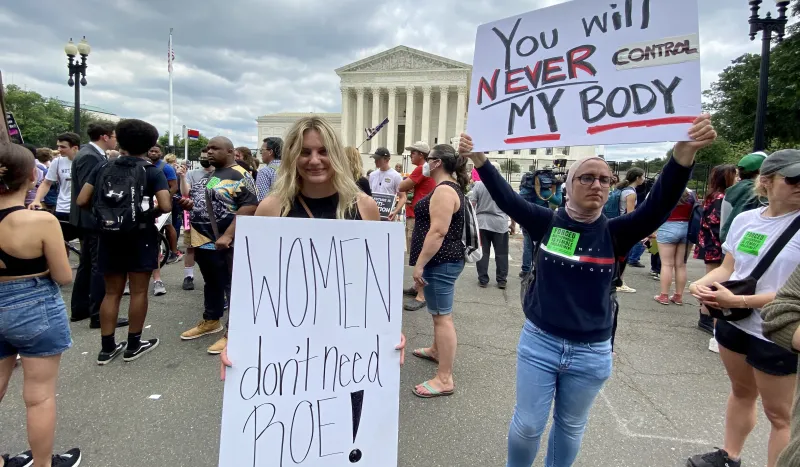
Anna Lulis from Moneta, Virginia, (left) who works for the pro-life group Students for Life of America, stands beside an abortion rights demonstrator outside the U.S. Supreme Court in Washington, D.C., on June 24, 2022, after the court’s decision in the Dobbs abortion case was announced. / Katie Yoder/CNA
Washington, D.C. Newsroom, Oct 5, 2022 / 13:31 pm (CNA).
U.S. Catholic voters are split on the Supreme Court’s decision to overturn Roe v. Wade, but a majority agrees that abortion should be restricted and that there should be at least some protections for the unborn child in the womb, according to a new EWTN News/RealClear Opinion Research poll.
The court’s June 24 ruling in the Mississippi abortion case Dobbs v. Jackson Women’s Health Organization upended 49 years of nationwide legalized abortion and freed states to regulate abortion as they see fit.
When asked whether they agreed or disagreed with Roe being overturned, 46.2% agreed, 47.8% disagreed, and 6% said they weren’t sure.
Catholic voters were similarly split on whether they are more or less likely to support a candidate who agrees with Roe’s dismantling: 42% said they were more likely, 41.9% said they were less likely, and 16.1% were unsure.
At the same time, the poll results point to apparent inconsistencies in Catholic voters’ positions on abortion.
While nearly half of Catholic voters in the poll said they disagreed with Roe being overturned, a large majority (86.5%) said they support some kind of limit on abortion, even though Roe and related abortion cases allowed only narrow regulation at the state level. The breakdown is as follows:
26.8% said abortion should be allowed only in cases of rape, incest, or to save the life of the mother;
19.8% said abortion should be allowed until 15 weeks when the baby can feel pain;
13.1% said that abortion should be allowed only during the first six months of pregnancy;
9.9% said that abortion should be allowed only until a heartbeat can be detected, and
9.1% said that abortion should be allowed only to save the life of the mother.
Of special note for Catholic pro-life leaders, only a small minority of Catholic voters — 7.8% — were aligned with the clear and consistent teaching of the Catholic Church that abortion should never be allowed.
On the other end of the spectrum of abortion views, 13.4% of Catholic voters said that abortion should be available to a woman at any time during her pregnancy.
The poll, conducted by the Trafalgar Group from Sept. 12–19, surveyed 1,581 Catholic voters and has a margin of error of 2.5%. The questionnaire was administered using a mix of six different methods, including phone calls, text messages, and email.
The poll’s results echo surveys of the general U.S. population on abortion. A Pew Research Center survey from March found that 19% of U.S. adults say abortion should be legal in all cases, while 8% said it should be illegal in all cases. More recent Gallup data from May found that 35% of U.S. adults say abortion should be legal under any circumstances while 13% said it should be illegal in all circumstances.
The Pew Research Center data also looked at Catholic adults. Thirteen percent said abortion should be legal in all cases, while 10% said it should be illegal in all cases.
A previous EWTN News/RealClear Opinion Research poll released in July found that 9% of Catholic likely voters said abortion should never be permitted and 18% said that abortion should be available at any time. The poll similarly showed that a majority of Catholic voters (82%) support some kind of restriction on abortion.
Confused about what Roe said?
The poll’s results came as little surprise to Catholic pro-life public policy experts such as Elizabeth R. Kirk.
“This study confirms a phenomenon we have known for some time, i.e., that there is an enormous disconnect between the scope of abortion practices permitted by the Roe regime and what abortion practices Americans actually support,” Kirk, director of the Center for Law and the Human Person at The Catholic University of America, told CNA.
Kirk, who also serves as a faculty fellow for the Institute for Human Ecology and research associate and lecturer at the Columbus School of Law, noted the finding that nearly 42% of Catholic voters said they are less likely to support a candidate who agrees with Roe being overturned.
“At first glance that suggests that many Catholic voters wanted to keep Roe in place,” she said. “Yet, the study also reveals that 86.5% of Catholic voters want some type of restriction on abortion access.”
Why the inconsistency? “Most people do not realize that Roe allowed states to permit unlimited abortion access throughout the entire pregnancy and made it difficult, or even impossible, to enact commonsense restrictions supported by the majority of Americans,” Kirk observed.
“Many people who ‘support Roe’ actually disagree, unknowingly, with what it permitted,” she added. “All Dobbs has done is return abortion policy to the legislative process so that the people may enact laws which reflect the public consensus.”
Mass-goers more strongly pro-life
The new poll, the second of three surveys of Catholic voters tied to the midterm elections on Nov. 8, shows that the opinions of Catholic voters on abortion and other issues vary depending on how often respondents attend Mass.
Only a small portion of those who attend Mass at least once a week said that abortion should be allowed at any time: 0% of those who attend Mass daily, 1% who attend more than once a week, and 8% of those who attend weekly support abortion without restrictions. In contrast, 57.5% of Catholic voters who attend Mass daily, 21.5% of those who attend more than once a week, and 15.6% of those who attend weekly say abortion should never be permitted.
In addition to respondents’ apparent confusion about what Roe stipulated, the poll suggests that many Catholic voters don’t fully understand what their Church teaches about abortion.
Less than one-third of Catholic voters who said they accept all Church teachings (31.1%) said that abortion should never be permitted, and 5% who profess to fully accept the Church’s teachings said abortion should be permitted at any time.
Overall, 32.8% of respondents reported attending Mass at least once a week, with another 30.7% attending once a year or less. Only 15% agreed that they accept all of the Church’s teachings and live their lives accordingly, with another 34.5% saying they generally accept most of the Church’s teachings and try to live accordingly.
Pew Research Center also looked at how Mass attendance factors into Catholics’ views on abortion. Among those who attend Mass at least once a week: 4% said abortion should be legal in all cases, and 24% said it should be illegal in all cases, Pew found.
Strong support for pregnancy centers
The poll asked Catholic voters about a variety of other topics including abortion limits, Holy Communion for pro-abortion politicians, conscience protections for health care workers, and pro-life pregnancy centers.
EWTN
Among the findings:
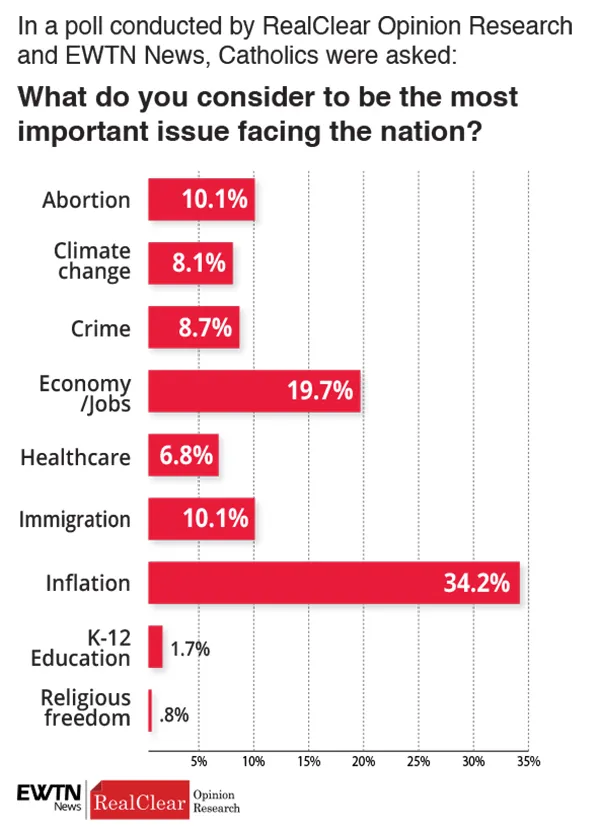
Catholic voters are prioritizing other issues above abortion. Only 10.1% of Catholic voters identified abortion as the most important issue facing the nation, falling behind inflation (34.2%) and the economy/jobs (19.7%) and tying with immigration. At the same time, a higher percentage of Catholic voters chose abortion than crime (8.7%), climate change (8.1% ), health care (6.8%), K–12 education (1.7%), or religious freedom (0.8%).
About half of Catholic voters (49.3%) disagreed that Catholic political leaders who support abortion publicly and promote policies that increase abortion access should refrain from taking Communion, while 36.7% said they should refrain.
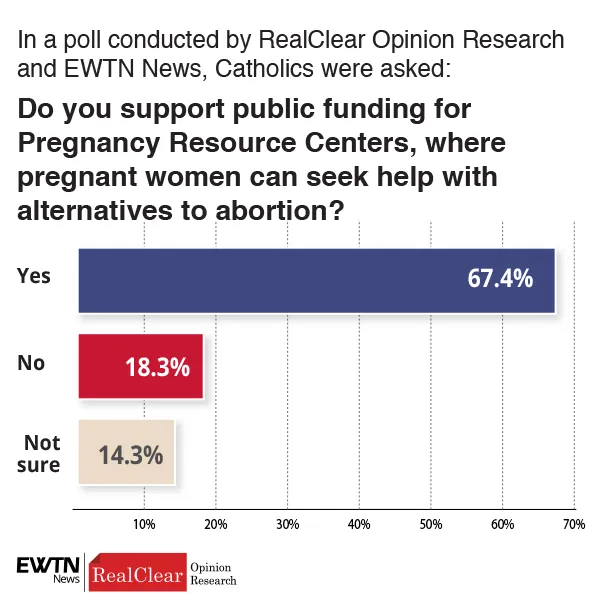
A majority (67.4%) of Catholic voters said they support public funding for pro-life pregnancy centers that offer pregnant women life-affirming alternatives to abortion, while 18.3% said they did not favor using tax dollars for this purpose.
A comparable majority (61.8%) said that political and church leaders should be speaking out against the recent attacks and acts of vandalism on pregnancy resource centers.
When asked about conscience protections for health care workers that would allow them to opt out of providing “services” such as abortion, a majority of Catholic voters (60.7%) said that health care workers should not be obligated to engage in procedures that they object to based on moral or religious grounds. Conversely, 25.3% said that health care workers should be obligated to engage in procedures that they object to based on moral or religious grounds.
Work to be done
What is the takeaway from the latest poll, where abortion is concerned?
“This polling shows that Catholics, like the overwhelming majority of Americans, support commonsense protections for women and the unborn,” Ashley McGuire, a senior fellow with The Catholic Association, told CNA.
“It also affirms other recent polling that found Americans by strong numbers support the work of pregnancy resource centers in providing women facing crisis pregnancies with a real choice and the chance to thrive as mothers despite difficult circumstances,” she noted.
EWTN
At the same time, McGuire added, “This new polling is also a reminder that more work needs to be done in catechizing Catholics on foundational Church teaching in support of vulnerable life in all stages — an effort that is continually undermined by Catholic politicians in the highest echelons of power who use their platforms to advocate for extreme abortion policies in direct violation of Church teaching.”
Nearly all of those surveyed (99.2%) said they plan to vote in the midterm elections on Nov. 8.
Pope Francis at the general audience in Paul VI Hall on March 2, 2022 / Vatican Media
Vatican City, Mar 27, 2022 / 10:36 am (CNA).
Pope Francis has again lamented the war in Ukraine and appealed for peace more than a month after Russia’s invasi… […]
23 Comments
Said Bishop Batzing: ” I very much hope that the Synodal Way can make its contribution to building new trust.”
Said his apparent confessor: “If banging your head against the wall causes a headache, then just bang harder and it might go away.”
A failed experiment, indeed, is the German church.
Nevertheless, the bishop of Rome actually encouraged Batzing to continue his efforts to move forward with this insanity of the German bishops.
Is the Vatican anti-Catholic?
A breakdown of religion in Germany pop approx 86 m reveals one favorable factor for Catholicism, which is the historical Catholic territories in the South and West remain largely Catholic. Whereas the East, what was Communist E Germany formally Prussia is predominantly non committal to any form of religion. Amazing to this reader on the destructive power of Marxism. Protestant Germany with the loss of mainly Lutheran Prussia is a N S swath between the Atheist? East and Catholic West. Insofar as traditional Catholic regions the loss of practice noted in this article trended at the 2000 year mark. Prior 2000 Catholicism grew post it plummets. German religious tax mandated by the Govt [although the churches are free to rescind the policy] is ancient pre Christian practice imposed by the tribal chiefs. It was retained through the centuries and adopted by several other European nations. Germans tolerated it when Catholicism surged presently with worldwide loss of faith not. Example, approx 66% German population claim Christianity only 10% claim certainty there is a God. That’s a remarkably distressing stat that may well be similar in most of Europe. Bishop Georg Bätzing seems delusional if he’s convinced himself the Synodal process of further liberalizing practice of traditional Catholicism will lure Germans back. Apparently he’s out of ideas except for this notion he and progressive intellectuals have of creating a more comfortable accommodating Church as the answer, when it was during the more traditional years of Catholicism that the Church increased. Germany is open for reconversion to a more dedicated practice that Catholicism can offer. Although Bätzings Synodality virtually insures that possibility will putatively belong to Islam. They’re sufficient German bishops and laity opposed with which the pontiff can reorganize and redirect German Catholicism.
Quote: “If an individual is registered as a Catholic in Germany, 8-9% of their income tax goes to the Church. The only way they can stop paying the tax is to make an official declaration renouncing their membership. They are no longer allowed to receive the sacraments or a Catholic burial.” I find this totally unacceptable and scandalous. What mentality is there in the German Church that allows this sort of system to continue?
A few years back, Pope Benedict conceded that while the church tax might have a logical rationale, the penalty of excommunication for not paying (branded by the hierarchy/shepherds as “apostasy”!) is “indefensible.”
And, as for the ascendancy of Islam in Germania (Fr. Morello’s correct point), the primary factor obstructing Muslim demands for a share of a church/mosque tax (like Catholics and Protestants) is probably the fact that the several immigrant Islamic sects are so congregational/divided that they cannot yet decide on the single or more federated mailing address for enjoying such status and largess.
And then there’s the historical/cultural problem…the traditional Muslim tax is not based on annual income like the church tax, but instead takes a cut of total property ownership each year (the zakat, historically and very generally 2.5 percent).
Ah, well, maybe the inclusive Synodal Path—arguably the ecclesial version of “open marriage”—can broaden its membership even further. And then, by sacred majority vote, mandate a “binding” decision governing this wider congeries of whatever. Quick, someone frame an action memo for Bishop Batzing’s blessing as already for gay unions!
Germany’s problem is that they have incompetent bishops.
They seem to think that the problem has to do with power, sexual morality, priesthood, and the role of women. These problems are ancillary. The problem is that the Church in Germany has abandoned Christ. They no longer know him, and so they flounder around grappling for answers.
We, the laity, have been waiting in vain for the Hierarchy to fix the problems in the Church. Let’s face it. They aren’t going to do it. They actually are heading from worse to total disaster. The laity must take up the defense of Christ’s Church by restoring the perennial Truth that Christ has taught through His Church for 2000 years. And by restoring Tradition preserved in the Church by God Himself and not by man. We must recognize that the pre-Vatican ll Church was God’s doing. Man has attempted to destroy all of pre-Vatican ll, but the Church is alive and well, just as Christ promised us, “The gates of hell shall not prevail against it.” Deo Gratias!
We’ve seen various religious orders trade the Gospel of Jesus Christ for leftism. They seem inevitably to die out in a generation or two, since somehow — mysteriously — young people who love the Lord above all things are not attracted to orders that don’t.
I wonder whether the same may be true of national churches, where believers who are committed to the Lord abandon a church whose leadership is not.
Just like America, the “signals” have been going on for decades, only the prelates don’t like these signals. By scheduling more meetings and promoting their own agenda they think the signals should change. This is willful blindness on the part of the uppers. Meanwhile the forlorn will retreat to their desert to pray and fast or they will wander away from their neglected home.
In common with Catholics in a number of other countries, there are three groups leaving the Catholic Church (or any other denomination). 1) Those who strongly disagree with Church teachings but are honest enough to leave instead of trying to overthrow from within. 2) Those who are fed up with the attacks on traditional beliefs and what they view as personal insults to their faith (this group feels that they are not leaving the Church, rather, the Church left them long ago). 3) Those who see the Church as filling no need or want in their lives.
The so-called synodal way addresses the concerns of none of these groups, but attempts to conform Church teachings to worldly standards. It is self-defeating, as it reinforces the very reasons people are leaving. Simply because dissenters are often louder than the orthodox and the lukewarm doesn’t mean they are more numerous or important, simply that they are louder. Catering to them is driving others away..
One might ask how many of those who left did so out of a rejection of Catholic belief and how many left because they perceive the Roman Catholic Church as rejecting its own perennial Magisterium. How many are saying “I didn’t leave the Church, the Church left me?” That would be a very difficult question to avoid in Germany where the episcopate is demonstrating a perverse behavior which exceeds the imagination. Indeed, we might begin to analyze the defections from the priesthood and religious life, the abandonment of the practice of the faith by the laity in the wake of the mid-century council in the same light.
Rose colored glasses serve no purpose but to buttress self-deceit.
“If an individual is registered as a Catholic in Germany, 8-9% of their income tax goes to the Church. The only way they can stop paying the tax is to make an official declaration renouncing their membership. They are no longer allowed to receive the sacraments or a Catholic burial.”
Who concocted this tax madness? The Church or the State? Certainly, it’s the Church who decides that you can’t receive the sacraments if you don’t pay the tax. This is an abomination — and I don’t use that word lightly.
I suggest the German Church drop, absolutely and completely this so-called “synodal Way” business and remember that Christ gave the keys of heaven to Peter and it’s he who can bind and loose on earth and in heaven, not “a multi-year process bringing together bishops and lay people to discuss four main topics: the way power is exercised in the Church; sexual morality; the priesthood; and the role of women”. It’s simple, Bishop Batzing, it’s simple! Germans are saying they don’t want this “synodal way” because they recognize what you are trying to do, and you will fail! Read the scriptures and pray for forgiveness! The Synodal Way is not the Vicar of Christ. Pope Francis is! Got it?
What was going to happen has happened. Bishops around the world have lost their faith or never had it. If they have no faith, how can they transmit what they themselves do not possess? It all happened at Vatican ll when the Modernist heresy became the new false religion in the Church founded by Christ. God does not bless what is not pleasing to Him. Traditionalist groups are growing and that because they are being blessed by God, who is pleased. The laity for over 50 years has been pointing the Modernist heresy to Church authorities, but it has mostly fallen on deaf ears. The Catholic laity must bring back the Reform of the Reforms. We can no longer wait in vain for the Hierarchy to act.
here in the US I was confronted right during the opening that, “they ought to build you guys a place where you can practice your own religion”. Indicating the Catholic Church is a white institution not for the natives. On its face that statement is at least historically true. Since everybody there saw fit to interrupt I asked why was I baptized a Catholic?? Confirmed catholic? They felt as if I was mocking them. I took to some serious reading and going further than religion being the opiate of the people, these religions are all false and for the purpose of exploitation. I left churchianity some years ago.
If it is that once you are baptised Catholic you remain a Catholic and that defection from the Church was no longer recognised as possible “following ‘Omnium in Mentem’ (For the Attention of All) in 2009, promulgated by (Pope) Benedict XVI,” how is it that so many Germans have “left” the Catholic Church? Surely the article should be ammended in its use of language. As an Irish person with a strong desire to leave the church, I have been told repeatedly that this is not an option for me. But the article here states that over 220,000 German citizens have “left.” Could somebody please clarify?
“If an individual is registered as a Catholic in Germany, 8-9% of their income tax goes to the Church. The only way they can stop paying the tax is to make an official declaration renouncing their membership. They are no longer allowed to receive the sacraments or a Catholic burial.”
Just sit and think about that for a while – You have to pay 8-9% of your income just to belong. Would you really want to belong to a ‘Church’ like that? I know that I certainly would not, and I would slso like to know how long that ‘law’ has been in place.






Said Bishop Batzing: ” I very much hope that the Synodal Way can make its contribution to building new trust.”
Said his apparent confessor: “If banging your head against the wall causes a headache, then just bang harder and it might go away.”
Good one.
A failed experiment, indeed, is the German church.
Nevertheless, the bishop of Rome actually encouraged Batzing to continue his efforts to move forward with this insanity of the German bishops.
Is the Vatican anti-Catholic?
A breakdown of religion in Germany pop approx 86 m reveals one favorable factor for Catholicism, which is the historical Catholic territories in the South and West remain largely Catholic. Whereas the East, what was Communist E Germany formally Prussia is predominantly non committal to any form of religion. Amazing to this reader on the destructive power of Marxism. Protestant Germany with the loss of mainly Lutheran Prussia is a N S swath between the Atheist? East and Catholic West. Insofar as traditional Catholic regions the loss of practice noted in this article trended at the 2000 year mark. Prior 2000 Catholicism grew post it plummets. German religious tax mandated by the Govt [although the churches are free to rescind the policy] is ancient pre Christian practice imposed by the tribal chiefs. It was retained through the centuries and adopted by several other European nations. Germans tolerated it when Catholicism surged presently with worldwide loss of faith not. Example, approx 66% German population claim Christianity only 10% claim certainty there is a God. That’s a remarkably distressing stat that may well be similar in most of Europe. Bishop Georg Bätzing seems delusional if he’s convinced himself the Synodal process of further liberalizing practice of traditional Catholicism will lure Germans back. Apparently he’s out of ideas except for this notion he and progressive intellectuals have of creating a more comfortable accommodating Church as the answer, when it was during the more traditional years of Catholicism that the Church increased. Germany is open for reconversion to a more dedicated practice that Catholicism can offer. Although Bätzings Synodality virtually insures that possibility will putatively belong to Islam. They’re sufficient German bishops and laity opposed with which the pontiff can reorganize and redirect German Catholicism.
Quote: “If an individual is registered as a Catholic in Germany, 8-9% of their income tax goes to the Church. The only way they can stop paying the tax is to make an official declaration renouncing their membership. They are no longer allowed to receive the sacraments or a Catholic burial.” I find this totally unacceptable and scandalous. What mentality is there in the German Church that allows this sort of system to continue?
A few years back, Pope Benedict conceded that while the church tax might have a logical rationale, the penalty of excommunication for not paying (branded by the hierarchy/shepherds as “apostasy”!) is “indefensible.”
And, as for the ascendancy of Islam in Germania (Fr. Morello’s correct point), the primary factor obstructing Muslim demands for a share of a church/mosque tax (like Catholics and Protestants) is probably the fact that the several immigrant Islamic sects are so congregational/divided that they cannot yet decide on the single or more federated mailing address for enjoying such status and largess.
And then there’s the historical/cultural problem…the traditional Muslim tax is not based on annual income like the church tax, but instead takes a cut of total property ownership each year (the zakat, historically and very generally 2.5 percent).
Ah, well, maybe the inclusive Synodal Path—arguably the ecclesial version of “open marriage”—can broaden its membership even further. And then, by sacred majority vote, mandate a “binding” decision governing this wider congeries of whatever. Quick, someone frame an action memo for Bishop Batzing’s blessing as already for gay unions!
Germany’s problem is that they have incompetent bishops.
They seem to think that the problem has to do with power, sexual morality, priesthood, and the role of women. These problems are ancillary. The problem is that the Church in Germany has abandoned Christ. They no longer know him, and so they flounder around grappling for answers.
We, the laity, have been waiting in vain for the Hierarchy to fix the problems in the Church. Let’s face it. They aren’t going to do it. They actually are heading from worse to total disaster. The laity must take up the defense of Christ’s Church by restoring the perennial Truth that Christ has taught through His Church for 2000 years. And by restoring Tradition preserved in the Church by God Himself and not by man. We must recognize that the pre-Vatican ll Church was God’s doing. Man has attempted to destroy all of pre-Vatican ll, but the Church is alive and well, just as Christ promised us, “The gates of hell shall not prevail against it.” Deo Gratias!
We’ve seen various religious orders trade the Gospel of Jesus Christ for leftism. They seem inevitably to die out in a generation or two, since somehow — mysteriously — young people who love the Lord above all things are not attracted to orders that don’t.
I wonder whether the same may be true of national churches, where believers who are committed to the Lord abandon a church whose leadership is not.
Just asking.
“Many have lost confidence and want to send a signal by leaving the Church”.
I’ve pretty well lost confidence in the German Church too.
Gilberta,
Just like America, the “signals” have been going on for decades, only the prelates don’t like these signals. By scheduling more meetings and promoting their own agenda they think the signals should change. This is willful blindness on the part of the uppers. Meanwhile the forlorn will retreat to their desert to pray and fast or they will wander away from their neglected home.
Lieber Bischof Georg Bätzing,
Sie versagen in ihrem Charakter.
Sie wollen das Rad neu erfinden.
Sie scheinen wenig Frömmigkeit zu haben.
Könnten sie die Liturgie richtig feiern?
Wir stecken in großen Schwierigkeiten.
Wer das Gebet vergisst, hat alles vergessen.
Bitte, komm zurück zu deinen richtigen Sinnen.
In common with Catholics in a number of other countries, there are three groups leaving the Catholic Church (or any other denomination). 1) Those who strongly disagree with Church teachings but are honest enough to leave instead of trying to overthrow from within. 2) Those who are fed up with the attacks on traditional beliefs and what they view as personal insults to their faith (this group feels that they are not leaving the Church, rather, the Church left them long ago). 3) Those who see the Church as filling no need or want in their lives.
The so-called synodal way addresses the concerns of none of these groups, but attempts to conform Church teachings to worldly standards. It is self-defeating, as it reinforces the very reasons people are leaving. Simply because dissenters are often louder than the orthodox and the lukewarm doesn’t mean they are more numerous or important, simply that they are louder. Catering to them is driving others away..
In few words you say much.
Blessings and thanks.
One might ask how many of those who left did so out of a rejection of Catholic belief and how many left because they perceive the Roman Catholic Church as rejecting its own perennial Magisterium. How many are saying “I didn’t leave the Church, the Church left me?” That would be a very difficult question to avoid in Germany where the episcopate is demonstrating a perverse behavior which exceeds the imagination. Indeed, we might begin to analyze the defections from the priesthood and religious life, the abandonment of the practice of the faith by the laity in the wake of the mid-century council in the same light.
Rose colored glasses serve no purpose but to buttress self-deceit.
“If an individual is registered as a Catholic in Germany, 8-9% of their income tax goes to the Church. The only way they can stop paying the tax is to make an official declaration renouncing their membership. They are no longer allowed to receive the sacraments or a Catholic burial.”
Who concocted this tax madness? The Church or the State? Certainly, it’s the Church who decides that you can’t receive the sacraments if you don’t pay the tax. This is an abomination — and I don’t use that word lightly.
I suggest the German Church drop, absolutely and completely this so-called “synodal Way” business and remember that Christ gave the keys of heaven to Peter and it’s he who can bind and loose on earth and in heaven, not “a multi-year process bringing together bishops and lay people to discuss four main topics: the way power is exercised in the Church; sexual morality; the priesthood; and the role of women”. It’s simple, Bishop Batzing, it’s simple! Germans are saying they don’t want this “synodal way” because they recognize what you are trying to do, and you will fail! Read the scriptures and pray for forgiveness! The Synodal Way is not the Vicar of Christ. Pope Francis is! Got it?
What was going to happen has happened. Bishops around the world have lost their faith or never had it. If they have no faith, how can they transmit what they themselves do not possess? It all happened at Vatican ll when the Modernist heresy became the new false religion in the Church founded by Christ. God does not bless what is not pleasing to Him. Traditionalist groups are growing and that because they are being blessed by God, who is pleased. The laity for over 50 years has been pointing the Modernist heresy to Church authorities, but it has mostly fallen on deaf ears. The Catholic laity must bring back the Reform of the Reforms. We can no longer wait in vain for the Hierarchy to act.
Interesting article on the number of people leaving the Church in Germany. Would like to see similar numbers for the Church in America.
here in the US I was confronted right during the opening that, “they ought to build you guys a place where you can practice your own religion”. Indicating the Catholic Church is a white institution not for the natives. On its face that statement is at least historically true. Since everybody there saw fit to interrupt I asked why was I baptized a Catholic?? Confirmed catholic? They felt as if I was mocking them. I took to some serious reading and going further than religion being the opiate of the people, these religions are all false and for the purpose of exploitation. I left churchianity some years ago.
If it is that once you are baptised Catholic you remain a Catholic and that defection from the Church was no longer recognised as possible “following ‘Omnium in Mentem’ (For the Attention of All) in 2009, promulgated by (Pope) Benedict XVI,” how is it that so many Germans have “left” the Catholic Church? Surely the article should be ammended in its use of language. As an Irish person with a strong desire to leave the church, I have been told repeatedly that this is not an option for me. But the article here states that over 220,000 German citizens have “left.” Could somebody please clarify?
“If an individual is registered as a Catholic in Germany, 8-9% of their income tax goes to the Church. The only way they can stop paying the tax is to make an official declaration renouncing their membership. They are no longer allowed to receive the sacraments or a Catholic burial.”
Just sit and think about that for a while – You have to pay 8-9% of your income just to belong. Would you really want to belong to a ‘Church’ like that? I know that I certainly would not, and I would slso like to know how long that ‘law’ has been in place.
I can’t believe that. Though I do believe you Terence. It’s unacceptable. .