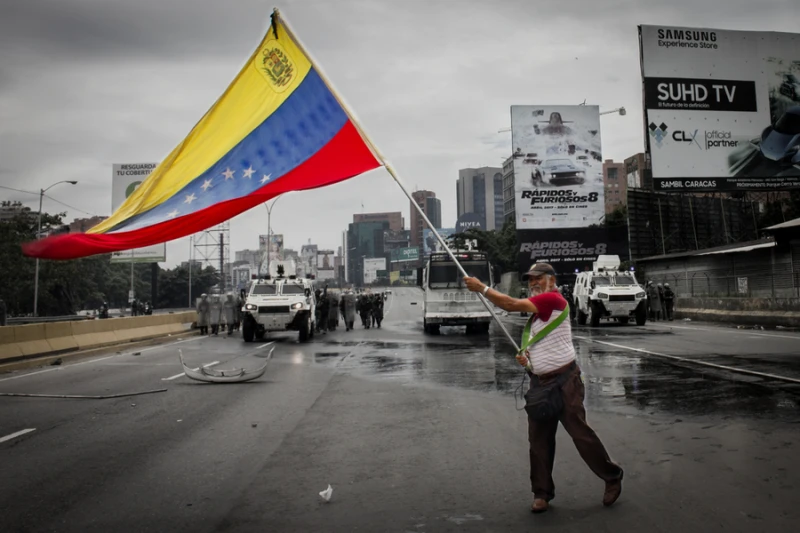
May 3, 2017 Deputy of the National Assembly holds a Venezuelan flag when the protest in Caracas is repressed by the Bolivarian National Guard with tear gas. Credit: Reynaldo Riobueno/Shutterstock
Caracas, Venezuela, Jul 7, 2021 / 16:19 pm (CNA).
The Venezuelan bishops’ plenary assembly, being held July 7-9, will address the country’s situation, as well as pastoral concerns.
Among topics of discussion are the second national pastoral assembly; the listening process of the Ecclesial Assembly of Latin America and the Caribbean; the conclusions on the first and second Joint Virtual Meeting of Bishops and Priests; the Synod on Synodality to be held in Rome in 2022; and the restructuring of the Permanent Secretariat of the Venezuelan bishops.
In addition, the bishops will address “the current situation in the country” regarding pastoral care for Venezuelan migrants, the pandemic, and vaccination.
In the previous plenary assembly, held in January, Archbishop Jose Luis Azuaje Ayala of Maracaibo, president of the conference, encouraged the faithful not to lose hope amid the country’s ongoing crisis, which has been exacerbated by the COVID-19 pandemic.
Archbishop Azuaje stressed, “it is necessary to forge and create an economy with a human face, with solidarity, that puts the human being at the center and not exploitation, corruption and waste.”
Under the socialist administration of Nicolas Maduro, Venezuela has been marred by violence, political and social upheaval, with severe shortages of food and medicine, high unemployment, power outages, and hyperinflation. Over four million Venezuelans have emigrated since 2015.
If you value the news and views Catholic World Report provides, please consider donating to support our efforts. Your contribution will help us continue to make CWR available to all readers worldwide for free, without a subscription. Thank you for your generosity!
Click here for more information on donating to CWR. Click here to sign up for our newsletter.
Students from hundreds of universities from around the world are attending this year’s SEEK24 conference in St. Louis. / Credit: Jonah McKeown/CNA
St. Louis, Mo., Jan 4, 2024 / 09:10 am (CNA).
A record number of college-age students, priests, bishops, religious brothers, sisters, and more are attending this week’s SEEK24 conference in downtown St. Louis with anticipation already building for 2025’s conference, set to be held in Salt Lake City.
The conference, which is being held by the Fellowship of Catholic University Students (FOCUS) for a second straight year in St. Louis, has attracted nearly 20,000 young people for presentations and talks related to the Catholic faith from world-renowned speakers as well as opportunities for Mass, confession, and Eucharistic adoration. As of Tuesday evening, the conference had 19,707 paid attendees registered, a 28% increase over last year.
The keynote address Tuesday evening, presented in the former NFL stadium attached to the convention center, was delivered by Monsignor James Shea and Sister Mary Grace, SV.
Monsignor James Shea is president of the University of Mary in Bismarck, North Dakota. Credit: Fellowship of Catholic University Students
“If you’re sad, anxious, burned out, or overwhelmed, maybe you’re not dead wrong. Maybe you’re responding reasonably” to the fact that Satan is real, said Shea, who is president of the University of Mary in Bismarck, North Dakota.
“But Jesus came to break the power of Satan!” Shea continued, to thunderous applause.
“The wound of sin is deep in us, but it’s nowhere near the deepest part of us. Much deeper in our baptized soul is a place for God … and we’re capable, through baptism, of life with God and God living in us.”
Also on Tuesday evening, FOCUS announced that its 2025 conference will be held in Salt Lake City.
Wednesday morning’s session featured separate tracks for male and female attendees. During the men’s session, Catholic comedian and speaker Paul J. Kim spoke passionately about the importance of cultivating brotherly relationships, using the image of a soldier dragging a comrade off a battlefield.
“We’re all involved in spiritual battles. And the stakes are very very high. I don’t know if you know this, and if you don’t, you need to become aware of this very very quickly,” Kim told the young men in attendance.
“Some of the happiest, most joyful, amazing men of God that I know on this planet are totally sold out for Jesus Christ. And there’s no shame. What is it to gain the whole world and lose your soul, gentlemen?
Catholic comedian and speaker Paul Kim addressed a separate conference breakout session of young men. Credit: Jonah McKeown/CNA
This year’s SEEK participants come from hundreds of universities and also include active-duty servicemen and women based at installations across the country. There are also 44 bishops attending this year — a doubling of the number who showed up last year — as well as 450 seminarians registered, up from 250 last year.
Anna Sturtin, a freshman at Hillsdale College in Michigan and a St. Louis-area native, told CNA that she has noticed a joy and a pride among the young Catholics who are at SEEK that has also caught the attention of others in the city.
“People in St. Louis who know nothing about this are seeing the signs, seeing all the people in town and the craziness, and they’re like, what is this? What is SEEK?” Sturtin said.
Katherine Cullen, Evelyn Shirtliff, and Anna Sturtin are among the SEEK24 conference’s many enthusiastic participants. Credit: Jonah McKeown/CNA
“I bet a lot of people are researching it and finding out that this is a Catholic youth conference … and that contradicts the secular narrative that the faith is dead. It’s a great witness to our faith … and I think that is really wonderful just for the city of St. Louis.”
The conference continues all this week, wrapping up with a closing Mass on Friday morning.
On Wednesday evening, Catholics from the St. Louis area were scheduled to join conference attendees for a massive Eucharistic adoration. FOCUS spokesperson Kate Milligan said they expect to surpass 24,000 attendees for the event.
Theodore McCarrick before his laicization / Copyright Mazur_catholicchurch.org.uk
Washington D.C., Jul 29, 2021 / 12:11 pm (CNA).
Former Cardinal Theodore McCarrick has reportedly been charged with sexual assault of a teenage boy, a crime allege… […]
Managua, Nicaragua, Jun 12, 2019 / 02:13 pm (CNA).- The results of a Nicaraguan law granting amnesty to both anti-government activists and security forces will determine whether the legislation is good for the country, the Archbishop of Managua has said.
Nicaragua’s unicameral National Assembly passed the amnesty law June 8. Though it has allowed the release of a group of political prisoners, the law has been criticized by the opposition over fears it will also give impunity to troops and paramilitaries responsible for crimes and arbitrary arrests that have taken place during the past 14 months of protests.
The law also requires those released to refrain from future protests.
Fifty-six activists were released June 11, and 50 protesters June 10. The government has detained more than 700 in connection with the protests.
Cardinal Leopoldo José Brenes Solorzano of Managua commented June 9: “I’m just thinking of a text in Saint Matthew and Saint Luke: ‘By their fruits you will know them.’ I think there have been a lot of amnesties that have been given in Nicaragua, and here we would have to evaluate what fruits they have borne.”
He added that it will be the implementation of the law that will end up vindicating the detractors or defenders of this legislation. However, he said that more time “ would have been helpful” to deliberate calmly “such an important law like amnesty.”
“That all the prisoners are getting out is a joy for the families because they’re waiting for them to return. Now we’re going to see how this law will be implemented and hopefully it won’t be to their detriment, and that all detainees can live freely in their country,” Cardinal Brenes reflected.
Anti-government protests in Nicaragua began in April 2018. They have resulted in more than 320 deaths, and the country’s bishops mediated on-again, off-again peace talks until they broke down that June.
A new round of dialogue began in February, but the opposition has made the timely release of all protesters a condition of its resumption.
Nicaragua’s crisis began last year after president Daniel Ortega announced social security and pension reforms. The changes were soon abandoned in the face of widespread, vocal opposition, but protests only intensified after more than 40 protestors were killed by security forces.
The pension reforms which triggered the unrest were modest, but protests quickly turned to Ortega’s authoritarian bent.
Ortega has been president of Nicaragua since 2007, and oversaw the abolition of presidential term limits in 2014.
The Church had suggested that elections, which are not scheduled until 2021, be held this year, but Ortega has ruled this out.
Ortega was a leader in the Sandinista National Liberation Front, which had ousted the Somoza dictatorship in 1979 and fought US-backed right-wing counterrevolutionaries during the 1980s. Ortega was also leader of Nicaragua from 1979 to 1990.
Leave a Reply