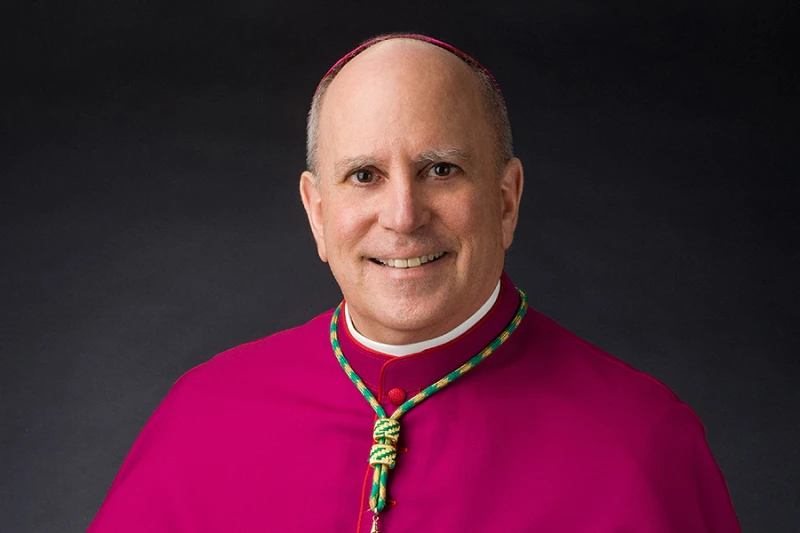
Archbishop Samuel Aquila of Denver in his Friday column called out the 60 Catholic Democrats who penned a letter defending their pro abortion position to stop “weaponizing the Eucharist.”
“Those of us who have followed the news in the last week or so know that the press has declared that the U.S. Bishops are planning to ban President Biden from Communion, allegedly ignoring the Vatican’s guidance,” Archbishop Aquila wrote in his July 2 column, “Enter the narrow gate to receive the Eucharist”.
He explained that “after hours of discussion, the bishops voted 174 to 55 to draft a document that addresses both this issue and the broader question of what places any person in a state of not being able to receive Communion. The document, which will be drafted and then discussed regionally in the coming months, will strive to make the Church’s teachings on the Eucharist and worthily receiving the Lord more widely known.”
Reacting to the 60 Catholic lawmakers who released a letter justifying their support for legalized abortion, the Archbishop of Denver said, “instead of accepting their own responsibility to understand and follow Church teaching, these politicians are the ones who are ‘weaponizing the Eucharist’ by insisting that they remain in good standing despite publicly committing grave sins and continuing to receive Communion.”
“One cannot say one believes something, do the complete opposite and then credibly say that they are in communion with a Church that believes what they did is evil,” he added.
In his column Archbishop Aquila revelead that many US bishops, including himself, have been privately dialoguing with Catholic politicians on abortion and other issues for years, urging them to refrain from Communion if they won’t change their immoral political positions.
“Unfortunately, many – but not all – of these public figures have chosen political expediency over the Gospel. They value their political party and their power more than the Gospel of Jesus Christ. They do not serve as a leaven of the Gospel in society, but rather build a culture of death. They cite the importance of following their consciences but fail to explain how their conscience is a properly formed conscience,” he said.
After recalling that the Catechism of the Catholic Church teaches explicitly that “anyone aware of having sinned mortally must not receive communion without having received absolution in the sacrament of penance”, Aquila explained that he has “two motivations in speaking out on this subject: first, to protect and faithfully hand on the teachings Christ has given us, and second, to warn those who are endangering their souls by receiving Communion in a state of grave sin, whatever that grave sin is.”
“The people who I hear from the most about these issues,” the Archbishop of Denver wrote, “feel betrayed by the Catholic lawmakers and other public figures who claim that they are Catholic but then vote and act against the faith. What do these people have to say to the young children, moms and dads and grandparents who are fighting for the lives of the unborn by praying outside of abortion clinics or caring for young moms in need before and after they’ve had their baby?”
“Every Catholic, regardless of their prominence, must choose who they will follow – Jesus Christ and his Church, or the false gods of power, influence and the world’s acclaim. May we all respond to this choice as Jesus did when Satan tempted him, ‘The Lord, your God, shall you worship and him alone shall you serve’.”
If you value the news and views Catholic World Report provides, please consider donating to support our efforts. Your contribution will help us continue to make CWR available to all readers worldwide for free, without a subscription. Thank you for your generosity!
Click here for more information on donating to CWR. Click here to sign up for our newsletter.
Washington, D.C. Newsroom, Aug 3, 2022 / 04:00 am (CNA).
Abortion — a procedure with the sole or primary intent and purpose of ending human life in the womb — is never medically necessary, according to medical experts.Three … […]
Catholic journalists are called to report the truth with "a consuming passion for excellence," veteran journalist and scholar Francis X. Maier says. / Shutterstock
Members of the Sts’ailes First Nation at Holy Rosary Cathedral last year for the first Mass to integrate a First Nation language. A Cardus report presents the voices of Indigenous Canadians speaking about their faith and distinguishing it from the traditional spirituality they’re often associated with. / Photo courtesy Nicholas Elbers, 2022
Vancouver, Canada, May 17, 2023 / 14:15 pm (CNA).
A groundbreaking report published by the Ottawa-based Cardus Institute has given voice to Indigenous Canadians who are frustrated by secular society’s unawareness of — or unwillingness to accept — the fact that almost half of them are Christian.
“I find that insulting to Indigenous people’s intelligence and freedom,” Catholic priest Father Cristino Bouvette said of the prejudice he regularly encounters.
Bouvette, who has mixed Cree-Métis and Italian heritage and now serves as vicar for vocations and Young Adults in the Diocese of Calgary, was one of 12 individuals interviewed by Cardus for the report “Indigenous Voices of Faith.”
Father Deacon Andrew Bennett, left, leads a post-production discussion by Indigenous Voices of Faith participants. Photo courtesy of Cardus
Prejudice against Indigenous Christians has become so strong, even inside some Indigenous communities, “that Indigenous Christians in this country right now are living in the time of new martyrdom,” Bouvette said.
Although that martyrdom may not cost them their lives, “they are ostracized and humiliated sometimes within their own communities if they openly express their Christian or Catholic faith.”
Statistics Canada reported last year that the 2021 census found that 850,000, or 47%, of Canada’s 1.8-million Indigenous people identify as Christian and that more than a quarter of the total report they are Catholic. Only 73,000, or 4%, of Indigenous people said they adhere to traditional Indigenous spiritual beliefs.
In a new report, Cardus wants to “amplify the voices of Indigenous Canadians speaking for themselves about their religious commitments, which sometimes clash with the typical public presentation of Indigenous spirituality.” Photo courtesy of Cardus
Ukrainian Catholic Deacon Andrew Bennett, program director for Cardus Faith Communities, conducted the interviews for the think tank last fall. He published his report in March at a time when Canadian mainstream media and many political leaders continued to stir division and prejudice through misleading commentary about abandoned cemeteries at Indian Residential Schools.
The purpose of the report, he writes, “is to affirm and to shed light on the religious freedom of Indigenous peoples to hold the beliefs and engage in the practices that they choose and to contextualize their faith within their own cultures.”
Too often, however, “the public narrative implies, or boldly declares, that there’s a fundamental incompatibility between Indigenous Canadians and Christianity or other faiths,” Bennett said. “[M]any Indigenous Canadians strongly disagree with those narratives.”
Father Bouvette is clearly one of those.
“We did not have Christian faith imposed upon us because of [my Indigenous grandmother’s] time in the residential school or her father’s time in the trade school that he was sent to,” Bouvette said. “No, it was because our family freely chose to receive the saving message of Jesus Christ and lived it and had continued to pass it down.”
Bouvette said his “grandmother was not tricked into becoming something that she didn’t want to be, and then tricked into staying that way for 99 years and 11 months of her life. She was a Christian from the day of her birth, and she remained a Christian until the day of her death. And so that was not by the consequence of some imposition.”
Nevertheless, Canadians continue to labor under a prejudice holding the opposite view. “I do believe that probably the majority of Canadians at this time, out of some mistaken notion of guilt for whatever their cultural or ethnic background is, think they are somehow responsible for Indigenous people having had something thrust upon them that they didn’t want,” Bouvette said.
“We did not have Christian faith imposed upon us,” Father Cristino Bouvette says in a Cardus report on Indigenous faith. Photo courtesy of Cardus
“But I would say, give us a little more credit than that and assume that if there is an Indigenous person who continues to persevere in the Christian faith it is because they want to, because they understand why they have chosen to in the first place, and they remain committed to it. We should be respectful of that.”
The executive director of the Catholic Civil Rights League, Christian Elia, agrees and says society should grant Indigenous Catholics the respect and personal agency that is due all Canadians.
“Firstly, I am not an Indigenous person, so I cannot speak for our Indigenous brothers and sisters, but neither can non-Indigenous secularists who choose to ignore that Indigenous people in Canada continue to self-identify as Christian, the majority of these Catholic,” Elia said in an interview with The B.C. Catholic.
He said his organization has heard from many Indigenous Catholics who are “growing weary of the ongoing assumption that somehow they have been coerced into the faith, that it is inconceivable that they wish to be Catholic. This condescending attitude must stop.”
Deacon Rennie Nahanee, who serves at St. Paul’s Indian Church in North Vancouver, was another of the 12 whom Bennett interviewed. A cradle Catholic and member of the Squamish First Nation, Deacon Nahanee said there is nothing incompatible with being both an authentic Indigenous person and a Catholic.
“I’m pretty sure we had a belief in the Creator even before the missionaries came to British Columbia,” he said. “And our feelings, our thoughts about creation, the way that we lived and carried out our everyday lives, and the way that we helped to preserve the land and the animals that we used for food, our spirituality and our culture, were similar to the spirituality of the Catholic Church.”
“I believe that’s why our people accepted it. I don’t think anybody can separate themselves from God, even though they say so.”
Interviewed later by The B.C. Catholic, Nahanee said he is not bothered by the sort of prejudice outlined by Bouvette. “People are going to say or do what they want,” he said.
Voices of Indigenous Christianity
Bennett, program director of Cardus Faith Communities, interviewed 12 Indigenous Canadians, most of them Christian, about their religious commitments, “which often clash with the typical public presentation of Indigenous spirituality.” Here is a selection of some of their comments:
Tal James of the Penelakut First Nation in Nanaimo spoke about the relationship between Indigenous culture and his Christian faith:
Tal James and wife Christina. Photo courtesy of Project 620 – James Ministry
“I think … that our [Indigenous] cultures were complete, and in Jesus they’re more complete. I think that’s a big thing and a big step for a lot of us. You’re going to have a lot of non-Indigenous people look at you and question your actions based on your Aboriginal heritage. Don’t take that to heart. They’re the ignorant ones who don’t want you to flourish. Those of you who are Christians, First Nations Christians, you come to the table with the same gifting that non-Aboriginal people have. For them to say, ‘We want to make room for you at the table,’ correct them. You are already at the table, and encourage them to step back and allow your gifts to flourish. Because it’s one in the same spirit.”
Rose-Alma McDonald, a Mohawk from Akwesasne, which borders New York, Ontario, and Quebec, talked about re-embracing her Catholic faith:
Rose-Alma McDonald. Photo courtesy of Cardus
“I surprised everybody, including myself, in terms of embracing Catholicism after 20 years away. So I’ve had a few epiphanies in the sense that this is why my mother made me do so much in the church growing up. When I’m working, volunteering, and doing stuff in the church, I remember that. I keep remembering I’m Catholic and I’m still Catholic. I will stay Catholic because of the way I was raised.”
Jeff Decontie, a Mohawk from the Algonquin First Nations who lives in Ottawa, talked about being a person of faith in a secular world:
Jeff Decontie. Photo courtesy of Cardus
“Secular worldviews can sort of eat up everything around them and accept a whole wide range of beliefs at the same time. For example, you have the prevailing scientific thinking alongside New Age believers, and people in society just accept this, saying, ‘Oh, whatever it is you believe in, all religions lead to the same thing.’ No one questions it. How can these contradictions coexist? … Then we ask an [Indigenous] elder to lead prayer? Any other religion would be a no-no, but you can ask for an elder who’s going to pray a generic prayer to some generic Creator, and it’s not going to ruffle any feathers. I think that’s the danger of secular thought creeping into Canada: It goes unnoticed, it’s perceived as neutral, but at the same time it’s welcoming a whole wide range of beliefs. And it doesn’t just influence Indigenous thought. It’s influencing Christianity.”
Rosella Kinoshameg, a member of the Wikwemikong Reserve on Manitoulin Island in Ontario, spoke about being Indigenous and Catholic:
Rosella Kinoshameg. Photo courtesy of the Catholic Register
“Well, I can’t change being Indigenous. That’s something that is me. I can’t change that. But to believe in the things that I was taught, the traditional things, the way of life and the meanings of these things, and then in a church, well, those things help one another and they make me feel stronger.”
This article was originally published May 10, 2023, in The B.C. Catholic, a weekly publication serving the Catholic community in British Columbia, Canada, and is reprinted here on CNA with permission.
It is the medical industry that is “weaponized” (as in abortions and euthanasia), NOT the Church which witnesses absolutely to the transcendent dignity of each person, without exception–and therefore also has something to say about Eucharistic coherence.
But, as for the couple dozen bishops who, at best, find it inopportune to act at this moment like successors of the apostles—it’s not that they no longer believe in absolutes. Rather, their belief that a more discerning access to the Eucharist “weaponizes” the sacramental Real Presence…THIS belief is hackneyed and “absolute” nonsense.
Archbishop Aquila says, “One cannot say one believes something, do the complete opposite and then credibly say that they are in communion with a Church that believes what they did is evil”. True. Although this moment requires that the bishops themselves act forcefully, wording what is required in the Eucharistic statement, and implementing it. Hierarchy cannot criticize and not follow up with refusal of the Eucharist as they as they did in 2004 regarding CDF prefect Ratzinger’s Instruction [as it was titled] on worthy reception that stated politicians who promote abortion are not worthy. Many of us were unaware that at the time bishops became aware of Cardinal Ratzinger’s letter of Instruction forwarded to then Cardinal McCarrick, who redacted out the significant portions that sanctioned abortion proponents from receiving the Eucharist. That redaction nevertheless became known by the bishops, the complete Instruction was published in the Italian media, and the McCarrick redaction, his lies to the USCCB was addressed by Richard Neuhaus First Things October 2004. Word spreads. McCarrick attempted to defend his chicanery to the bishops and they complied. Now they must not only write on it as they did back in 04, they must act on it. And, to borrow Neuhaus’ words mandate specific pastoral approaches, including the denial of Communion to the obdurate. If they don’t, who will?
The archbishop’s mention of “dialoguing” with Catholic politicians about support for abortion “for years” reveals a fundamental misunderstanding of the situation. This approach would be appropriate if the issue were a private sin and involved a person’s subjective frame of mind, which could lesson culpability. The principal responsibility for determining eligibility to receive Communion in such cases falls on the communicant, as Canon 916 states. But with political support of abortion, the key issue is one of public scandal, and in this case the bishop has an obligation, according to Canon 915, not to “dialogue” while the scandal continues (for years!), but to deny those politicians admission to Holy Communion. Of course, once the danger of scandal has been removed, dialogue should proceed for the sake of their souls.
The failure of bishops to follow through on Canon 915 is itself a terrible scandal, thus permitting ongoing public sacrilege.
I don’t see the archbishop making the case that the 60 Democrats who signed off on the letter are “weaponizing” anything. It’s ironic that someone like the archbishop who wants to preclude civil leaders from the Eucharist for their views on civil political matters should work so hard to deflect his own, true weaponizing.
It’s ironic that someone like the archbishop who wants to preclude civil leaders from the Eucharist for their views on civil political matters should work so hard to deflect his own, true weaponizing.
Correction: It’s in keeping with his mandate as an ordained Bishop that he correctly warns civil leaders who claim to be Catholic from receiving the Eucharist in a sacrilegious manner due to their prudential views; which are in direct opposition with the teaching of the Church, on the destruction of innocent life in the womb. Aquila is right to remind them that their eternal salvation is at risk if they do not amend their lives. Failing to do so is complicit in their and Biden’s public, unabashed sin.
It is the medical industry that is “weaponized” (as in abortions and euthanasia), NOT the Church which witnesses absolutely to the transcendent dignity of each person, without exception–and therefore also has something to say about Eucharistic coherence.
But, as for the couple dozen bishops who, at best, find it inopportune to act at this moment like successors of the apostles—it’s not that they no longer believe in absolutes. Rather, their belief that a more discerning access to the Eucharist “weaponizes” the sacramental Real Presence…THIS belief is hackneyed and “absolute” nonsense.
Archbishop Aquila says, “One cannot say one believes something, do the complete opposite and then credibly say that they are in communion with a Church that believes what they did is evil”. True. Although this moment requires that the bishops themselves act forcefully, wording what is required in the Eucharistic statement, and implementing it. Hierarchy cannot criticize and not follow up with refusal of the Eucharist as they as they did in 2004 regarding CDF prefect Ratzinger’s Instruction [as it was titled] on worthy reception that stated politicians who promote abortion are not worthy. Many of us were unaware that at the time bishops became aware of Cardinal Ratzinger’s letter of Instruction forwarded to then Cardinal McCarrick, who redacted out the significant portions that sanctioned abortion proponents from receiving the Eucharist. That redaction nevertheless became known by the bishops, the complete Instruction was published in the Italian media, and the McCarrick redaction, his lies to the USCCB was addressed by Richard Neuhaus First Things October 2004. Word spreads. McCarrick attempted to defend his chicanery to the bishops and they complied. Now they must not only write on it as they did back in 04, they must act on it. And, to borrow Neuhaus’ words mandate specific pastoral approaches, including the denial of Communion to the obdurate. If they don’t, who will?
The archbishop’s mention of “dialoguing” with Catholic politicians about support for abortion “for years” reveals a fundamental misunderstanding of the situation. This approach would be appropriate if the issue were a private sin and involved a person’s subjective frame of mind, which could lesson culpability. The principal responsibility for determining eligibility to receive Communion in such cases falls on the communicant, as Canon 916 states. But with political support of abortion, the key issue is one of public scandal, and in this case the bishop has an obligation, according to Canon 915, not to “dialogue” while the scandal continues (for years!), but to deny those politicians admission to Holy Communion. Of course, once the danger of scandal has been removed, dialogue should proceed for the sake of their souls.
The failure of bishops to follow through on Canon 915 is itself a terrible scandal, thus permitting ongoing public sacrilege.
I don’t see the archbishop making the case that the 60 Democrats who signed off on the letter are “weaponizing” anything. It’s ironic that someone like the archbishop who wants to preclude civil leaders from the Eucharist for their views on civil political matters should work so hard to deflect his own, true weaponizing.
It’s ironic that someone like the archbishop who wants to preclude civil leaders from the Eucharist for their views on civil political matters should work so hard to deflect his own, true weaponizing.
Correction: It’s in keeping with his mandate as an ordained Bishop that he correctly warns civil leaders who claim to be Catholic from receiving the Eucharist in a sacrilegious manner due to their prudential views; which are in direct opposition with the teaching of the Church, on the destruction of innocent life in the womb. Aquila is right to remind them that their eternal salvation is at risk if they do not amend their lives. Failing to do so is complicit in their and Biden’s public, unabashed sin.
