

 By
By 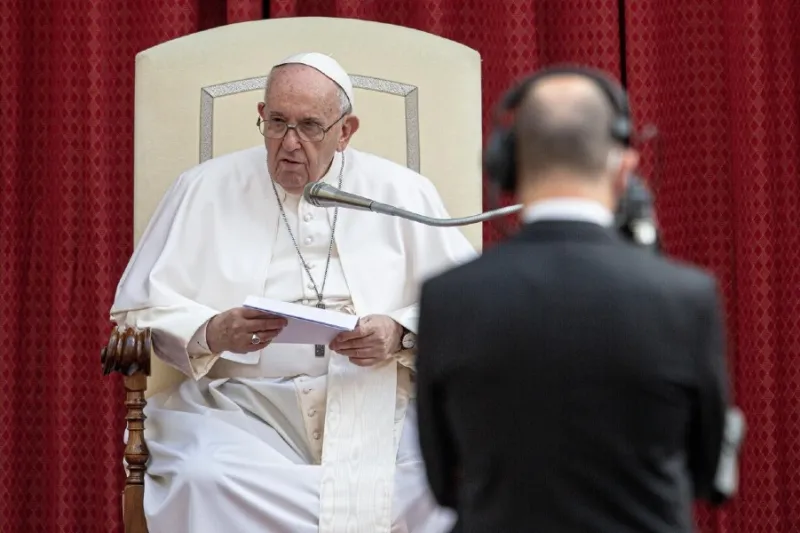
Washington D.C., Jun 25, 2021 / 14:30 pm (CNA).
According to a recent online survey released by the Pew Research Center on June 25, Pope Francis’ popularity remains “fairly stable” among both American Catholics and Americans in general.
More than six-in-ten U.S adults, 63%, have a “very” or “mostly” favorable opinion of Pope Francis, according to the survey conducted in March using the center’s online American Trends Panel.
Among U.S. Catholics overall, 82% say they have a favorable opinion of the pope.
Claire Gecewicz, who focuses on religion research at Pew Research Center and who authored the report, explained that “views of Pope Francis have remained fairly stable among Catholic subgroups, too.”
“For example, Catholics who identify as Democrats or who lean toward that party continue to have a more positive opinion of Francis than their Republican counterparts, a partisan pattern that has held since 2018,” she said.
“In the latest survey, 90% of Catholic Democrats expressed a favorable opinion of the pope, compared with 73% of Catholic Republicans and GOP leaners,” she said.
The survey also found little difference in opinions of Pope Francis among Catholics who attend Mass regularly, and those who attend less often. Among weekly Mass-goers, 84% said they have a very or mostly favorable opinion of Pope Francis, compared to 82% of Catholics who answered similarly and who attend Mass less often, or not at all.
Pope Francis’ overall popularity in the United States has rebounded since 2018, Pew said, when new revelations had surfaced regarding the sex abuse crisis in the U.S. Church and questions were raised regarding Pope Francis’ handling of allegations against former cardinal Theodore McCarrick.
The survey showed that over a 13-month period from February 2020 to March 2021, a higher percentage of overall respondents gave favorable ratings to Pope Francis than in January 2020. Fewer people declined to answer the question on favorability. Pew said that the disparity in figures could be related to the survey being conducted by phone in January 2020, while the survey over the 13-month period in 2020 and 2021 was conducted online.
“Online and phone surveys sometimes produce disparate results, a polling phenomenon called a mode effect,” Pew noted, adding that “online polls tend to result in fewer respondents declining to answer the question if there are fewer opportunities to express ‘no opinion.’”
If you value the news and views Catholic World Report provides, please consider donating to support our efforts. Your contribution will help us continue to make CWR available to all readers worldwide for free, without a subscription. Thank you for your generosity!
Click here for more information on donating to CWR. Click here to sign up for our newsletter.


The same majority that denies the Real Presence?
Accuracy in measures is not always consistent with reality due to variables. In the instance of Pope Francis’ popularity among Catholics at 83%, you can bet the farm that the number of actual practicing Catholics among those claiming to be Catholic in America is 17% [portend of Benedict’s remnant Church]. “In the latest survey, 90% of Catholic Democrats expressed a favorable opinion of the pope, compared with 73% of Catholic Republicans and GOP leaners” (Claire Gecewicz for Pew). That Republicans favor the Pontiff’s views that high [73%] spells great difficulty for the Church to recover what it once was, even stretching back as recent as the seventies. If Gecewicz’s figures are reasonably accurate the large statistic in favor of Francis is consistent with a belief that attending Mass [the vacant or sparsely attended churches worldwide is a strong indicator] receiving the sacraments, following an Apostolic moral code is irrelevant to salvation [one can have far more fun and still be saved at crunch time]. Again, if the figures are more or less correct, what is the message, if not the popularity of Francis’ doctrine of mercy that surpasses divine justice contemporaneously, that is, in respect to how we live our lives? The tragedy of those beguiled to follow this view is the stark reality of final judgment, that belongs to God, not Francis.
Instead of “opinions,” has the overloaded public reverted back mostly to impressions? Lest we forget everything, governance by “pollsters” came into use in the mid-twentieth century precisely because the term sounded so much like hucksters.
You said it!
Define “Catholic” before I even consider this survey. In my mind, a Catholic is someone who through baptism believes ALL that the Church holds to believe. When I say “ALL” I mean all.
So what?
Polls utilizing specious, at best, methodologies are to the illiterate as smack is to a junkie.
I’m willing to bet that the more likely a Catholic is to practice their faith, attend Mass regularly and the more likely to actually believe what the Church teaches (and apply it to their everyday lives), the lower their opinion of Pope Bergoglio.
To me the mercy of Pope Francis takes after that of the Parable of the Dishonest Manager, who wrote off the debts(sins) of others(world) to ingratiate himself. This could explain the polls.