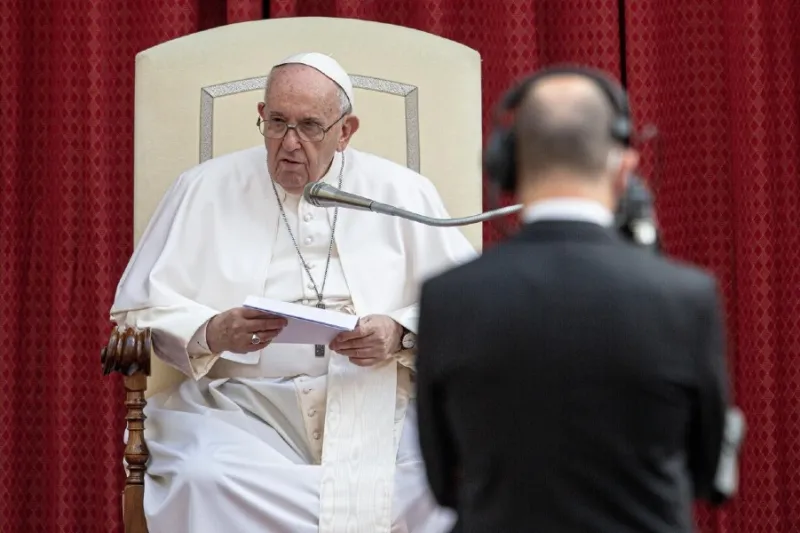
Pope Francis holds his weekly general audience in the Courtyard of St. Damaso on June 9, 2021. / Daniel Ibanez/CNA
Washington D.C., Jun 25, 2021 / 14:30 pm (CNA).
According to a recent online survey released by the Pew Research Center on June 25, Pope Francis’ popularity remains “fairly stable” among both American Catholics and Americans in general.
More than six-in-ten U.S adults, 63%, have a “very” or “mostly” favorable opinion of Pope Francis, according to the survey conducted in March using the center’s online American Trends Panel.
Among U.S. Catholics overall, 82% say they have a favorable opinion of the pope.
Claire Gecewicz, who focuses on religion research at Pew Research Center and who authored the report, explained that “views of Pope Francis have remained fairly stable among Catholic subgroups, too.”
“For example, Catholics who identify as Democrats or who lean toward that party continue to have a more positive opinion of Francis than their Republican counterparts, a partisan pattern that has held since 2018,” she said.
“In the latest survey, 90% of Catholic Democrats expressed a favorable opinion of the pope, compared with 73% of Catholic Republicans and GOP leaners,” she said.
The survey also found little difference in opinions of Pope Francis among Catholics who attend Mass regularly, and those who attend less often. Among weekly Mass-goers, 84% said they have a very or mostly favorable opinion of Pope Francis, compared to 82% of Catholics who answered similarly and who attend Mass less often, or not at all.
Pope Francis’ overall popularity in the United States has rebounded since 2018, Pew said, when new revelations had surfaced regarding the sex abuse crisis in the U.S. Church and questions were raised regarding Pope Francis’ handling of allegations against former cardinal Theodore McCarrick.
The survey showed that over a 13-month period from February 2020 to March 2021, a higher percentage of overall respondents gave favorable ratings to Pope Francis than in January 2020. Fewer people declined to answer the question on favorability. Pew said that the disparity in figures could be related to the survey being conducted by phone in January 2020, while the survey over the 13-month period in 2020 and 2021 was conducted online.
“Online and phone surveys sometimes produce disparate results, a polling phenomenon called a mode effect,” Pew noted, adding that “online polls tend to result in fewer respondents declining to answer the question if there are fewer opportunities to express ‘no opinion.’”
If you value the news and views Catholic World Report provides, please consider donating to support our efforts. Your contribution will help us continue to make CWR available to all readers worldwide for free, without a subscription. Thank you for your generosity!
Click here for more information on donating to CWR. Click here to sign up for our newsletter.
Washington, D.C. Newsroom, Dec 1, 2022 / 14:00 pm (CNA).
Today the U.S. bishops responded to the U.S. Senate’s passage of the Respect for Marriage Act, saying society “has lost sight of the purpo… […]
Attendees visit vendors at the Diocese of Arlington’s 2025 “From Inclusion to Belonging Conference.” / Credit: Porto Charities
Washington, D.C. Newsroom, Mar 17, 2025 / 07:00 am (CNA).
Families whose children have disabilities and Catholics with disabilities were welcomed by the Diocese of Arlington March 15 to the fourth annual “From Inclusion to Belonging Conference” which focused on plans for the future as those with disabilities prepare for adult life out of high school.
“The Lord, for us, is one who will always be there to strengthen us, to heal us, and to help us,” Bishop Michael Burbidge said in his opening remarks at the conference, held at Bishop Ireton High School in Alexandria, Virginia.
With more than 200 people in attendance, the diocesan conference featured an array of talks, in English and Spanish, about resources for children with intellectual, emotional, and physical disabilities. These included tips for life skills, faith formation, education, and employment, which were presented to parents, teachers, priests, and others.
The conference also provided talks for teenagers with disabilities, designed to help guide them on how to advocate for themselves. Those participants were brought to vendors who offered resources to connect them with opportunities.
“We are called to live the Gospel of life,” Burbidge told CNA after giving his remarks. “In fact, it is a mandate to protect, to revere, to celebrate, to cherish, and to welcome all human life. …There are no exceptions.”
Nearly 20 diocesan schools educate students with disabilities, including all four high schools. A few of the schools also have specialized programs for children who have disabilities.
Diane Elliott, an assistant superintendent for Arlington Diocese Catholic Schools, told CNA that it is important for Catholic schools to have the mindset that “we’re going to serve all God’s children.”
She said it’s “not only about the kids with disabilities,” but it’s also important for other children to learn “how to accept individual differences” and avoid stigmatizing people.
Elliott added, “the majority of what we do, it doesn’t cost any money for inclusion,” and spoke about the sensory Masses offered by the diocese. Those Masses are designed for people with sensory processing issues, and usually include dimmed lights, no organ music, and homilies that are very concise. Some people who benefit from those Masses include people with autism, downs syndrome, and Alzheimer’s disease.
For efforts that do require financial resources, Burbidge told CNA that the inclusion of those with disabilities should still always be a priority, and that when resources are limited, priorities “must be reflected in how you use those resources.”
Guadalupe Williamson, whose 14-year-old son Patrick has an intellectual disability caused by a malformation in the brain, told CNA she sends him to Saint Anthony of Padua School in Falls Church because she wanted all of her children to attend the same Catholic school.
Williamson said the inclusion efforts ensure Patrick has a “learning environment that also matches our values as a family — our Catholic values.” She said he is also an altar server, and “just absolutely loves everything that the Church has to offer.”
Roxanne Miller, a mother of 10 who lives in Huntley, sends her 18-year-old daughter Megan to St. Paul VI Catholic High School in Chantilly. She said her daughter, who has down syndrome, is “part of the fabric of the school” and referred to the inclusion efforts as “second to none.”
Miller told CNA she attended the conference while she is helping her daughter plan for her future with employment opportunities and possibly advocacy. She said Megan is in the high school’s post-graduate transitional program for those with intellectual disabilities, which is helping them connect her with future opportunities.
Faith formation for those with special needs
The Diocese of Arlington also operates a Special Religious Development (SPRED) Program, which helps those with disabilities develop a faith community and have “access to prepare for and receive the sacraments,” Burbidge told CNA.
“That’s been a great work in our diocese,” the bishop said.
Charleen Katra, who serves on the board of the National Catholic Partnership on Disability, gives talk on ensuring those with disabilities have access to the sacraments at the Diocese of Arlington’s “From Inclusion to Belonging Conference.”. Credit: Tyler Arnold/Catholic News Agency
Nancy Emanuel, the coordinator for Special Needs Ministries in the diocese, told CNA that the program provides special religious development designed for those “who don’t fit into the typical religious education programs.”
Emmanuel said about 150 adults and children participate in the program, which divides those who are enrolled by age. The program is inclusive of those with physical and mental disabilities, which includes people with autism and down syndrome.
For some Catholics with disabilities, Emmanuel said that accessing the sacraments can at times be “overwhelming” for them. She said the program uses a lot of visual and tactile learning. For a person’s First Communion or for Confirmation, she said the instructors will practice those rituals with those children or adults to “make it so that it’s a friendly experience.”
Charleen Katra, who serves on the board of the National Catholic Partnership on Disability, gave a talk on the importance of ensuring Catholics with disabilities have access to the sacraments and the ways in which dioceses can accommodate their needs.
She said that dioceses must “meet the real needs” of each person. She noted that catechesis for a person affected by serious intellectual disabilities can sometimes be as simple as ensuring the person knows that the Eucharist is the literal Body and Blood of Christ before communion and ensuring the person knows he or she is receiving the Holy Spirit prior to confirmation.
“If there’s anybody missing in the Body of Christ, we know it’s not complete,” Katra said.
Former cardinal Theodore McCarrick arrives at Massachusetts’ Dedham District Courthouse for his arraignment on Sept. 3, 2021. / Credit: Andrew Bukuras/CNA
CNA Staff, Dec 30, 2024 / 15:05 pm (CNA).
A Wisconsin judge last week ordered that a sexu… […]
Accuracy in measures is not always consistent with reality due to variables. In the instance of Pope Francis’ popularity among Catholics at 83%, you can bet the farm that the number of actual practicing Catholics among those claiming to be Catholic in America is 17% [portend of Benedict’s remnant Church]. “In the latest survey, 90% of Catholic Democrats expressed a favorable opinion of the pope, compared with 73% of Catholic Republicans and GOP leaners” (Claire Gecewicz for Pew). That Republicans favor the Pontiff’s views that high [73%] spells great difficulty for the Church to recover what it once was, even stretching back as recent as the seventies. If Gecewicz’s figures are reasonably accurate the large statistic in favor of Francis is consistent with a belief that attending Mass [the vacant or sparsely attended churches worldwide is a strong indicator] receiving the sacraments, following an Apostolic moral code is irrelevant to salvation [one can have far more fun and still be saved at crunch time]. Again, if the figures are more or less correct, what is the message, if not the popularity of Francis’ doctrine of mercy that surpasses divine justice contemporaneously, that is, in respect to how we live our lives? The tragedy of those beguiled to follow this view is the stark reality of final judgment, that belongs to God, not Francis.
Instead of “opinions,” has the overloaded public reverted back mostly to impressions? Lest we forget everything, governance by “pollsters” came into use in the mid-twentieth century precisely because the term sounded so much like hucksters.
Define “Catholic” before I even consider this survey. In my mind, a Catholic is someone who through baptism believes ALL that the Church holds to believe. When I say “ALL” I mean all.
I’m willing to bet that the more likely a Catholic is to practice their faith, attend Mass regularly and the more likely to actually believe what the Church teaches (and apply it to their everyday lives), the lower their opinion of Pope Bergoglio.
To me the mercy of Pope Francis takes after that of the Parable of the Dishonest Manager, who wrote off the debts(sins) of others(world) to ingratiate himself. This could explain the polls.
The same majority that denies the Real Presence?
Accuracy in measures is not always consistent with reality due to variables. In the instance of Pope Francis’ popularity among Catholics at 83%, you can bet the farm that the number of actual practicing Catholics among those claiming to be Catholic in America is 17% [portend of Benedict’s remnant Church]. “In the latest survey, 90% of Catholic Democrats expressed a favorable opinion of the pope, compared with 73% of Catholic Republicans and GOP leaners” (Claire Gecewicz for Pew). That Republicans favor the Pontiff’s views that high [73%] spells great difficulty for the Church to recover what it once was, even stretching back as recent as the seventies. If Gecewicz’s figures are reasonably accurate the large statistic in favor of Francis is consistent with a belief that attending Mass [the vacant or sparsely attended churches worldwide is a strong indicator] receiving the sacraments, following an Apostolic moral code is irrelevant to salvation [one can have far more fun and still be saved at crunch time]. Again, if the figures are more or less correct, what is the message, if not the popularity of Francis’ doctrine of mercy that surpasses divine justice contemporaneously, that is, in respect to how we live our lives? The tragedy of those beguiled to follow this view is the stark reality of final judgment, that belongs to God, not Francis.
Instead of “opinions,” has the overloaded public reverted back mostly to impressions? Lest we forget everything, governance by “pollsters” came into use in the mid-twentieth century precisely because the term sounded so much like hucksters.
You said it!
Define “Catholic” before I even consider this survey. In my mind, a Catholic is someone who through baptism believes ALL that the Church holds to believe. When I say “ALL” I mean all.
So what?
Polls utilizing specious, at best, methodologies are to the illiterate as smack is to a junkie.
I’m willing to bet that the more likely a Catholic is to practice their faith, attend Mass regularly and the more likely to actually believe what the Church teaches (and apply it to their everyday lives), the lower their opinion of Pope Bergoglio.
To me the mercy of Pope Francis takes after that of the Parable of the Dishonest Manager, who wrote off the debts(sins) of others(world) to ingratiate himself. This could explain the polls.
