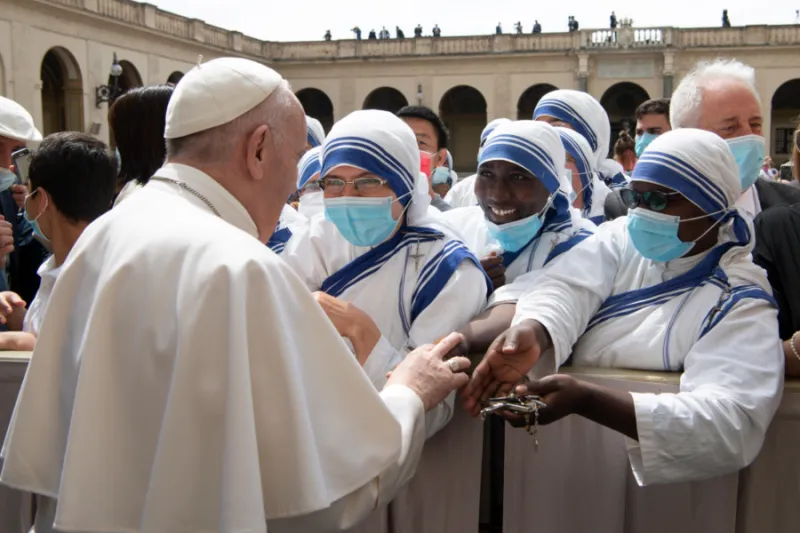
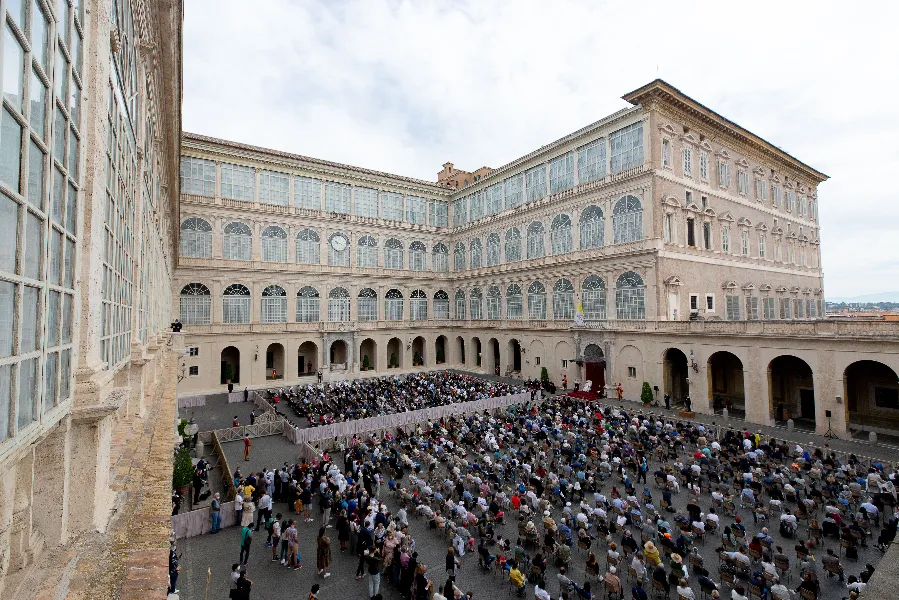
Pope Francis’ general audience in the San Damaso Courtyard of the Apostolic Palace, June 2, 2021. / Vatican Media.
Vatican City, Jun 2, 2021 / 06:30 am (CNA).
Pope Francis said Wednesday that just as Jesus prayed for his friends while on earth, he also prays for each person eternally before the Father in heaven.
“We must always keep this in mind: Jesus prays for me. He is praying now before the Father and makes Him see the wounds He carried with Him, to show the Father the price of our salvation, it is the love that He holds for us,” the pope said on June 2.
/ Daniel Ibáñez/CNA.
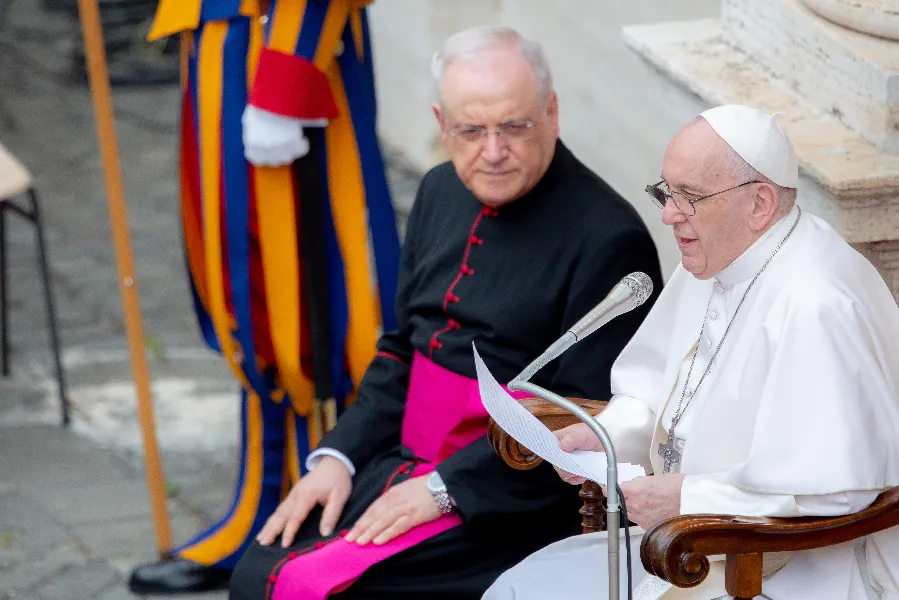
Speaking from Vatican City’s San Damaso Courtyard, Pope Francis encouraged pilgrims at his general audience and those watching via live stream to remember in the face of difficulty, or even in a time of distraction, that Jesus is praying for them.
“Do not forget: Jesus is praying for me. Now? Now. In the moment of trial, in the moment of sin, even in that sin, Jesus is praying for me with so much love,” he said.
/ Daniel Ibáñez/CNA.
The pope also looked ahead to the Solemnity of Corpus Christi this week and prayed that the feast day would deepen awareness of the Real Presence of Jesus in the Eucharist.
“May you find in the Eucharist a mystery of love and glory, that source of grace and light that illuminates the paths of life,” Pope Francis said in his message to Italian-speaking pilgrims.
/ Daniel Ibáñez/CNA.
He told the elderly, young people, the sick, and newlyweds that the Body and Blood of Christ is a support in the midst of suffering and a pledge of eternal life.
“Let us not forget that what sustains each of us in life is Jesus’ prayer for every one of us, with our name and surname, before the Father, showing Him the wounds that are the price of our salvation,” Francis said.
/ Daniel Ibáñez/CNA.
Looking up from his prepared text to speak to the crowd, the pope said: “Once, a good bishop told me that in a very bad moment in his life, a very, very, very great trial, in which all was in darkness, he looked up in the basilica and saw this phrase written: ‘I, Peter, will pray for you.’ And this gave him strength and consolation.”
“It is necessary to pray more intensely, every time the road takes an uphill turn,” he advised.
/ Daniel Ibáñez/CNA.
The pope highlighted how much Jesus prayed in the Gospels, particularly before big moments in his life, such as calling the Apostles and the Last Supper.
“The great turning points of Jesus’ mission are always preceded by prayer, but not just in passing, by intense, prolonged prayer. There is always prayer in those moments,” he said.
The pope also noted that “prayer on behalf of His friends continually reappears in the life of Jesus.”
“The Apostles sometimes become a cause of concern for Him, but Jesus, as He received them from the Father, after prayer, thus He carries them in His heart, even in their errors, even when they fall. In all this, we discover how Jesus was both teacher and friend, always willing to wait patiently for the conversion of the disciple.”
/ Daniel Ibáñez/CNA.
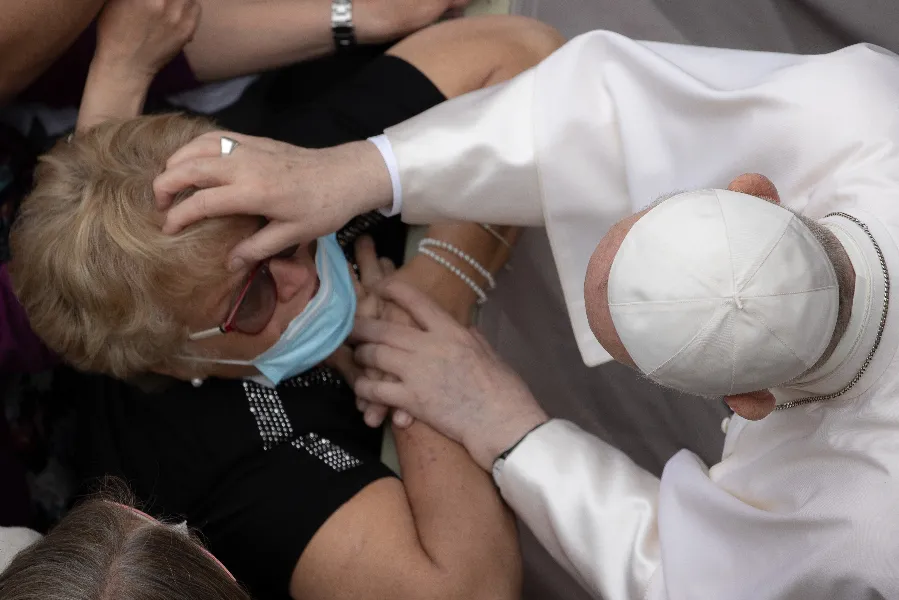
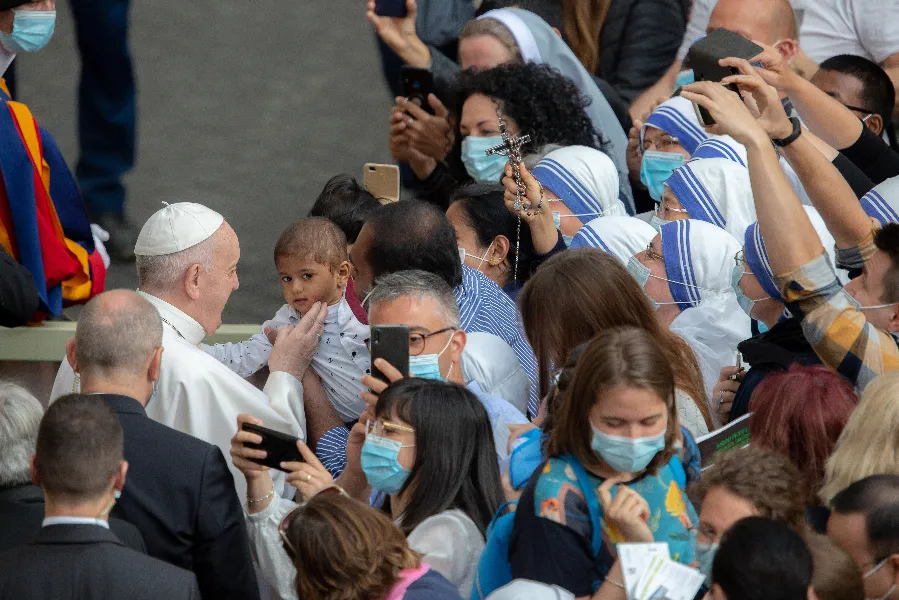
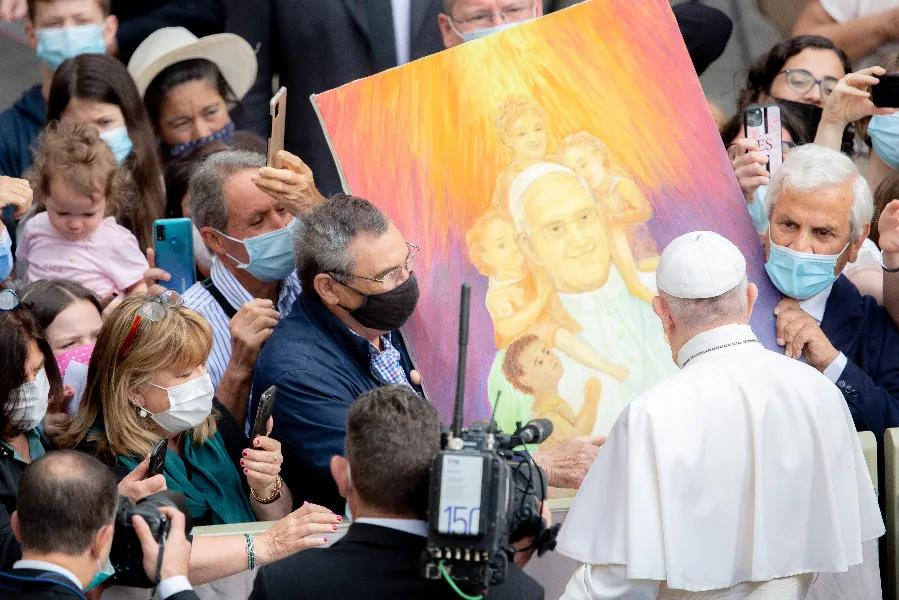
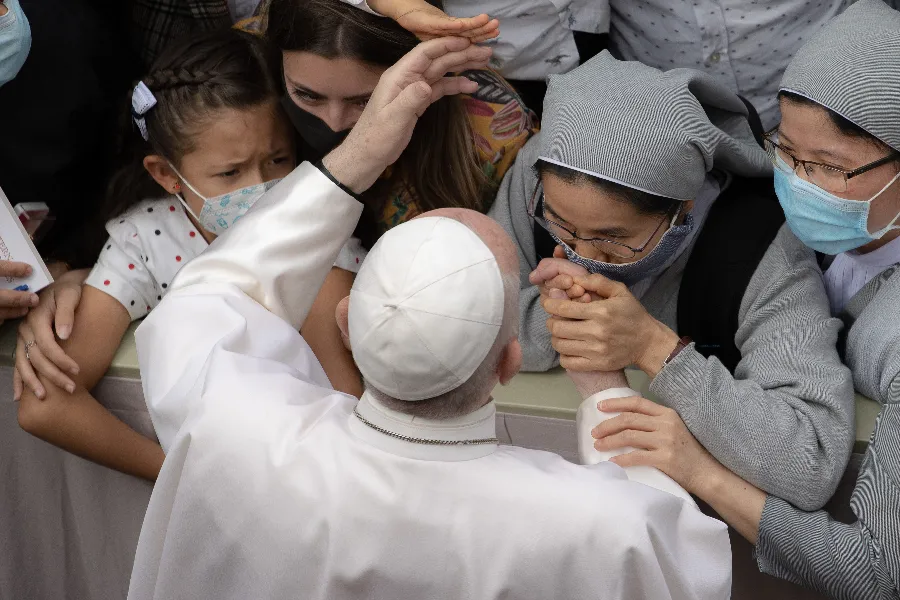
At the beginning of the audience, the pope walked around the small courtyard greeting pilgrims. He received gifts, including an icon and a large painting. He offered blessings, signed a white miter, and stopped to pray with a woman who brought a photo of a loved one.
/ Daniel Ibáñez/CNA.
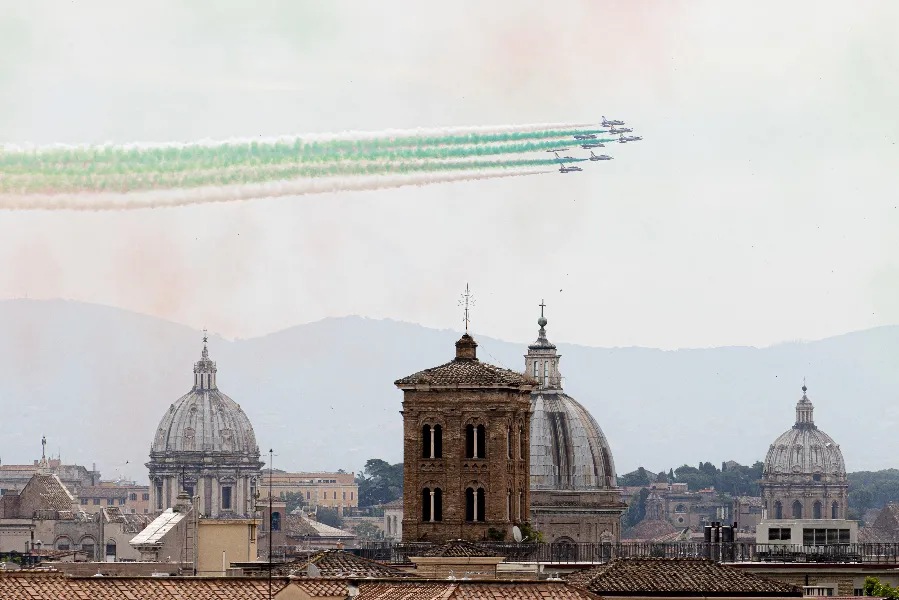
Seagulls flew over the window-covered courtyard as the pope spoke at the audience, and it was also possible to hear the Italian Air Force’s aerobatic unit, Frecce Tricolori, as it flew over Rome with the colors of the Italian flag to mark the 75th anniversary of the Italian Republic.
The address was the 36th reflection in the pope’s cycle of catechesis on prayer, which he launched in May 2020 and resumed in October following nine addresses on healing the world after the pandemic.
“It is impressive to know that at that moment, during the time of weakness, Jesus’ love does not cease,” Pope Francis said.
He continued: “‘But Father, if I am in mortal sin, does Jesus love me?’ – ‘Yes’ – ‘And does Jesus continue to pray for me?’ – ‘Yes’ – ‘But if I have done the worst things, and more, committed so many sins … does Jesus continue [to pray]?’ – ‘Yes.’”
“Jesus’ love, Jesus’ prayer for each one of us does not cease. It does not cease, but rather becomes more intense, and we are at the center of his prayer.”
If you value the news and views Catholic World Report provides, please consider donating to support our efforts. Your contribution will help us continue to make CWR available to all readers worldwide for free, without a subscription. Thank you for your generosity!
Click here for more information on donating to CWR. Click here to sign up for our newsletter.
Ricky Reyes dribbles the ball up court as now-Father Peter Schirripa follows behind at the national basketball tournament for seminaries in 2022. / Credit: St. John’s Seminary
CNA Staff, Nov 6, 2023 / 14:40 pm (CNA).
Imagine the scene: The alarm clock starts beeping and it’s 4 a.m. Basketball practice starts in an hour. It’s time for a group of bleary-eyed young men to grab their gear, meet their teammates, and begin a one-mile uphill jog in the middle of New England’s freezing weather to the basketball facility.
Once inside the gym, the work begins: stretching, sprints, layups, scrimmaging, shooting, defensive posture, all with one goal in mind — winning.
This type of intense training is all in a day’s work for one team of men in Boston.
No, it’s not the Division I team at Boston College, Boston University, or Northeastern University.
Rather, it’s how a team of seminarians at St. John’s Seminary in Boston trains. And their goal of winning is twofold: victory in the spiritual life and a championship trophy at the national tournament for seminaries, which is held once a year.
But what does playing basketball have to do with priestly formation? Well, according to the seminarians who play for the St. John’s Eagles, quite a lot.
St. John’s Seminary’s basketball team at practice. Credit: St. John’s Seminary/YouTube May 18, 2023
A ‘microcosm of the spiritual life’
When 27-year-old Deacon Marcelo Ferrari, the team’s co-captain, first entered seminary, he saw the game as more of an extracurricular activity, “a good opportunity to spend some time with close friends and maybe build some fraternity.”
“But very quickly it became clear that the basketball team is just a microcosm of the spiritual life,” Ferrari, of Monterrey, Nuevo León, Mexico, said.
Playing the game together imitates the spiritual life in that “you experience a lot of humiliation, especially if you’re not as skilled like me,” said Ferrari, who has more experience in soccer than in basketball.
“But you also just learn a real sense of what sacrifice means,” he said. “Even practice just being at 5 in the morning is enough to demand a lot of the human heart.”
The experience of being on the team aided in Ferrari’s priestly formation in “so many ways,” he said, adding that “it became a critical space for me to recognize especially more of those subtle movements of the heart.”
“There’s nothing like team sports to bring out every part of you,” he said.
An uphill climb
Ferrari had never played organized basketball until he entered St. John’s Seminary. It wasn’t until another seminarian who established the team, now-recently ordained Father Peter Schirripa, asked him to join that he considered it.
“He saw me playing soccer and was like, ‘Oh, this guy’s mildly athletic. Let’s see if we can get him a basketball and see what he can do,’” Ferrari said.
This type of recruiting was par for the course for Schirripa, 30, who grew up in Lexington, Massachusetts, and had the idea for the team when he first entered seminary more than six years ago.
But Schirripa, who had experience in basketball, track and field, and soccer, credits the founder of the media apostle Word on Fire, Bishop Robert Barron, with the conception of the idea.
Schirripa was visiting his alma mater St. Anselm College during its 2017 graduation ceremony, the spring before his entrance to seminary, when he met Barron, who was giving the commencement address. Barron mentioned to him that there was a national basketball tournament for seminaries and encouraged Schirripa to put together a team from St. John’s.
So, Schirripa brought the idea to his superiors at the seminary and got a green light to start building a team for the national tournament.
Deacon Marcelo Ferrari at one of St. John’s Seminary’s basketball practices. Credit: St. John’s Seminary/YouTube May 18, 2023
“The leadership was like, ‘Sure, you can do it if you can pull it off.’ But I was a first pre-theologian. I’d been there for, like, three weeks,” Schirripa said.
“And let’s just say there was not a robust athletic or even really communal culture at St. John’s at the time. And so trying to inspire guys to do this and play on the team, it was like I was just taking whatever warm body I could get,” he said.
Eventually, enough seminarians wanted in, and Schirripa’s idea came to fruition, which culminated in St. John’s taking a squad of 15 guys to the national tournament at Mundelein Seminary in Mundelein, Illinois, and winning two games in 2018.
“We went out to it and we won two games, which is crazy because we were so bad,” he said.
He noted that the games were livestreamed and their brother seminarians were watching.
“The whole common room was watching it and I think people couldn’t believe that we did it,” he said.
“And the rest,” Schirripa said, “is history.”
St. John’s has been sending a team to the national tournament ever since. The best they’ve done is third place in a tournament that typically consists of between 12 and 16 teams.
The future of the church
Part of St. John’s success can be attributed to their volunteer coach, Patrick Nee, 44, a practicing Catholic in the greater Boston area who was a Division I basketball player at Brown University in the 1990s.
Nee had coached on the high school level, on travel teams, and even on his young children’s teams, but what made this coaching experience different was the “shock” of being immersed in seminary culture.
“It’s not an experience like I’d ever had before, just being in a gym with 15 seminarians, being on a bus or being on a plane with them and just realizing how good it was,” he said. “And these guys are really holy guys that are just terrific. Getting to know them all, it has just been really inspiring for me.”
Patrick Nee coaches St. John’s Seminary’s basketball team. Credit: St. John’s Seminary/YouTube May 18, 2023
Nee, a high school state champion from St. Raphael Academy in Pawtucket, Rhode Island, said that he stopped practicing his Catholic faith during his college years and didn’t come back to it until his late 20s.
He said that when he returned to the Church it took him on “a journey.” And over the last five years, that journey has “intensified” even more, he said, adding that “this experience has played a role in that.”
Nee said that it’s overwhelming “in the best way” when he is at the tournaments and “every guy you meet is this on-fire guy who’s studying to be a priest.”
One of those men on fire for the faith is Brian Daley, a member of the St. John’s team, Ferrari said. He recalled an incident at practice one day when a newer seminarian began to indulge in “light mockery” of the other teams they would be playing in the tournament.
Ferrari said that Daley reminded his teammate: “No, these men that we’ll be competing against are all giving their lives for Christ and they’re great examples for us.”
Ferrari called it a moment of “deep fraternity” for the team, who were all inspired by the wisdom Daley shared.
The deacon also said that as a team that fire is seen at every practice through prayer.
At every practice, each player is handed a sheet of prayer intentions to offer up their labor on the court so that all of their work is “done with an eye that sacrifice is fruitful.”
Seeing all of the hard work the teams put in for one weekend showed Nee that they care a lot about winning, “but they never lose track of the bigger picture.”
St. John’s Seminary basketball coach Patrick Nee guides his players during the 2022 tournament. Credit: St. John’s Seminary/YouTube May 18, 2023
He said that being a part of the team has strengthened his faith and added that the whole experience inspired him to tell Schirripa that “we need to share this with people.”
“I wish other people could see this. I mean, if you know anyone who is negative about the future of the Church, it’s like, well, walk into this gym for five minutes and you’ll change your mind immediately,” he said.
Nee’s vision for sharing the experience with others became a reality five months ago when St. John’s Seminary released “Souls in the Game,” a documentary that “highlights priestly formation beyond the study of philosophy and theology.”
The 28-minute documentary follows the team’s journey from the early morning practices to the recruiting and training of the seminarians to the final tournament.
“There is no pressure at all. Go out and play. We have brought life to St. John’s Seminary. God has used this team and let’s go out there and show everyone that we love each other, we love our vocations, and we’re going to represent St. John’s,” Schirripa says to his team during a pregame speech in the documentary.
Viewers might be surprised by how competitive the games are, especially in the scene where 6-foot-4 Schirripa is shown slamming it down during the tournament, which resulted in a technical foul for the team.
Despite the penalty, the team was roaring with excitement at Schirripa’s slam dunk, a feat that not many players ever get to experience on a 10-foot hoop.
“We were ready to storm the court,” Ferrari said in excitement in the documentary.
That documentary can be seen below.
Physical exercise such as can be had playing on a basketball team is something that every seminary should “absolutely” have, Schirripa said.
“I think it’s absolutely essential because you need a physical outlet and you need to obviously have a healthy body, mind, and soul. But it also teaches you to work towards something that’s bigger than yourself, which ultimately is the apostolate,” he said.
“And so it’s such a great venue for formation,” he said.
Original painting of the Divine Mercy, by Eugeniusz Kazimirowski in 1934. Wikimedia Commons 4.0.
Vilnius, Lithuania, Apr 24, 2022 / 06:03 am (CNA).
Among Catholic devotions, the Divine Mercy message is well-known: the iconic image of Christ, with rays of red and white pouring from his heart; St. Faustina, called the “Apostle of Divine Mercy;” and the Basilica of Divine Mercy in Krakow, Poland.
But what you might not know is that more than 450 miles north of Krakow, in the Lithuanian capital Vilnius, there is another Sanctuary of Divine Mercy, one which houses the first image of the merciful Jesus created, and the only Image of Divine Mercy St. Faustina herself ever saw.
Archbishop Gintaras Grusas of Vilnius told CNA that the city, often called the “City of Mercy,” is not only “a place of the Divine Mercy revelations, but also a place that is in need of mercy, throughout history, and a place that in the last couple decades has been a place where we need to show mercy.”
Since long before St. Faustina and the Divine Mercy revelations, the Mother of Mercy has been the patroness of Vilnius, Grusas said.
In fact, in the 1600s, a painting of Our Lady of the Gate of Dawn was created and placed in a niche above one of the prominent city gates. Many miracles are attributed to the image, which was canonically crowned Mother of Mercy by Pope Pius XI in 1927.
It was in this small chapel of the Mother of Mercy, above the gate, that the image of Divine Mercy was first displayed. So Vilnius has had “mercy upon mercy,” Grusas noted.
The story of St. Faustina and Divine Mercy
St. Faustina Kowalska was a young Polish nun born at the beginning of the 20th century. Over the course of several years she had visions of Jesus, whereby she was directed to create an image and to share with the world revelations of Jesus’ love and mercy.
St. Faustina received her first revelation of the merciful Jesus in Plock, Poland in February 1931. At the time, she had made her first vows as one of the Sisters of Our Lady of Mercy.
In 1933, after she made her perpetual vows, her superior directed her to move to the convent house in Vilnius. She stayed there for three years and this is where she received many more visions of Jesus. Vilnius is also where she found a priest to be her spiritual director, the now-Bl. Michael Sopocko.
With the help of Fr. Sopocko, St. Faustina found a painter to fulfill the request Jesus had made to her in one of the visions – to “paint an image according to the pattern you see, with the signature: Jesus, I trust in You” – and in 1934 the painter Eugene Kazimierowski created the original Divine Mercy painting under St. Faustina’s direction.
In its creation, St. Faustina “was instrumental in making all the adjustments with the painter,” Archbishop Grusas said.
The image shows Christ with his right hand raised as if giving a blessing, and the left touching his chest. Two rays, one pale, one red – which Jesus said are to signify water and blood – are descending from his heart.
St. Faustina recorded all of her visions and conversations with Jesus in her diary, called Divine Mercy in My Soul. Here she wrote the words of Jesus about the graces that would pour out on anyone who prayed before the image:
“I promise that the soul that will venerate this image will not perish. I also promise victory over [its] enemies already here on earth, especially at the hour of death. I Myself will defend [that soul] as My own glory.”
When the image was completed, it was first kept in the corridor of the convent of the Bernardine Sisters, which was beside the Church of St. Michael where Fr. Sopocko was rector.
In March 1936 St. Faustina became sick, with what is believed to have been tuberculosis, and was transferred back to Poland by her superiors. She died near Krakow in October 1938, at the age of 33.
“St. Faustina, because of her illness, was brought back to Krakow by her superiors. But she left the painting in Vilnius because it was the property of her spiritual director, who paid for the painting,” Grusas explained.
Jesus, in one of St. Faustina’s visions, had expressed his wish that the image be put in a place of honor, above the main altar of the church. And so, though St. Faustina had already returned to Poland, on the first Sunday after Easter in 1937, they hung the image of Merciful Jesus next to the main altar in the Church of St. Michael.
The history of the image
Archbishop Grusas explained that many people have only recently learned about the image because it was hidden for many years, and it was only rediscovered and restored within the last 15 years.
During World War II, Lithuania was under Soviet occupation and in 1948, the communist government closed the Church of St. Michael and abolished the convent. Many of the sacred objects and artworks were moved to another church to be saved from Soviet hands, but the Divine Mercy image was left undisturbed in St. Michael’s for several years.
In 1951, two women were able to pay the keeper of St. Michael’s church and save the image. Since it couldn’t be taken across the border to Poland, they gave it to the priest in charge of the Church of the Holy Spirit for safekeeping.
Five years later it was moved to a church in Belarus, where it remained for over a decade. In 1970 this church too was shut down by the government and looted, but miraculously, again the Image of Divine Mercy was untouched.
Eventually it was brought back to Lithuania in secret and again given to the Church of the Holy Spirit. In the early 2000s its significance was rediscovered and after a professional restoration it was rehung in the nearby Church of the Holy Trinity in 2005, which is now the Shrine of Divine Mercy.
So though it is a more recent arrival on the international scene, the painting “is also probably the most profound of the Divine Mercy paintings,” Grusas said. “It has a very deep theology, very closely tied with St. Faustina’s diary.”
The Shrine of Divine Mercy
Today in Vilnius the archdiocese has begun to set up a guide for pilgrims who come and wish to visit the holy sites, such as the place where St. Faustina lived, the room where the image was painted, and the several churches which all held the painting at different points.
The Shrine of Divine Mercy itself is not a large place, since it’s only a converted parish church, but its sacramental life “is really quite something,” said Justin Gough, an American seminarian studying in Rome who spent a summer working in the Archdiocese’s pilgrim office in Vilnius.
He said that “between Mass, the Divine Mercy chaplet every day in Lithuanian and Polish, adoration 24/7… vespers every Sunday night led by the youth of Vilnius,” the rosary and the sacrament of Confession, there is always some sort of prayer or sacrament taking place.
Of course the original Image of Divine Mercy is also there, he pointed out, and yet the shrine is not just about the image, but about connecting the image and what it represents to prayer and the reception of God’s mercy through the sacraments.
“I think it’s ironic in a certain sense that God teaches us about his mercy through a holy woman who died at the age of 33,” he said. “She lived a very devout life, endured great sufferings for the sake of Christ, and yet it’s through people like her that we’re taught, great sinners that we are, how to actually receive God’s mercy and to be merciful to others.”
In Vilnius, it’s a great blessing “to know a saint of the 20th century walked here, prayed here, and experienced Christ here, and that we can do that as well.”
This article was originally published on CNA Nov. 26, 2017.
Hong Kong Bishop-elect Stephen Chow Sau-yan. / Screenshot.
Hong Kong, China, Oct 26, 2021 / 12:00 pm (CNA).
Hong Kong is famous for having long been one of the most densely populated urban areas in the world. It is one of the last places on eart… […]
1 Comment
If ever in human history there were the need for intense, prolonged prayer…it is now. Hebrews 10:21-22 (ESV) “since we have a great priest over the house of God, 22 let us draw near with a true heart in full assurance of faith”
