

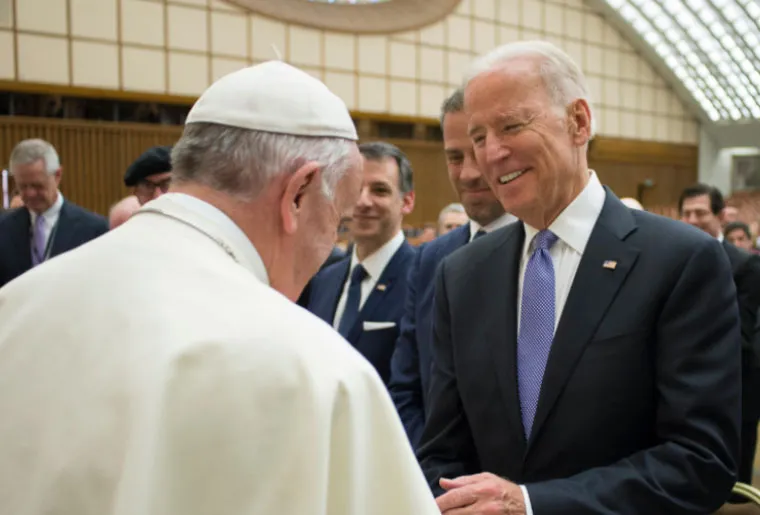
Pope Francis greets then-U.S. Vice President Joe Biden at the Vatican in this April 29, 2016. / Vatican Media
Denver, Colo., Apr 29, 2021 / 21:29 pm (CNA).
Prominent Catholics are passionately responding to a recent Washington Post tweet which said “A rising group of right-wing U.S. Catholic bishops is colliding with a very Catholic president who supports abortion rights.”
Brian Burch, President of Catholic Vote criticized the media’s exaltation of Biden’s supposed Catholicity. “Joe Biden’s press secretary routinely refers to him as ‘devout.’ And without skipping a beat, the Washington Post calls him ‘very Catholic.’”
“For decades public officials have flouted the Church’s call to protect innocent human life,” Burch said. “Now we face the scandal of a president who professes to be Catholic but calls for the destruction of innocent unborn children, and he forces those who object to pay for it anyway.”
The April 29 Washington Post article noted that there is a deep political divide within the Catholic Church. Specifically, the Post brought to light the heated debate within the Church over President Biden’s permissibility to receive Holy Communion while he publicly supports abortion and many other laws which defy Church teaching.
“The bishops need two-thirds of their conference to move forward with a document, and experts disagree about what two-thirds of the men will agree upon when it comes to this topic,” the article said, referring to debate on a pro-abortion politician’s reception of communion.
“The Washington Post realizes perhaps better than some Catholics that if the bishops spoke with courage and unity, that hearts and minds would change on abortion,” Burch said. “And it’s clear that the Washington Post isn’t just covering this story, they’re deeply invested in influencing this debate.”
Burch’s Catholic Vote created a timeline for Catholics, showing all the instances in which President Biden has publicly opposed Catholic teachings.
Grazie Pozo Christie, a Policy Advisor with The Catholic Association, also denounced Biden’s defiance of Catholic teaching.
“The President’s decision to present himself as a devout Catholic, while simultaneously advancing an agenda openly hostile to foundational church teachings from his unique position of power, creates confusion and division” Christie said.
Christie affirmed the bishops’ concern that the message Biden’s contradictory lifestyle is sending, causes pain and unclarity to their flocks.
“It is up to each individual bishop to discern the best course of action for this unfortunate situation which the president himself has created,” Christie told CNA.
Commenting on Biden’s first 100 days in office, former Democratic representative Daniel Lipinski told EWTN Prolife Weekly’s Catherine Hadro on Thursday that Catholics should be different. “Catholics really have an obligation, and an understanding, of what the dignity of the individual means,” he said. “We need to live that out in public life. We should be Catholic first.”
In President Biden’s first 100 days of office he has pushed an aggressive pro-abortion agenda overturning many of the Trump administration’s protections of the unborn, reversing restrictions on federally-funded research using fetal tissue and organs of aborted babies, revoking the Mexico City Policy that prohibits direct funding of abortions abroad, and nominating a slew of pro-choice politicians to key positions in government.
This is in addition to Biden withdrawing support for faith-based women’s shelters that make placements based on sex rather than gender identity, permitting the LGBTI envoy from the Department of State to fly “Pride” flags, appealing the district court to keep transgender mandates in place that destroy conscience protections for medical personnel, signing an executive order mandating single-sex dorms or bathrooms to be available to members of the opposite biological sex at religious colleges and universities, and effectively halting the resettlement of refugees.
If you value the news and views Catholic World Report provides, please consider donating to support our efforts. Your contribution will help us continue to make CWR available to all readers worldwide for free, without a subscription. Thank you for your generosity!
Click here for more information on donating to CWR. Click here to sign up for our newsletter.


Brian Burch of Catholic Vote – “And it’s clear that the Washington Post isn’t just covering this story; they’re deeply invested in influencing this debate”.
Amen and ditto for the rest of the so-called MSM.
Every indication to the world is the President Biden is in complete alignment with a majority of the hierarchy and the laity. “To the most casual observer at an infinite distance” (thanks to Thermo Prof) Biden is a devout catholic. We just have to begin to be clearer on our definitions. There are secular catholics including most bishops in the world. The Holy Father is clearly tending to secular. Then there are many faithful Catholics. We must begin to truly separate the term catholic into these two groups for there to be any rationality in the term. President Biden is a very devout secular catholic. IF we make thorough use of the adjectives secular and faithful then we have a logical and coherent way to continue to use catholic. Is the Pope catholic? Well yes he is a secular catholic who occasionally does something faithful. If WaPo uses this distinction then they will be fine. Either that or the rest of us have to fill in the blank.
This so-called ‘debate’ has been going on for over 30 years.
It’s NOT a debate – either you adhere to Catholic Dogma or you don’t – it’s not complicated at all. The Catholic Church has NEVER said abortion is ok, does not say it’s ok today, and it NEVER will. The fact that so-called ‘catholic’ politicians say it’s ok is irrelevant. The fact that they say it in public and that rags such as the Post who are clueless about the Church quote them and then build a story from that is sad, but really of no concern to faithful Catholics.
Try this – if it’s growing it’s ALIVE.
We are living in a time where TRUTH is being universally denied. Praying sanity returns.
Catholicism has a devastating image problem. If Archbishop Gomez Pres USCCB allows the Washington Post, a Leftist propaganda media to define Catholicism, and continue to respond to Pres Biden’s manifest heresy with feckless understatements, “Christie affirmed the bishops’ concern that the message Biden’s contradictory lifestyle is sending”, it will be the Left that actually controls the message of Catholicism. Causing pain in reality translates causing despondency, loss of faith and exodus from the Church. Biden claims adherence to the teaching of Pope Francis, Pope Francis remains silent a form of approbation, and just as egregious the USCCB remains silent on whether there is a doctrinal cohesion between Biden and Francis. They cannot be ruled by fear of how Pope Francis might react, if for example they had the moral courage to challenge Biden’s claim. Regardless of his unwillingness to respond to the Dubia this instance, because of its open public controversy is sui generis. If silent, that of itself on this openly contested matter convicts. If the Pope refutes Biden’s claim the Pope defends what must be defended during public controversy. As said before the bishops by commission of their ordination are defenders of the faith. If cardinals Parolin, Cupich were to intervene to halt the bishops’ request, they have the moral right to refuse compliance. Whatever and wherever that faith is compromised they are obliged, under grave consequence to address it squarely and openly for the faithful. This is their moment to redeem themselves and strengthen their witness to the faith they swore to defend.
After reviewing my comment it appears I was grasping for straws assuming that the Pontiff could be compelled by the bishops to respond to a supposition. I apologize to the reader.
“Catholicism has a devastating image problem.” That seems to be quite the superficial characterization. The true Catholic Church is indefectible. If the Church has appeared to have defected, then it is the human element which has done so, not the Church herself.
I wish to add my criticism of “feckless” response was not directed at Dr Grazie Pozo Christie of the Catholic Association, rather the bishops’ endless ‘concern’ sans action.
From the Washington Post, we read: ” “The bishops need two-thirds of their conference to move forward with a document, and experts disagree about what two-thirds of the men will agree upon when it comes to this topic.”
Appealing to the very best of American literature (before inauguration of the cancel culture)and our record on split decisions, we’re surely reminded of Mark Twain’s Jim who understood what was self-evident in the split decision confronting the biblical and sane Solomon:
“De’ spute warn’t ’bout a half a chile [or even two-thirds!], de ’spute was ’bout a whole chile; en de man dat think he kin settle a ’spute bout a whole chile wid a half a chile, doan’ know enough to come in out’n de rain” (The Adventures of Huckleberry Finn, 1884).
Even with the “n” word deleted throughout, one wonders if Twain’s masterpiece would ever be restored to school bookshelves, given its violation here of today’s political correctness and nose-counting rationalizations. After all, puppet-master Pelosi already pontificated in the summer of 2013 that even partial-birth abortion is “sacred ground.”
The real vote count: wannabe-pope Biden- 1, Solomon- 0.