

CNA Staff, Apr 28, 2021 / 09:00 am (CNA).
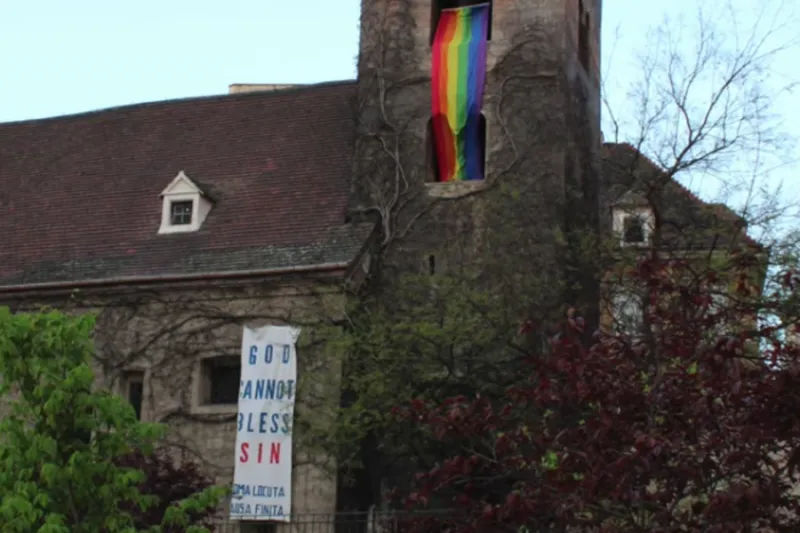
Young Catholics have hung a banner declaring “Roma locuta, causa finita” (Rome has spoken, the case is closed) beneath a rainbow flag on Vienna’s oldest church.
A video posted to YouTube April 26 showed young people climbing up the side of St. Rupert’s Church at night and draping a banner reading in full: “God cannot bless sin. Roma locuta, causa finita.”
The video explained that they took the step after a rainbow flag, also known as the LGBT pride flag, was hung from the church’s tower in protest over the Vatican doctrinal congregation’s “no” to same-sex blessings.
The Congregation for the Doctrine of the Faith (CDF) issued a “Responsum ad dubium” March 15 replying to the question, “does the Church have the power to give the blessing to unions of persons of the same sex?” The CDF answered, “Negative,” outlining its reasoning in an explanatory note and accompanying commentary.
The explanatory note, signed by CDF prefect Cardinal Luis Ladaria, S.J., and secretary Archbishop Giacomo Morandi, stressed that God never ceases to bless all “His pilgrim children.”
“But he does not and cannot bless sin,” it said.
Campaigners in Austria and Germany have announced that they will hold a day for blessings for same-sex partners on May 10 in defiance of the Vatican’s statement, which was issued with the approval of Pope Francis.
Representatives of the group that attached the banner to St. Rupert’s Church told CNA Deutsch, CNA’s German-language news partner, that they regarded the rainbow flag as a “provocation.”
“On the one hand, we wanted to show that such a provocation is not simply tolerated in Vienna and, on the other hand, we hope that this might trigger a rethink among certain officials,” said the representatives of group, known as Christus Vincit, who wished to remain anonymous.
“We also think that such an action can give other Catholics courage and hope. We actually hope that no further actions will be necessary, but should there be another one, it would arise from the same intention, namely to defend the Catholic faith.”
If you value the news and views Catholic World Report provides, please consider donating to support our efforts. Your contribution will help us continue to make CWR available to all readers worldwide for free, without a subscription. Thank you for your generosity!
Click here for more information on donating to CWR. Click here to sign up for our newsletter.


Austria of all places. Amnesiac about past use of the rainbow thingy…
Joseph Stalin, the murderous communist of the twentieth century, gave this secularist mindset a devastating shot in the Soviet Union in 1929. In addition to widespread purges, and to keep the factories on schedule, and finally to plowed under the institutions of religion and the family.
He replaced the seven-day calendar with a five-day calendar. The five work brigades of the “workers paradise” were first branded with numbers but when this didn’t take, each brigade was assigned a color (the original “rainbow coalition”?). The members of individual families were divided into different colors and regimented into different work schedules under the new five-day weeks. Under such state-organized veneer of color-coded diversity gatherings of community and family were impossible, especially for religious observances.
Instead of a synchronized lifting of the social order, the assembly line society suffered slowdowns. Adjustments were made. These included, or course, more re-education, but this fiction would not sell. The seven-day week was finally reinstated in the middle of 1940, such that the Soviet Union could participate in the larger dislocation of World War II in step with the other Allies.
–Lifted from my recent book, reviewed here by CWR: https://www.catholicworldreport.com/2018/03/29/a-generation-abandoned-why-whatever-is-not-enough/
Tsunami is a fitting description for the immoral flood of homosexuality within the Church, celebrated by aficionados in all its diverse forms of which there aren’t sufficient colors to represent. Acts of defiance, interestingly in Austria the home of the crown prince of disordered behavior Cardinal Christoph Maria Michael Hugo Damian Peter Adalbert Graf von Schönborn, OP. Impressive name for an impressive impresario once eminent theologian [the Catechism] today noted for homosexual altarail dance productions at St Stephen’s Cathedral Vienna. Another young Austrian happily famed for attempted murder by drowning of the goddess Pachamamma. Why Austria perhaps an angry reaction to the grotesque caprices of that impresario Cardinal? Tsunamis are caused by hidden deep sea earthquakes. Sexual disorder within the Church long groomed in Darkness seems to have suddenly erupted from beneath the paginal depths of a certain Apostolic exhortation.
Ironic, that non of them shows his face. And how they fix a poster in English on a church in German speaking Vienna. Suspicious
Did any of the martyrs hide their face?