CNA Staff, Mar 26, 2020 / 01:01 pm (CNA).- The British government has published its legal framework for abortion services in Northern Ireland, which will come into force March 31. It allows for elective abortions up to 12 weeks of pregnancy.
“Our guiding principles for this framework are to uphold the protection of women and girls, the promotion of their health and safety, and the provision of clarity and certainty for the healthcare profession, while being responsive and sensitive to the Northern Ireland Executive and Assembly being back up and running,” read a foreward to the framework written by Robin Walker, Minister of State for Northern Ireland.
The Abortion (Northern Ireland) Regulations 2020 also allow abortions up to 24 weeks “in cases where the continuance of the pregnancy would involve risk of injury to the physical or mental health of the pregnant woman or girl, greater than the risk of terminating the pregnancy.”
Abortion access will be permitted with no time limit in cases of severe fetal impairment and fatal fetal abnormalities, i.e. when “there is a substantial risk that the condition of the fetus is such that the death of the fetus is likely before, during or shortly after birth; or if the child were born, it would suffer from such physical or mental impairment as to be seriously disabled,” and when “there is a risk to the life of the woman or girl, greater than if the pregnancy were terminated, or where necessary to prevent grave permanent injury to the physical or mental health of the pregnant woman or girl, including in cases of immediate necessity.”
Doctors, registered nurses, and registered midwives will be allowed to perform abortions. They will be able to do so at General Practitioners premises, and Health and Social Care clinics and hospitals. The Northern Ireland Health Minister will be able to approve further locations for medical abortions.
In elective abortions or in cases of immediate necessity where there is a risk to the life of the mother, only one medical professional is needed to certify that there are lawful grounds for abortion. For abortion on other grounds, two medical professionals must make the certification.
In England, Wales, and Scotland, two medical professionals must certify in all cases that there were lawful grounds for abortion. While consulting on the framework, the government noted that only one doctor’s certification might be appropriate in Northern Ireland, “as it is likely that there will be a more significant number of people raising conscientious objections than in other parts of the UK. This could create practical difficulties, in particular delays in women accessing termination services, if two medical professionals … are required to certify the grounds for an abortion.”
Northern Ireland’s conscientious objection provisions will mirror those of the Abortion Act 1967, which legalized abortion in England, Wales, and Scotland. Under the provisions, “no person shall be under any duty, whether by contract or by any statutory or other legal requirement, to participate in any treatment authorised by the Regulations to which the person has a conscientious objection. The only exception will be where the participation in treatment is necessary to save the life or to prevent grave permanent injury to the physical or mental health of a pregnant woman or girl.”
Conscientious objection will not be extended to “ancillary, administrative and managerial tasks that might be associated” with abortions.
The government wrote that “broadening the scope ‘beyond the participation in treatment’ would have consequences on a practical level and would therefore undermine the effective provision of abortion services in Northern Ireland. For example, fewer people providing ancillary services in relation to abortion could result in fewer appointments and longer waiting times, creating de facto barriers to access, and almost certainly adversely impacting the quality of care and standard of services. The Government is satisfied that the current scope of the conscientious objection provision in the Abortion Act 1967 works satisfactorily in practice, is human rights compliant, and is therefore appropriate to apply in Northern Ireland to the provision of abortion services.
Performing an illegal abortion will be a criminal offense punishable with a fine of up to GBP 5,000 ($6,070), and intentional failure to comply with certification and notification will be punishable with a fine of up to GBP 2,500 ($3,035). These will not apply to the mother, or anyone acting in good faith to save the mother’s life or to prevent grave permanent injurty to her health.
Buffer zones will not be set up around locations where abortions are procured, barring protest in the locations’ immediate vicinity. The government has decided to wait and see what the situation will be, keeping the matter under review so it can “respond to any challenges as needed at the time.”
The new framework was adopted to implement to the Northern Ireland (Executive Formation etc) Act 2019, which decriminalized abortion in Northern Ireland and placed a moratorium on abortion-related criminal prosecutions, and obliged the UK government to create legal access to abortion in the region by March 31.
It was passed while the Northern Ireland Assembly was suspended, though the legislature resumed meeting in January.
Prior to the NI EF Act abortion was legally permitted in the region only if the mother’s life was at risk or if there was risk of long term or permanent, serious damage to her mental or physical health.
Walker wrote in his foreword that despite the restoration of the Northern Ireland Assembly, “the Government remains under a legal duty under section 9 of NI EF Act, and that the government “understands the strength of feeling on this issue and we have always been clear that the best way of bringing forward reform in this area would have been for the Executive and Assembly to take this forward, in the best interests of Northern Ireland.”
The framework was adopted following a consultation in November and December 2019 which asked 15 questions regarding particularities of how legal abortion provision should be made in Northern Ireland. The consultation was based on a proposed framework.
More than 21,200 responses to the consultation were received. Of the responses, 79% “expressed a view registering their general opposition to any abortion provision in Northern Ireland beyond that which is currently permitted.”
“The Government appreciates the wide range of consultation responses received and we are extremely thankful to all individuals and organisations who took the time to respond,” Walker wrote. “We also recognise that there are a wide range views on these sensitive policy issues, which we have carefully considered and sought to ensure are appropriately reflected in the Government’s response to the consultation.”
He said that “in considering the consultation responses, we have sought to balance the range of views against our legal obligations, and taken pragmatic decisions informed by evidence, in order to bring forward a new legislative framework that will be operationally sound, that works best for Northern Ireland and that delivers on the Government’s duty.”
The government said it “particularly reflected” on the consultations provided by “respondents with experience or expertise in terms of operational workability and proper access to services on the ground in Northern Ireland.”
The adopted framework closely mirrors the proposed framework.
The 12 week limit for elective abortions was adopted “to allow access for victims of sexual crime (i.e. rape and incest)” and because, the government said, “introducing a framework which creates barriers to access is unlikely to reduce the rate of terminations, but would rather be likely to lead to women buying abortion pills online, unlawfully, with attendant health risks, rather than accessing safe services.”
Many of the provisions were adopted to be in line with existing law in England, Wales, and Scotland.
Carla Lockhart, a newly-elected MP for a Northern Irish constituency who is a member of the Democratic Unionist Party, said the adopted framework “ignores the devolution settlement and the overwhelming viewpoint of the Northern Ireland people.”
Northern Ireland rejected the Abortion Act 1967, and bills to legalize abortion in cases of fatal fetal abnormality, rape, or incest failed in the Northern Ireland Assembly in 2016.
The amendment to the NI EF Act obliging the government to provide for legal abortion in Northern Ireland was introduced by Stella Creasy, a Labour MP who represents a London constituency.
In October 2019, the High Court in Belfast had ruled that the region’s ban on the abortion of unborn children with fatal abnormalities violated the UK’s human rights commitments.
Northern Irish women have been able to procure free National Health Service abortions in England, Scotland, and Wales since November 2017.
[…]
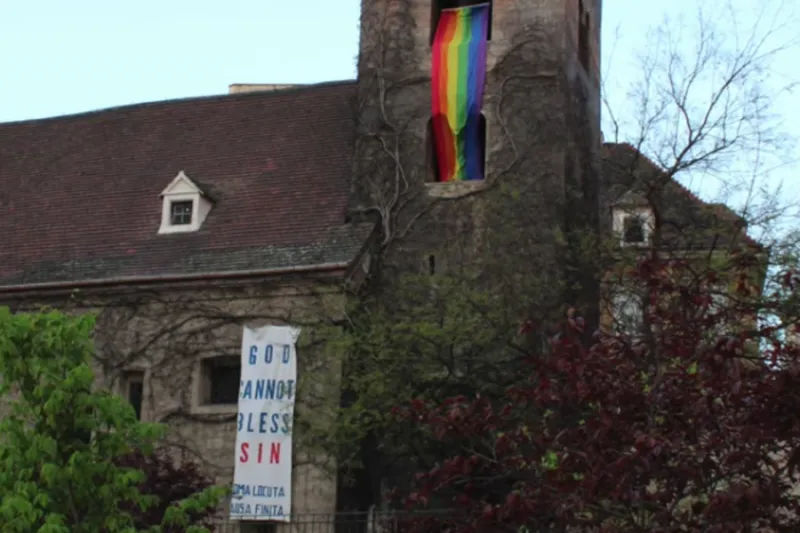
Austria of all places. Amnesiac about past use of the rainbow thingy…
Joseph Stalin, the murderous communist of the twentieth century, gave this secularist mindset a devastating shot in the Soviet Union in 1929. In addition to widespread purges, and to keep the factories on schedule, and finally to plowed under the institutions of religion and the family.
He replaced the seven-day calendar with a five-day calendar. The five work brigades of the “workers paradise” were first branded with numbers but when this didn’t take, each brigade was assigned a color (the original “rainbow coalition”?). The members of individual families were divided into different colors and regimented into different work schedules under the new five-day weeks. Under such state-organized veneer of color-coded diversity gatherings of community and family were impossible, especially for religious observances.
Instead of a synchronized lifting of the social order, the assembly line society suffered slowdowns. Adjustments were made. These included, or course, more re-education, but this fiction would not sell. The seven-day week was finally reinstated in the middle of 1940, such that the Soviet Union could participate in the larger dislocation of World War II in step with the other Allies.
–Lifted from my recent book, reviewed here by CWR: https://www.catholicworldreport.com/2018/03/29/a-generation-abandoned-why-whatever-is-not-enough/
Tsunami is a fitting description for the immoral flood of homosexuality within the Church, celebrated by aficionados in all its diverse forms of which there aren’t sufficient colors to represent. Acts of defiance, interestingly in Austria the home of the crown prince of disordered behavior Cardinal Christoph Maria Michael Hugo Damian Peter Adalbert Graf von Schönborn, OP. Impressive name for an impressive impresario once eminent theologian [the Catechism] today noted for homosexual altarail dance productions at St Stephen’s Cathedral Vienna. Another young Austrian happily famed for attempted murder by drowning of the goddess Pachamamma. Why Austria perhaps an angry reaction to the grotesque caprices of that impresario Cardinal? Tsunamis are caused by hidden deep sea earthquakes. Sexual disorder within the Church long groomed in Darkness seems to have suddenly erupted from beneath the paginal depths of a certain Apostolic exhortation.
Ironic, that non of them shows his face. And how they fix a poster in English on a church in German speaking Vienna. Suspicious
Did any of the martyrs hide their face?
