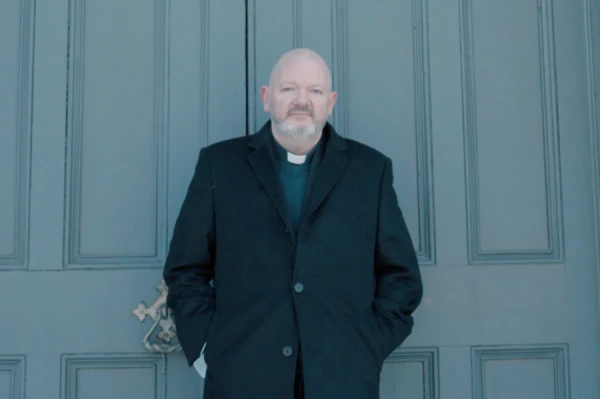
Canon Tom White, who is challenging Scotland’s ban on public worship. / Photo courtesy of ADF International.
CNA Staff, Mar 10, 2021 / 09:00 am (CNA).- A Catholic priest will proceed with a challenge to the Scottish government’s ban on public worship on Thursday despite an announcement that restrictions will be lifted earlier than previously expected.
Canon Tom White will press ahead with the hearing at Scotland’s supreme civil court on March 11-12 in the hope of discouraging future bans on public Masses.
Scotland’s First Minister Nicola Sturgeon said on March 9 that public worship would be restored from March 26 — rather than early April, as she had previously announced — as long as certain conditions were fulfilled.
“This is in time for Passover, Easter, Ramadan, and Vaisakhi,” she said, referring to Jewish, Christian, Muslim, and Sikh celebrations.
A cap on the number of worshipers will be raised from 20 to 50, where buildings can accommodate that number of people keeping around six feet apart.
Sturgeon said: “This change is relatively minor, it is proportionate, which we believe can be achieved relatively safely, and which will hopefully enable more people to draw strength, comfort, and inspiration from acts of collective worship.”
Scotland, which has a population of 5.5 million, has recorded 206,465 cases of COVID-19 and 7,441 deaths as of March 10, according to the Johns Hopkins Coronavirus Resource Center. It reported 691 new cases and a further 20 deaths on March 10.
White’s legal challenge will be presented on Thursday at the Court of Session in Edinburgh by Aidan O’Neill, QC. The human rights advocate will argue that the ban is unconstitutional and incompatible with the European Convention on Human Rights.
White is pastor of St. Alphonsus Church in Glasgow, as well as dean of the City East Deanery and canon of St Andrew’s Cathedral Chapter. His parish includes three of the most deprived areas of the U.K.
CNA reported last month that White had filed a pre-action letter with the Scottish government seeking to lift restrictions. The priest is using a crowdfunding site to cover the costs of the legal challenge.
Ryan Christopher, director of the Christian legal group ADF UK, which is backing the case, said: “While the decision to eventually reopen churches after almost three months is a step in the right direction, it is important for the court to decide whether this ban was truly justified — especially as there is a good chance such measures could be repeated in the future.”
Scotland’s Catholic bishops called earlier this month for “dialogue” with government officials over the cap on worshipers.
In a March 1 statement, they welcomed plans to permit public worship.
“At the same time,” they said, “we anticipate ongoing dialogue with the Scottish Government regarding the requirement of a numerical ‘cap’ on the number of worshipers.”
The bishops argued that numbers should be dictated instead by the size of church buildings.
Public worship was first suspended in Scotland on March 19, 2020. Masses with congregations were permitted to resume from July 15.
The Scottish government suspended public worship again on Jan. 4 this year, although it continued to be permitted over the border in England.
White said: “I’m deeply grateful to the Christian and wider community across Scotland and the whole United Kingdom who have generously given their financial support, as well as words of great encouragement, to my legal challenge.”
“Freedom of worship is a human right, and receiving the sacraments is as vital to me and my parishioners as receiving food and water. As St Matthew’s Gospel tells us, ‘Man shall not live on bread alone.’”
He continued: “The court must decide if this right was suspended in an unnecessary and disproportionate manner, in order to prevent further undue restrictions in future. I invite all Christians to pray with me over the coming days, that the right decision will be made, and church doors once again opened throughout our country.”
If you value the news and views Catholic World Report provides, please consider donating to support our efforts. Your contribution will help us continue to make CWR available to all readers worldwide for free, without a subscription. Thank you for your generosity!
Click here for more information on donating to CWR. Click here to sign up for our newsletter.
Pope Francis spoke about apostolic zeal and the example of Korean martyr St. Andrew Kim Taegon at the Wednesday general audience in St. Peter’s Square on May 24, 2023. / Vatican Media
Vatican City, May 24, 2023 / 05:26 am (CNA).
St. Andrew Kim Taegon and the other Korean martyrs teach us to have courage when sharing the Gospel, even in the face of difficult situations, Pope Francis said on Wednesday.
At his weekly public audience May 24, the pope spoke about the first Korean-born Catholic priest, who was tortured and beheaded near Seoul, South Korea in 1846 at the age of 25.
St. Andrew Kim Taegon was canonized in 1984 with 102 other Korean martyrs.
Pope Francis pointed out that around 200 years ago in Korea, Christianity was severely persecuted.
“At that time, believing in Jesus Christ in Korea meant being ready to bear witness even unto death,” he said.
“No matter how difficult the situation may be — and indeed, at times it may seem to leave no room for the Gospel message — we must not give up and we must not forsake pursuing what is essential in our Christian life, namely evangelization,” the pope said.
He recalled an event from St. Andrew Kim’s life that illustrates the quality of never giving up.
When the Korean Catholic was a seminarian, he needed to find a way to secretly welcome foreign missionary priests to Korea, since foreigners were forbidden from entering the country.
“One time,” Francis said, the saint “walked as the snow was falling, without eating, for so long that he fell to the ground exhausted, risking unconsciousness and freezing.”
“At that point, he suddenly heard a voice, ‘Get up, walk!’ Hearing that voice, Andrew came to his senses, catching a glimpse of something like a shadow of someone guiding him.”
Pope Francis said “this experience of the great Korean witness makes us understand a very important aspect of apostolic zeal; namely, the courage to get back up when one falls.”
The pope shared another example of St. Andrew’s courage in evangelization.
Given the situation at the time, to confirm the Christian identity of others, they would agree ahead of time upon a sign of recognition.
“Then the saint would surreptitiously ask the question, but all quietly: ‘Are you a disciple of Jesus?’” Francis explained. “Since other people were watching the conversation, the saint had to speak in a low voice, saying only a few words, the most essential ones. So, for Andrew Kim, the expression that summed up the whole identity of the Christian was ‘disciple of Christ.’”
As the example of St. Andrew Kim Taegon shows, the pope said, being a disciple of the Lord “means to follow him, to follow his way, and this involves giving one’s life for the Gospel.”
“The Christian is by nature a missionary and a witness, just as Jesus was a missionary and witness to the Father. Every Christian community receives this identity from the Holy Spirit, and so does the whole Church, since the day of Pentecost,” he said.
Pope Francis said seeing the example of these great saints, we might wonder to ourselves how we can evangelize in our own lives.
We can do this in our own, small way, he said, “evangelizing family, evangelizing friends, talking about Jesus, but talking about Jesus and evangelizing with a heart full of joy, full of strength.”
“Let us prepare ourselves,” he added, “to receive the Holy Spirit in the coming Pentecost and ask him for that grace, the grace of apostolic courage, the grace to evangelize, to always carry on the message of Jesus.”
The pope’s catechesis on St. Andrew Kim Taegon was part of a series on apostolic zeal.
Thousands of pro-life advocates gathered outside the U.S. Supreme Court in Washington, D.C., on Dec. 1, 2021, in conjunction with oral arguments in the Dobbs v. Jackson Women’s Health Organization abortion case. / Katie Yoder/CNA
Washington D.C., Dec 2, 2021 / 08:04 am (CNA).
Anna Del Duca and daughter, Frances, woke up at 5 a.m. Wednesday morning to brave the 30-degree weather outside the U.S. Supreme Court in Washington, D.C. They arrived hours before oral arguments began in the highly-anticipated abortion case, Dobbs v. Jackson Women’s Health Organization.
The case, which involves a Mississippi law restricting most abortions after 15 weeks, challenges two landmark decisions: Roe v. Wade, the 1973 ruling that legalized abortion nationwide, and Planned Parenthood v. Casey, which upheld Roe in 1992.
“We’re looking forward to the end of Roe versus Wade in our country,” Anna, who drove from Pittsburgh Tuesday night, told CNA. In her hands, she held a sign reading, “I regret my abortion.”
Anna Del Duca (right) and her daughter, Frances, traveled from Pittsburgh to attend a pro-life rally outside the U.S. Supreme Court on Dec. 1, 2021, in conjunction with oral arguments for the Dobbs v. Jackson Women’s Health Organization abortion case. Katie Yoder/CNA
“I would like to use my testimony to be a blessing to others,” she said, so that “others will choose life or those who have regretted abortion or had an abortion would turn to Jesus.”
Anna remembered having an abortion when she was just 19. Today, she and her daughter run a group called Restorers of Streets to Dwell In Pittsburgh that offers help to women seeking healing after abortion.
Anna and Frances were among thousands of Americans who rallied outside the Supreme Court before, during, and after the oral arguments. To accommodate them, law enforcement closed the street in front of the court. Capitol police also placed fencing in the space in front of the building in an attempt to physically separate rallies held by abortion supporters and pro-lifers.
At 21-weeks pregnant, pro-life speaker Alison Centofante emceed the pro-life rally, called, “Empower Women Promote Life.” The event featured a slew of pro-life women of diverse backgrounds and numerous politicians.
“It’s funny, there were so many diverse speakers today that the only unifying thread was that we want to protect preborn children,” Centofante told CNA. They included Democrats, Republicans, Christians, Catholics, agnostics, atheists, women who chose life, and women who regretted their abortions, she said.
She recognized women there, including Aimee Murphy, as people who are not the typical “cookie cutter pro-lifer.”
Aimee Murphy, 32, founder of pro-life group Rehumanize International, arrived at the Supreme Court around 6:30 a.m. She drove from Pittsburgh the night before. Her sign read, “Queer Latina feminist rape survivor against abortion.”“At Rehumanize International, we oppose all forms of aggressive violence,” she told CNA. “Even as a secular and non-partisan organization, we understand that abortion is the most urgent cause that we must stand against in our modern day and age because it takes on average over 800,000 lives a year.”
She also had a personal reason for attending.
“When I was 16 years old, I was raped and my rapist then threatened to kill me if I didn’t have an abortion,” she revealed.
“It was when he threatened me that I felt finally a solidarity with unborn children and I understood then that, yeah, the science told me that a life begins at conception, but that I couldn’t be like my abusive ex and pass on the violence and oppression of abortion to another human being — that all that I would be doing in having an abortion would be telling my child, ‘You are an inconvenience to me and to my future, therefore I’m going to kill you,’ which is exactly the same thing that my rapist was telling me when he threatened to kill me.”
On the other side of the police fence, the Center for Reproductive Rights and the National Abortion Access Coalition and NARAL Pro-Choice America participated in another rally. Yellow balloons printed with the words “BANS OFF OUR BODIES” escaped into the sky. Several pro-choice demonstrators declined to speak with CNA.
Voices clashed in the air as people, the majority of whom were women, spoke into their respective microphones at both rallies. Abortion supporters stressed bodily autonomy, while pro-lifers recognized the humanity of the unborn child. Chants arose from both sides at different points, from “Whose choice? My choice!” to “Hey hey, ho ho, Roe v. Wade has got to go!”
At 10 a.m., the pro-life crowd sudddenly went silent as the oral arguments began and the rally paused temporarily as live audio played through speakers.
Hundreds of students from Liberty University in Lynchburg, Virginia, traveled to Washington, D.C. for a pro-life rally outside the U.S. Supreme Court on Dec. 1, 2021, in conjunction with oral arguments in the Dobbs v. Jackson Women’s Health Organization abortion case. Katie Yoder/CNA
During the oral arguments, students from Liberty University knelt in prayer. One student estimated that more than a thousand students from the school made the more than 3-hour trip from Lynchburg, Virginia.
“Talking about our faith is one thing, but actually acting upon it is another,” he said. “We have to be the hands and feet of Jesus Christ. So to me this is part of doing that.”
Sister Mary Karen, who has been with the Sisters of Life for 21 years, also stressed the importance of prayer. She drove from New York earlier that morning because, she said, she felt drawn to attend. She came, she said, to pray for the country and promote the dignity of a human person.
“Our culture is post-abortive,” she explained. “So many people have suffered and the loss of human life is so detrimental, just not knowing that we have value and are precious and sacred.”
Theresa Bonopartis, of Harrison, New York, was among the pro-life demonstrators outside the U.S. Supreme Court on Dec. 1, 2021. She runs a nonprofit group called Entering Canaan that ministers to women and others wounded by abortion. Katie Yoder/CNA
She stood next to Theresa Bonopartis, who traveled from Harrison, New York, and ministers to women and others wounded by abortion.
“I’ve been fighting abortion for 30 years at least,” she told CNA.
Her ministry, called Entering Canaan, began with the Sisters of Life and is observing its 25th anniversary this year. It provides retreats for women, men, and even siblings of aborted babies.
Abortion is personal for Bonopartis, who said she had a coerced abortion when she was just 17.
“I was kicked out of the house by my father and then coerced into getting an abortion,” she said. “Pretty much cut me off from everything, and that’s something people don’t really talk about … they make it try to seem like it’s a woman’s right, it’s a free choice. It’s all this other stuff, but many women are coerced in one way or another.”
She guessed that she was 14 or 15 weeks pregnant at the time.
“I saw my son. I had a saline abortion, so I saw him, which I always considered a blessing because it never allowed me to deny what abortion was,” she said. Afterward, she said she struggled with self-esteem issues, hating herself, guilt, shame, and more. Then, she found healing.
“I know what that pain is like, I know what that experience is like, and you know that you can get past it,” she said. “You just want to be able to give that message to other people, that they’re able to heal.”
Residents of Mississippi, where the Dobbs v. Jackson case originated, also attended.
Marion, who declined to provide her last name, drove from Mississippi to stand outside the Supreme Court. She said she was in her early 20s when Roe v. Wade was decided in 1973.
“At the time, of course, I could care less,” she said. Since then, she had a change of heart.
“We were the generation that allowed it,” she said, “and so we are the generation who will help close that door and reverse it.”
Marion, who declined to provide her last name, was among those who attended a pro-life rally outside the U.S. Supreme Court on Dec. 1, 2021, from Mississippi, where the Dobbs v. Jackson Women’s Health Organization abortion case originated. Katie Yoder/CNA
The crowd at the pro-life rally included all ages, from those who had witnessed Roe to bundled-up babies, children running around, and college students holding up homemade signs.
One group of young friends traveled across the country to stand outside the Supreme Court. They cited their faith and family as reasons for attending.
Mathilde Steenepoorte, 19, from Green Bay, Wisconsin, identified herself as “very pro-life” in large part because of her younger brother with Down syndrome. She said she was saddened by the abortion rates of unborn babies dianosed with Down syndrome.
Juanito Estevez, from Freeport, a village on Long Island, New York, at a pro-life rally outside the U.S. Supreme Court on Dec. 1, 2021. Katie Yoder/CNA
Juanito Estevez, from Freeport, a village on Long Island, New York, arrived Tuesday. He woke up at 6 a.m. to arrive at the Supreme Court with a crucifix in hand.
“I believe that God is the giver of life and we don’t have the right [to decide] whether a baby should live or die,” he said.
He also said that he believed women have been lied to about abortion.
“We say it’s their right, and there’s a choice,” he said. When girls tell him “I have the right,” his response, he said, is to ask back, “You have the right for what?”
Mallory Finch, from Charlotte, North Carolina, was among the pro-life demonstrators outside the U.S. Supreme Court on Dec. 1, 2021.
Mallory Finch, from Charlotte, North Carolina, also woke up early but emphasized “it was worth it.” A pro-life podcast host, she called abortion a “human-rights issue.”
“I hope that it overturns Roe,” she said of the case, “but that doesn’t mean that our job as pro-lifers is done. It makes this, really, just the beginning.”
CompassCare, a pro-life pregnancy center near Buffalo, New York, was heavily damaged by fire and spray-painted with pro-abortion graffiti on June 7, 2022. / CompassCare
Washington, D.C. Newsroom, Jun 7, 2022 / 13:43 pm (CNA).
A pro-life pregnan… […]
Leave a Reply
