Washington D.C., Mar 3, 2021 / 11:00 am (CNA).- A campaign finance bill under consideration in the House could present grave concerns for religious liberty, an opponent of the bill told CNA.
Earlier this month, House Speaker Nancy Pelosi introduced the For the People Act of 2021 (H.R. 1), alongside Reps. Zoe Lofgren (D-Calif.) and John Sarbanes (D-Md.), saying the bill is necessary because the state of American democracy is in “deep disrepair.”
But some opponents of the bill–including pro-life groups–have warned of First Amendment implications to religious freedom and free speech.
Hans von Spakovsky, manager of the Election Law Reform Initiative and Senior Legal Fellow at the Meese Center for Legal and Judicial Studies at the Heritage Foundation, told CNA in an interview that he considers the For the People Act of 2021 the worst bill he’s seen in his 20 years in Washington.
“It’s filled with so many unconstitutional provisions,” he said. “I think it would change the face of American politics.” He said it could even impose a religious test on people seeking to serve on redistricting commissions.
Among the bill’s provisions is one that would take away the power to draw congressional districts from state legislatures and grant it instead to “independent redistricting commissions.” In order to serve on such a commission, an individual would need to meet certain criteria, including disclosing “any involvement with, or financial support of, professional, social, political, religious, or community organizations or causes.”
That language could amount to the implementation of a religious test, von Spakovsky said.
“It’s very concerning that to get on a commission like this you have to disclose which church, which religion, you’re a member of,” he said, adding “it would discourage individuals from participating.”
Pro-life groups have come out in opposition to the bill as well. March for Life Action shared its concerns about the legislation to CNA in January, that pro-life donors could be subject to unnecessary public harassment.
The Susan B. Anthony List (SBA List) said in a letter to members of Congress that the legislation would put “onerous and unworkable regulatory standards on the ability of pro-life voters and the pro-life community to discuss policy issues with elected officials and the public.”
“It would subject citizens who contribute to nonprofit organizations to harassment and intimidation by making their personal information available in a government-controlled data base, and through an expansion of the definition of ‘electioneering communications’ it would subject virtually all issue-related ads to burdensome disclaimer requirements,” SBA List said.
Carol Tobias, president of National Right to Life, warned that the bill “would allow lawmakers to employ the threat of criminal sanctions to reduce the amount of private speech regarding the actions of the lawmakers themselves.”
The White House supports the legislation, with President Biden issuing a statement Monday saying that his administration “supports House passage of H.R. 1, the For the People Act of 2021.”
“In the wake of an unprecedented assault on our democracy, a never before seen effort to ignore, undermine, and undo the will of the people, and a newly aggressive attack on voting rights taking place right now all across the country, this landmark legislation is urgently needed to protect the right to vote and the integrity of our elections, and to repair and strengthen American democracy,” the statement said.
The statement added that as with any bill “of this scope and complexity,” it intends to work with Congress “to refine provisions of H.R. 1 as it proceeds through the legislative process to ensure that the bill achieves lasting reform consistent with Congress’ broad constitutional authority to strengthen our democracy.”
The ACLU opposed a 2019 version of the bill and has criticized portions of the 2021 bill, but has not formally opposed the latest version.
If you value the news and views Catholic World Report provides, please consider donating to support our efforts. Your contribution will help us continue to make CWR available to all readers worldwide for free, without a subscription. Thank you for your generosity!
Click here for more information on donating to CWR. Click here to sign up for our newsletter.
Anti-death penalty activists, including members of MoveOn.org and other advocacy groups, rally outside the U.S. Supreme Court to prevent the execution of Oklahoma inmate Richard Glossip on Sept. 29, 2015, in Washington, D.C. / Credit: Larry Fren… […]
Father J.J. Mech, rector of the Cathedral of the Most Blessed Sacrament in Detroit, stands next to the life-sized statues of the apostles that have now been installed in the cathedral’s worship space, along with first-class relics of each apostle. The “Journey with the Saints” pilgrimage, which will be dedicated Feb. 8, 2024, in a special ceremony with Archbishop Allen H. Vigneron, is part of the cathedral’s ongoing transformation into an “apostolic center for the arts and culture.” / Credit: Photo courtesy of the Cathedral of the Most Blessed Sacrament and Detroit Catholic
Detroit, Mich., Jan 29, 2024 / 06:00 am (CNA).
At the Cathedral of the Most Blessed Sacrament in Detroit, the band is getting back together. The band of Christ’s 12 apostles, that is.
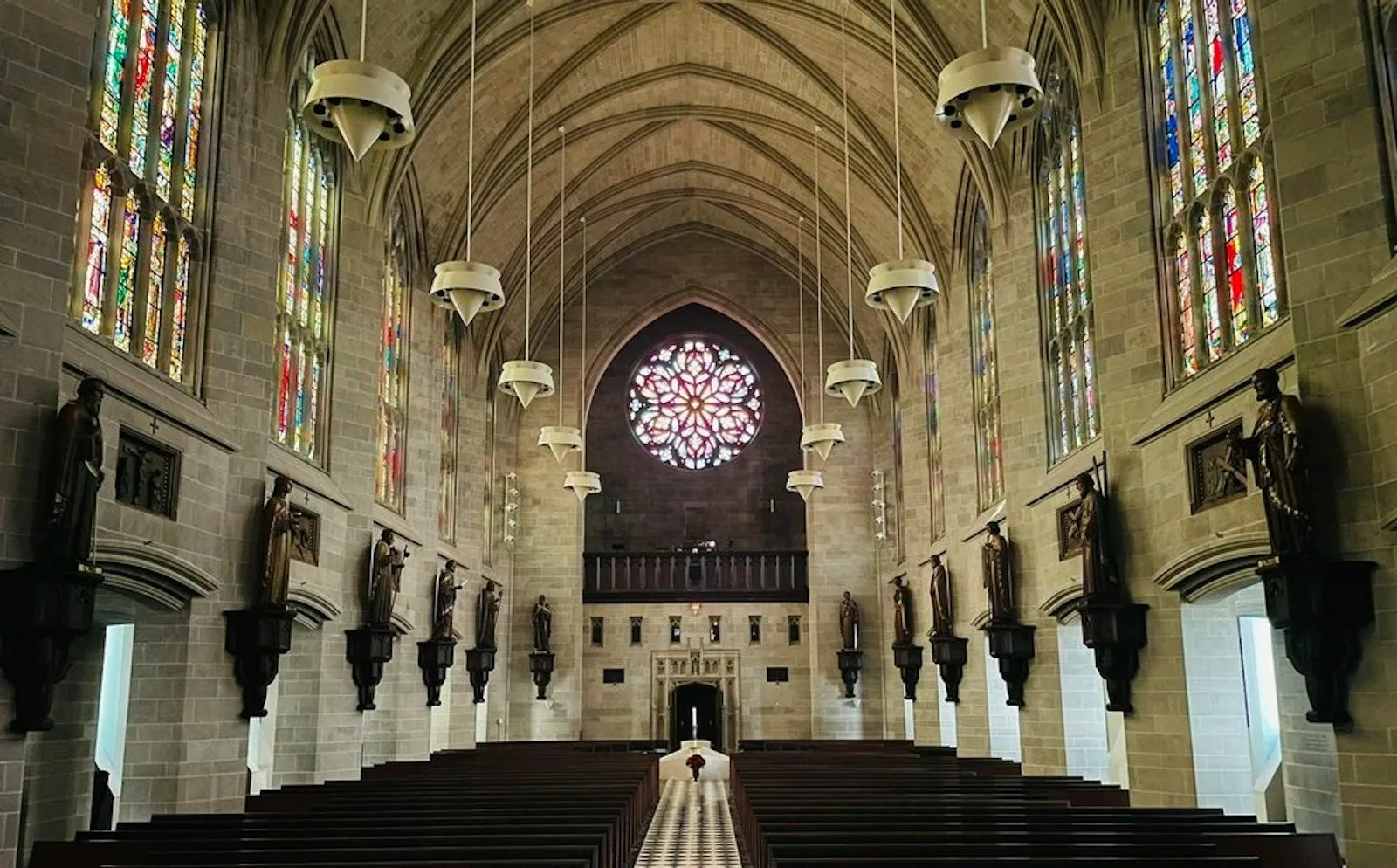
On Feb. 8, Detroit’s mother church will publicly unveil its long-awaited “Journey with the Saints” project, a permanent installation of 14 “larger than life” statues accompanied by first-class relics of each apostle, the latest accomplishment in the cathedral’s ongoing mission to turn itself into an apostolic center in the city of Detroit.
Archbishop Allen H. Vigneron will join Father J.J. Mech, rector of the cathedral, to dedicate the new installation during a special event at 7 p.m.
From its central perch on Woodward Avenue, the looming gothic cathedral of the Archdiocese of Detroit stands out in its neighborhood. Following Vigneron’s instruction to turn the church into a “cathedral of the arts,” Mech has spent the last several years converting the cathedral into a hub of missionary activity and beauty, drawing people to the faith via “shallow entry points.”
“Our goal is that we are going to be more accessible to people off of Woodward,” Mech told Detroit Catholic. “We want this to be a flexible public space, maybe even a community hub for not only spiritual enrichment but cultural enrichment, and it will be a safe place, and we will have security and all of that.”
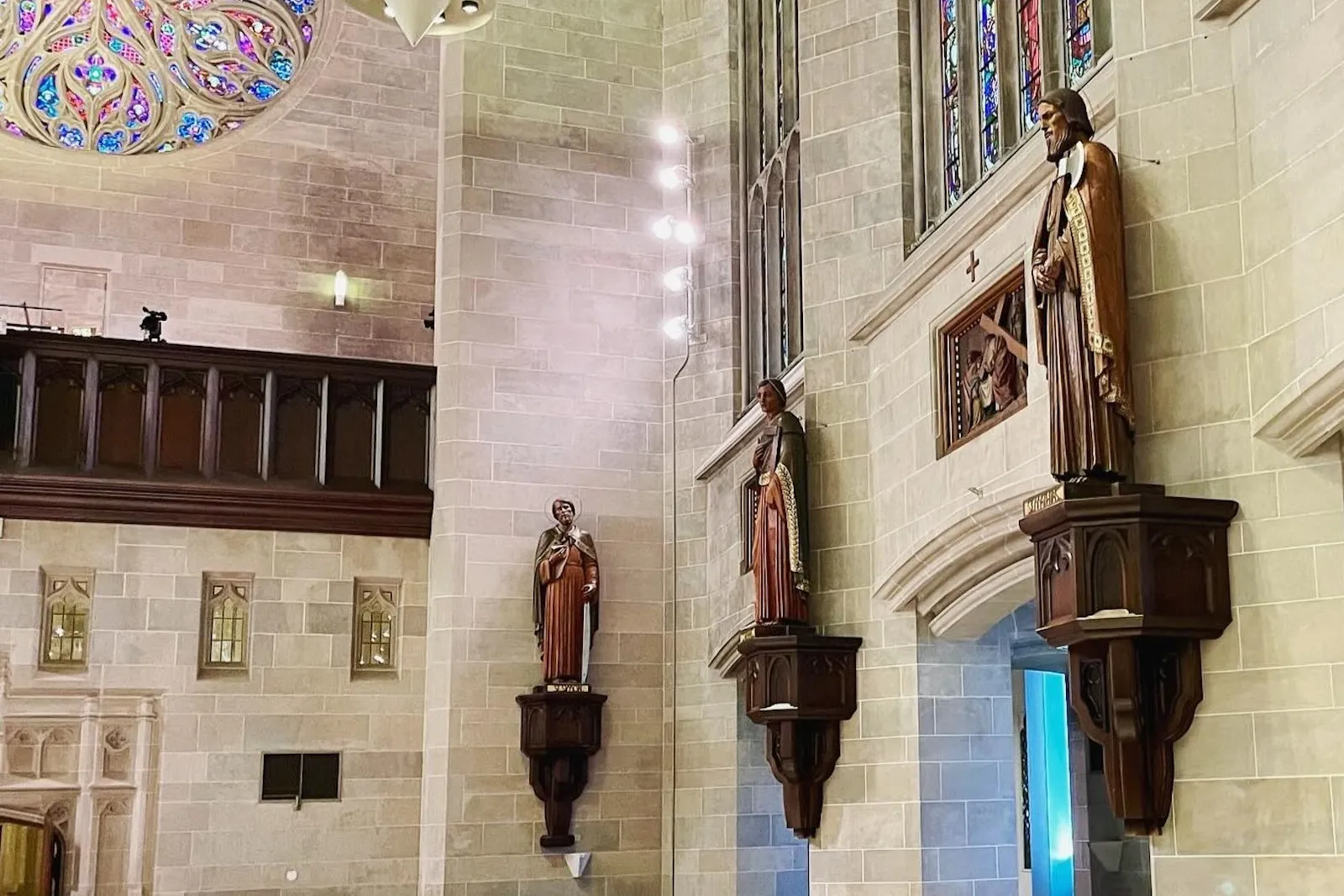
St. Simon, St. Thomas, and St. Matthias are pictured in their permanent fixtures atop the pillars inside the Cathedral of the Most Blessed Sacrament. The statues and relics of the apostles will be officially unveiled Feb. 8, 2024, as part of a permanent pilgrimage experience at the cathedral, “Journey with the Saints.” Credit: Photo courtesy of Detroit Catholic
The name “Cathedral of the Arts,” Mech explained, is a reminder that the proof of God is beauty — a principle that guides each of the new initiatives he and his team have undertaken on the cathedral’s campus.
The latest project, the installation of the seven-and-a-half-foot-tall statues and relics encircling the cathedral’s interior worship space, is the crowning jewel of those efforts, transforming the cathedral into a permanent pilgrimage site, guided by the men who knew Christ most intimately during his time on earth.
Complete with first-class relics, the new installation is among the first of its kind in North America bringing together all 12 of Christ’s apostles for veneration, and the only exhibit in the world with the relics accessible in this way.
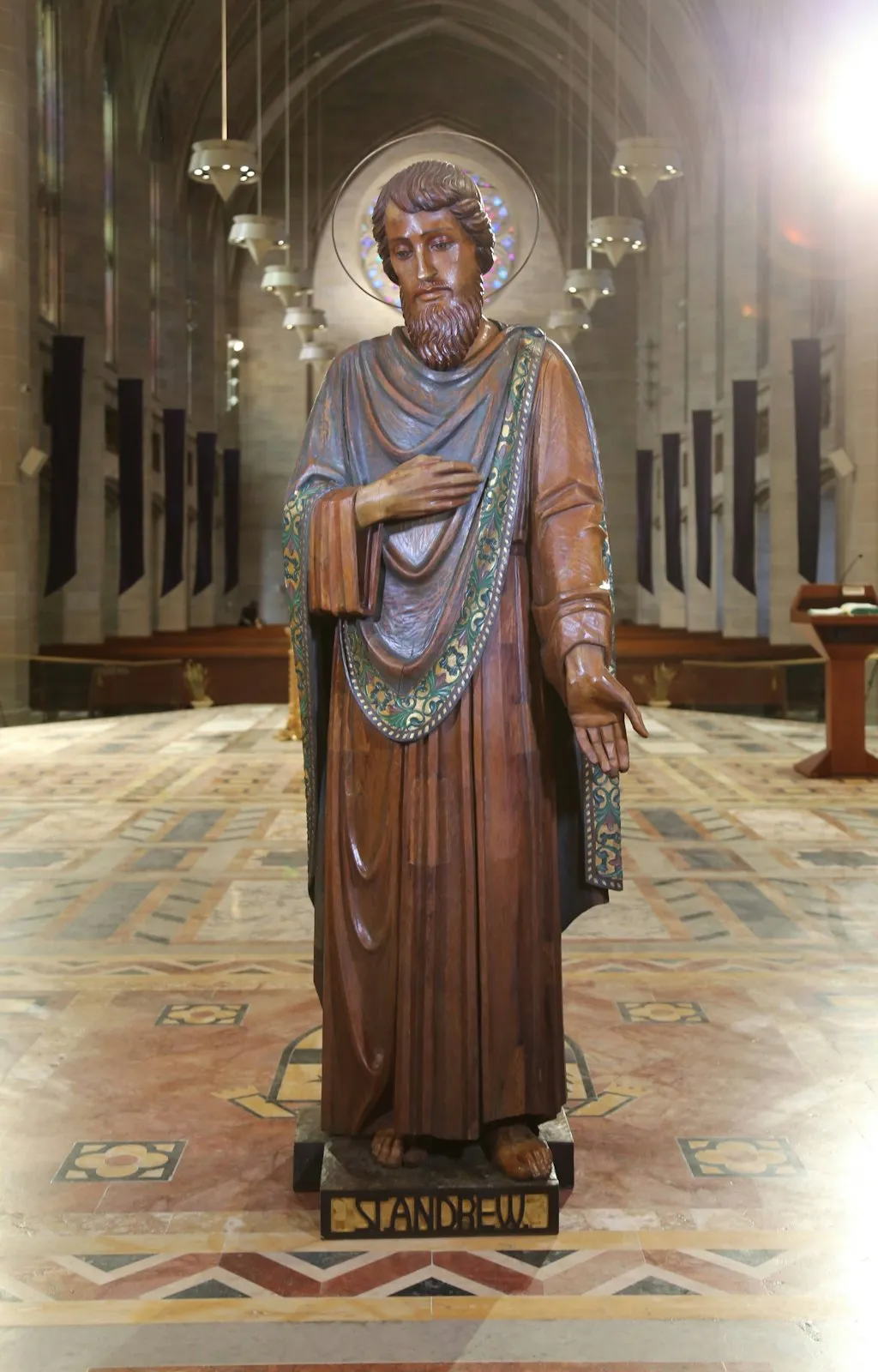
The 14 statues — including two eight-foot angels — each were carved from a single tree trunk in St. Ulrich Groeden, in modern-day Italy, in 1927. The statues were rescued from St. Benedict Church in Highland Park, which closed in 2014. After undergoing extensive restoration, the statues were installed in the cathedral’s nave in December.
The statue of St. Andrew. Each of the statues were carved from a single tree trunk and rescued from St. Benedict Church in Highland Park, which closed in 2014. After undergoing extensive restoration, the statues were installed in the cathedral’s nave in December 2023. Credit: Photo courtesy of Detroit Catholic
The statues include two angels, 10 of the original 12 apostles, St. Paul, and St. Matthias, the apostle who replaced Judas. Mech discovered that he had relics corresponding to the 12 saints, part of a collection of nearly 200 relics owned by the cathedral, all of which he hopes to be able to one day put on display.
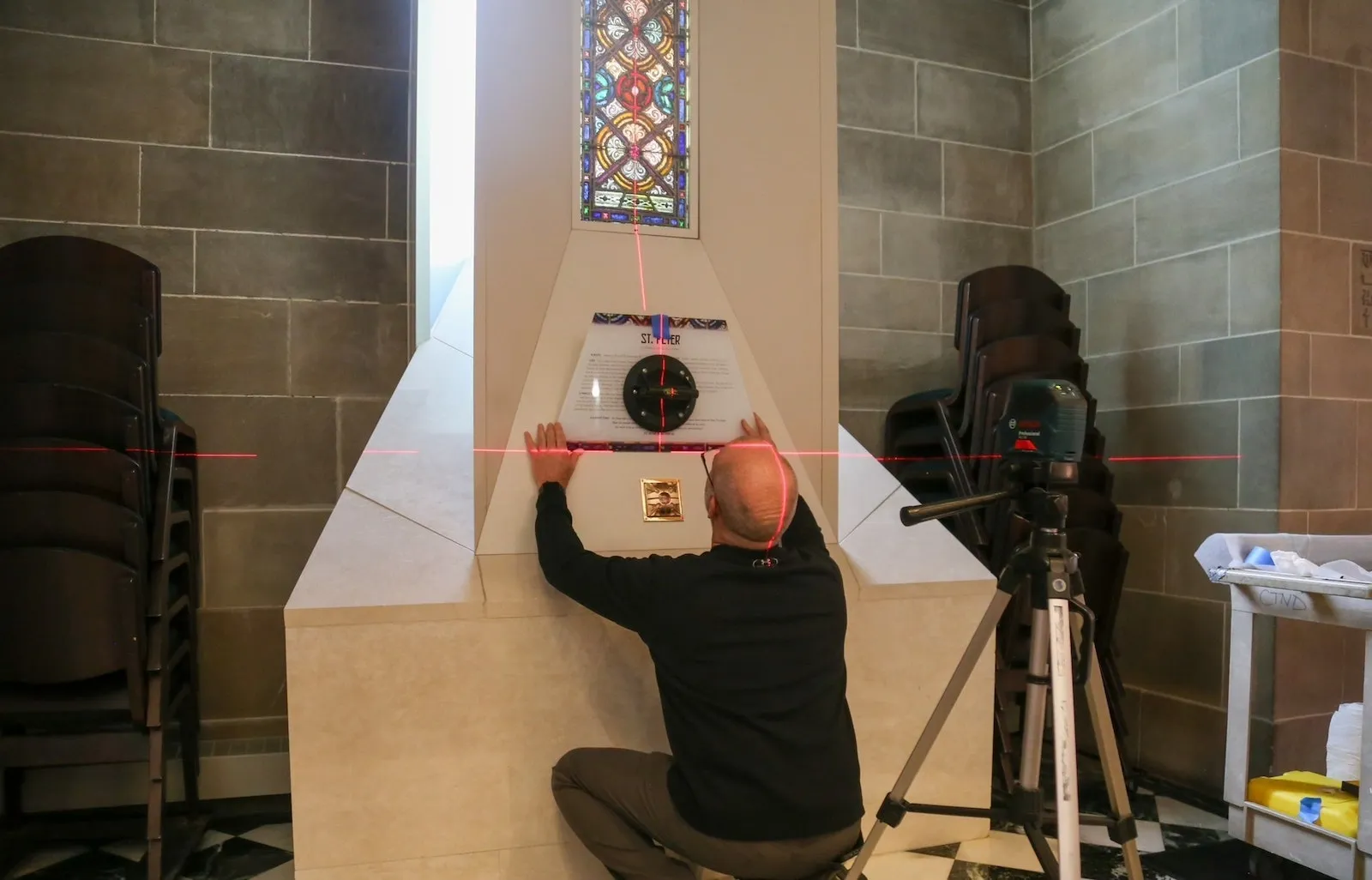
The relics and the signage were installed beneath each statue beginning on Jan. 8, in time for the dedication and blessing of the new reliquary pilgrimage on Feb. 8.
“I am so excited about the transformation that is happening,” Mech said. “When you come in, there will be three main signs that tell you how to go on a pilgrimage, what the goal of a pilgrimage is, and how to interact with these relics. [Pilgrims] are going to walk away transformed, different, and they are going to enter through prayer.”
“Journey with the Saints” is much more than a museum of Church history, Mech said, but a rare opportunity to invoke the help of Catholicism’s greatest saints.
“It’s not just about looking at a pretty statue and touching some bones. [Pilgrims] are going to have a purpose when they walk away,” Mech said. “People can decide what they want intercession for, what they are hoping for when they pray to a particular saint, and when they walk away, they’ll keep praying for that.”
Keith Calleja began installation of relics on Jan. 8, 2024, starting with the relic of St. Philip. Credit: Photo courtesy of Detroit Catholic
Mech said those whose prayers have been answered through the intercession of the saints will be invited to return to the cathedral and contribute a tile to a mosaic art piece that will be installed to show how God is answering prayers through the project.
While the saints and relics are the culmination of a long-sought project, it’s all part of a greater vision for Detroit’s cathedral, Mech said.
Another piece of the puzzle will be dedicated on May 12, when Archbishop Vigneron will unveil a new outdoor grotto at the cathedral in honor of the Blessed Virgin Mary.
During the height of the coronavirus pandemic in 2020, as the archbishop emotionally addressed the faithful during a livestreamed Mass from the cathedral, he entrusted the archdiocese to the protection of Our Lady of Lourdes and pledged to build the grotto “as a perpetual reminder” of her care and in memory of the lives lost to COVID-19.
Under the guidance of the archbishop, the Cathedral of the Most Blessed Sacrament finished a majority of the work on the grotto this fall, including statues of St. Bernadette Soubirous and Our Lady, whose face will reflect the one St. Bernadette saw in Lourdes, France, in 1858.
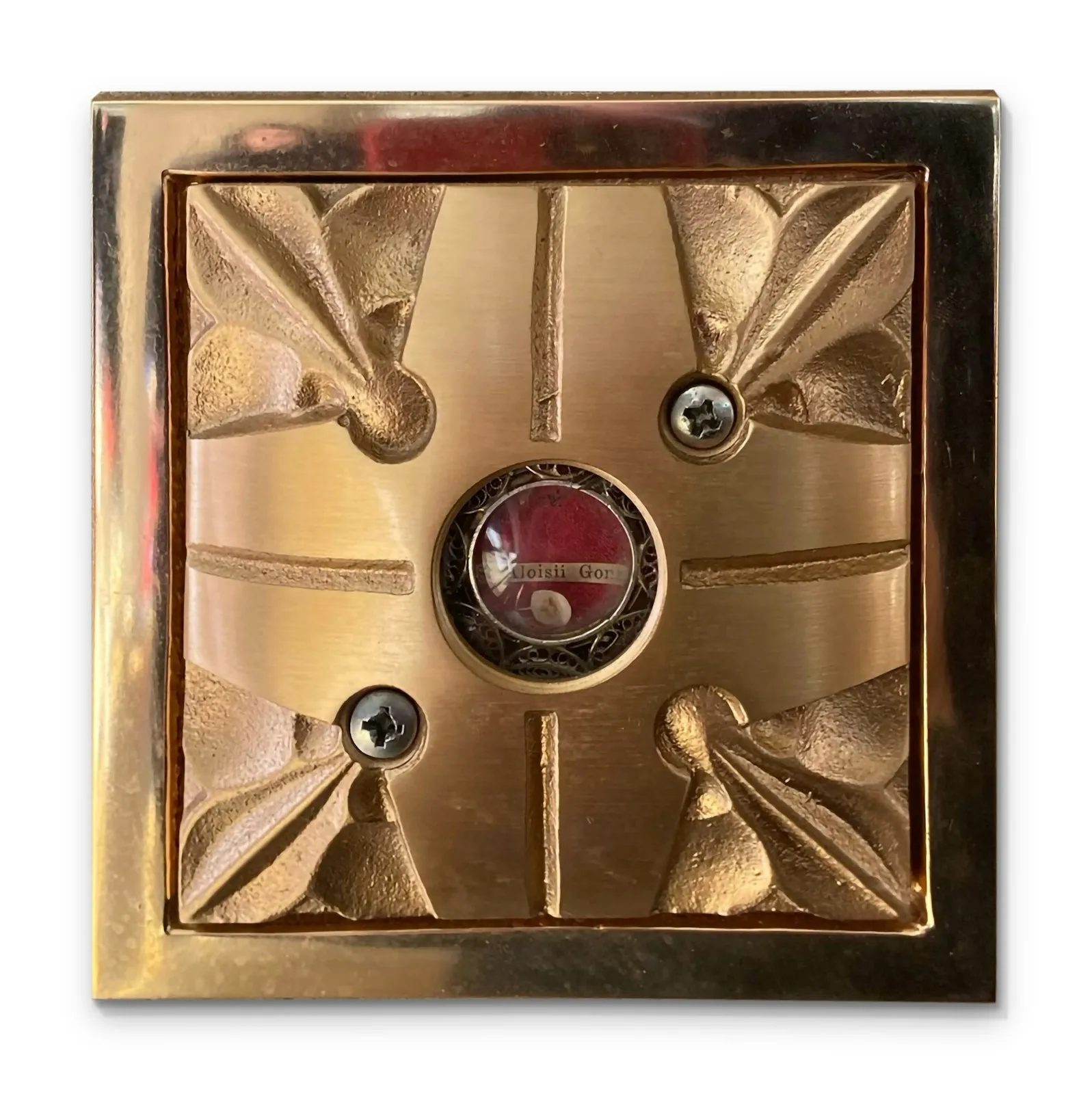
The first-class relics are among nearly 200 relics currently housed in the cathedral, which Father Mech hopes to find a way to display. The gold reliquaries are installed beneath each of the apostles’ statues. January 2024. Courtesy of Detroit Catholic
“People are already presently coming to pray [at] the grotto with the Blessed Mother,” Mech said. “We put some beautiful landscaping in this fall so people would feel welcomed, and in fact, we have used the site in a couple of ways for prayer services already.”
The grotto will also connect seamlessly with a garden walk that is being created around the cathedral’s plaza lawn, which will include art, benches, solar charging stations, a dog park, a bird sanctuary and pollination habitat.
Working alongside the U.S. Fish and Wildlife Service, the cathedral’s co-director of family ministries, Christine Broses, is spearheading the transformation of two previously empty lots on the corner of Trowbridge and John R Streets into green space for wildlife to thrive.
“We learned that the city of Detroit is a north, south, east, and west crossing for bird migration,” Broses said. “So a lot of birds fly over the city of Detroit, but they don’t have anywhere to stop and rest because there isn’t a lot of green space. Creating green space is really important for the city and for wildlife in general, and research shows hearing birds and having green space in neighborhoods helps improve people’s mental health.”
Last spring, Broses oversaw the planting of native flowers in the area, and the next step is to let the space grow wild, which will inevitably attract birds and bees over the coming years. Broses said the final step will be to add educational plaques and pathways to make the spot accessible to schools and families.
Mech wants the garden spaces and pathways to be welcoming and intends to build benches — something the neighborhood is currently lacking.
The statues, pictured in their final fixed locations above the cathedral’s pillars, are just one piece of an ever-developing project to turn the cathedral into a true apostolic center in the heart of Detroit, Father J.J. Mech said. Credit: Photo courtesy of Detroit Catholic
“We did a study of our neighborhood and found there is not a single park bench in any of the parks in our area,” Mech said. “We want to have park benches so people can come and rest and enjoy themselves. This will be a place where community can be built, and people will realize that the cathedral is not a fortress; we are actually unleashing the Gospel.”
And there is more.
In June, construction began on the Cathedral Arts Apartments, which will include four stories and 53 two-bedroom housing units for low-income Detroiters. The $19.7 million project is the joint effort of the Archdiocese of Detroit; MHT Housing, Inc.; and the city of Detroit and will include a community space and workforce training center.
At the end of the day, the vision of a “Cathedral of the Arts” — like the cathedrals of old — is about listening to the Holy Spirit and making a difference from the very small to the large scale, so that everyone who steps onto the property is transformed, Mech said.
“When we get people onto the campus, they start to see what we are doing, and they get involved,” he said. “Then, the Holy Spirit does the rest and helps them to get to know Our Lord in new and wonderful ways.”
Denver, Colo., Mar 24, 2020 / 06:19 pm (CNA).- The Catholic bishops of Colorado have welcomed the repeal of the death penalty, as the state becomes the 22nd to repeal capital punishment.
“For many years, the Colorado Catholic Conference has supp… […]





Leave a Reply