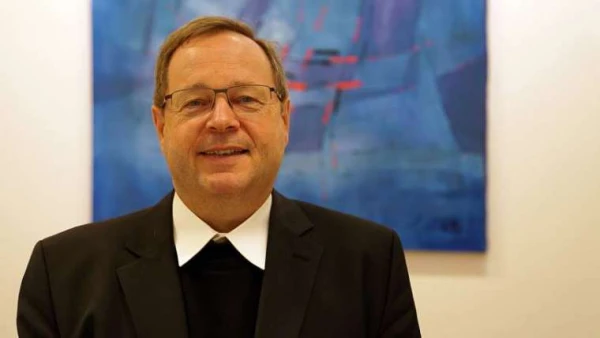
Bishop Georg Bätzing of Limburg. Credit: Bistum Limburg.
CNA Staff, Feb 26, 2021 / 04:00 am (CNA).- The president of the German Catholic bishops’ conference said on Thursday that he would continue to give Holy Communion to Protestants who ask for it.
Bishop Georg Bätzing told journalists at a press conference on Feb. 25 that it was necessary to respect the “personal decision of conscience” of those seeking to receive Communion.
CNA Deutsch, CNA’s German-language news partner, reported that Bätzing was responding to a question about a controversial proposal for a “Eucharistic meal fellowship” between Catholics and Protestants.
The proposal was made by the Ecumenical Study Group of Protestant and Catholic Theologians (known by its German initials, ÖAK) in a 2019 document entitled “Together at the Lord’s Table.”
The ÖAK adopted the text under the co-chairmanship of Bätzing and the retired Lutheran Bishop Martin Hein.
Asked how he would respond if a Protestant came to him seeking the Eucharist, he told reporters: “I have no problems with it and I see myself in line with papal documents.”
The 59-year-old bishop added that this was already a “practice” in Germany “every Sunday” and that priests in his Diocese of Limburg would not face negative consequences if a case were reported to him.
He underlined that one should not “simply invite everyone.” But while a general invitation to receive the Eucharist was not permitted, he said it was important to show “respect for the personal decision of conscience of the individual” seeking Communion.
“I do not deny Holy Communion to a Protestant if he asks for it,” he said.
The ÖAK was established in 1946 to strengthen ecumenical ties. It is independent of both the German Catholic bishops’ conference and the Evangelical Church in Germany (EKD), an organization representing 20 Protestant groups. But the ÖAK informs both bodies about its deliberations.
The ÖAK document raised concerns at the Vatican, prompting an intervention by the Congregation for the Doctrine of the Faith (CDF) in September 2020.
In a four-page critique and letter to Bätzing, the doctrinal congregation emphasized that significant differences in understanding of the Eucharist and ministry remained between Protestants and Catholics.
“The doctrinal differences are still so important that they currently rule out reciprocal participation in the Lord’s Supper and the Eucharist,” it said.
“The document cannot therefore serve as a guide for an individual decision of conscience about approaching the Eucharist.”
The CDF cautioned against any steps towards intercommunion between Catholics and members of the EKD.
Following the Vatican intervention, Bätzing reaffirmed his view that intercommunion with Protestants should be possible.
Cardinal Kurt Koch, prefect of the Pontifical Council for Promoting Christian Unity, has also expressed serious misgivings about the “Eucharistic meal fellowship” proposal.
At Thursday’s press conference, held virtually due to the coronavirus pandemic, Bätzing underlined his high hopes for the “Synodal Way,” a process bringing together German lay people and bishops to discuss four major topics: the way power is exercised in the Church; sexual morality; the priesthood; and the role of women.
He was speaking at the end of the bishops’ spring plenary meeting, which saw the election of theologian Beate Gilles as the first female general secretary of the German bishops’ conference.
If you value the news and views Catholic World Report provides, please consider donating to support our efforts. Your contribution will help us continue to make CWR available to all readers worldwide for free, without a subscription. Thank you for your generosity!
Click here for more information on donating to CWR. Click here to sign up for our newsletter.

The trailer of the upcoming Russell Crowe movie “The Pope’s Exorcist” indicates that the film might not do justice to the Italian exorcist Father Gabriel Amorth or the rite of exorcism as practiced in the Catholic Church, according to an exorcist organization Amorth himself helped to found.
The International Association of Exorcists on March 7 voiced concern that the film seems to fall under the category of “splatter cinema,” which it calls a “sub-genre of horror.”
The Vatican, the statement said, is filmed with a high-contrast “chiaroscuro” effect seen in film noir.
This gives the film a “‘Da Vinci Code’ effect to instill in the public the usual doubt: Who is the real enemy? The devil or ecclesiastical ‘power’?” the exorcists’ association said.
While special effects are “inevitable” in every film about demonic possession, “everything is exaggerated, with striking physical and verbal manifestations, typical of horror films,” the group said.
“This way of narrating Don Amorth’s experience as an exorcist, in addition to being contrary to historical reality, distorts and falsifies what is truly lived and experienced during the exorcism of truly possessed people,” said the association, which claims more than 800 exorcist members and more than 120 auxiliary members worldwide.
“In addition, it is offensive with regard to the state of suffering in which those who are victims of an extraordinary action of the devil find themselves,” the group’s statement added. The statement responded to the release of the movie trailer and promised a more in-depth response to the film’s April 14 theatrical release.
Father Gabriele Amorth, chief exorcist of Rome, speaks to CNA on May 22, 2013. Steven Driscoll/CNA
Amorth, who died at age 91 in 2016, said he performed an estimated 100,000 exorcisms during his life. He was perhaps the world’s best-known exorcist and the author of many books, including “An Exorcist Tells His Story,” reportedly an inspiration for the upcoming movie.
Several of Amorth’s books are carried by the U.S. publisher Sophia Institute Press. The publisher’s newly released book “The Pope’s Exorcist: 101 Questions About Fr. Gabriele Amorth” is an interview in which the priest addresses many topics ranging from prayer to pop music.
Michael Lichens, editor and spokesperson at Sophia Institute Press, voiced some agreement with the exorcist group.
“The International Association of Exorcists is right to be concerned and I’m thankful for their words,” Lichens told CNA. “My hope is that audiences will remember that Father Amorth is a real person with a great legacy and perhaps a few moviegoers will look up an interview or pick up his books.”
“This was a man who included St. Padre Pio and Blessed Giacomo Alberione as mentors, as well as Servant of God Candido Amantini, who was his teacher for the ministry of exorcism,” he said. “Father Amorth fought as a partisan as a young man and grew to fight greater evil as an exorcist. His life is an inspiration and I know that his work and words will still reach many.”
Amorth was born in Modena, Italy, on May 1, 1925. In wartime Italy, he was a soldier with the underground anti-fascist partisans. He was ordained a priest in 1951. He did not become an exorcist until 1986, when Cardinal Ugo Poletti, the vicar general of the Diocese of Rome, named him the diocesan exorcist.
The priest was frequently in the news for his comments on the subject of demonic forces. In an interview with The Sunday Telegraph in 2000, he said: “I speak with the devil every day. I talk to him in Latin. He answers in Italian. I have been wrestling with him, day in, day out, for 14 years.”
The movie “The Pope’s Exorcist” claims to be “inspired by the actual files of the Vatican’s chief exorcist.” The Sony Pictures movie stars the New Zealand-born actor Russell Crowe as Amorth. Crowe’s character wears a gray beard and speaks English with a noticeable accent.
“The majority of cases do not require an exorcism,” the Amorth character says in the movie’s first trailer. A cardinal explains that Crowe’s character recommends 98% of people who seek an exorcism to doctors and psychiatrists instead.
“The other 2%… I call it… evil,” Crowe adds.
The plot appears to concern Amorth’s encounter with a particular demon. Crowe’s character suggests the Church “has fought this demon before” but covered it up.
“We need to find out why,” he says.
The trailer shows short dramatic scenes of exorcism, including a confrontation between Amorth and a girl apparently suffering demonic possession.
The International Association of Exorcists said such a representation makes exorcism become “a spectacle aimed at inspiring strong and unhealthy emotions, thanks to a gloomy scenography, with sound effects such as to inspire only anxiety, restlessness, and fear in the viewer.”
“The end result is to instill the conviction that exorcism is an abnormal, monstrous, and frightening phenomenon, whose only protagonist is the devil, whose violent reactions can be faced with great difficulty,” said the exorcist group. “This is the exact opposite of what occurs in the context of exorcism celebrated in the Catholic Church in obedience to the directives imparted by it.”
CNA sought comment from Sony Pictures and “The Pope’s Exorcist” executive producer Father Edward Siebert, SJ, but did not receive a response by publication.
Amorth co-founded the International Association of Exorcists with Father René Laurentin in 1994. In 2014 the Catholic Church recognized the group as a Private Association of the Faithful.
The association trains exorcists and promotes their incorporation into local communities and normal pastoral care. It also aims to promote “correct knowledge” about exorcism ministry and collaboration with medical and psychiatric experts who have competence in spirituality.
Exorcism is considered a sacramental, not a sacrament, of the Church. It is a liturgical rite that only a priest can perform.
Hollywood made the topic a focus most famously in the 1973 movie “The Exorcist,” based on the novel by William Peter Blatty.
“Most movies about Catholicism and spiritual warfare sensationalize,” Lichens of Sophia Institute Press told CNA. “Sensationalism and terror sell tickets. As a fan of horror movies, I can understand and even appreciate that. As a Catholic who has studied Father Amorth, though, I think such sensationalism distorts the important work of exorcism.”
“On the other hand, ‘The Exorcist’ made the wider public more curious about this overlooked ministry. That is a good thing that came out, despite other reservations and concerns,” he continued. “Still, I would love it if a screenwriter and director spoke to exorcists and tried to show the often-quotidian parts of the ministry.”
An unhealthy curiosity can be a problem, Lichens said.
“When I work as a spokesperson for Amorth’s books, I am always concerned about inspiring curiosity about the demonic,” he told CNA. “As Christians, we know we have nothing to fear from the demonic but curiosity might lead some to want to seek out the supernatural or the demonic. Father Amorth has dozens of stories of people who found themselves afflicted after party game seances.”
Lichens encouraged those who are curious to read more of Amorth’s writings, some of which are excerpted on the Catholic Exchange website. Sophia Institute Press has published “Diary of an American Exorcist” by Monsignor Stephen Rosetti and “The Exorcism Files” by the American lay Catholic Adam Blai.
“First and foremost, Father Amorth was involved in a healing ministry,” Lichens said. “Like other exorcists, his work often involved doctors in physical and mental health because the goal is to bring healing and hope to the potentially afflicted.”
“Those of us who read Amorth might have been excited to read firsthand accounts of spiritual warfare, but readers quickly see a man whose heart was always full of love for those who sought his help,” he added.
The International Association of Exorcists, for its part, praised the 2016 documentary “Deliver Us,” saying this shows “what exorcism really is in the Catholic Church and “the authentic traits of a Catholic exorcist.” It shows exorcism as “a most joyful event,” in their view, because through experiencing “the presence and action of Christ the Lord and of the Communion of the Saints,” those who are “tormented by the extraordinary action of the devil gradually find liberation and peace.”
Pope Francis at the Church of St. Anselm on Ash Wednesday, March 1, 2017. / Credit: L’Osservatore Romano
ACI Prensa Staff, Feb 8, 2024 / 08:00 am (CNA).
Pope Francis will preside at the Mass and the traditional Ash Wednesday procession on Feb. 14 on Aventine Hill in Rome.
The Office of Liturgical Celebrations announced Feb. 6 that before the Eucharist, the Holy Father will preside at the first Lenten station at St. Anselm Church, also situated on the Aventine, at 4:30 p.m. local time.
Later, Pope Francis will participate in the penitential procession to St. Sabina Basilica, where he will celebrate Mass at 5 p.m. and bless the ashes that will be distributed to the faithful.
The Lenten stations are one of the most deeply rooted traditions for the beginning of Lent in Rome. It is an ancient custom in which the faithful stopped at different churches to meditate on the Passion of the Lord.
Every day of Lent, the Roman faithful stopped in front of one of the churches in the historic city center erected in memory of the martyrs. Subsequently, the procession took place in which the litanies were usually sung and finally Mass was celebrated.
Pope Francis will be making his personal Lenten spiritual retreat from the afternoon of Sunday, Feb. 18, to Friday, Feb. 23.
This story was first published by ACI Prensa, CNA’s Spanish-language news partner. It has been translated and adapted by CNA.
Vatican City, Apr 10, 2021 / 03:03 am America/Denver (CNA). Pope Francis’ private visit to Cardinal Angelo Becciu on Holy Thursday set off speculation about whether the pope is attempting to rehabilitate the disgraced cardinal. The […]
Bishops like this need to be put in their place by the Vatican and/ or removed from their positions immediately. The Catholic church is not run like a Protestant sect where almost anyone can establish their own church with their own rules as they see fit. If the Bishop wants to continue down this line of thought he needs to recant or leave the church. “Anything goes because I decide it can” is not a way to run the Church.
And Scripture is quite clear on receiving the Holy Eucharist, unworthily. Claiming ‘conscience’ and the rejection of the Catholic Church, doesn’t cut it.
And yet, ALL of the sacraments are denied ANY Catholic who refuses to routinely check the box and pay the state-collected Church-tax (added to the federal personal income tax).
Automatic excommunication! “Apostasy!” is the chorus of the sanctimonious, fat, and ever-compassionate German hierarchy. (Perhaps those who disagree remain silent rather than suffer a blackmail/cut in their annual diocesan allotment… one can only speculate.) The state-tax possibly makes sense, but the ecclesial penalty is “inexcusable,” said Emeritus Pope Benedict, only a few years back.
And now the stench of this incoherent and deconstructionist “synodal path” proposes to go pandemic and infect a universal synod in Rome. Someone, turn the lights on, assuming there still are lights.
Only lunacy coming out of Germany these days.
Bishops like this need to be put in their place by the Vatican and/ or removed from their positions immediately. The Catholic church is not run like a Protestant sect where almost anyone can establish their own church with their own rules as they see fit. If the Bishop wants to continue down this line of thought he needs to recant or leave the church. “Anything goes because I decide it can” is not a way to run the Church.
He probably would deny communion to a Catholic not wearing a covid mask.
And Scripture is quite clear on receiving the Holy Eucharist, unworthily. Claiming ‘conscience’ and the rejection of the Catholic Church, doesn’t cut it.
And the Eucharistic Minister has no idea whether the recipient is Catholic or Protestant or free from sin or not!
Then you are guilty of a mortal sin.
The Protestant may possibly have the excuse of ignorance. You don’t.
And yet, ALL of the sacraments are denied ANY Catholic who refuses to routinely check the box and pay the state-collected Church-tax (added to the federal personal income tax).
Automatic excommunication! “Apostasy!” is the chorus of the sanctimonious, fat, and ever-compassionate German hierarchy. (Perhaps those who disagree remain silent rather than suffer a blackmail/cut in their annual diocesan allotment… one can only speculate.) The state-tax possibly makes sense, but the ecclesial penalty is “inexcusable,” said Emeritus Pope Benedict, only a few years back.
And now the stench of this incoherent and deconstructionist “synodal path” proposes to go pandemic and infect a universal synod in Rome. Someone, turn the lights on, assuming there still are lights.