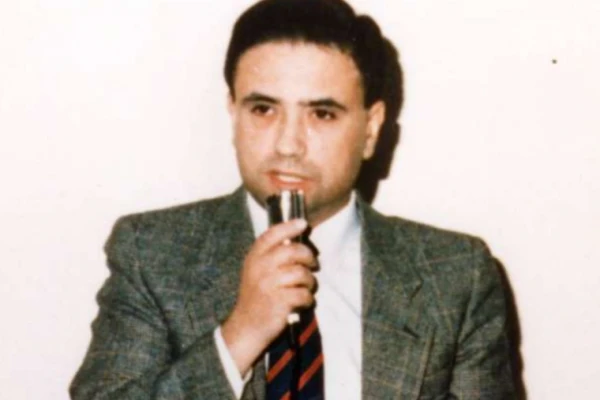
Martyred Italian judge Rosario Livatino (1952-1990). Public domain.
Rome Newsroom, Feb 5, 2021 / 09:00 am (CNA).- Rosario Livatino, a Sicilian judge and magistrate killed by the mafia in 1990, will be beatified on the Italian island on Sunday, May 9.
Cardinal Francesco Montenegro, archbishop of Agrigento, Sicily, announced the date of the Catholic judge’s beatification on Friday, together with his coadjutor, Archbishop Alessandro Damiano.
Livatino’s beatification Mass will take place in the Cathedral Basilica of Agrigento, where the martyr’s mortal remains will be translated from his hometown of Canicattì, which is about 21 miles to the northeast.
The mafia killed the 37-year-old magistrate on Sept. 21, 1990, because of his efforts to combat organized crime in Sicily.
He was driving unescorted toward the Agrigento courthouse when another car hit him, sending him off the road. He ran from the crashed vehicle into a field, but was shot in the back and then killed with more gunshots.
On Dec. 22, 2020, Pope Francis declared him a martyr killed in hatred of the faith.
The beatification date falls on the 28th anniversary of St. Pope John Paul II’s visit to Agrigento in May 1993.
Situated on the southern coast of Sicily, Agrigento was one of the leading cities of Magna Graecia during the golden age of Ancient Greece. It got its nickname, the “City of Temples,” because it is home to the largest and best-preserved ancient Greek buildings outside of Greece. Today the city has a population of around 60,000 people and is the seat of the archdiocese.
Cardinal Montenegro and Archbishop Damiano said in a letter last month that Livatino’s holiness “is rooted in its original context, but goes beyond the confines of a circumscribed place to take on much larger dimensions.”
They called him an “unprecedented model of holiness” in the history of the Church because he will be the first lay magistrate “engaged on the front line in the fight against the Mafia, to be proclaimed ‘blessed’ and martyr.”
Livatino has been noted for his exemplary courtesy to everyone — even toward the criminal defendants who came before his bench.
One of the magistrate’s high school classmates, Giuseppe Palilla, said when they were collecting witness testimony about Livatino’s life, they could not find one person who spoke badly about him.
Fr. Giuseppe Livatino, postulator of the cause for Livatino’s beatification and his cousin, said that the young Catholic judge provided a “credible witness” of coherence in his life of faith and his daily work.
“More than just ‘holy cards,’ Christians today urgently need credible witnesses. And that [is what] Rosario is,” his postulator said.
“Livatino drew directly from the experience of the saints, and in every dimension of his life he rejected any mediocrity,” Fr. Livatino said. “What he has to do, Rosario likes to do it right. He pursues that ‘perfection’ indicated by Jesus in the Gospel, to build the Kingdom of God.”
“Rosario had drawn his profound wisdom from the Gospel and the Magisterium of the Church. He knows and lives the Gospel, knows and applies the reflections of the [Second Vatican] Council Fathers on the role of the lay faithful in today’s world,” he said.
If you value the news and views Catholic World Report provides, please consider donating to support our efforts. Your contribution will help us continue to make CWR available to all readers worldwide for free, without a subscription. Thank you for your generosity!
Click here for more information on donating to CWR. Click here to sign up for our newsletter.

Mother Trinidad, foundress of The Work of the Church / Photo courtesy of The Work of the Church
Rome Newsroom, Jul 28, 2022 / 10:36 am (CNA).
“Glory for God, that alone! The rest does not matter.” These are the words of Mother Trinidad de la Sa… […]
Madrid, Spain, Mar 21, 2017 / 03:19 pm (CNA/EWTN News).- A recent video ad released by the Down Federation seeks to increase awareness of persons with Down syndrome.
Through a series of videos and photographs, the campaign seeks to challenge the preju… […]
Ukraine’s Minister of Foreign Affairs, Dmytro Kuleba, speaking to journalists, Dec. 9, 2022 / Marcin Mazur
Kyiv, Ukraine, Dec 10, 2022 / 00:00 am (CNA).
Every effort for peace in Ukraine coming from Pope Francis and the Holy See is welcome, Ukraine’s Foreign Minister said Friday, whether it is helping to mediate for the exchange of prisoners or in assisting migrants and refugees.
However, the time for broad negotiations after the Russian aggression has not come yet, Dmytro Kuleba told a small delegation of journalists visiting Ukraine on Dec. 9 that his country has requirements for any such mediation to eventually take place.
The interview lasted about 40 minutes, and the questions dealt with Holy See-Ukraine relations, Holy See efforts for peace, and how Ukraine would welcome this effort.
Though appreciating Pope Francis’ constant mention of the Ukrainian situation and expressing an open invitation to the pope to visit the country, Kuleba also told CNA that some of the pope’s words have been “painful” for Ukrainians.
Ukraine’s Minister of Foreign Affairs, Dmytro Kuleba, speaking to journalists, Dec. 9, 2022. Marcin Mazur
Pope Francis has often stressed that the Holy See is available to facilitate broad negotiations. Kuleba told journalists that “the protocolar response would be that a negotiation would be more than welcome,” but “the sad truth is that the time for this broad mediation hasn’t come yet and the reason for that is President [Vladimir] Putin.”
If you want peace, Kuleba said, “you do not send 100 missiles every week to destroy infrastructure. You do not send one wave of your soldiers after another into the Donbas. You don’t do all these things when you seek a peaceful solution.”
And so, he concluded, “the day for a big mediation will come, but we are not there yet, to our deepest regret.”
Kuleba told CNA that mediation should have some requirements, as any other commitment the Holy See would undertake. He said he also tackled this issue in the last meeting with the Vatican’s Secretary for Relations with States, Archbishop Paul Richard Gallagher.
Gallagher, whose role is equivalent to that of a foreign minister, spoke with his Ukrainian counterpart on Dec. 2 in Lodz, during the OSCE Ministerial Council.
I met with Secretary for Relations with States of the Holy See Mons. Paul R. Gallagher. I briefed Archbishop on Ukraine’s efforts to alleviate the global food crisis through our #GrainFromUkraine program and details of President @ZelenskyyUa’s Peace formula. pic.twitter.com/SNAc3iGbq4
Kuleba said he told Gallagher that the Vatican could choose which aspect to help with.
The Vatican might help with negotiating an exchange of prisoners, for instance, or the “return of thousands of kids kidnapped from Russia,” or also participating “in the implementation of the peace formula.”
However, Kuleba added that “picking an issue is the first step, while the second step is how you address the issue,” adding that “mistakes” needed to be avoided.
Among such “mistakes,” according to Kuleba, are the notion of a brotherhood between Ukrainian, Russian, and Belarusian people.
“We are not brothers and if you insist on the concept you are misled,” the Ukrainian minister told journalists since Russians “came to Kyiv to rape, to violate all the laws of God on the land of Ukraine.”
Kuleba also said hat one cannot be “neutral in public comments” and should “always remember that Russia is the aggressor and Ukraine is the victim of the aggression.”
Any attempt at making both sides somehow evenly responsible created “a completely wrong message,” the minister warned.
In his Oct. 2 Angelus, Pope Francis appealed to Russia’s President Vladmir Putin to stop the war, and to Ukraine’s President Volodymyr Zelenskyy to be seriously open to the pope’s proposal.
Kuleba explained why he was somewhat critical of such appeals by Pope Francis: While saying President Putin should stop the war made “perfect sense,” calling on President Zelenskyy to be open to serious peace proposals made it sound like Zelenskyy was “not open to peace.”
In other words, Kuleba added, the pope’s words wrongly “create the impression that both sides are guilty: one is guilty because of the attack, and the other is guilty because [it is] not open to peace proposals.”
Ukraine’s Foreign minister called on journalists to be pay attention when writing about a “serious peace proposal” being “based on the territorial integrity of Ukraine”, including Crimea.
“Every time you write or read or say that Ukraine insists on the restoration of Crimea, you send a message that Crimea is a special case. But for us and international law, there is no difference between [the towns of] Sebastopol and Kherson, Yalta and Donetsk.”
Speaking about the role religion can play in helping to reconstruct the country, the Ukrainian foreign minister said that the “Russian aggression caused big fractures” among religions. He also pointed to differences in viewpoints between Muslims in Russia and in Ukraine, and Russian and Ukrainian Jews.
Kuleba said that the “first and foremost expectation from confessions is to console people, to help them spiritually.” Most people turned to God “only in times of hardship,” he added.
“When everything is fine, you forget about God. Now, there is a higher demand for spiritual help, to be consoled by the Church.”
Kuleba also spoke to CNA about sanctions imposed on Dec.1 against some Orthodox clerics and moves to legislate against Russian influence through religious means.
Ukraine’s Minister of Foreign Affairs, Dmytro Kuleba, speaking to journalists, Dec. 9, 2022. Marcin Mazur
The Ukrainian government will draw up a law banning churches affiliated with Russia under moves described by President Volodymyr Zelenskiy as necessary to prevent Moscow being able to “weaken Ukraine from within,” according to Reuters.
Ukraine’s National Security and Defence Council told the government to draft the law following a series of raids on parishes that Kyiv said might be taking orders from Moscow.
Such moves, Kuleba told CNA, were motivated by “unacceptable” behavior by some clerics, such as the blessing of Russian soldiers for success on the battlefield.
Kuleba, however, praised the role of the churches, especially the presence of chaplains on the front.
Speaking about Pope Francis’ position on the Ukrainian issue, Kuleba said that he saw improvements.
“The truth,” he said, “is that this war shattered many foundations of the global political order.”
A big disappointment, he added, was what Pope Francis had said about NATO “barking” at the gates of Russia.
Kuleba stressed that he understood how and why the pope used the expression, but he noted that this argument was forged in Russia, so even mentioning served to legitimize it.
While it was “painful that the pope said something like that, I have to commend the pope for understanding”, Kuleba added, saying he was grateful to the pontiff for not sticking to “concepts that do not work and do not meet the reality check.”
Ukraine’s foreign minister said he was moved by the public prayer of Pope Francis for Ukraine on Dec. 8 in Rome. “[The] pope’s compassion means a lot to us and goes directly to the heart of Ukrainians,” Kuleba said.
He added that “obviously, we are waiting for his visit. He has many followers in Ukraine”, not only from the Roman Catholic and Greek Catholic communities: “The visit of the pope will be welcomed by a bigger part of Ukrainian society. So we are looking forward to welcoming him.”
Heroic witness. The late Italian Judge Rosario Livatino is an inspiration. May his tribe increase.