Rome, Italy, Jan 25, 2021 / 12:19 pm (CNA).- Papal almoner Cardinal Konrad Krajewski offered a funeral Mass Monday for a 64-year-old homeless man who died in Rome.
Roberto Mantovani died in a homeless shelter near Rome’s Termini train station after contracting pneumonia.
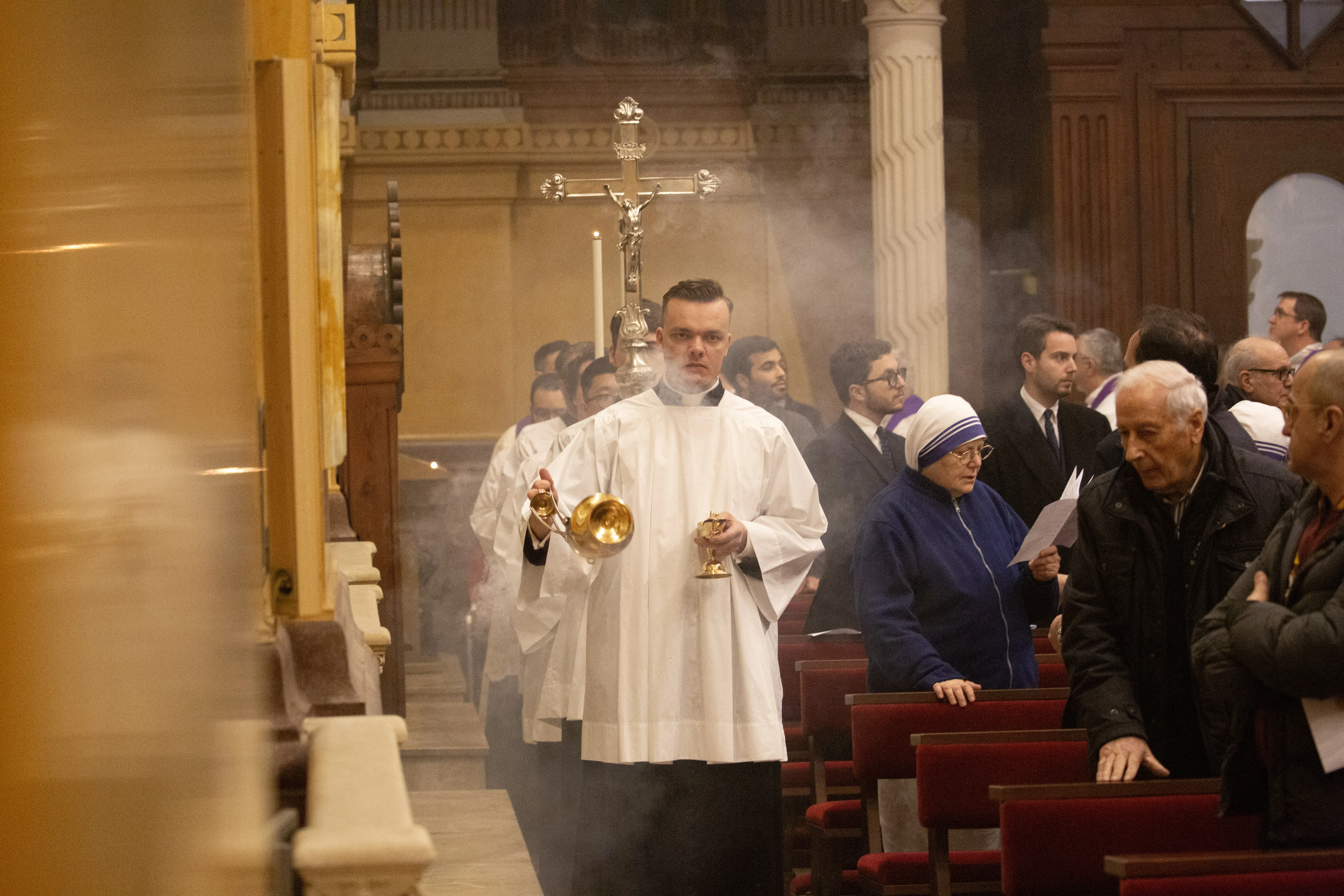
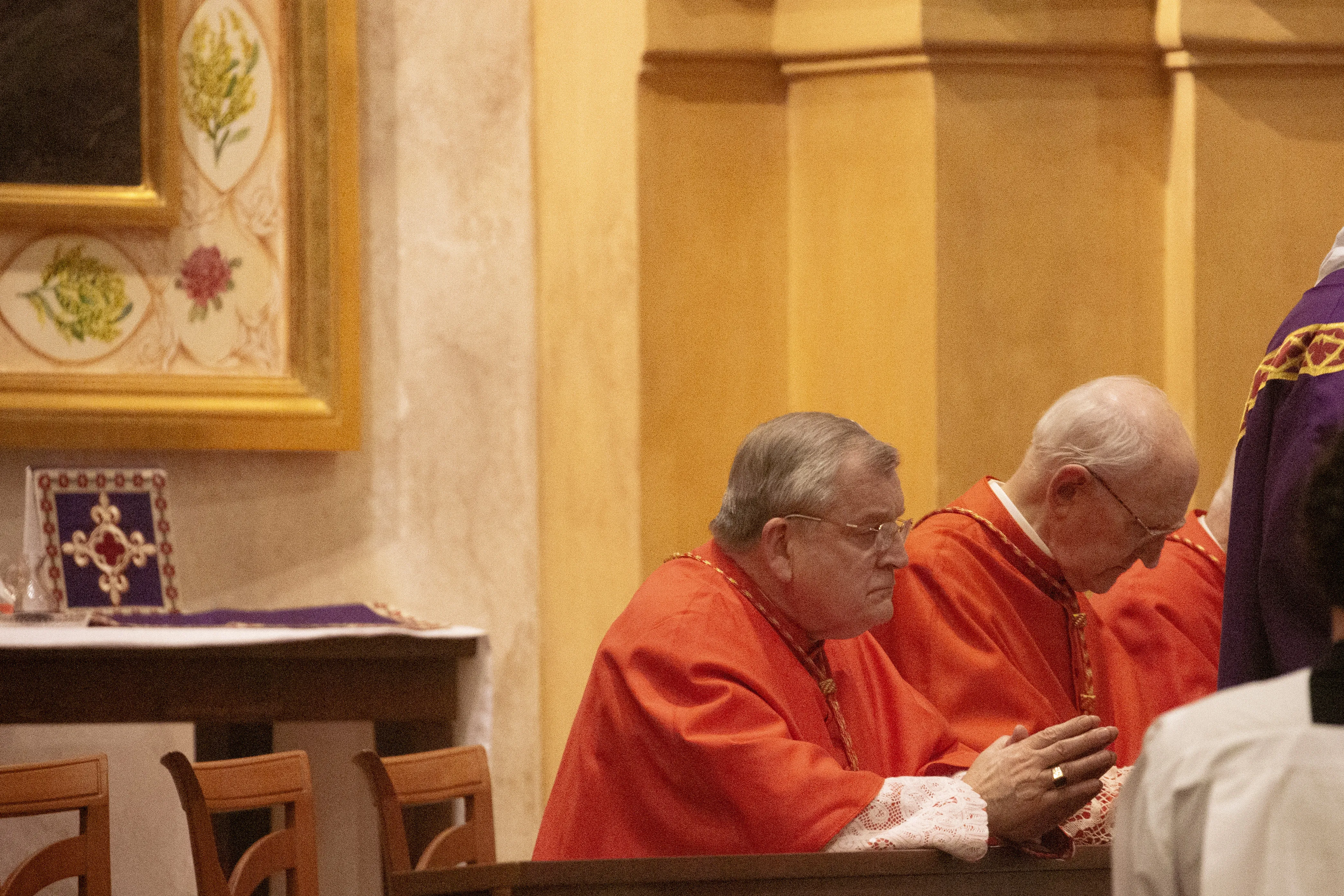
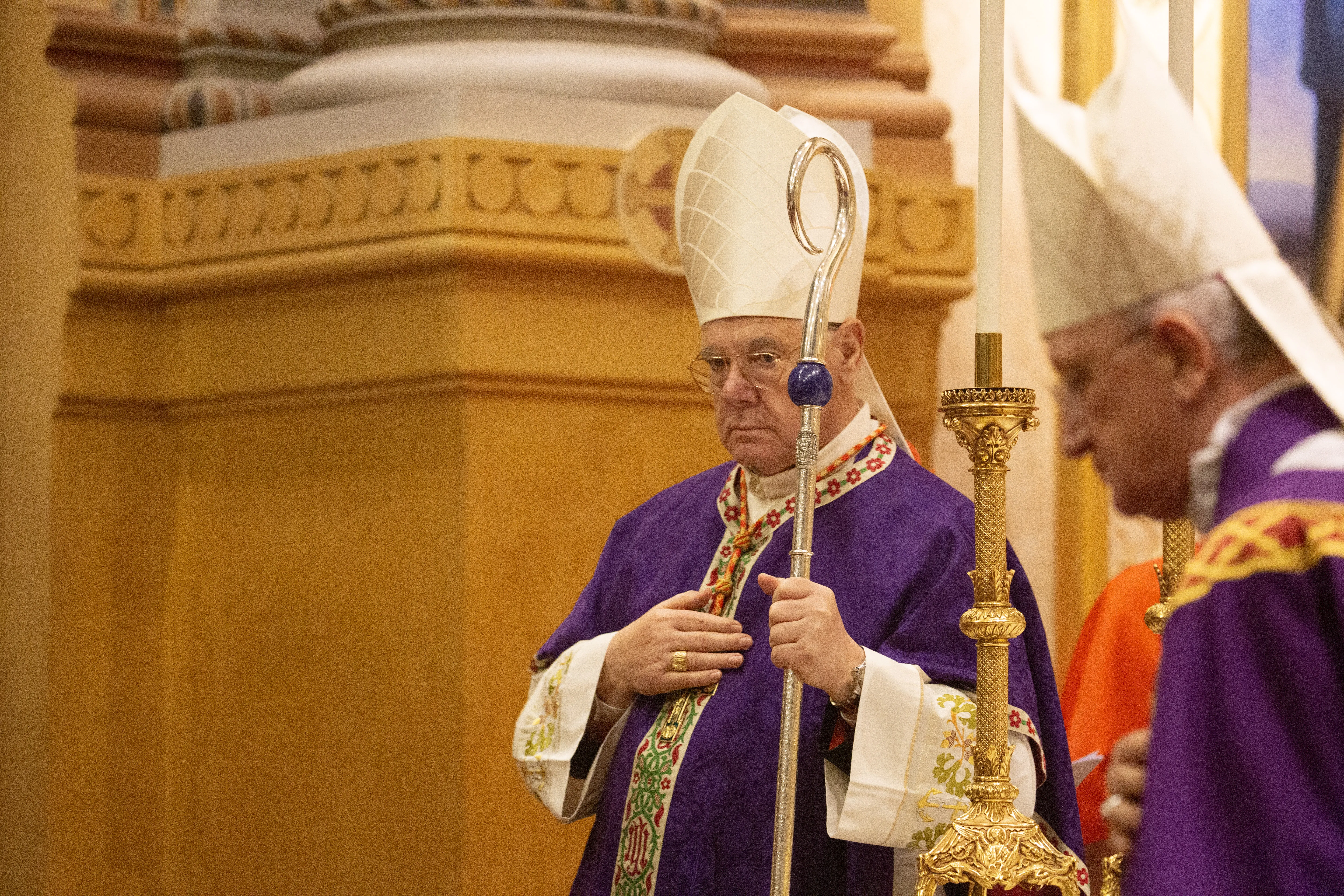
Cardinal George Pell concelebrated the funeral Mass Jan. 25 at the parish of St. Pius X with Archbishop Arthur Roche, Secretary of the Congregation for Divine Worship and the Discipline of the Sacraments, and a dozen priests, according to Vatican News.
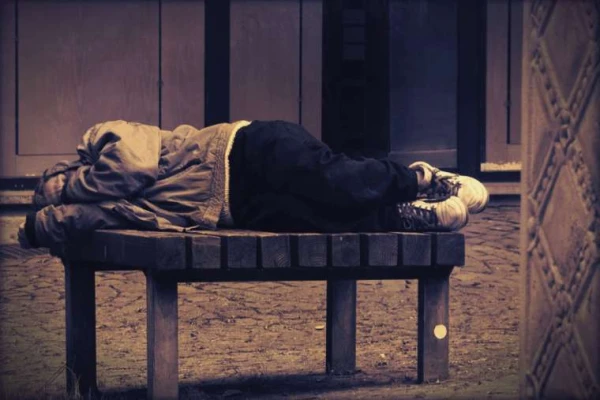
Cardinal Krajewski, who knew Mantovani, said that he chose the reading from the Gospel of Luke in which Christ recounts the parable of Lazarus and the rich man, for the funeral Mass because “Robert always slept in front of a closed door.”
“He was a cheerful, sunny person, at the lunches we had he made everyone laugh,” Cardinal Krajewski said.
Mantovani will be buried next to his parents in his hometown of Oppeano in northern Italy. He had formerly been a professional soccer player with Hellas Verona F.C. but an injury ended his career.
His funeral took place one day after Pope Francis prayed for another homeless man, a 46-year-old Nigerian man named Edwin, who was found dead near St. Peter’s Square last week.
“Last Jan. 20, a few meters from St. Peter’s Square, a 46-year-old Nigerian homeless man named Edwin was found dead because of the cold,” the pope said Jan. 24.
“His story was added to that of many other homeless people who recently died in Rome in the same dramatic circumstances. Let us pray for Edwin.”
According to the news website RomaToday, Edwin was the fourth homeless person to die this year in Rome, where there are an estimated 8,000 homeless people. Many sleep in tents along the edge of Bernini’s colonnade, the semi-circular columns enclosing St. Peter’s Square.
“Let us think about Edwin,” Pope Francis said. “Let us think of how this man, 46 years old, felt in the cold, ignored by all, abandoned, even by us. Let us pray for him.”
If you value the news and views Catholic World Report provides, please consider donating to support our efforts. Your contribution will help us continue to make CWR available to all readers worldwide for free, without a subscription. Thank you for your generosity!
Click here for more information on donating to CWR. Click here to sign up for our newsletter.
One of 100 ancient churches identified for preservation by France’s Patrimony Foundation, this church is in Cachen, located within the Nouvelle-Aquitaine region of southwestern France. / Credit: Wikimedia Commons
CNA Staff, Jun 4, 2024 / 06:00 am (CNA).
The danger that has been threatening France’s religious heritage for decades is becoming a matter of concern to the authorities and the general public.
As experts estimate that the country loses a religious building every 15 days, the country’s leading historical preservation nonprofit “Fondation du Patrimoine” (“Patrimony Foundation”)has launched a campaign aimed at restoring a thousand buildings, the vast majority of which are Catholic, in rural areas of the country.
This is the first time that the nonprofit organization, founded in 1996 to promote French heritage, has launched such a major campaign to raise awareness and preserve religious monuments. As part of the campaign, the foundation released a list of the first 100 sites to benefit from renovation funding.
The grants are aimed primarily at religious buildings in municipalities with fewer than 10,000 inhabitants in mainland France and fewer than 20,000 inhabitants in the French overseas territories, which cannot be protected by the French state as historical monuments.
Since the French Revolution (1789), which nationalized clergy property, and the 1905 law separating church and state, most religious heritage has belonged to municipalities, which are often unable to meet the costs of maintaining the sites. The preservation of historic places of worship also tends to be at the bottom of their budget priorities.
Of the 45,000 Catholic sites in France, only 15,000 are classified as historical monuments, as the president of the French Religious Heritage Observatory pointed out in a 2021 interview with CNA. For its part, the Patrimony Foundation estimates that some 5,000 religious monuments are currently directly threatened with extinction.
This list of the 100 sites selected by the foundation — spread throughout the French territory and most of which required urgent work — represents just the first ambitious move in a vast project to rehabilitate some 1,000 religious buildings over the next four years. The aim is to raise a total of 200 million euros (about $218 million) through corporate and individual donations.
The first subscription, which runs until the end of 2025 and includes special tax deductions, currently stands at just over 2.6 million euros ($2.8 million), thanks to the participation of some 14,000 people.
While this sum is still a long way short of the 15 million expected for the first 100 monuments awaiting renovation, Patrimony Foundation officials are noticing a new awareness on the ground, which is tending to become more widespread as the need grows to enhance the value of rural life and all that can represent anchoring and rallying points for communities.
“Even if they no longer go to Mass, [the French] are attached to their monument, to the steeple that gives them their identity, that establishes a landmark in space. People don’t want us to do just anything with their church,” Guillaume Poitrinal, president of the Patrimony Foundation, told the weekly Le Point.
He also pointed to a “Notre-Dame effect” in this growing public awareness of the decay of France’s heritage, of which religious monuments form a substantial part. Following the fire at the famous Paris cathedral in 2019, the images of which stunned and moved the whole world, some 40 million euros ($44 million) had been donated via the same Patrimony Foundation by 236,000 different donors.
If the campaign achieves its objectives, it could pave the way for additional large-scale initiatives, marking a real turning point in mindsets and heritage preservation policies.
Cardinal Gerhard Müller (center) and Father Joseph Hamilton (at left), personal secretary to the late Cardinal George Pell, were among the priests celebrating the Jan. 10, 2024, Mass held on the first anniversary of the cardinal’s death. / Credit: Elizabeth Alva
Rome Newsroom, Jan 10, 2024 / 16:45 pm (CNA).
A requiem Mass was held in Rome on Tuesday evening to mark the first anniversary of the death of Cardinal George Pell and to celebrate the cardinal’s illustrious ecclesiastical career.
The chapel of the Domus Australia was filled to capacity for the Mass, which was celebrated by Cardinal Gerhard Müller. In attendance were numerous cardinals and bishops, an array of priests from Rome, ambassadors to the Holy See, and faithful from Rome and abroad who came to pray for the beloved cardinal.
The chapel of the Domus Australia was filled to capacity for the Jan. 10, 2024, Mass, which was celebrated by Cardinal Gerhard Müller. Credit: Elizabeth Alva
Father Joseph Hamilton, rector of the Domus Australia and Pell’s former secretary, noted in an exclusive interview with EWTN: “I think His Eminence was very loved here in the city of Rome. His witness was very much appreciated and his loss was very unexpected.”
“I think that a beautiful Mass to commemorate his life, to pray for the repose of his soul, and to ask for his intercession here in the chapel, which he renovated and which he loved, I’m hoping will bring consolation and some degree of closure for those who have been grieving for the cardinal over the last year,” Hamilton added in his interview.
Pell died at the age of 81 on Jan. 10, 2023, after suffering a cardiac arrest following a scheduled hip replacement days prior at Rome’s Salvator Mundi hospital. He previously served as archbishop of Sydney and Melbourne before Pope Francis appointed him to head the Vatican’s Secretariat for the Economy in 2014, making him the most senior Australian prelate.
Cardinal Raymond Burke was among those at the Mass on the first anniversary of Cardinal George Pell’s death Jan. 10, 2024. Credit: Elizabeth Alva
During his homily, Müller reflected on the long illustrious life of the departed cardinal, noting that Pell and Pope Benedict — who passed away less than two weeks before the cardinal — were “role models of the true faith.”
Müller reflected on his early life, noting that the cardinal showed great “athletic abilities” and “high intellectual talent,” which would have brought him “a brilliant career in the world.” But, Müller continued, Pell eschewed worldly goals and opted to “follow Christ’s call to the priestly service.”
Cardinal Gerhard Müller at the requiem Mass on Jan. 10, 2024, marking the first anniversary of Cardinal George Pell’s death. Credit: Elizabeth Alva
Pell was renowned for his quick wit and towering stature. Müller, reflecting on his personal relationship with the late cardinal, highlighted Pell’s commitment to “marriage and family in the spirit of Christ, teachings against relativization by secularist-minded participants in the Synod of this topic.”
Müller also touched upon the darkest chapter of Pell’s life, which stands as “a great testimony of Christian patience.”
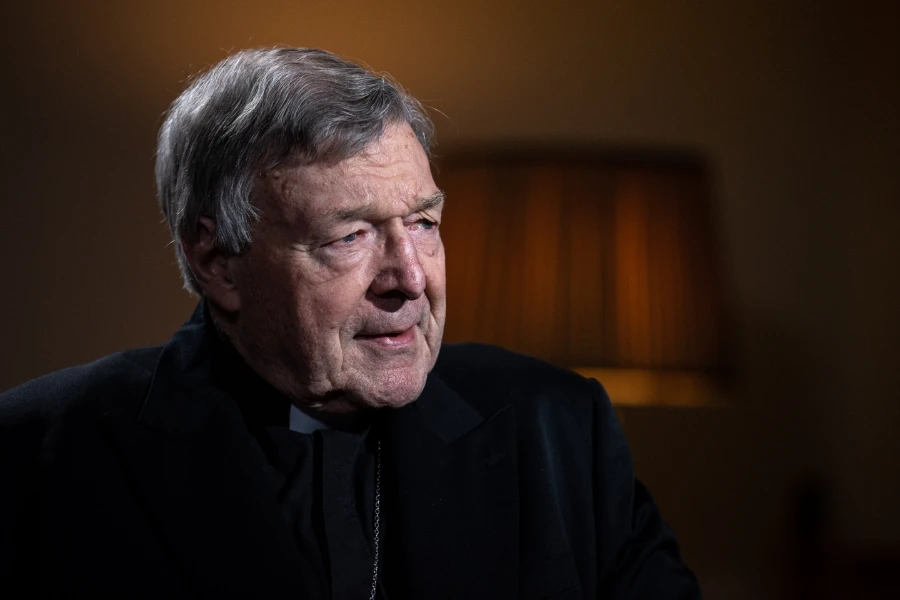
Cardinal George Pell gives an interview to EWTN News in Rome, Italy, on Dec. 9, 2020. Credit: Daniel Ibáñez/CNA.
Pell was convicted on Dec. 11, 2018, on five charges of sexual abuse while he served as archbishop of Melbourne in the late 1990s. After serving 404 days in solitary confinement, Australia’s high court unanimously overturned the convictions, based on reasonable doubt of the appellate proceedings, in April 2020.
“He was relentlessly pursued by a bloodthirsty mob and made himself a victim of justice by anti-Catholic agitators in the media and the police apparatus,” Müller remarked regarding the vilification of the late cardinal in mainstream media.
Auxiliary Bishop Richard Umbers of the Archdiocese of Sydney spoke with EWTN after the Mass, noting that the evening was an opportunity to mark “the anniversary of a man who was a lion in the Church. I think it’s giving due recognition to someone who’s been very important in the life of Australia, if not in fact the whole world.”
While recognizing that Pell was a “lightning rod for the Church,” Umbers explained that he was a man “of great strength and tremendous courage.”
Pell’s legacy is not just limited to his theological acumen or reforms of the Vatican’s handling of financial affairs, but it is most tangibly seen in the revitalization of the Church in Sydney.
“I think the impact of Cardinal Pell is very visible in Sydney,” Umbers said. “He was a big man with great vision, and the last 20 years in the Archdiocese of Sydney have seen real growth and leadership amongst a number of young Catholics.”
“You find an environment there which is quite extraordinary. A lot of life, especially in the area of university chaplaincy. He [Pell] invested heavily in that area and took great interest in the next generation of leaders,” Umbers added.
According to Father Hamilton, one of the hallmarks of Pell’s legacy will be his example of strength and unity for the Church as it is going through a period marked by division and is mired in crises.
“We are one Catholic Church, we have one faith, we have one pope, we’re one people. If we stand together, we’re strong. If we’re divided, we’re weak, and I think that his [Pell’s] witness to us and his legacy to the Church is that it is one, holy, catholic, apostolic Church that he was proud to serve and that he was proud, in a very humble way, to be a confessor of. I think that that leaves us an astonishing and shining example,” he said.
Respectful farewell to Roberto Mantovani. Eternal rest grant unto him O Lord and let your perpetual light shine upon Roberto, Edwin, and other souls of the homeless gone ahead.





Respectful farewell to Roberto Mantovani. Eternal rest grant unto him O Lord and let your perpetual light shine upon Roberto, Edwin, and other souls of the homeless gone ahead.