No Picture
News Briefs

Colorado abortion ban backers optimistic, but opponents have big funding advantage 

October 16, 2020 CNA Daily News 0

Denver, Colo., Oct 16, 2020 / 06:00 am (CNA).-  

Polling shows a close race for a Colorado ballot measure seeking to ban abortion after 22 weeks of pregnancy, and backers are “very optimistic” that with enough volunteers and community outreach they will succeed, even while abortion advocates have outraised pro-life campaigners by millions in the weeks leading to the election.

“The more Coloradans learn about the truth of late term abortion, the more supporters we gain for Proposition 115. That’s the reason why our supporters are growing every day,” Giuliana Day, a sponsor of the proposition with the Coalition for Women and Children, told CNA Oct. 15.

 Proposition 115 asks voters whether to ban abortion in the state after 22 weeks of pregnancy, except in cases where a mother’s life is threatened.
 
A 9 News / Colorado Politics survey of 1,021 registered likely voters found 42% of respondents said they are certain to vote yes on Prop. 115, 45% said no, while 13% are uncertain, 9 News reported.

63% of Republicans said they would vote in favor of the ban, as did 28% of Democrats and 35% of unaffiliated voters. The survey was conducted by SurveyUSA between Oct. 1 and Oct 6. It claims a credibility interval of plus or minus 3.9%.
 
More than 150,000 Coloradans signed a petition to put Prop. 115 on the ballot. Day characterized these signers as “a diverse group of Democrats, Independents, and Republicans.”
 
Day told CNA that “19,000 Democrats alone signed the petition. Self-identified ‘pro-choice’ men and women voters signed the petition because they realized that late-term abortions are just too extreme.”
 
“Coloradans are compassionate, fair and reasonable,” Day continued. “People are very surprised to learn that late-term abortion even exists in our beautiful state.”

Opponents of the measure have a significant cash advantage in the weeks before the election.

About $276,000 in monetary and other contributions have gone to groups supporting the proposition, like the Coalition for Women and Children, according to records from the Colorado Secretary of State’s office. The Roman Catholic Archdiocese of Denver so far has been the largest donor, giving about $50,000 to support the campaign, followed by several donors who have given $10,000 to $12,000 apiece.
 
Foes of the measure have given over $5.7 million in cash and other contributions, mainly to the group Abortion Access for All. Planned Parenthood of the Rocky Mountains has given over $1.15 million, the D.C.-based North Fund has given $1 million, and the Planned Parenthood Action Fund has given over $500,000. Cobalt Advocates, formerly known as NARAL Pro-Choice Colorado, has given over $438,000 and the Planned Parenthood Federation of America has given $400,000.
 
“Our campaign relies on grassroots door knocking, phone calling, and texting,” Day told CNA. “Prop. 115 supporters are actively engaged in getting the word out about Prop 115. They are also proudly displaying YES on 115 signs in their yards and gathering at intersections throughout Colorado.  It is our passion that is our secret to success.” 
 
Colorado currently has no laws regulating late-term abortion, the state is one of just seven in the country where abortions can take place up until birth. Each year, about 200 to 300 babies are aborted after 21-weeks gestation in the state.
 
 Asked what she would say to undecided voters, Day said abortion at 22 weeks is “especially barbaric.” The dilation and evacuation procedure used means “the systematic dismemberment of the fetus followed by crushing the head before the remaining torso is extracted.”
 
“This would result in unimaginable fetal pain and suffering,” she said. “Sometimes a poison is administered before the (dilation and evacuation) which causes intense nausea, retching, pain, and delirium before the fetus dies over a period of minutes to hours–sometimes as long as 24 hours.”
 
“Late term abortions generally take 2-4 days to complete and a delivery can be accomplished in as little as 30 minutes,” she said.
 
“The late term abortionist Warren Hern instructs his patients to anticipate ‘kicks’ for hours after the feticide is administered,” Day continued. “When the digoxin fails to kill the baby during the first attempt, the poisoning is repeated. This is a very traumatic experience for the woman and cruel e inhumane for the baby. We don’t even treat animals this way.”
 
“If a preborn baby at 22-weeks can survive outside the mother’s womb, there’s no reason to kill her inside the womb,” said Day.
The Catholic bishops of Colorado asked voters to support the ban in a June 30 letter and placed the ballot measure under the patronage of St. Frances Xavier Cabrini, also known as Mother Cabrini, who aided orphans and immigrants in her time in Colorado.
 
“Ending the legal protection for abortion is the most important political objective of Colorado Catholics because these children are deprived of their right to live. While the late-term abortion ban will not ban abortion entirely, it does protect children who are older than 22 weeks’ gestation. This is a positive change from the status quo and promotes a ‘culture of life’ that values unborn children. It is a step in the right direction.”
 
If the ballot measure becomes law, doctors would face a three-year license suspension for performing or attempting to perform an abortion of an unborn child beyond 22-weeks of gestation. Women would not be charged with seeking or obtaining an abortion.

In 1984 Colorado voters passed a constitutional amendment banning public funding of abortions except to prevent the death of the mother. In 1998 they passed an initiative requiring parental consent and a waiting period for minors who seek abortions.
 
Other measures have not succeeded. The 2008 and 2010 Colorado ballots included two Personhood initiatives, which tried to define a person under state law to include every human being from the moment of fertilization or “from the beginning of biological development.” The 2008 proposal won under 27% approval from voters, while the 2010 proposal received under 30% of votes.
 
For Day, these efforts were part of “a complex argument that would have prohibited all abortions,” a goal which Coloradans did not approve. She characterized Prop. 115 as “a modest restriction after fetal viability when the baby can survive outside the womb if born prematurely.”
 
“This is when a majority of Americans agree that unrestricted abortion is too extreme,” she said.  

Another pro-life group, Colorado Right to Life, was a backer of the Personhood initiatives but rejects Prop. 115. It was a longtime state affiliate of the National Right to Life Committee, a national pro-life organization established with the support of the U.S. Catholic bishops in 1968. However, the Colorado affiliate broke from the national organization in 2007 over philosophical differences and the Colorado group’s criticism of a partial-birth abortion Supreme Court decision.
 
A spokesperson for Colorado Right to Life told CNA the group opposes “regulating the killing of the innocent” and “emphatically opposes passage of this and every abortion regulation”
 
“Everyone should know that regulating which fetus can be killed and which fetus cannot be killed further erodes the public’s understanding of inalienable rights,” said the group. “Abortion regulations typically say that abortion is ‘illegal except’…” which in the group’s view violates “God’s enduring command, ‘Do not murder’, by re-authorizing abortion.”
 
Day, however, said she thinks “the vast majority of the pro-life community is behind us.”
 
“Colorado Right to Life has opposed all legal maneuvers that don’t totally ban abortion,” she said. “Coloradans have tried this approach before and failed.”
 
“We are promoting a restriction on abortion that will save between 400 and 500 babies each year,” she told CNA. “We are hoping that Colorado Right to Life will lower their criticism of this important proposition.  They are welcome to join our movement at Due Date Too Late.”  

In the meantime, Day urged supporters of the measure to keep promoting it.

“Supporters of Prop. 115 need to talk about this issue every chance they get: in their family, church, and community.  They need to volunteer their time and money so that the truth about Prop. 115 is heard throughout Colorado,” Day said. “It is through these grassroots efforts that we can overcome the multimillion TV/social media propaganda campaign launched by our opponents.”


[…]

No Picture
News Briefs

Florida martyrs remembered at Mass of thanksgiving for their sainthood cause

October 16, 2020 CNA Daily News 1

Denver Newsroom, Oct 16, 2020 / 03:01 am (CNA).- At a Mass on Monday said in thanksgiving for the cause for canonization of the martyrs of Spanish colonial Florida, the Bishop of Pensacola-Tallahassee emphasized that martyrs were not just in the Old World, but in what is the United States as well.

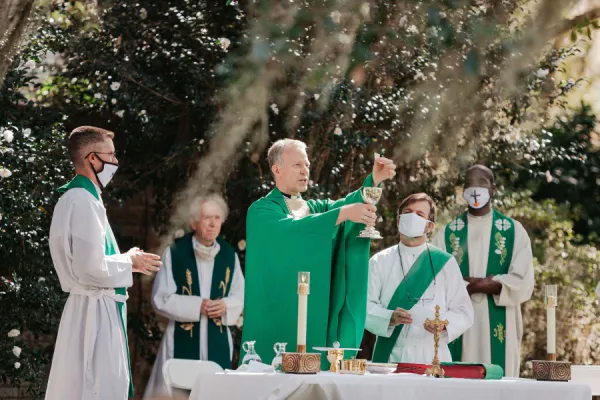
Bishop William Wack said Mass Oct. 12 in Tallahassee to observe the fifth anniversary of the opening of the cause of Antonio Cuipa and his companions.

Antonio Cuipa was a member of the Apalachee people of the Florida panhandle, who largely embraced the faith from Franciscan missionaries.

In 1704, militias from the English Carolina colony massacred the Catholic Apalachee. Thousands were taken as slaves, and another thousand were martyred.

Martyrs were tied to the stations of the Cross and burned alive, while they invoked the Blessed Virgin. In addition to the 1,000 Appalachee martyred, six Franciscans died for the faith, including Juan Praga and Manuel Mendoza.

Antonio Cuipa, a catechist, was killed Jan. 26, 1704, tied to a cross and burned alive. When he cried out from the cross near the end of his life, an apparition o f the Blessed Virgin reportedly attended to him.

“We don’t have to look across the world at the Holy Land or Colosseum to find martyrs. We have our brothers and sisters right here who gave their lives for Christ,” Bishop Wack said in his homily.

“May we keep the faith alive that many more people know God’s goodness through them,” he added.

The Mass was said at the site of a planned shrine to the martyrs of Spanish Florida.

The cause for canonization is investigating 54 events of martyrdom. The cause includes more than 60 Native Americans, 17 priests and religious, and seven Spanish laypersons.

The first martyrs of La Florida were three Dominican missionaries, clubbed to death in 1549. They were to be joined by many Franciscans and indigenous peoples, as well as Jesuit missionaries, who were killed as late as 1761.

The petitioners in the cause for canonization are the board of the Martyrs of La Florida Missions, which is working to build the shrine.

Michael Sheedy, vice president of the Martyrs of La Florida Missions Board, told CNA, “I’m thankful that we are rediscovering this incredible history of this period in the United States, and to grow up here, where centuries ago before we had a country  … there were people who were living vibrantly the Catholic faith and ultimately gave their lives for it,”

He added that Antonio Cuipa “was a fearless evangelist” who “had great patience and zeal that brought countless natives to ask for baptism.”

Following the Mass, Chris Stavres, president of the Martyrs of La Florida Missions Board, read from Antonio Cuipa’s will, which set aside funds to support places of pilgrimage in the Holy Land.

The cause for canonization is in the diocesan phase, with information being gathered to be sent to Rome.

Sheedy said there are historical documents of the martyrs, including records from Clement XI and Philip V of Spain, who declared a feast day for the martyrs of La Florida in 1743. Sheedy added that that it is likely the cause will soon progress to the next stage.

Sheedy said this is an important project for the Church in Florida and the southeastern United States, because of its ties to the history of the land. He said it also contradicts popular claims about Spanish colonial imperialism, noting that these Native Americans were not forced into the faith but willingly gave their lives out of love for Christ.

“What’s so exciting about the cause … is that it’s the Native Americans who had embraced the faith,” he said. “These people weren’t forced to convert. They embraced the faith, they died for the faith because of love for God.”

“It does serve as a source of inspiration and encouragement for those of us who have followed them …  that there are others who have walked this journey ahead of us who confronted great challenges and persevered. Somehow that gives us hope, encourages us, and inspires us to continue.”


[…]

No Picture
News Briefs

Federal judge strikes down Tennessee abortion waiting period

October 15, 2020 CNA Daily News 1

CNA Staff, Oct 16, 2020 / 12:31 am (CNA).- A federal judge on Wednesday ruled unconstitutional a mandatory 48-hour waiting period for women seeking abortion in Tennessee, which had been in effect since 2015.

In the legal challenge brought by Planned Parenthood and the pro-abortion Center for Reproductive Rights, Judge Bernard Friedman wrote that most women are already certain about their decision to have an abortion when they go in for their first appointment.

The judge cited testimony from abortion providers that abortion does not increase risk of negative psychological outcomes. He said the regulation placed an “undue burden” on women’s “right to abortion.”

Tennessee Right to Life, a pro-life organization active in the state, decried the court’s decision, contending that the waiting period had saved “countless unborn lives” and spared women the regret of abortion by allowing them extra time to identify life-affirming resources near them.

“Not only is this decision a slap at Tennessee’s abortion-vulnerable women, it is an affront to Tennessee’s voters who passed a 2014 constitutional amendment in which allowing a short waiting period was a key factor,” said Brian Harris, president of Tennessee Right to Life.

“Our organization remains committed to seeing a similar statute drafted and enforced during the next legislative session.”

Tennessee’s law required abortion doctors to inform a woman during her first appointment “that numerous public and private agencies and services are available to assist her during her pregnancy and after the birth of her child” if she chooses not to have the abortion.

Barring a medical emergency, a patient was then required to wait 48 hours before the second appointment and proceeding with the abortion.

Though waiting periods have been struck down before in state courts, this case marks the first time a federal court has struck down an abortion waiting period.

Under Tennessee law, the district court’s striking down of the 48-hour waiting period would automatically bring a 24-hour waiting period into effect for the state, but Friedman also blocked the state from enforcing the 24-hour requirement.

The Tennessee Attorney General’s Office is considering appealing Judge Friedman’s decision.

At least 26 states mandate waiting periods for women seeking abortions, most of them 24 hours. Five states— Utah, Missouri, Arkansas, Oklahoma, and South Dakota— have a 72-hour waiting period in place.

In Iowa, the legislature passed a 72-hour waiting period during May 2017, which the Iowa Supreme Court in 2018 declared unconstitutional. The Iowa House and Senate passed a 24-hour waiting period requirement for abortion during June 2020, which also requires a woman to have the chance to view an ultrasound of the unborn child and to receive information on adoption.

In January 2020, the authors of a study from Advancing New Standards in Reproductive Health (ANSIRH) reported that approximately 95% of women who had abortions did not regret their decision five years after the fact, even if they did initially experience regret. Friedman cited that study in his opinion.

Dr. Priscilla Coleman, a professor of human development and family studies at Bowling Green State University who testified in the Tennessee case, told CNA that she disagrees with that study’s conclusion and methodology.

In addition, larger studies have turned up opposite conclusions. While it did not directly measure “regret,” a study by Dr. D. Paul Sullins of The Catholic University of America published in 2016 followed more than 8,000 women for over 13 years, and found that a significant increase in the relative risk of mental health disorders such as depression and anxiety for women who have abortions.


[…]

Features

Our Lady’s care for broken lives

October 15, 2020 Joseph M. Hanneman 21

SAN DIEGO, Calif. — Grace Williams’ five-year-long drive to open a home for victims of child sex trafficking is a good argument for the reality—and beauty—of Divine Providence. Doing battle with a hostile California state […]

No Picture
News Briefs

Byzantine priest who made up hate crime ordered to life of penance after abuse allegation

October 15, 2020 CNA Daily News 0

CNA Staff, Oct 15, 2020 / 08:00 pm (CNA).-  

A Byzantine priest in Indiana has been ordered to a life of prayer and penance two years after he was placed on administrative leave for a credible accusation of sexual abuse. The priest made headlines in 2018 when he claimed to have been attacked in his parish church; a claim the eparchy said later had been fabricated.

After a period of “appropriate due process according to canon (Church) law” Fr. Basil Hutsko has been ordered to live a life of prayer and penance by Bishop Milan Lach, S.J. of the Byzantine Catholic Eparchy of Parma, the eparchy said in an Aug. 17 letter posted online, that was first reported this week by the Chicago Tribune.

“A cleric who has been ordered to live a life of prayer and penance has been permanently removed from engaging in public ministry and does not live on premises belonging to the Eparchy,” the letter stated.

“He is not permitted to celebrate Divine Liturgy/Mass publicly or to administer the sacraments. He is forbidden to wear a clerical garb and present himself as a priest. He is bound in conscience to pray and offer acts of penance for those in need of healing due to the harmful actions of clergy,” the letter added.

Hutsko, 67, had been serving as pastor of St. Michael Parish in Merrillville, Ind., immediately south of Gary, before he was placed on leave in 2018. He has also served at parishes in Cleveland, Dayton, and Marblehead, Ohio, and Sterling Heights, Michigan.

In October 2018, the eparchy announced that Hutsko was being placed on administrative leave following a credible accusation of past sexual misconduct with a minor. At that time, the eparchy said that although Hutsko denied the accusation, it had been found to be credible.

Just two months prior, in August 2018, Hutsko had claimed that he had been “attacked and knocked unconscious” in the altar server’s sacristy at his parish after celebrating the Divine Liturgy. Hutsko also claimed that the attacker had said “This is for all the kids” as he assaulted him.

The attack was investigated as a hate crime, but in October 2018, when Hutsko was placed on leave, the eparchy said in a statement that it had “verified with a member of Father Basil Hutsko’s immediate family that the incident Father Basil Hutsko reported on Aug. 20, 2018, did not occur.”

The accusation against Hutsko of sexual abuse of a minor came from a woman who reported that Hutsko had abused her between the years 1979 and 1983.

According to the Chicago Tribune, the woman first came forward in 2004, though an independent review by the eparchy at the time did not find enough evidence to warrant further action.

Bishop Lach did not know of the abuse allegation against Hutsko when the priest claimed to have been attacked in August 2018, the Chicago Tribune noted, but “new facts’ about the accusation surfaced in October 2018.

“It is the same allegation,” attorney James Niehaus told the Chicago Tribune. “As a result of new information, the allegation was reviewed again and now determined to be credible.”

“The Eparchy of Parma remains committed to the protection of youth according to the Safe Environment norms given by the USCCB,” the eparchy’s August 2020 letter concluded.


[…]